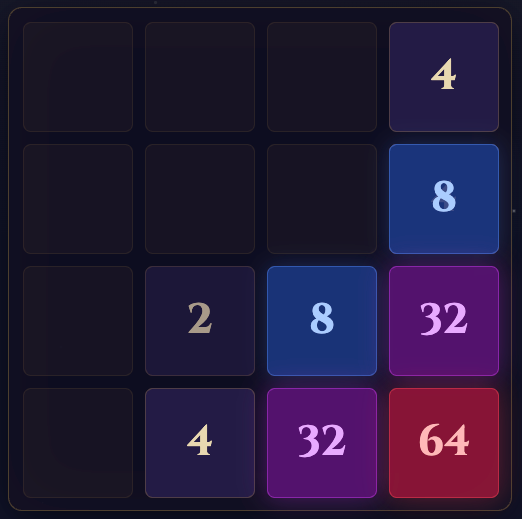
2048 Strategy Guide
Mechanics, Tactics, and Group Play Strategies
Understanding 2048: The Game That Conquered the Web
2048 burst onto the gaming landscape in March 2014 when developer Gabriele Cirulli released his deceptively simple 4×4 grid puzzle. Within days it became a cultural phenomenon, with millions playing on mobile devices, browsers, and social media. Yet beyond the surface lies a deeply strategic puzzle game with genuine skill separators and teaching moments about probability, foresight, and collaborative problem-solving.
The game's elegance lies in its constraint: you have exactly four directions to move (up, down, left, right). When you move, identical adjacent numbers combine into one tile with their sum. A pair of 2s becomes a 4. Two 4s merge into an 8. The goal is algebraic: reach 2048. The challenge is spatial. After each move, a new tile (either a 2 or a 4) spawns randomly on an empty cell. One small mistake-one moment of tunnel vision-and the board locks into a loss state where no more moves are possible.
What separates casual players (reaching 512–1024) from serious competitors (routinely hitting 2048, 4096, or beyond) is not luck. It's planning. It's knowing the optimal position for your high-value tiles. It's understanding how the randomness mechanic forces trade-offs and how to exploit them.
A Brief History: How 2048 Conquered the Internet
2048 was created by Gabriele Cirulli, an Italian web developer, and released on March 9, 2014. Cirulli built the original version in a single weekend as a side project, inspired by two earlier games: 1024 by Veewo Studio and the iOS game Threes! by Asher Vollmer and Greg Wohlwend, which had launched just weeks before. Cirulli posted his version to GitHub under an MIT open-source license, expecting little attention.
What happened next surprised everyone, including Cirulli. Within days, the game was shared virally across Twitter, Reddit, and Facebook. In its first week online, it received over four million visits. By the end of March 2014 it had been played more than 100 million times. Tech blogs, mainstream news outlets, and productivity forums all ran articles asking the same question: why is this game so addictive?
The appeal was immediate and obvious in hindsight. 2048 is free to play in any browser, requires no account, and can be picked up in under a minute. The mechanics are transparent-you can see exactly why you won or lost-yet mastery takes hours of practice. That combination of low barrier and high depth is rare in casual games.
Cirulli himself noted some ambivalence about 2048's success, acknowledging that Threes! was the genuinely original design and that 2048 was an openly-derived project. The Threes! creators wrote a long and generous postmortem about the experience of watching a simplified clone eclipse the original. It became a widely-cited case study in how open-source, browser-accessible distribution can outpace premium App Store games regardless of design quality.
Today, 2048 exists in hundreds of variants-hexagonal grids, 5×5 boards, Fibonacci sequences, themed tile sets-and has been cloned, remixed, and reimagined across virtually every platform. It remains a staple of casual gaming and is often used in computer science courses to illustrate AI search algorithms, since it is a tractable but non-trivial environment for reinforcement learning agents.
Core Mechanics Every Player Must Know
Before strategy, understand the mechanics. The rules are minimal but the implications are vast.
Movement and merging: When you press a direction, all tiles slide as far as possible in that direction. If two tiles with the same number touch, they merge into one tile with double the value. A 16 and a 16 collide into a 32. The newly merged tile cannot merge again in the same move-this is critical. If you have three 4s in a row, moving left merges the first two into an 8, and the third 4 stays separate. This "no-double-merge rule" is the hinge on which many tactical decisions turn.
Spawning mechanics: After each move, a new tile appears in a random empty cell. Most tiles are 2s (90% probability); 4s appear 10% of the time. The randomness is adversarial by design. You cannot predict where the next tile lands. This is why rigid "follow this exact sequence" strategies fail-the board always has surprises. Successful players adapt to randomness rather than fight it.
Loss conditions: The game ends when the board is completely filled and no more merges are possible. A single wasted move-sliding in a direction that changes nothing-sometimes costs you the game by consuming a move slot and spawning a tile in a crucial position.
The Corner Strategy: Why Position Matters More Than Luck
The single most powerful 2048 principle is the corner lock. This is where experts differ from everyone else.
The strategy is simple to describe, hard to execute: keep your largest tile pinned to a corner (typically bottom-right). Build all your major merges in that corner. Never-ever-create a large tile anywhere else. Why? Because a large tile in the middle or left side of the board is a trapped asset. It blocks your movement options. It forces suboptimal moves. Worst case, it walls off high-value merges you need for the endgame.
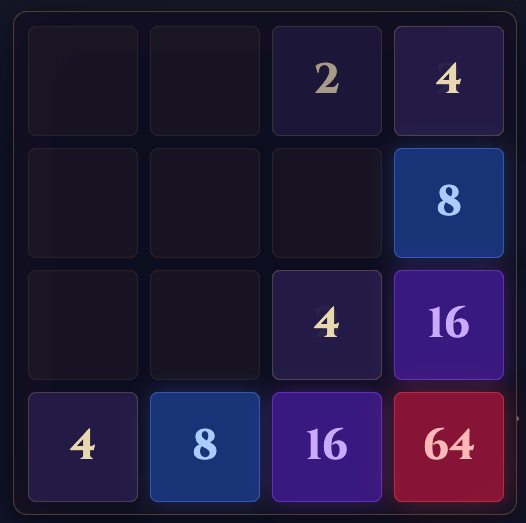
Real example: You have a 512 tile at position (2, 1)-middle-left of the board. You need to merge toward a 1024 to make progress toward 2048. But to move that 512 right, you must clear a path. You're forced into a series of moves that disrupt your 256s and 128s elsewhere on the board. Compare this to a 512 locked in the bottom-right corner: you control the board around it. New tiles spawn; you have the flexibility to either merge them up-column or right-row, always feeding your corner strategy.
The corner lock creates a cascade structure. Your second-largest tile is positioned adjacent to the corner tile (either directly above or directly left, depending on your chosen corner). Third-largest sits one step further. This creates a "staircase" of descending values that you methodically build during the game. Each move either contributes to this staircase or is a "clearing move"-a move that repositions smaller tiles to create space for new spawns.
The 2048 Beginner's Checklist
Use this mental checklist on every turn:
- Avoid the center: Never create your largest tile in the middle four squares unless you have an immediate clear exit.
- Keep one corner empty: Preserve at least one corner cell as your primary spawning zone; this reduces chaos.
- Build a staircase: Position tiles so your high values sit in a predictable, walkable pattern (e.g., bottom-right corner, then directly above, then one step left).
- Minimize wasted moves: Before moving, verify that your chosen direction actually changes the board state. A move that slides nothing is a free tile spawn to your opponent (the randomness).
- Prioritize larger merges: Given a choice between merging two 64s (yielding 128) or two 256s (yielding 512), do the 256s first. The larger merges compound your progress.
- Plan two moves ahead: After you move, a tile spawns unpredictably, but you can usually see your next two choices. Does moving up next leave you in a bad position? If yes, reorder your current move.
2048 as Collaborative Group Puzzle: A Game Night Pro Original Insight
This is where 2048 transforms from a solo phone game into a powerful group experience. Unlike competitive board games where one player's gain is another's loss, collaborative 2048 asks a group to solve a shared puzzle. One person controls the gamepad or browser; others vote or discuss strategy. The tension is productive: working memory, pattern recognition, risk tolerance, and group decision-making all surface quickly.
In a typical group session, player one controls the input. The group discusses the next move. Debates erupt: "Should we merge left to clear space, or save this tile for later?" The newer player might not see why a move "wastes" randomness. The experienced player gets frustrated. The compromise-explaining your reasoning aloud-is where learning happens.
Here's the Game Night Pro original insight: 2048 collaborative sessions expose decision-making frameworks. Some players are risk-averse and want safety (always preserve corner structure). Others are optimistic and think "we'll figure out what to do with that tile later." Neither is wrong, but the group must negotiate a shared philosophy. The best sessions I've observed are ones where a player with deep 2048 experience "coaches" newer players by explaining not just the move but the principle behind it. Within 3–4 games, the group synchronizes. That coordination-reaching a shared mental model-is a microcosm of collaborative problem-solving in larger, more complex board games.
Advanced: The Endgame and the 2048 Threshold
In general, the goal of the game is to reach a single tile with a value of 2048. However, the game doesn't stop there. Once you hit 2048, you can keep playing, pushing toward the largest tile you can possibly build. In theory, the mathematical ceiling on a 4×4 grid is a tile with the value 131,072-reached by filling every cell optimally and chaining perfect merges from the first move. In practice, only a handful of players have come close, and most expert runs aim for 4096–16384 as ambitious-but-realistic targets.
Reaching 2048 is the famous milestone, but the mechanics don't change. What does change is board density. In the early game, empty cells are plentiful. Randomness is forgiving-new tiles spawn in "safe" positions. By mid-game, the board is 60–70% full. Errors compound. The late game is ruthless. At 90% density with seven moves left before a loss state, a single misstep ends the run.
The final 512 → 1024 → 2048 merges are where skill peaks. These tiles are large enough that moving them costs you board control. You cannot afford a wasted move. The sequence feels like solving a puzzle where each piece must fit perfectly. This is where the corner lock strategy pays off-your preparation in the early and mid-game buys you the flexibility to handle the endgame without panic.
Advanced players maintain a "floating tile" zone-a small area (3–4 cells) where small tiles (2s, 4s, 8s) live. As new tiles spawn in this zone, the player merges them upward toward medium tiles (16–64) which then feed into the main staircase. This separates "spawned chaos" from "planned merges," giving the player more agency.
The Most Common Mistakes That Derail Runs
These errors trap even experienced players:
- Chasing center merges: You see two high-value tiles in the middle of the board that can merge. You go for it. The subsequent tile spawn locks the board two moves later.
- Forgetting the no-double-merge rule: Especially in group play, a player thinks they can merge three tiles into one larger tile in a single move. They can't. This misunderstanding breaks the whole strategy.
- Vertical moves early game: In the opening moves, vertical moves (up/down) shuffle the board unpredictably. They're often wasted. Horizontal moves (left/right) give you more control.
- Ignoring a 4: When a 4 spawns (10% chance), it's twice as powerful as a 2. Don't treat it as "just another small tile"-prioritize merging it or moving it to a safe zone faster than you would a 2.
- Tunnel vision on the goal: You're so focused on reaching 2048 that you don't see a board state where a loss is 5 moves away. Periodically scan the full board, not just your staircase.
Probability and Long-Term Thinking
2048 is a game of probability folded into deterministic moves. You control the direction; the spawn location and tile value (2 vs. 4) are random. This asymmetry is the core tension.
A key insight: prepare for both outcomes. When you move, two scenarios are possible: a 2 spawns (90%) or a 4 spawns (10%). If your next move assumes a 2 spawned, what happens if a 4 lands instead? If your corner staircase breaks, you've lost. If it flexes and absorbs the 4 into a future merge, you're fine. The best moves are ones where both outcomes lead to playable board states.
What does the optimal algorithm look like? Computer scientists have studied 2048 extensively and there is no single perfect solution-the game's blend of deterministic moves and random tile spawns makes it fundamentally resistant to one clean answer. The most effective approach identified by researchers is the Expectimax algorithm, a game-theory technique that evaluates not just what will definitely happen next, but what is expected to happen across all possible random tile spawns. Unlike Minimax (which assumes an adversary is actively trying to beat you), Expectimax treats the random spawns as neutral probability events and calculates the expected utility of each possible move several turns ahead. Alongside it, researchers pair several heuristics that mirror the human strategies in this guide: monotonicity (tiles should decrease in value as you move away from the corner), smoothness (adjacent tiles should have similar values to encourage merges), corner weighting (heavy bonus for keeping the largest tile anchored in a corner), and free-tile count (more empty cells means more flexibility). Some implementations layer in Monte Carlo Tree Search, which samples thousands of random future game continuations from each candidate move and picks the one with the best average outcome. Deep reinforcement learning agents, trained through self-play, can push even further by developing long-term positional intuition that rule-based systems miss. The takeaway for human players: the same principles the algorithms rely on-corner locking, preserving empty cells, building monotonic staircases-are the ones that emerge as mathematically optimal, not just conventional wisdom. For a deeper technical breakdown, see Design Gurus: Optimal Algorithm for 2048.
At first glance, 2048 seems like a game of chance. However, it is absolutely a game of strategy where players are able to control the outcome. Many games are like this-they may appear to be total luck, but once players recognize the nuances, luck becomes much less of a factor. The randomness in 2048 is bounded and manageable; over many moves its influence averages out, and skill dominates the result.
This is why patience beats aggression. A patient player accepts that the next 10 tiles might be 2s. They build flexibility. An aggressive player assumes perfect spawns and locks the board into rigid positions. When unlucky (or normally lucky) spawns occur, the aggressive player has nowhere to move.
Where to Play 2048
Game Night Pro hosts a free web-based 2048 game for solo play. Open it in your browser on any device and practice the corner lock and staircase tactics from this guide. For collaborative group play, gather around a shared screen and vote on moves together-the discussion and debate often teach more than solo play alone.
Ready to test your 2048 strategy? Open the game and apply the corner lock, staircase structure, and checklist above. Better yet, gather a group and play collaboratively. The debate about which move to take next will surprise you with how much you learn about shared decision-making.
Play 2048 Now →