Backgammon Strategy Guide
5,000 Years of History, Core Rules, and the Tactics That Win Games
The Oldest Board Game Still Played Competitively
Backgammon is older than chess, older than playing cards, older than almost every game you have ever touched. Archaeological excavations at the Burnt City in southeastern Iran unearthed a backgammon-like board dating to roughly 3000 BCE — five thousand years ago. The board came complete with sixty game pieces and two dice made from an agate stone. Someone, five millennia back, sat down and rolled dice against an opponent. The fundamental tension of the game has not changed since.
Ancient Egypt played a precursor called Senet. The Romans played Ludus duodecim scriptorum ("game of twelve lines") and later Tabula, which is structurally almost identical to modern backgammon. Roman emperors — Claudius was documented as a devoted player — kept boards built into their carriages so they could play while travelling. The game spread along every trade route the Roman Empire touched.
The name "backgammon" itself is English, appearing in writing in 1645. Scholars debate its etymology: either from the Old English baec (back) and gamen (game), describing the mechanic of sending pieces back to the start, or from the Welsh bach (small) and cammaun (battle). Either origin captures something true about the game: it is a small, intimate battle played backward and forward across a narrow board.
The modern doubling cube — one of the game's most strategically rich elements — was introduced in New York City in the 1920s. It transformed backgammon from a pleasant pastime into a deeply tactical, competitive pursuit and sparked the game's explosion in popularity across American and European social circles. By the 1970s, backgammon was played in every casino, every yacht club, every fashionable living room. Today it is played by an estimated 300 million people worldwide, with a thriving competitive circuit, world championships, and an active online community.
How Backgammon Is Played: The Complete Rules
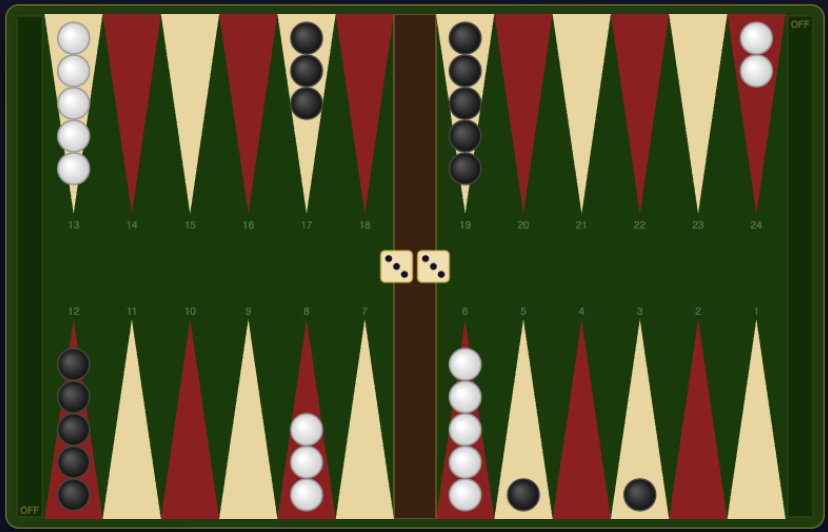
Backgammon is a two-player race game played on a board divided into four quadrants of six narrow triangles called points. Each player has 15 checkers. The goal is to move all your checkers into your home board (the quadrant nearest you) and then bear them off the board. The first player to bear off all 15 checkers wins.
The board layout: Points are numbered 1–24 from each player's perspective. Your home board contains points 1–6. Your outer board contains points 7–12. Your opponent's outer board is 13–18, and their home board is 19–24. Checkers travel in opposite directions: you move from high numbers to low, your opponent from low to high. The bar runs down the center of the board.
Starting position: The game begins with a fixed setup. Each player places: 2 checkers on their 24-point, 5 checkers on their 13-point, 3 checkers on their 8-point, and 5 checkers on their 6-point. This arrangement creates immediate tension — you have checkers scattered across the entire board.
Moving checkers: Both players roll two dice on their turn. The numbers on each die represent two separate moves. A roll of 3 and 5 means you can move one checker 3 points and another checker 5 points, or you can move a single checker 8 points total (if the intermediate point is open). Doubles let you move four times instead of two: rolling double 4 means four moves of 4.
Blocking and hitting: A point occupied by two or more of your own checkers is made — your opponent cannot land there. A point with exactly one checker is a blot. If your opponent lands on your blot, your checker is hit and placed on the bar. A hit checker must re-enter from your opponent's home board before any other move can be made. If all six entry points are blocked, you lose your entire turn.
Bearing off: Once all 15 of your checkers are in your home board, you begin bearing them off by rolling numbers that correspond to their point positions. A roll of 6 bears off a checker on the 6-point. If no checker occupies the exact point, you must move another checker. If no checker is on a higher point, you may bear off the next highest checker.
Winning and scoring: A regular win (your opponent still has checkers remaining) scores 1 point. A gammon (your opponent has not borne off a single checker) scores 2 points. A backgammon (your opponent has checkers on the bar or in your home board when you win) scores 3 points. The doubling cube multiplies all these scores.
The doubling cube: Before rolling on your turn, you may offer to double the current point value of the game by presenting the doubling cube turned to 2. Your opponent may accept (the game continues at the new value, and they take possession of the cube with the right to redouble later) or refuse (they concede the game at the current value). A doubling cube that starts at 1 can escalate to 2, 4, 8, 16, 32, and 64.
The Four Core Strategies — and When to Use Each
Expert backgammon players do not play reactively. They adopt a coherent strategic plan early and adjust it based on the dice and their opponent's position. There are four primary game plans, each suited to different positions.
1. The Running Game: Move your checkers forward as fast as possible. Pure race — no blocking, no hitting. This strategy is correct when you are ahead in the pip count (your checkers have fewer total points to travel) and the board is relatively open. If you are 20+ pips ahead and no contact remains, run. Every tempo matters. Aggressive use of doubles accelerates the lead.
2. The Blocking (Priming) Game: Build a wall of consecutive made points — called a prime — to trap your opponent's checkers. A six-prime (six consecutive made points) is a perfect prison: your opponent literally cannot escape with any roll. The goal is to anchor a prime in front of your opponent's back checkers, then race your other pieces home. A five-prime is powerful. A four-prime is a real threat.
3. The Holding Game: Maintain an anchor — a made point — in your opponent's home board (typically their 20, 21, or 22 point). This anchor gives you a safe landing point and a constant threat to hit their blots as they bear in. The holding game is a strong defensive strategy when you are behind: you stay in contact and wait for your opponent to make a mistake. The anchor also drastically reduces your gammon risk.
4. The Back Game: Deliberately hold two or more anchors deep in your opponent's home board (often the 1 and 3 points, or 1 and 2). The back game is a recovery strategy when you are significantly behind and have been hit multiple times. You intentionally absorb more hits, timing your escape to coincide with your opponent bearing in — creating maximum hit opportunities. The back game is high variance but often your only winning path when severely behind.
| Strategy | Use When | Core Mechanic | Risk Level |
|---|---|---|---|
| Running Game | Ahead in pip count, board open | Race at full speed | Low |
| Blocking / Priming | Opponent has back checkers to trap | Build consecutive made points | Medium |
| Holding Game | Slightly behind, need contact | Anchor in opponent's home board | Medium |
| Back Game | Significantly behind, multiple hits | Multiple deep anchors, wait for hits | High |
Pip Counting: The Skill That Separates Intermediate from Expert
A pip count is the total number of points all your checkers must travel to bear off. The starting pip count for each player is 167. As the game progresses, both pip counts decrease. The difference between your pip count and your opponent's tells you who is winning the race — and by how much.
Knowing the pip count lets you make critical decisions: when to double, when to accept a double, and whether to pursue a racing strategy or a contact strategy. Without a pip count, you are guessing. With one, you are calculating.
How to count pips: For each checker, multiply its point number by how many checkers occupy that point, then sum everything. A checker on your 6-point is worth 6 pips. Three checkers on your 8-point contribute 24 pips. Add across all points for your total.
The quick estimate method: Exact pip counting mid-game is a skill developed with practice. Beginners can use a simplified method: count "roughly how far ahead or behind each cluster of checkers is" and compare. You do not need a precise number — you need to know if you're ahead, behind, or roughly even, and by what magnitude.
Rule of thumb for doubling: If you are 10% or more ahead in pips with good distribution (no awkward stacks), consider doubling. If you are more than 25% behind, strongly consider dropping a double. Between 10–25% behind, cube decisions become more nuanced and position-dependent.
Mastering the Doubling Cube
The doubling cube is the most intellectually interesting element of backgammon. Used correctly, it is a powerful weapon. Used carelessly, it is a liability. Most casual players either never double (leaving value on the table) or double recklessly (giving their opponent free information and unfavorable odds).
When to double: Double when your winning probability is roughly 70–80%. Below 70%, you are too aggressive — your opponent has too much equity in the game. Above 80%, you risk an opponent pass (they concede without playing on), which means you collect less than you might earn from continued play. The sweet spot is called the market window: the moment where your opponent should just barely accept.
When to accept: Accept a double when your winning probability is at least 25% (the "take point"). This counter-intuitive math works because of gammons: if you win, you might win a gammon (2 points) while if you lose, you lose only 1. The gammon vig shifts your take point. In positions with significant gammon risk — where losing might cost you a doubled gammon — your take point rises to 27–30%.
The Crawford Rule: In match play, when one player reaches one point from winning the match, the Crawford game is played without the doubling cube. This protects the leading player from being immediately doubled into a match-losing position. After the Crawford game, the cube is live again — and the trailing player should often double immediately on their first turn.
Optional variants — Beavers: In some informal rule sets, players allow a beaver: when your opponent doubles you, you may immediately redouble and retain the cube. This optional rule is rare in tournament or match play but appears in certain casual rule sets. Check which rules apply before your first game with a new opponent.
Reading Your Opponent: Patterns, Tendencies, and Predictions
Backgammon players develop consistent habits. Those habits are information. In a live game, you can observe and exploit them. Online, you track patterns over multiple games. Here is what to watch for.
Risk tolerance on the cube: Does your opponent double early (aggressive) or wait until they have a dominant position (conservative)? An aggressive doubler will have a wider doubling window, giving you more takes. A conservative doubler telegraphs strength when they finally cube — their doubles are more accurate but also rarer. Against an aggressive doubler, take more; against a conservative one, take less.
Tendency to hit or not hit: Beginners often refuse to hit blots because hitting feels rude or risky. Observe whether your opponent leaves blots uncontested. If they rarely hit, you can play more aggressively, leaving blots in positions where the risk/reward favors you because your opponent will not capitalize on the opportunity.
Home board construction speed: Does your opponent rush to close their home board early, or do they neglect it while running checkers forward? A weak home board is far less threatening when hitting — your checkers re-enter more easily. A closed or near-closed home board (5–6 points made) is a danger zone: getting hit costs you your entire turn plus re-entry difficulty.
Anchor preference: Watch which points your opponent anchors on in your home board. A player who anchors on the 20-point (your 5-point) is playing a safer defensive game. One who digs into the 22 or 23 point is playing a riskier back game. Knowing their preference lets you decide whether to apply pressure or give them room to make mistakes.
Bearing-in errors: The end game is where many players blunder. Watch how they bear their checkers into their home board. Do they spread their checkers efficiently across multiple points, or do they pile everything onto high points (leaving gaps)? Gaps in the home board are vulnerability — if they hit you during bear-in, they create awkward re-entry positions. If your opponent bears in sloppily, wait for the moment they leave a blot before your own last checkers have escaped.
Predicting moves: Once you know your opponent's style, you can predict their response to a given position. If an aggressive player rolls a number that allows a bold hit, they will usually take it. Plan your own moves assuming they will act boldly — position your checkers to survive the hit. Against a conservative player, plan for them to consolidate points rather than attack.
25 Tactical Tips That Win Games
These principles cover the full range from opening moves to end-game execution. Internalize them one at a time.
- Make the 5-point immediately: Your own 5-point (also called the "golden point") is the most valuable point on the board. Making it early restricts your opponent's options severely. Opening rolls of 3-1, 4-2, and 6-4 can all be used to make or build toward the 5-point.
- Make your opponent's 5-point: Anchoring on their 5-point (your 20-point) is almost equally powerful. It gives you a safe haven and an attacking position. An early anchor here wins games.
- Avoid leaving direct shots unnecessarily: A direct shot is a blot that your opponent can hit with a single die (within 6 points). Indirect shots (7–11 points away) are hit by specific combinations. Calculate your exposure before each move.
- Never stack more than 5 checkers on a point: Beyond 5, additional checkers are wasted — they add no blocking value and reduce your flexibility. Spread across multiple points instead.
- Build builders: A checker one point behind a target point is a builder — it helps you make that point on a future roll. Position builders efficiently in your outer board to give yourself maximum point-making opportunities.
- Prioritize making points over hitting: Hitting a blot feels satisfying but is not always correct. If you can make an important point (especially the 5-point), do that instead, even if a hit is available. Made points are permanent; a hit only sets your opponent back temporarily.
- Hit loose in your home board: When your opponent leaves a blot in your home board while bearing in, hit it aggressively. They must re-enter from your 25-point while closing out their remaining checkers — a very difficult position.
- Escape your back checkers early: Your two checkers on your opponent's 24-point are the most constrained pieces. Free them as early as possible, especially when an open point in their outer board is available. Trapped back checkers are your most common route to losing.
- Keep your home board strong: As the game progresses, actively maintain points in your home board. A 6-point closed home board (a full prime) means any opponent checker hit goes to the bar with no re-entry — effectively winning the game.
- When in a prime vs. prime battle, advance your prime: If both players have primes, the one whose prime advances faster wins. Move the back edge of your prime forward to maintain pressure on the escaped checkers you are trying to trap.
- Do not run from a holding game prematurely: If you have an anchor, do not abandon it without a clear advantage. Leaving your anchor turns your defensive asset into a liability. Stay until you have a better position or the timing favors escape.
- Bear off efficiently: During bear-off, fill gaps rather than piling checkers on high points. You want even distribution so that any roll bears off at least one checker. Avoid positions where a large number of rolls bear off zero checkers.
- Use small numbers to fill gaps in bear-off: Rolling a 1 or 2 late in the game is frustrating — but use them to fill gaps on low points so your distribution improves for future rolls.
- Watch your pip count before every double: Never double by feel alone. Count pips (or estimate) before offering the cube. A double from a losing position gifts your opponent equity.
- Redouble aggressively when you hold the cube: If you accepted a double and then the position swings in your favor, redouble promptly. Your opponent likely has some psychological reluctance to take again — exploit that.
- In match play, understand score-related cube strategy: At certain match scores, taking a cube (or doubling) has different math than in casual point-play. When you are ahead 2-away, 3-away in a match, cube strategy changes significantly. Know the basics of match equity.
- Play the percentages, not the ideal scenario: Beginners play toward the best possible outcome. Experts play to maximize expected value across all possible dice outcomes. The move that wins best on the perfect roll is not always the move that wins best on average.
- Recognize gammon threats early: If your opponent's back checkers are deep and you can close your home board, you may have a gammon threat. Conversely, if you risk a gammon loss, consider whether taking the cube (and potentially being gammoned) or dropping it (conceding 1 point) is better mathematically.
- Do not play the back game by choice: The back game is a recovery plan, not an opening strategy. Playing a deliberate back game from the start means intentionally falling behind — rarely correct. Let the back game arise from the position forcing it.
- Advance the anchor when possible: If you hold the 24-point anchor, advancing to 23, then 22, then 21 improves your position without abandoning safety. Sliding your anchor forward keeps you in the game.
- Avoid closed boards without immediate threats: A closed home board is a powerful weapon — but only if you can hit an opponent checker soon. A closed board with no contact is wasted: your own checkers pile up and eventually you must open points before bearing off. Don't close too early.
- Calculate hits, not wishes: Before leaving a blot, count how many of your opponent's rolls hit you. There are 36 possible dice combinations. If 15 or more hit you, the blot is too exposed. Below 12, the exposure may be acceptable if the upside is worth it.
- Use the "lover's leap" opening move: On an opening 6-5, move a back checker from your 24-point all the way to the mid-point (13-point). This "lover's leap" efficiently escapes one back checker and is widely considered the best use of a 6-5 opening.
- Respect the bar: Being sent to the bar resets your tempo entirely. Plays that avoid leaving blots under heavy attack are often worth sacrificing other positional gains. Tempo losses from the bar compound quickly.
- Stay calm after bad luck: The dice will be cruel sometimes. Backgammon is designed with that variance intentionally. The player who maintains clear thinking after poor rolls wins more over time than the one who chases losses emotionally.
The Most Common Mistakes That Cost Games
Even experienced players fall into habitual errors. Recognizing these patterns in your own play is the fastest route to improvement.
- Ignoring pip count and guessing the race: "I think I'm about even" is not strategy. Count the pips. A 10-pip deficit that feels even is actually a decisive edge for your opponent.
- Abandoning an anchor too early: You escape your 20-point anchor because you want to run. Your opponent immediately covers a critical point and starts a prime. The anchor had value. Use it.
- Doubling from a losing position: Desperation doubles are transparent. Your opponent takes, the game continues, and you concede twice the score. Only double from winning positions.
- Dropping correct takes: Fear of getting gammoned makes players drop cubes they should take. If your winning probability is above 25–27%, take the cube. Dropping surrenders equity.
- Leaving multiple blots simultaneously: Two exposed blots double your opponent's hitting opportunities. Combine your moves to minimize exposure. If you must leave a blot, leave only one.
- Piling high during bear-off: Stacking 5 checkers on the 6-point while leaving the 1 and 2 points empty. Any roll of 1 or 2 wastes a move. Distribute checkers evenly across all six points.
- Playing on autopilot: Backgammon punishes habit play. If your opponent recognizes you always make the same moves on standard positions, they will anticipate and counter. Vary your approach slightly to remain unpredictable.
The Mental Game: Patience, Variance, and Long-Run Thinking
Backgammon's deepest strategic lesson is also its most psychologically demanding: individual games are unreliable indicators of quality play. Because of the dice, the best player loses a significant percentage of sessions. This is not failure — it is math.
Expert players think in terms of equity — the expected long-run value of a position — rather than win/loss in a single game. A move that gives you 60% winning probability is correct even if you end up losing that specific game. Over 100 games, the player making higher-equity moves wins more, regardless of short-term variance.
This mindset requires emotional detachment from outcomes. A lucky roll that reverses a dominant position is frustrating but irrelevant to whether your decisions were correct. Evaluate your moves, not your results. Ask: "Given what I knew at the time, was that the highest-equity decision?" If yes, the loss is acceptable — it was a statistical event, not a strategic failure.
Patience is a tactical tool in backgammon in a literal sense. Some positions are winning only if you wait — holding an anchor, refusing to break a prime, resisting the urge to escape and run. The urge to act is powerful. Experienced players sit comfortably in static positions, trusting that their positional advantage will convert when the dice cooperate.
Where to Play Backgammon
Game Night Pro hosts a free web-based backgammon game you can play directly in your browser — no download, no account required. Practice the opening positions, test your pip counting, and explore the doubling cube mechanics against a computer opponent. For collaborative learning, open it in a group setting and discuss each move before executing it: explaining your reasoning to others accelerates your own strategic clarity faster than silent solo play.
Ready to put these strategies to work? Open the game, count your pips on the starting position, and practice the opening moves described here. Within ten games you will see the patterns clearly. Within fifty, the tactical decisions will feel instinctive.
Play Backgammon Now →