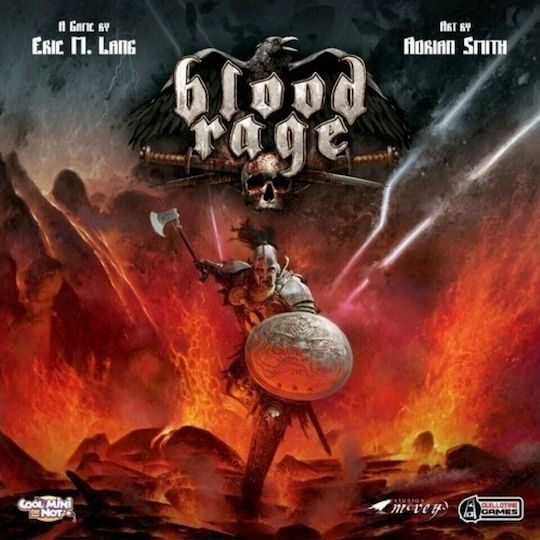
Blood Rage Review
Die Gloriously. Draft Brilliantly. Embrace Ragnarök.
Hook / First Impression
Most area-control games punish you for losing a battle. In Blood Rage, losing a battle can be your best move of the turn. That single design inversion — Glory earned through glorious death — is what makes Eric M. Lang's 2015 Viking saga one of the most inventive conflict games of the past decade. The world is ending. Ragnarök is consuming the map province by province. Your clan has three ages to pillage, fight, quest, and die as spectacularly as possible before the final apocalypse arrives. The player who earns the most Glory wins — and there are more ways to earn Glory than you expect.
Blood Rage sits in a sweet spot that few games occupy: it looks like a miniatures brawler, plays like a card-drafting engine builder, and feels like a Viking saga. It is approachable enough to teach in twenty minutes and deep enough that experienced players are still discovering efficient card combinations after fifty sessions.
Overview
Blood Rage is a card-drafting, area-control game set in the final days of Norse mythology. Three ages of conflict play out across a map of the nine realms, with Ragnarök systematically destroying provinces each round. Players lead Viking clans — each with unique starting stats — competing to earn Glory through battle victories, fulfilled quests, slain monsters, and well-timed deaths.
| At a glance | |
|---|---|
| Designer | Eric M. Lang |
| Publisher | CMON (Cool Mini Or Not) |
| Year | 2015 |
| Players | 2–4 (5 with expansion) |
| Play time | 60–90 minutes |
| Age | 14+ |
| Weight | Medium-Heavy (BGG ~2.9/5) |
| Victory condition | Most Glory at the end of three ages |
Components & The Setting
The Setting: Players assume the role of Viking clan leaders in the twilight of the Norse gods. You are not trying to survive Ragnarök — you are trying to earn the most Glory before it consumes everything. The theme is deeply integrated: dying in battle sends your warriors to Valhalla (and earns Glory if your card says so), completing quests reflects genuine Norse mythology, and the monsters you recruit are drawn directly from the sagas — the Frost Giant, the Fenrir Wolf, the Midgard Serpent. Every mechanical decision has a thematic echo.
Component quality is Blood Rage's most immediately striking feature. The game contains over 75 miniatures, including clan warriors, clan leaders, ships, and a remarkable collection of Norse monsters. CMON is the publisher, and miniature production is their speciality — the sculpts are detailed, dynamic, and table-dominant in a way that no cardboard equivalent can match. The monster miniatures in particular are showstoppers: a Fenrir Wolf the size of a clan leader, a branching-antlered forest creature, a multi-limbed sea monster. Even unpainted, they create an immediate visual drama.
The game board represents the nine provinces of the Norse world arranged in a circular map around the central Yggdrasil. Provinces are destroyed each age by Ragnarök — tracked by a dedicated tile — which means the playable area shrinks systematically as the game progresses. The three-ring structure of most provinces (Village, with a pillage bonus; and the Yggdrasil centre, which can never be claimed) gives every province a territorial identity. The board is sturdy and clearly laid out.
The card decks are the strategic heart of the game. Each age has its own draft deck, with cards sorted by type: Upgrade cards (boosting your clan's permanent stats), Quest cards (secret objectives that score at age end), and Battle cards (played during combat to add hidden attack or defence power). Card stock is adequate, though sleeving is recommended if your group plays frequently — the draft cards receive heavy handling.
Player boards track four clan stats — Rage (action currency), Axes (combat strength), Horns (troop capacity), and Villages (max number of villages held). Upgrading these stats through card play is one of the game's most satisfying progressions.
How to Play
The goal is simple: accumulate the most Glory points across three ages. Glory comes from multiple sources — battle victories, pillaging provinces, completing quests, dying gloriously in battle (if your cards support it), and surviving the Ragnarök destruction of a province with troops inside it. The multi-source scoring is what makes Blood Rage strategically rich: no single path to Glory dominates, and the right path changes based on the cards you draft.
Each age follows the same four-phase structure:
- God's Gifts (Draft Phase): Each player receives a hand of eight cards from the age deck and simultaneously selects one to keep, passing the rest clockwise. This continues until each player has drafted six cards. Drafting is where Blood Rage's strategic depth lives — you are simultaneously building your own engine and denying your opponents theirs. A well-drafted hand can define your entire age; a reactive drafter who takes whatever remains will find themselves outmanoeuvred before the first battle is fought.
- Action Phase: Players take turns spending Rage (their action currency, reset to their current Rage stat at the start of each age) to take actions: Invade (place a new unit in a province), March (move units between provinces), Upgrade (play an Upgrade card to permanently boost a stat or add a special power), Quest (play a Quest card face-down as a secret objective), and Pillage (initiate a battle in a province you occupy to claim its bonus).
- Discard Phase: Any unplayed cards are discarded. Unspent Rage is lost. This phase encourages players to fully commit their drafted cards each age — hoarding cards is not a viable strategy.
- Ragnarök Phase: The current Ragnarök province is destroyed. All units inside it are sent to Valhalla — which means their owners gain any applicable Glory from dying. The province is removed from the board permanently, shrinking the map for the next age.
Combat is the game's centrepiece. When a player initiates a Pillage, all players with units in the targeted province may join the battle on either side — there are no permanent alliances, only temporary combat agreements. Each combatant secretly selects a Battle card from their hand and reveals simultaneously. The side with the highest total strength (units' base Axes + Battle card value) wins. Losers send their units to Valhalla; the province's pillage bonus goes to the victor. The loser of every battle also gains 1 Rage as consolation — a small incentive not to retreat from outnumbered fights.
Gameplay Feel
Pacing & Tension: Blood Rage runs in three acts, each shorter than it feels. Age one is positioning and card discovery — learning which cards your opponents are prioritising, which provinces will pay off, and what strategy your drafted hand suggests. Age two is the sharpest: the map is smaller, the stakes are higher, and the card quality in the age-two deck is noticeably stronger. Age three is a frantic compression — one fewer province, maximum card power, and Ragnarök consuming the last provinces while everyone scrambles for final Glory. The arc is near-perfect. Sessions that feel slow in age one feel frantic by age three.
Player Interaction: High and mostly positive. Blood Rage generates frequent combat, but the combat system — simultaneous reveal of Battle cards — keeps it fast and drama-filled rather than long and procedural. Multi-player battles where two players ally against a dominant third, then immediately turn on each other, happen organically and are among the game's best moments. Negotiation is informal but present: "I won't join this battle if you don't invade my province" is a perfectly legitimate table conversation.
Luck vs. Strategy Balance: Moderate luck in card draws, mitigated significantly by drafting. The draft means you always have agency over your hand — you are choosing among available cards, not drawing blind. Battle card play involves bluffing and prediction but not pure randomness. A skilled drafter will outperform a reactive one over multiple sessions. The dice-based combat of many area-control games is entirely absent; Blood Rage resolves conflict through card management, not random rolls.
Rule Overhead: Lighter than it looks. The miniatures and board create an imposing table presence, but the rules are clean. Teaching takes 15–20 minutes and most players are fully independent by end of age one. The most common rules question involves multi-player battle resolution (who commits to which side, and when) — worth clarifying at game start. Everything else flows intuitively from the Viking theme.
Mechanics Deep-Dive
The Draft as the Real Game
Blood Rage's combat is visible and dramatic, but its draft is where games are won and lost. Each age's deck contains a mix of card types in fixed quantities, and the draft is simultaneously a construction process (building your own strategy) and a denial mechanism (knowing which cards to take away from opponents even if you don't intend to use them). An experienced player evaluating a draft hand is asking three questions at once: Which card fits my current strategy? Which card does my opponent to the left need? Which card, if left in the pool, will enable a strategy I cannot counter?
The consequence is that Blood Rage plays differently depending on player count — not just in map density, but in draft density. With four players, the draft is tight and denial is a genuine tool. With two players, the alternate drafting structure means both players see a much larger fraction of the available cards, allowing longer-term planning but removing some of the tension of a contested pool.
Rage as Economy
Rage is Blood Rage's action currency, and its management is the game's tightest moment-to-moment decision. Each action costs Rage. Your Rage stat (starting at 6, upgradeable to a maximum of 8) resets at the start of each age but does not carry over. Spending Rage efficiently — enough actions to execute your strategy, not so many that you act on low-value targets — is the difference between a productive age and a wasted one. Players who consistently run out of Rage before completing their planned sequence lose ground not just on actions but on card plays, since unplayed cards are discarded at age end.
The Monsters
Each age deck contains a set of Monster cards. Playing a Monster card recruits a mighty creature — Fenrir, the Midgard Serpent, the Frost Giant — that counts as a unit in a province but has extraordinary base combat strength. Monsters are not upgrades; they are units with the power of advanced combatants. Recruiting a monster requires playing the card during the Action Phase and placing the miniature in any province. The monster then fights as part of your clan.
Monsters create memorable table moments. A player who recruits the Fenrir Wolf and marches it into the final contested province, backed by a high-value Battle card, can swing a battle single-handedly. More importantly, monsters are a shared resource — if one player drafts a monster card, no other player can have that monster that age. Monster denial is a legitimate draft strategy in experienced groups.
Quests and Secret Objectives
Quest cards are played face-down during the Action Phase and scored at age end if their condition is met. Quests range from simple (control a specific province at age end) to situational (win a battle in Yggdrasil) to statistical (have the highest Axes stat). The hidden nature of Quests creates a layer of uncertainty — you cannot be sure which provinces your opponents need to control, which makes defensive invasions riskier. Completing a Quest typically awards 3–7 Glory, making them a non-trivial scoring source alongside combat and pillaging.
Player Count Analysis
2 Players — Decent, not ideal. Two-player Blood Rage uses an alternate draft where players each see and select from a private pool of cards. The combat is functional but the multi-player alliance dynamics — the game's most dramatic moments — are absent. At two players, every province battle is a straight 1v1, removing the "join the underdog" politics that defines four-player sessions. Playable and strategically interesting, but you are missing the game's best feature.
3 Players — Very good. Three players restores the multi-player combat dynamics without the map saturation of four. Provinces are contested but not gridlocked, the draft feels open enough for meaningful strategy, and session length stays comfortably under 90 minutes. A strong player count that delivers the game's core experience in the shortest time.
4 Players — Excellent; the recommended count. Four players is Blood Rage at its best. The draft is tight, the map is dense, every province has contenders, and the battle politics — who to ally with, who to betray, when to let the leader win to preserve Rage for a counter-attack — are richest at this count. Session length is 75–90 minutes for experienced players. This is the count the game was designed for.
5 Players (with expansion) — Good, long. The 5th Player Expansion adds an additional clan and adjusts the map for the additional player. Five-player Blood Rage is chaotic in a way that is either thrilling or exhausting depending on your group. Downtime increases, province contention becomes occasionally unresolvable, and sessions push toward 100–110 minutes. For groups who love maximum chaos and have the patience for it: excellent. For tightly competitive groups: stick to four.
Replayability
Blood Rage's replayability is driven by three interlocking sources of variability. First, the clan asymmetry: each of the four base clans (Bear, Ram, Wolf, Serpent) has a unique starting stat distribution that suggests different strategies — the Bear clan's high base Axes favours direct combat; the Ram clan's higher Villages count supports territorial play. No two clans play the same way. Second, the card drafts: each age deck is shuffled independently, meaning the available upgrade, quest, and battle cards change every game. A strategy that worked brilliantly last session may be unavailable this time. Third, the Ragnarök sequence: which provinces are destroyed each age (drawn randomly at setup) changes the map pressure and territorial value of every province.
In practice, experienced groups report 30–40 sessions before the base game begins to feel fully mapped. The Gods of Asgard expansion and 5th Player Expansion add enough content to extend that significantly. Blood Rage is not Ark Nova in terms of depth ceiling, but it is far more replayable than its session length suggests — a 90-minute game with the strategic variability of a 150-minute one.
Learning Curve
Ease of teaching: Blood Rage is one of the easier medium-weight games to teach, especially to groups with any area-control experience. The phase structure is logical, the actions are intuitive (move troops, fight, upgrade, quest), and the theme carries players through moments of rule ambiguity — "what would a Viking do?" is a surprisingly good heuristic. A prepared teacher can have the table ready to play in 15–20 minutes.
Rulebook quality: The CMON rulebook is clear for core rules but thin on edge cases, particularly multi-player battle resolution (when one player can join, how Rage is spent if combat is joined mid-sequence). The BGG forums have thorough FAQ threads that resolve most common questions. Print a one-page combat reference before your first four-player session; it will save time.
First-game experience: Excellent. Blood Rage is one of those rare games where first-time players are genuinely having fun before they fully understand the strategic depth. The miniatures create immediate buy-in, the combat card reveals generate table reactions, and the three-age structure means that mistakes made in age one are recoverable by age two. The game rewards curiosity: players who experiment with the "death Glory" mechanic in age one usually discover the game's deepest insight on their first session.
Teaching tip: Before the first draft, walk through two or three example cards — one Upgrade, one Quest, one Battle card — and explain what each type does. The draft is where new players feel most lost, not because the mechanic is complex but because they do not yet know what they are selecting for. A one-minute card-type primer eliminates this confusion and makes the first draft feel purposeful rather than random.
Who It's For
Conflict game enthusiasts who are tired of pure dice combat: Blood Rage replaces dice rolls with card management, making every combat outcome the product of planning and bluffing rather than luck. If your group has bounced off Risk or Axis and Allies because too much comes down to dice, Blood Rage solves the problem without removing the tension.
Groups who want a medium-weight game with high drama: Blood Rage generates more memorable table moments per hour than almost any game at its weight class. The combination of miniatures, combat reveals, and multi-player alliance politics creates the narrative richness of a heavier game without the time commitment. For a four-player game night where you want everyone engaged and the session finished in 90 minutes, Blood Rage is an outstanding choice.
Theme-first players: The Norse mythology theme is executed with genuine care. The monsters are drawn from the Eddas, the provinces reference real Norse cosmology, and the Ragnarök mechanic — the world literally ending province by province — gives the game an escalating urgency that matches the thematic premise. Players who responded to the setting of Root or the lore of HeroQuest will find Blood Rage's theme equally rewarding.
Who it is not for: Solo players (there is no solo mode); players who dislike any player conflict (this is a conflict game at its core); groups who want a fully deterministic, zero-luck experience (the card draft introduces meaningful variance). For solo-friendly conflict games, Ark Nova's solo Automa or Gloomhaven: Jaws of the Lion are better fits.
Pros & Cons
What Blood Rage does exceptionally well:
- The "die gloriously" mechanic is a genuine design innovation — losing a battle can be your best turn, which keeps every combat decision interesting regardless of the odds.
- Card drafting gives every combat a strategic layer that pure dice games cannot match: you shaped this battle three rounds ago when you drafted that Battle card.
- Miniature quality is outstanding for the price point. The monster sculpts alone justify display space on a hobby shelf.
- Session length is honest. Four players reliably finish in 75–90 minutes once everyone knows the rules — rare for a game with this much on the table.
- The three-age structure creates a natural narrative arc. Age one is setup, age two is climax, age three is resolution. It feels like a story.
- Multi-player battle dynamics at four players generate organic diplomacy, betrayal, and dramatic reveals that generate the best table stories.
- Rules are accessible enough to teach non-hobbyist players who are drawn in by the theme and miniatures.
Where Blood Rage struggles:
- No solo mode. Blood Rage requires at least two players, and its best features require three or four. Solo players have no equivalent experience.
- At two players, the game's signature multi-player combat politics are completely absent. The two-player experience is functional but flat compared to four.
- The miniatures create table presence but also setup time. Sorting and arranging all units at game start adds 10–15 minutes to the session commitment.
- The rulebook is thin on edge cases. Groups without an experienced player should expect to consult BGG or the FAQ during their first session.
- Expansion creep is real. The base game is excellent on its own, but CMON has produced a significant volume of supplementary content (Kickstarter exclusives, Gods of Asgard, 5th Player, Mystics of Midgard) at varying price points. The collector's instinct the game triggers can become expensive.
- Runaway leader risk exists. A player who drafts efficiently in age one and wins key age-two battles can build a Glory lead that is difficult to close in age three.
Expansions & Ecosystem
Blood Rage's expansion ecosystem is primarily driven by CMON's Kickstarter model, which has produced a mix of essential content and optional collector's material. Here are the most relevant additions for retail purchasers:
1. 5th Player Expansion — Additional clan and map adjustments ★★★★☆
Adds the Raven clan and all necessary components (board, cards, miniatures) to support a fifth player. The Raven clan has a unique starting layout that encourages a pillage-heavy, fast-moving playstyle distinct from the four base clans. The expansion also includes additional monster miniatures. For groups that regularly play at five, this is an essential purchase. For groups who max out at four, it is optional but adds a worthy clan option even in four-player games.
2. Gods of Asgard — Two mighty deity figures and associated cards ★★★★☆
Adds two oversized deity miniatures (Odin and Thor, or Loki and Fenrir depending on printing) that can be recruited as extraordinary units. The deities come with their own card sets that integrate into the draft decks. Gods of Asgard adds dramatic table presence — the deity miniatures are significantly larger than standard monster sculpts — and meaningful strategic depth through the new card options. A worthwhile addition after 10–15 base game sessions.
3. Mystics of Midgard — New clan with unique mechanics ★★★☆☆
Adds the Mystics clan with a sorcery-based mechanic that plays differently from the four base clans. The Mystics can manipulate quest resolution and battle outcomes through arcane abilities rather than raw combat power. An interesting addition for groups who have exhausted the base clan variety, but not a priority purchase for newer players.
Quick Buyer's Guide
| Product | Best For | Complexity Added | Rating | Priority |
|---|---|---|---|---|
| 5th Player | Groups of 5 | Low | ★★★★☆ | 🥇 Essential if you play at 5 |
| Gods of Asgard | Experienced groups wanting more drama | Low-Medium | ★★★★☆ | 🥈 After 10–15 sessions |
| Mystics of Midgard | Clan variety seekers | Medium | ★★★☆☆ | Optional |
Value for Money
Blood Rage retails for approximately $60–$80 USD depending on retailer and edition. For a game containing over 75 miniatures, a substantial card pool across three age decks, and a replay depth that sustains 30–40 base-game sessions before feeling exhausted, this represents genuine value. The per-session cost for a regular four-player group drops into single digits within the first year.
- Regular gaming groups (3–4 players): Excellent value. Blood Rage delivers a 90-minute high-drama experience with a fraction of the setup burden of games at similar price points. Buy the base game and play it 15 times before considering expansions.
- Groups who play rarely: Good value. The miniature quality means it has shelf presence even between sessions, and the accessible rules mean occasional players can return to it without a full re-teach. Better suited to occasional play than heavy euros that require fresh rules familiarity each time.
- Solo players: Poor value. There is no solo mode. If you play primarily solo, Blood Rage is the wrong purchase.
- Miniature painters: Exceptional value. The sculpt quality and quantity of models — particularly the monsters — make Blood Rage one of the best-value painting projects in the hobby at this price point. Painted, it is a spectacular display piece.
Accessibility
Color blindness: Blood Rage uses colour to distinguish clans (each clan has a unique colour for warriors and leader miniature). The board uses colour-coded province markers for Ragnarök tracking. Players with red-green colour blindness may struggle to distinguish certain clan colours. The miniature sculpts are clan-unique in shape, which helps experienced players identify units by model rather than colour, but first-game colour ambiguity is a real concern. Consider adding coloured stickers or rings to unit bases as a supplement.
Language dependence: Moderate. Card text drives a significant portion of the game's strategy, and cards are not safely replaceable by icons alone. Blood Rage is published in English, German, French, Spanish, and several other languages; play in your primary language where possible. The rulebook is more critical to have in your native language than the cards, as card text can be read individually during play but rules need to be referenced quickly mid-session.
Cognitive accessibility: The core rules are accessible to players with mild cognitive limitations — the action menu is short (six action types, each simply described) and the phase structure is consistent. The strategic depth of the draft and multi-player battle politics is harder to engage with fully, but casual participation (take actions, fight battles, enjoy the drama) is achievable without deep mastery. Mixed-experience groups can play together with the understanding that experienced players will likely outperform newer ones.
Physical accessibility: The miniatures require moderate dexterity to handle and place — they are small enough that players with limited fine motor control may find placement fiddly. Cards are standard size and manageable. No timed elements. The game table footprint is significant (the board is large and each player needs space for their clan board and card hand); a standard dining table comfortably seats four.
Age range: The 14+ rating reflects strategic complexity rather than thematic content (the Norse combat theme is mythological, not graphic). Mature 11–12 year-olds with prior board gaming experience handle the rules comfortably; the drafting strategy takes longer to develop regardless of age.
Verdict
Blood Rage is one of the most successful designs in the conflict-game genre of the past decade because it does something deceptively simple: it makes losing interesting. When dying in battle can be your path to Victory Points, when the world is literally ending and you are racing a shrinking map, when every card you drafted in the last round of the draft is a deliberate bet on how the next two battles will resolve — the game generates a sustained engagement that pure dice-combat games cannot match. Eric M. Lang designed a game that feels like a brawl but plays like a puzzle.
Its limitations are real. Two-player games sacrifice the game's best feature. There is no solo mode. The miniature setup time is non-trivial. And a skilled drafter with a weak group can dominate in a way that feels lopsided. But at four players with experienced participants, Blood Rage produces more high-drama moments per hour than almost any game in the medium-weight category.
Buy it if: you want a conflict game with strategic depth, beautiful miniatures, and a 90-minute session commitment. It will be your group's answer to "let's play something with combat" for years.
Skip it if: you play solo, you want a fully cooperative experience, or direct conflict is not your group's preference. Blood Rage is, at its core, a game of Viking warfare — it does not apologise for that.
Upgrade it with: Gods of Asgard after 10–15 sessions. The deity cards integrate seamlessly and add enough draft variety to extend the base game's strategic ceiling meaningfully.
Score Breakdown
Love conflict and strategy games? Browse our full review library, player count guides, and game night tools — everything you need to choose the right game and play it well.
Browse All Reviews →