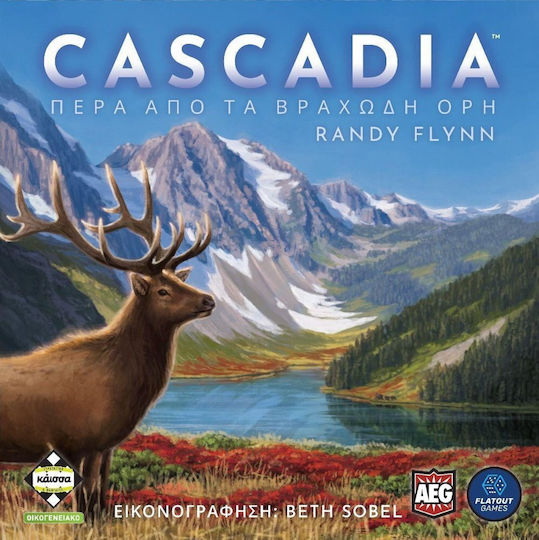
Cascadia Review
The Spiel des Jahres Winner That Actually Deserves Its Trophy
Hook / First Impression
Every few years a game arrives that makes you wonder why nobody thought of it sooner. Cascadia is one of those games. Its premise is almost embarrassingly simple: draft a landscape tile and a wildlife token, place them in your growing nature reserve, and score points by creating habitats and arranging animals in the patterns shown on your scoring cards. That's it. You can explain it in three minutes to someone who has never played a board game in their life.
And yet Cascadia won the Spiel des Jahres 2022 — the most prestigious award in tabletop gaming — and for good reason. What looks like a casual puzzle turns out to be a quietly satisfying engine of spatial decisions, competing priorities, and the kind of "just one more turn" momentum that keeps tables playing past midnight. This is not a game that wears its depth on its sleeve. It earns it.
Overview
Cascadia is a tile-laying and token-drafting game designed by Randy Flynn and published by Flatout Games in partnership with Alderac Entertainment Group (AEG). Each player builds their own personal landscape of the Pacific Northwest — mountains, forests, prairies, wetlands, and rivers — while placing five species of wildlife tokens (Bear, Elk, Salmon, Hawk, and Fox) to score against a set of randomised scoring cards.
| At a glance | |
|---|---|
| Designer | Randy Flynn |
| Publisher | Flatout Games / AEG |
| Year | 2021 |
| Players | 1–4 |
| Play time | 30–45 minutes |
| Age | 10+ |
| Weight | Light (BGG ~1.9/5) |
| Awards | Spiel des Jahres 2022 |
| Victory condition | Most points after 20 rounds |
Components & The Setting
The Setting: Cascadia is set in the Pacific Northwest of North America, a region of dramatic ecological diversity — old-growth forests, mountain ranges, coastal wetlands, salmon-filled rivers, and open prairies. You are a nature conservationist building a wildlife corridor: a patchwork of connected habitats designed to sustain populations of bears, elk, salmon, hawks, and foxes. The theme is unusually coherent for an abstract game. Every mechanical decision — connecting rivers for salmon runs, building open prairie for elk herds, keeping bears solitary — maps onto real ecological behaviour in a way that gives the game a pleasant naturalistic logic.
Component quality is a genuine highlight. The 85 hexagonal habitat tiles are thick, durable cardboard with artwork by Beth Sobel — luminous, detailed illustrations of Pacific Northwest flora and fauna that make your growing nature reserve genuinely beautiful to look at. The 100 wooden wildlife tokens are laser-cut animal shapes: a bear, an elk, a salmon, a hawk, a fox. They are small but chunky and tactile, and the table always draws admiring comments from new players seeing the game for the first time. The 25 scoring cards are clearly laid out with simple iconography. A cloth bag for token randomisation and a first-player pinecone marker complete the package.
The production quality punches well above the game's price point. The tiles don't warp, the wooden tokens don't chip, and the scoring card iconography is intuitive enough that players rarely need to re-read a card mid-game after the first session. The only minor gripe is that the token bag fills quickly and can make drawing specific tokens feel fiddly with small hands — a wider bag mouth would help.
How to Play
The goal is to score the most points over 20 rounds. Points come from two sources: habitat scoring (bonus points for the largest connected corridor of each terrain type) and wildlife scoring (points for arranging each of the five species according to their unique scoring card).
On your turn you do exactly two things: draft one habitat tile and one wildlife token from the four face-up pairs in the market, then place them. The tile goes adjacent to any tile in your existing nature reserve; the token goes onto any tile in your reserve that shows that animal's icon and does not already have a token on it.
The tile and token you draft do not have to come from the same pair — you can take the tile from pair A and the token from pair B. This single rule creates most of the game's tension: the market pairs are often not aligned with what you need, and every draft subtly reshapes what your opponents can take next turn.
After 20 rounds each player scores their reserve. Scoring cards for each wildlife species reward different spatial arrangements: Bears score for being placed in groups of exactly two, Elk for herds in straight lines, Salmon for chains along rivers, Hawks for spacing and isolation, Foxes for adjacency to as many different species as possible. Each scoring category has three or four variant cards, randomised each game, so the winning arrangements shift every session.
Habitat scoring awards bonus points to the player with the longest unbroken corridor of each terrain type, with all players receiving partial points for smaller corridors. A habitat tie goes to the player with more distinct terrain tiles in that corridor.
Gameplay Feel
Pacing & Tension: Cascadia has a calm, meditative rhythm. Turns are fast — the decision space is real but bounded — and the game rarely stalls. There is a steady, satisfying progression as your nature reserve grows from a small cluster of tiles into a richly illustrated landscape. Tension builds gradually as the endgame approaches and you realise your bear placement plan conflicts with where your elk corridor needs to go. It is the tension of an elegant puzzle tightening, rather than the tension of direct confrontation.
Player Interaction is indirect but present. You cannot directly harm another player's reserve. What you can do is draft a tile or token they clearly need, crowding the market in your favour or simply denying a key piece at a pivotal moment. Experienced players watch each other's reserves and draft defensively when it costs little — a subtle form of competition that stays completely friendly in tone but rewards attentiveness.
Luck vs. Strategy Balance: The randomised scoring cards, tile draw order, and token bag create meaningful variance, but Cascadia manages it well. The four-pair market gives you choices on every turn; the pinecone mechanism gives you agency over the token supply; and the sheer density of decisions about tile adjacency and token placement means skilled players adapt rather than just react. In our sessions, experienced players win noticeably more often than new ones — a reliable sign that skill matters — while new players still score competitively and enjoy the puzzle without feeling lost.
Rule Overhead: Minimal. The turn structure is two actions. The complexity lives entirely in the scoring cards, which have intuitive iconography and can be set up with "family" variant cards for a gentler introduction. A new player is fully functional after a five-minute explanation and one practice round.
Mechanics Deep-Dive
The Dual-Draft Market
The four face-up tile-token pairs drive every decision in the game. Because you can mix and match tiles and tokens across different pairs, the market rarely feels like a dead end — but it constantly presents the tension of which constraint to accept. Taking the mountain tile you need might mean picking up a hawk token when you're already running low on hawk placement spots. Leaving the salmon token for your opponent to claim might set back your own river corridor by two turns. Every draft is a small triage.
The market also creates a natural pace variation. Early rounds are loose and exploratory; mid-game the market starts to feel contested as players' reserve shapes diverge and specific tokens become critical; late-game a single market refill can shift two or three players' fortunes simultaneously. This arc requires no rule to produce — it emerges organically from everyone building toward the same scoring cards simultaneously.
Wildlife Scoring Depth
The five wildlife species each score differently, and the variant scoring cards change which arrangements are optimal. This is the engine that makes Cascadia endlessly replayable without adding mechanical complexity. Here are the core patterns and what makes each species interesting to optimise:
- Bears reward pairs — exactly two adjacent bears score well, but three or more in a group scores less per bear. Managing group size creates a delightful spatial sub-puzzle about knowing when to stop placing bears near each other.
- Elk score for herds in straight lines. Building a long elk corridor means planning your tile layout far in advance, since rivers and mountains interrupt the sightlines you need. The longest elk line on the table often wins the category outright.
- Salmon love rivers and score for chains — consecutive salmon along connected river tiles. This scoring aligns salmon naturally with habitat corridor strategy, making rivers the only terrain type where wildlife and habitat scoring reinforce each other directly.
- Hawks want isolation — they score best when no other hawk is within a certain radius. Placing your last hawk often means reconsidering half your tile layout to find a genuinely isolated spot. Hawks are the species most likely to generate a "wait, I can't put it there" moment in the endgame.
- Foxes score for diversity of adjacency — each unique species adjacent to a fox scores a point. A well-placed fox surrounded by bear, elk, salmon, and hawk scores four points from a single token. Foxes reward players who plan their reserve layout holistically rather than optimising for one species at a time.
Habitat Corridor Strategy
Habitat scoring rewards the largest connected corridor of each terrain type, but only one player can have the largest for each type. The key insight is that you do not need to win all five habitat categories — winning two or three convincingly while scoring partial credit in the others is a perfectly viable path to victory. New players often spread their reserve too evenly and win no habitat category outright; experienced players commit to two or three terrain types early and build their wildlife placement around the corridors they're already extending.
Player Count Analysis
Solo — Excellent. Cascadia includes a fully integrated solo mode where you play against a target score rather than an opponent. The goal shifts to beating par rather than beating a person, and the game's spatial puzzle holds up entirely on its own merits. Cascadia is one of a small number of gateway games where the solo mode feels like a designed feature rather than an afterthought. If you regularly play games alone, this is a meaningful buying consideration.
2 Players — Very good. Two-player Cascadia is tight and tactical. With only two competitors for the market, you have more information about what your opponent needs — and more opportunity to draft defensively. Games play in under 30 minutes. The indirect interaction is more noticeable at two players because market denials are more deliberate and impactful. Highly recommended for couples or gaming pairs.
3 Players — The sweet spot. Three players adds enough market competition to feel lively without the downtime of a larger group. The habitat scoring competition is richer because three players are each building distinct reserve shapes, and the tile-token market gets contested enough to require active attention. Our most memorable Cascadia sessions have been at three.
4 Players — Works well, slightly slower. Four players is the maximum and works perfectly within the rules, but the game stretches to 40–50 minutes and market dynamics shift — with four players drafting from four pairs each round, the market refreshes quickly enough that denial becomes less reliable and everyone gets a wider variety of tiles and tokens. The game is slightly more forgiving of suboptimal drafts at four. Still excellent; just the most luck-influenced count.
Replayability
Cascadia's replayability is exceptional for its weight class. The randomised scoring card combination — one card per species drawn from four variants each — produces 4⁵ = 1,024 possible scoring configurations before you account for tile draw and token bag variance. In practice, each new game feels meaningfully different from the last: the scoring card that rewarded isolated hawks last session now rewards densely packed ones; the elk that wanted straight lines now want connected clusters. Experienced players must rebuild their intuitions about which reserve shapes are optimal every game.
The tile and token randomness adds a second layer. Because you build your reserve from a shared tile draw, no two games produce the same landscape — and because the token bag is random, the animal you need most is reliably the last one to appear. This variance is managed rather than eliminated, which is exactly the right balance for a game at this weight.
The Landmarks expansion (included in the Kickstarter edition and widely available separately) adds habitat tiles with special bonus abilities — a lighthouse that scores points for adjacent wetlands, a cabin that grants extra pinecones, a waterfall that doubles adjacent salmon scoring. These add a third scoring layer without meaningfully increasing complexity, and they extend Cascadia's shelf life significantly for groups that have mastered the base game.
Learning Curve
Ease of teaching: Among the easiest in the hobby. The turn structure is two steps; the scoring cards use clear iconography; and the game's natural theme gives players an intuitive mental model before the rules are even explained. A complete rules explanation takes five minutes. Non-gamers consistently find the first game approachable and the second game strategic — the ideal learning curve for a gateway title.
Family variant: Cascadia includes a "family" scoring card set with simplified, more forgiving objectives for each species. These flatten the scoring curve and make the game accessible to children from around age 8 despite the 10+ rating. The family variant is also worth using for your group's very first game regardless of experience level — it lets everyone focus on spatial placement decisions before adding the full complexity of standard scoring.
First-game experience: Universally positive in our testing. New players enjoy building the landscape for its visual beauty before they fully understand the scoring — and by the time final scoring reveals how everything connects, they want to play again immediately. This "I see what I should have done" moment is one of Cascadia's most effective teaching tools: the game shows you its depth through a scored first game far more clearly than any rulebook could.
Who It's For
Casual players and non-gamers: Cascadia is one of the best gateway games available for non-gamers in 2026. The theme is universally approachable, the rules are minimal, the components are beautiful, and the game generates genuine engagement without demanding strategic expertise. If someone in your group liked Azul or Ticket to Ride, Cascadia is the natural next step.
Families: Excellent across a wide age range. The family scoring variant makes it accessible from age 8 upward. Younger children may need guidance on tile adjacency rules, but the concept of placing animals on their matching habitats is immediately intuitive. Unlike many family games, Cascadia does not condescend to experienced adult players — it is as satisfying at 15 as it is at 45.
Solo players: One of the best solo games at this weight. The integrated solo mode is designed, not tacked on, and the spatial puzzle is intrinsically satisfying whether or not there is an opponent at the table.
Hobbyist gamers: Cascadia works as a palette-cleanser between heavier sessions and as a reliable crowd-pleaser for mixed groups. Experienced gamers will engage with the market-denial and scoring-card-optimisation layers that newcomers miss, and the game is fast enough (30–45 minutes) that a competitive group can play two or three sessions in a sitting to explore different scoring configurations.
Comparisons: For players who want more direct conflict, Carcassonne offers tile-laying with contested scoring features. For deeper wildlife/nature themes, Wingspan delivers a richer engine-building experience at roughly double the learning time. For pure abstract elegance, Azul is faster and lighter. Cascadia sits in a comfortable niche between all three.
Pros & Cons
What Cascadia does well:
- Accessible to complete non-gamers and satisfying for experienced players simultaneously — a genuinely rare achievement in gateway game design.
- Beautiful, tactile components that make the table look inviting and give the game immediate visual appeal before anyone reads a rule.
- Excellent solo mode that treats single-player as a first-class experience rather than an afterthought.
- Outstanding replayability driven by randomised scoring cards — over 1,000 distinct scoring configurations without adding mechanical complexity.
- Fast play (30–45 minutes) that supports multiple sessions in one sitting and fits comfortably into game nights with limited time.
- Indirect player interaction stays friendly — the game is competitive without being confrontational, making it ideal for mixed groups.
- Theme genuinely maps onto mechanics — placing salmon along rivers and keeping hawks isolated feels logical, giving new players an intuitive mental model from the start.
Where Cascadia struggles:
- Low conflict ceiling — players who specifically enjoy direct confrontation, negotiation, or player elimination will find Cascadia too gentle.
- Token bag variance can produce frustrating token droughts for a specific species, particularly at four players where the bag empties faster and supply is harder to predict.
- Habitat scoring can feel anticlimactic when one player dominates three or four terrain categories — the scoring gap becomes insurmountable before the final rounds, but the game continues regardless.
- Experienced players may find the base game thin after 20–30 sessions without the Landmarks expansion to add complexity.
- No direct catch-up mechanism — a player who misreads the scoring cards early has no way to recover, and the gap is often visible by the midpoint of the game.
Expansions & Ecosystem
Cascadia's expansion ecosystem is modest but well-considered. Each expansion adds a targeted new layer without inflating setup time or rules overhead — a design philosophy that respects what makes the base game work.
Landmarks — New tiles with special abilities ★★★★☆
The most widely available and recommended first expansion. Landmarks adds 15 new habitat tiles, each printed with a special landmark — a lighthouse, a waterfall, a ranger station, a cabin — that grants a unique bonus when scored. Lighthouses score extra points for adjacent wetland tiles; waterfalls double the points from salmon in their river chain; cabins provide an extra pinecone draw at the start of the game. Landmarks integrate cleanly into the base game (simply shuffle them into the tile pool) and add a meaningful new decision layer without changing any rules. Setup takes 30 seconds longer.
Cascadia: Rolling Hills — A standalone roll-and-write spin-off ★★★☆☆
A standalone roll-and-write game that translates Cascadia's spatial puzzle onto paper score sheets, replacing tile drafting with dice rolling. It supports more players (up to 6) and plays even faster, making it a strong option for larger groups or travel. The spatial depth of the original is reduced — paper grids are less flexible than hex tiles — but the wildlife scoring logic is identical and feels familiar to anyone who knows the base game.
| Expansion | Best For | Complexity Added | Rating |
|---|---|---|---|
| Landmarks | Groups with 10+ base plays | Minimal | ★★★★☆ |
| Rolling Hills | 5–6 players, travel | None (standalone) | ★★★☆☆ |
Value for Money
Cascadia retails for approximately $40–$50 USD (€35–45 in Europe) — competitive for a game of its component quality and breadth of use. For that price you get beautiful wooden tokens, thick durable tiles, a robust solo mode, and a scoring system with over 1,000 configurations. The per-session cost drops rapidly with a game this fast and replayable; most groups recoup the price within their first month of ownership.
- New to the hobby: Outstanding value. Cascadia covers gateway games, family games, solo games, and casual group games in a single box. Few games at this price point are this versatile.
- Experienced gamers building a library: Worth it as a crowd-pleaser and solo option. It fills a specific niche — fast, accessible, beautiful — that heavier titles cannot cover.
- Solo players: Arguably the best value proposition in the game. A fully designed solo mode at gateway pricing is a genuine rarity.
- Gift-givers: One of the safest board game gifts available. The theme is universally appealing, the components photograph beautifully, and the rules never intimidate.
Second-hand copies are available and typically in excellent condition — the components are durable enough to survive heavy use without visible wear. That said, at its retail price Cascadia is inexpensive enough that buying new for the full component experience is easy to justify.
Accessibility
Color blindness: Cascadia handles this better than most games. Each habitat type uses both a distinct color and a distinct visual texture (the mountain tiles look structurally different from forest tiles, not just different shades of green). Wildlife tokens are laser-cut animal silhouettes — distinguishable by shape alone without relying on color. The scoring card iconography uses symbols rather than color coding. One of the more accessible games in the hobby for players with color vision deficiency.
Language dependence: Very low. The scoring cards use symbolic iconography; the rulebook is the primary language barrier; and the game itself requires no reading during play. Suitable for multilingual groups and players with limited literacy.
Cognitive accessibility: Well-suited to a wide range of cognitive profiles. Turn structure is minimal (two actions), the theme provides natural mnemonic anchors for rules, and the game never requires tracking hidden information or managing complex card interactions. The family scoring variant further simplifies the decision space for players who find the standard cards cognitively demanding. Cascadia is one of our recommended titles for groups that include players with cognitive disabilities.
Physical accessibility: The hexagonal tiles are large and easy to handle. Wildlife tokens are small but have distinct silhouettes that can be identified by touch. Players with dexterity limitations may find the token bag draw fiddly; placing tokens pre-drawn on the table eliminates this barrier entirely without affecting gameplay. The game requires no precise physical placement — tiles snap against each other naturally.
Age range: The 10+ rating is conservative. With the family scoring variant, children aged 7–8 engage with the game independently. The nature theme and wooden animal tokens have strong appeal for younger children even when adult guidance is needed for scoring rules.
Verdict
Cascadia earns its Spiel des Jahres trophy. It is not the most complex, the most dramatic, or the most strategically deep game you will ever play — but it is one of the most well-designed, in the specific sense that every element serves the experience without excess. The rules are minimal, the theme does meaningful work, the components are beautiful, the solo mode is genuine, and the replayability is exceptional. It plays in 30–45 minutes at every player count and leaves almost every table wanting another session.
Its weaknesses are real — the conflict ceiling is low, token variance occasionally frustrates, and experienced players will want the Landmarks expansion within a few months — but none of them undermine what the game is trying to be. For groups that have been burned by gateway games that feel too light, Cascadia offers just enough spatial strategy to reward attention without demanding expertise.
Buy it if: you want a game that works for everyone at your table — non-gamers, families, solo players, and experienced gamers — without compromising on quality or depth.
Skip it if: your group specifically wants direct conflict, negotiation, or player elimination, and has no interest in gentle spatial puzzles.
Add Landmarks if: your group has played the base game 10 or more times and wants a fresh layer of complexity without learning a new ruleset.
Score Breakdown
Love board game night? Explore our tools, score calculators, and strategy guides — everything you need to play better and have more fun.
Browse All Articles →