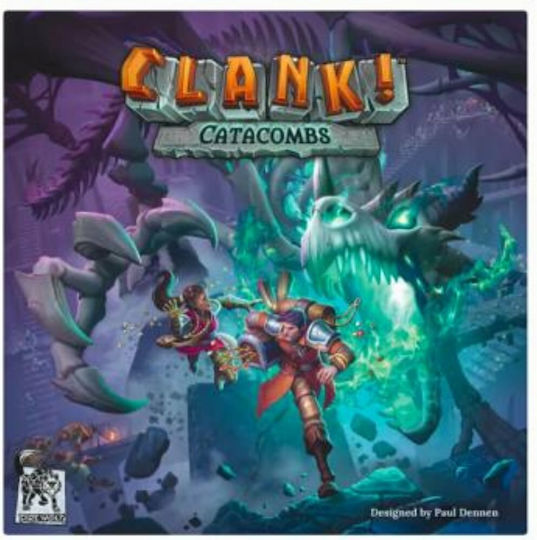
Clank! Catacombs Review
The Deck-Building Dungeon Delve That Perfected Push-Your-Luck
Hook / First Impression
Somewhere in the depths below the dungeon, a dragon is sleeping — and every noisy decision you make brings it one step closer to waking up and destroying you. Clank! Catacombs is the standalone, fully modular evolution of one of deck-building's most beloved series, and it does something few games manage: it makes every single turn feel dangerous in exactly the right way.
The premise is deceptively simple. You are a rogue descending into an ancient dungeon to steal the most valuable artifact you can carry — and then get out alive before the dragon hunts you down. You build a deck of cards that give you movement, combat, gold, and stealth. The deeper you go, the richer the rewards. But every card that makes noise adds your coloured cubes to the dragon attack bag, and when the dragon strikes, it draws blindly from that bag. Too many cubes of your colour in there and you are not coming back up.
Overview
Clank! Catacombs is a standalone deck-building dungeon delve designed by Andy Clautice, published by Dire Wolf (formerly Renegade Game Studios) in 2022. It is a fully independent game — you do not need any previous Clank! title to play. Players build personalised decks from a shared market row of cards, explore a dungeon whose layout is revealed tile by tile as they move, and race to grab artifacts and escape before the dragon finishes them off.
| At a glance | |
|---|---|
| Designer | Andy Clautice |
| Publisher | Dire Wolf |
| Year | 2022 |
| Players | 1–4 |
| Play time | 60–90 minutes |
| Age | 13+ |
| Weight | Medium (BGG ~2.5/5) |
| Mechanics | Deck-building, push-your-luck, modular tile map |
| Victory condition | Most points — from artifacts, dungeon loot, and cards — after escaping alive (or dying with an artifact above depth 3) |
Components & The Setting
The Setting: You play a rogue — a thief, a ranger, an arcane trickster — descending into the Catacombs beneath an ancient keep. The dungeon is not a fixed map but a living, breathing labyrinth of dungeon tiles that are revealed face-down and only flipped when a player enters them. This means no two games produce the same dungeon. The corridors shift, the treasure rooms appear in different sequences, and the monsters lurking at depth surprise you every time. The theme is fully integrated into the mechanics: every card in your deck represents a skill, contact, or piece of equipment you've accumulated during your heist. The dungeon feels like a real place rather than an abstract scoring surface.
Component quality is excellent. The dungeon tiles are thick, well-illustrated in a stylised fantasy palette that evokes classic roguelikes without tipping into generic. The dragon bag — a cloth drawstring bag used for the attack mechanic — is tactile and satisfying to reach into. The card stock is good for its price point; heavy enough to survive repeated shuffling. Each player has a personalised deck of ten starting cards and wooden cubes in their colour for the dragon bag mechanic. The artifact tokens are chunky and chunky. The rulebook is clean, with a worked example of the dragon attack that eliminates the most common source of first-game confusion. At approximately $55–$65 USD, the production punches well above its price.
How to Play
The goal is to score the most points. Points come from: artifacts you carry out (or die with, if you made it past depth 3), gold tokens collected in the dungeon, secret tomes and treasures looted along the way, and the cards in your deck at game end. The catch: if you are still underground when the game ends — triggered by the dungeon countdown or by the last player escaping — you only score if you have an artifact and are above depth 3. Go too deep and fail to escape, and you score zero.
On your turn you play all the cards in your hand. Cards produce one or more of four resources: Skill (used to buy new cards from the market), Boots (movement), Swords (combat with monsters), and Clank! (noise cubes you add to the dragon bag). Some cards produce multiple resources; some have triggered abilities that activate when certain conditions are met. After playing all your cards, you may buy cards from the market row, fight monsters, move through the dungeon, and loot any room you occupy. Then you discard your hand and draw five new cards.
The dungeon is explored by moving onto face-down tiles and flipping them. Each tile shows rooms, connectors, and sometimes monsters, items, or special effects. Artifacts — the big-ticket scoring items — sit on specific tiles at increasing depths. The deeper the artifact, the more points it is worth, and the harder it is to escape with it alive.
Gameplay Feel
Pacing & Tension: Clank! Catacombs has one of the best pacing arcs in the hobby. Early turns feel exploratory — you are building your deck, revealing tiles, mapping the dungeon, deciding how deep to go. Mid-game is where the tension peaks: you are deep enough that the artifacts are in reach, but the dragon bag is accumulating your cubes at a rate that feels increasingly precarious. Other players are escaping above you, triggering the countdown, and every remaining turn is a calculation of how many more dragon attacks you can survive versus how much more loot you can grab. Late game is a panicked sprint for the exits that invariably produces the table's best stories.
Luck vs. Strategy Balance: This is where Clank! Catacombs earns its reputation. The dragon bag is genuinely unpredictable — you can minimise your exposure by choosing quiet cards and avoiding noisy actions, but you cannot eliminate it. The dungeon tile draws introduce spatial uncertainty that even the most prepared player cannot fully plan around. But these luck elements are managed, not suffered. You choose how much Clank! you generate. You choose how deep to go. You choose when to turn around. The randomness creates situations you must respond to; your deck-building decisions over the whole game determine how capable you are of responding well.
Rule Overhead: Medium-low. The turn structure is simple (play all cards, take actions, refill hand). The dragon attack procedure is the only genuinely fiddly rule and is well-documented in the rulebook. Most groups are playing fluently by turn three of their first game. The dungeon tile connection rules occasionally require a moment of attention but are quickly internalised after a handful of tiles are placed.
Player Interaction: Moderate and mostly indirect. Players compete for the same market cards — the card you buy is gone before the next player can take it. Monsters are claimed first-come. Artifacts are finite. But there is rarely direct player-vs-player combat, and the dungeon is large enough that players often explore in parallel rather than fighting over the same corridors. The most pointed interaction is the escape countdown: the first player to escape triggers a clock that gives the remaining players a limited number of turns. Choosing exactly when to escape — maximising your own score while starting the clock that pressures opponents still underground — is one of the game's most satisfying strategic decisions.
Mechanics Deep-Dive
The Deck-Building Engine
Unlike many deck-builders where you build toward a single powerful combo, Clank! Catacombs rewards balanced decks that cover all four resource types. A deck loaded with Swords but no Boots leaves you unable to navigate the dungeon efficiently. A deck heavy on Skill lets you buy expensive cards but generates lots of Clank! if those cards are noisy. The best decks are lean and purposeful: a small number of high-efficiency cards that produce what you specifically need for the depth you're targeting.
The Catacombs-specific wrinkle is that the dungeon itself rewards specialisation in certain rooms. Some tiles provide bonuses to players carrying specific types of items; others reward players with particular card types in their deck. Reading the dungeon as it reveals itself and adjusting your buying strategy accordingly — rather than committing to a fixed plan at game start — is one of the hallmarks of experienced play.
The Dragon Bag: Risk Made Physical
The clank/dragon bag mechanic is perhaps the most elegant push-your-luck system in modern board games. Its genius is in making risk visible. As you add more cubes to the bag, you can literally see the proportion of your colour growing relative to the neutral black cubes. The probability of being hit in the next dragon attack is right there in front of you — tactile, immediate, and genuinely anxiety-inducing in the best possible way.
- Clank! generation is printed on every card. You always know exactly how much noise you're making — the question is whether the reward justifies the exposure.
- Clank! reduction cards and abilities let you pull your own cubes back out of the bag — one of the most satisfying actions in the game, akin to taking a breath before the next dive.
- Dragon rage increases as the game progresses: later dragon attacks draw more cubes, making survival progressively less predictable even for cautious players.
- Monster fights often require Swords but produce Clank! when won — a deliberate trade-off that makes every combat feel like a cost-benefit calculation.
The Modular Dungeon: Every Game Is Different
The original Clank! used a fixed board. Catacombs replaces it entirely with a stack of double-sided dungeon tiles that are drawn and placed as players explore. This means the dungeon layout, the position of key rooms (artifact rooms, shrine rooms, market stalls), and the routing options between them are all different every game. Players who have mastered the fixed board of original Clank! will find their mental maps completely reset — which is exactly the point.
The tile adjacency rules (matching coloured archways) ensure the dungeon stays spatially coherent: corridors connect sensibly, rooms cluster logically, and dead ends feel earned rather than arbitrary. Occasionally the tile draw produces a dungeon that is either especially brutal (artifact rooms deep and hard to reach) or especially generous (short routes to valuable loot), but this variance is modest in practice and feels like natural dungeon personality rather than broken balance.
Player Count Analysis
Solo — Surprisingly excellent. Clank! Catacombs includes an automa system (the "Phantom Player") that competes for market cards and generates Clank! to populate the dragon bag, making the risk feel real even without human opponents. Solo games play in 40–50 minutes and are genuinely tense. The dungeon scale contracts slightly with one player, which keeps pace brisk. Recommended for players who enjoy deck-builders as a personal puzzle and want the full dungeon experience alone.
2 Players — Tight and focused. The market competition is fierce at two players — key cards sell out before your next turn with predictable regularity. The dungeon feels personal; you are often aware of exactly where your opponent is and what they are trying to do. Escape timing becomes a direct strategic lever: triggering the countdown at the optimal moment relative to your opponent's position is one of the most satisfying two-player interactions in the game. Play time is approximately 50–65 minutes.
3 Players — The sweet spot. Three players provides enough market competition to make buying decisions meaningful without bottlenecking supply completely. Dungeon routes diverge naturally, allowing players to develop in relative isolation before the escape countdown forces convergence. The dragon bag fills at a rate that keeps everyone nervous without eliminating players prematurely. Most play groups settle on three as their preferred count after a few sessions. Play time is 65–80 minutes.
4 Players — Lively, slightly chaotic. Four players is fun and social but the longest experience. The market empties quickly, making it harder to execute planned deck strategies. Downtime between turns is noticeable if players are deliberate planners; the dungeon can become crowded in the middle sections. The dragon bag fills rapidly with four players generating Clank!, which can produce devastating early attacks. Recommended for groups who prioritise the social experience over tight strategic play. Play time is 80–100 minutes.
Replayability
Clank! Catacombs has exceptional replayability driven by three intersecting sources of variability: the modular dungeon (every game produces a different layout), the market card draw (the cards available to buy change every game, forcing different deck strategies), and the dragon bag dynamics (the timing and severity of dragon attacks is always different). No two games play the same way, and the game has no solved lines — the correct strategy shifts based on what the dungeon reveals and what the market offers.
Beyond randomness, the strategic ceiling is genuinely deep. The efficiency of your deck-building decisions — which cards to buy when, how to sequence purchases relative to your planned depth, when to pivot your strategy based on dungeon layout — rewards repeated play in ways that make veterans meaningfully better than newcomers without making the game inaccessible to first-timers.
The game also supports variant characters (included in the box) that give each player a unique starting hand and ability, adding another axis of variability for groups who have played enough to want asymmetric starting positions.
Learning Curve
Ease of teaching: Moderate. The turn structure is straightforward — play all your cards, take your actions, draw back up to five — but there are more moving parts than lighter games. New players need to internalise four resource types, the dungeon tile placement rules, and the dragon attack procedure before the game flows naturally. An experienced teacher can get a group to first-turn readiness in about 15 minutes; a cold rulebook read takes 30–40 minutes. The rulebook is well-organised and includes a full worked example of the dragon attack that we recommend reading aloud before the first game.
First-game experience: Consistently positive in our sessions. New players are almost universally gripped by the dragon bag — the physical act of reaching into the bag and drawing cubes during an attack creates genuine table drama regardless of whether anyone understands the optimal strategy. Most first-game groups make the depth trap mistake (going too far in and not making it out), which generates both the game's best story and its most effective teaching moment. Players who are eliminated early are frustrated but, in our experience, immediately want to replay.
Deeper mastery: Expert play in Clank! Catacombs centres on three skills: deck efficiency (buying fewer, better cards rather than padding your deck with cheap ones), dungeon reading (routing toward the best artifact your deck can realistically reach and escape from), and escape timing (triggering the countdown at the optimal moment relative to opponents' positions). These skills develop naturally over 5–10 plays and the game rewards investment in them with a strategic depth that few gateway-adjacent titles offer.
Who It's For
Deck-builder fans: If you enjoy Dominion, Thunderstone, or Star Realms but want more spatial engagement and a concrete win condition beyond "build the best engine", Clank! Catacombs delivers. The deck-building is familiar enough that existing fans hit the ground running; the dungeon exploration adds exactly the kind of embodied, directional tension that pure tableau deck-builders lack.
Dungeon crawl fans: If you love the idea of Gloomhaven or Mansions of Madness but don't want the multi-hour commitment or complex setup, Clank! Catacombs is the best compact alternative. It captures the dread of going deeper, the satisfaction of finding treasure, and the desperate sprint for the exit — all in 60–90 minutes with a 10-minute setup.
Hobbyist groups who want something to grow into: The game's medium weight and short play time make it accessible for hobbyist groups who want strategic depth without the full weekend commitment. It teaches well and rewards repeated play in a way that keeps it relevant on the shelf for years.
Not ideal for: Groups who dislike any luck in their games — the dragon bag is not fully controllable and will occasionally produce devastating results for cautious players through no strategic fault of their own. Also not ideal for groups looking for cooperative play (Clank! Catacombs is fully competitive) or for younger players who may find the tension of impending dragon death more stressful than exciting.
Comparisons: For a purely cooperative dungeon experience without the deck-building, Gloomhaven: Jaws of the Lion is superb but heavier. For more deck-building with less spatial exploration, Dominion remains the genre standard. For a similar push-your-luck tension in a lighter package, King of Tokyo delivers at half the complexity.
Pros & Cons
What Clank! Catacombs does exceptionally well:
- The dragon bag push-your-luck mechanic is one of the most elegant and physically satisfying risk systems in modern tabletop gaming — visible, tactile, and genuinely tense.
- The modular dungeon eliminates the map-memorisation problem of fixed-board predecessors, delivering a genuinely fresh exploration experience across dozens of plays.
- A standout pacing arc: exploratory early game, tense mid-game depth decisions, and a frantic late-game escape that consistently produces memorable moments.
- Excellent solo mode that preserves the full risk feel of multiplayer using a simple automa system.
- Medium weight that rewards strategic mastery while remaining teachable in under 20 minutes — a rare balance.
- High production value at a fair price: thick tiles, good card stock, satisfying dragon bag, and clear iconography.
Where Clank! Catacombs falls short:
- The dragon bag is not fully controllable: a run of unlucky draws in the early game can cripple a player before they've made meaningful decisions, which feels unfair rather than earned.
- Player elimination is real — players knocked out with no artifact score nothing and may be idle for 30–40 minutes if they were eliminated mid-game. This is the game's most divisive design choice.
- Four players extends play time noticeably and introduces more market scarcity than the deck-building engine handles gracefully; three players is meaningfully better.
- The dungeon tile adjacency rules occasionally require rules lookups in early games when unusual archway combinations arise.
- The base box's character asymmetry (variant starting decks) is modest; groups wanting stronger asymmetry should look to the Adventuring Party expansion.
Expansions & Ecosystem
Clank! Catacombs is a standalone game in the broader Clank! universe — it does not require any previous Clank! title to play, but it is compatible with some components from the wider ecosystem. The relevant expansions and related products:
Clank! Catacombs: Adventuring Party — The essential expansion ★★★★★
Adds six fully asymmetric adventurer characters, each with unique starting decks, special abilities, and personal goals that change how you approach the dungeon. If you have played Catacombs more than five times with the same group and want to differentiate the player experience, this is the single best purchase in the ecosystem. The character abilities interact with the dungeon tile system in interesting ways that the base game cannot offer.
Clank! Legacy: Acquisitions Incorporated — For committed groups ★★★★☆
A legacy campaign version of the Clank! system — not Catacombs specifically, but compatible in spirit. Plays across 10 sessions with a persistent narrative, permanent card changes, and escalating mechanical revelations. Outstanding for groups who can commit to a full campaign; unsuitable for casual or irregular play groups. Uses the original fixed-board format rather than Catacombs' modular tiles.
Clank! In! Space! — A thematic reskin with twists ★★★☆☆
A standalone sci-fi version of the Clank! system with its own unique mechanics and fixed board. Plays differently enough from Catacombs to warrant owning both if you love the core system. Not required; best for groups who specifically want a sci-fi flavour or who have exhausted the fantasy theme.
| Expansion | Best For | Complexity Added | Rating |
|---|---|---|---|
| Adventuring Party | Regular groups wanting asymmetry | Minimal | ★★★★★ |
| Clank! Legacy | Committed campaign groups | High (campaign system) | ★★★★☆ |
| Clank! In! Space! | Sci-fi flavour seekers | Moderate (new mechanics) | ★★★☆☆ |
Value for Money
Clank! Catacombs retails for approximately $55–$65 USD (€50–60 in Europe). For that price you get a complete, highly replayable game with built-in solo support, excellent component quality, and a design that holds up across dozens of sessions without becoming predictable. Relative to comparable deck-builders with exploration components, this is strong value — the modular dungeon alone justifies the premium over the original Clank! base game.
- Deck-builder fans: Excellent value as a spatial evolution of the genre. The dungeon integration adds genuine strategic texture that pure tableau deck-builders at the same price cannot match.
- Dungeon crawl fans: Strong value as a compact crawl. You get the core emotional experience — dread, greed, desperate escape — without the $80+ price tag and multi-hour sessions of heavier crawlers.
- Gift buyers: A well-regarded, broadly appealing gift for anyone who enjoys strategy games. The dragon bag gives the game an immediate "show and tell" hook that communicates the experience before a single card is played.
The Adventuring Party expansion adds approximately $35–$40 USD for character asymmetry that meaningfully extends the game's long-term interest. Both together represent the complete Catacombs experience and total approximately $90–$100 — reasonable for a game with this replay depth.
Accessibility
Color blindness: Player cubes are in four distinct colours; some colour pairings (red/orange in certain printings) may be difficult to distinguish under low light. The dragon bag mechanic requires distinguishing your cubes from others' cubes at a glance — for players with colour vision deficiency, we recommend marking cubes with tactile stickers or using a strong desk lamp during dragon attacks. The dungeon tile and card art uses sufficient visual differentiation beyond colour to remain functional for most CVD conditions.
Language dependence: Moderate. Card text is in English and some cards have triggered effects that require reading during play. The dungeon tiles use symbols rather than text for most icons, which is accessible. Not ideal for groups with significant language barriers without translation support, though the core mechanics (buy cards, move, fight) can be taught through demonstration for simple card effects.
Cognitive accessibility: Medium. The four resource types, dungeon tile placement rules, and dragon attack procedure create more cognitive overhead than lighter games. Manageable for most adults with one teaching game; may be challenging for players who struggle with simultaneous resource tracking or spatial reasoning. The solo mode works particularly well as a learning vehicle before introducing multiplayer.
Physical accessibility: The dragon bag mechanic requires drawing cubes from a cloth bag — manageable for most dexterity limitations, though players with significant hand tremor may prefer having another player draw on their behalf. Cards require standard shuffling. The dungeon tiles are large (approximately 4" square) and easy to handle. Play time of 60–90 minutes is reasonable for players with fatigue-related conditions.
Age range: The 13+ rating reflects card text complexity and the strategic depth rather than mature content. In our experience, engaged players from around age 10 can participate meaningfully; the dragon bag mechanic is especially accessible for younger players who respond to its physical immediacy.
Verdict
Clank! Catacombs is the best version of the Clank! system and one of the finest deck-builders with a spatial component ever published. The dragon bag push-your-luck mechanic alone would justify recommending it — there is nothing else quite like watching your colour accumulate in that bag, running the arithmetic of survival, and then deciding to go one room deeper anyway. Add a modular dungeon that ensures genuine novelty across dozens of sessions and a pace arc that produces the hobby's best "one more room" moments, and you have something special.
Its weaknesses are real but manageable. Player elimination stings. The dragon bag can occasionally be unkind to careful players through pure misfortune. Four players is one too many for optimal balance. None of these are fatal — they are design trade-offs in service of a tension-management system that delivers more table drama per minute than almost anything at this weight.
Buy it if: you want a medium-weight game that combines deck-building mastery with dungeon exploration tension — especially if you've ever felt like pure deck-builders are missing a spatial dimension. It is the best argument for why push-your-luck belongs in strategy games.
Skip it if: your group has a low tolerance for luck-based elimination or if you specifically want a cooperative dungeon experience. Gloomhaven: Jaws of the Lion is the cooperative alternative; Dominion is the luck-minimised deck-builder.
Add Adventuring Party when: you have played 5–10 sessions with the base game and want the player experience to diverge more strongly from the first turn. It is the correct first expansion and the only one most groups will need.
Score Breakdown
Love board game night? Explore our tools, score calculators, and strategy guides — everything you need to play better and have more fun.
Browse All Articles →