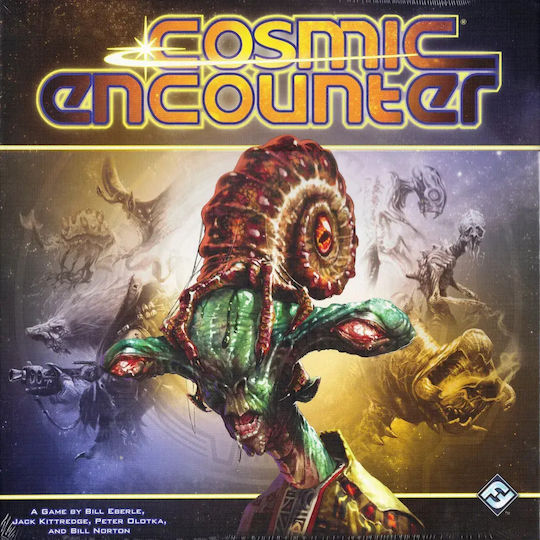
Cosmic Encounter Review
The Greatest Chaos Game Ever Made
Hook / First Impression
There is a game that was invented in 1977 and has never been beaten at its own genre. Cosmic Encounter is the definitive alien negotiation game — a chaotic, joyful, rule-breaking experience in which every player controls a different extraterrestrial race with a unique power that ignores, bends, or smashes a core rule of the game. In nearly 50 years nobody has made a better one.
It is not the most balanced game. It is not the most strategic game. It is almost certainly not the fairest game at the table on any given night. What it is, without competition, is the most alive game you will play this year. At five players, Cosmic Encounter produces more table talk, alliance shifting, dramatic reversals, and stories you will retell for weeks than any game at double its weight. That is the pitch. If that sounds like your table, read on.
Overview
Cosmic Encounter was originally designed by Peter Olotka, Jack Kittredge, Bill Norton, and Bill Eberle and published by Eon Products in 1977. The current edition was published by Fantasy Flight Games in 2008 and remains in print. Players each command a unique alien civilisation racing to establish five foreign colonies across each other's planets before anyone else does.
| At a glance | |
|---|---|
| Designers | Peter Olotka, Jack Kittredge, Bill Norton, Bill Eberle |
| Publisher | Fantasy Flight Games |
| Year | 1977 (current FFG edition: 2008) |
| Players | 3–5 (up to 8 with expansions) |
| Play time | 60–120 minutes |
| Age | 12+ |
| Weight | Light-medium (BGG ~2.4/5) |
| Victory condition | First to 5 foreign colonies |
Components & The Setting
The Setting: You are an alien species. You have five home planets. You need to establish colonies on five foreign planets before the other aliens do the same. That's it. The theme is gloriously, intentionally thin — it exists mainly to justify why a Virus alien (who multiplies instead of adding its attack value) is fighting a Clone alien (who copies the Virus's power back at it) while a Diplomat alien (who can stop any encounter at any time) watches from the sideline. Cosmic Encounter's "theme" is really just a licence for each alien power to be as weird and rule-defying as possible, and the game is richer for it.
Component quality in the FFG edition is good-to-excellent. The alien power cards are the stars — each features a brief flavour description of the alien's civilisation and a precise statement of its power. The planet systems are cardboard rings that mount on plastic stands, creating a surprisingly satisfying physical table presence. Ship tokens are plastic, colour-coded, and chunky enough to handle. The Hyperspace Gate — a translucent plastic cone that points from the aggressor's system toward the target — is one of the most functionally clever pieces in any board game. It is unmistakable, always visible, and sets up the encounter tableau clearly for every player. Encounter cards (the combat cards) are large and legible. The cosmic deck (the equivalent of a fate deck) is well-paced.
One component criticism: the rulebook is genuinely difficult. Cosmic Encounter has more edge-case interactions than almost any game at its weight, and the core book does not handle them all cleanly. The FFG FAQ documents are essential reading for repeat players, and many veteran groups simply adopt a "table rules" convention for rare interactions. This is less a flaw than an acknowledgement of what the game is: a system designed to produce chaos, and one that occasionally generates ambiguity it cannot fully resolve in print.
How to Play
The goal is to establish five foreign colonies — that is, five of your ships on planets belonging to other players. You do not need to hold all five simultaneously; once a colony is established it persists unless displaced.
Each turn, the active player is the Offense. They draw a Destiny Card from a shuffled deck of colour-coded cards, which determines which opponent's system they must attack. They then launch a fleet of one to four ships through the Hyperspace Gate to one of the target player's planets.
Before combat resolves, both the Offense and Defense may invite allies. Any player can choose to ally with either side by sending ships into the encounter. Allies share in victory or defeat — meaning every encounter is potentially a group decision, not just a one-on-one fight.
Both sides then secretly choose and simultaneously reveal an Encounter Card. Attack cards are numbered 0–40; the winner is whoever has the highest total (their card value plus the number of ships on their side). The losing side loses all their ships to the Warp — the game's graveyard, from which ships can be retrieved. The winning Offense establishes a colony; the losing Offense retreats empty-handed.
There is a second card type: Negotiate. If both sides reveal Negotiate simultaneously, they must make a deal — trading cards or colonies — within 60 seconds. If only one side plays Negotiate while the other plays Attack, the Negotiate player loses the encounter but may compensate their lost ships by taking cards from the winner's hand.
Gameplay Feel
Pacing & Tension: Cosmic Encounter moves quickly. Turns take under five minutes for experienced players and there is almost always something to engage with even when it is not your turn — an alliance invitation is a live decision point every single encounter. The game can end in 45 minutes with a lucky run or stretch to two hours if the table is cautious and no one pulls ahead. Most games land around 75–90 minutes at five players.
Player Interaction is total and constant. Almost nothing happens in Cosmic Encounter without touching every other player — as a potential ally, a potential target, or a potential victim of someone else's alien power. The table is loud in the best possible way. Side conversations happen during every encounter. Coalitions form and dissolve. Players who seemed to be friends three turns ago are now locked in a two-on-three conflict they did not plan for. The game is a social engine first and a strategy game second.
Luck vs. Strategy Balance: Cosmic Encounter is deliberately luck-heavy by design, and the players who most enjoy it accept this as the point rather than a flaw. The Destiny Card deck determines your targets; the Encounter Card draw is semi-random; alien powers interact in ways that cannot be fully predicted. What skill controls is alliance management — who you ally with, when you invite others, when you hold back, when you bluff a Negotiate play. A poor alliance decision can cost you more than a terrible encounter card. Players who lean into the diplomacy layer consistently outperform those who treat it as a straight combat game.
Rule Overhead: The base rules explain in 20–25 minutes. The first game will have at least one alien power interaction that nobody at the table has seen before and that the rulebook does not handle cleanly. This is not an exception; it is the expected experience. Cosmic Encounter groups quickly develop a "table lawyer" — the player who has read the most FAQs — and this person is valued and occasionally resented in equal measure.
Mechanics Deep-Dive
The Alliance System
Alliances are the mechanic that separates Cosmic Encounter from every game that copied its surface structure. When you invite allies, you are not just asking for numbers — you are offering them a share of victory. Successful Offense allies each place one ship as a foreign colony on the target planet; successful Defense allies retrieve ships from the Warp. These are real stakes, and the negotiation around them is real diplomacy.
The key tension: the more allies the Offense recruits, the stronger they are in combat — but each additional ally they win with is one step closer to that ally hitting five colonies and winning the game. Helping someone win the fight might be handing them the game. This creates a calculation that runs through every single encounter: "Do I need these ships on my side more than I need to slow down this player?"
Equally critical is the concept of a shared win. If the Offense wins and reaches five colonies in the same encounter as an ally, both players win simultaneously. Cosmic Encounter explicitly supports joint victories — and this rule, simple as it sounds, completely changes the diplomatic calculus. You can deliberately try to co-win with an ally. You can race to deny someone their fifth colony by allying against them repeatedly. You can promise someone a shared win and then betray them at the moment of truth by refusing to invite them.
The Alien Power Layer
The alien power system is what makes Cosmic Encounter irreducible — you cannot strip it out and still have the same game. Powers do not just provide a statistical advantage; they change what the game means for that player. Playing as the Pacifist (who wins by losing attack encounters) requires you to lose on purpose while convincing opponents that you are not deliberately trying to lose — a social deception challenge embedded directly in the mechanics. Playing as the Trader (who can force a hand swap before the encounter card reveal) turns information asymmetry into the entire game. Playing as the Philanthropist (who gives cards away each turn) creates obligations and alliances that shape the whole table's behaviour.
The result is a game that is about a different thing every session, with a different texture of diplomacy, a different threat profile, and different winning conditions depending entirely on which aliens are in play. After hundreds of plays, experienced groups still encounter power combinations they have never navigated before.
- Track the Warp: Ships in the Warp cannot be deployed. A player with most of their fleet in the Warp is nearly defenceless and ripe to be attacked repeatedly. Watch the Warp count as carefully as the colony count.
- Negotiate cards are weapons: Playing Negotiate into an opponent's Attack wins you cards from their hand. Against a hand-hungry opponent — or an alien whose power depends on card quantity — this is often the correct play even when you could win the combat outright.
- Invite allies late: If you wait until the last possible moment to invite allies, opponents cannot use your invitation as information about your encounter card strength.
- The Destiny Deck is information: Track which colours have been drawn to estimate when a player will next be forced to attack a specific opponent. Timing your vulnerability accordingly is a real strategic lever.
- Read the alien, not just the encounter: Against the Zombie, combat attrition is irrelevant. Against the Virus, a large fleet on your side can backfire catastrophically. Every alien changes what the optimal play is for every other player.
Player Count Analysis
Solo — Not applicable. Cosmic Encounter is a social game in the same way that conversation is a social activity. There is no solo mode and there should not be one.
2 Players — Poor. The game's diplomatic engine collapses without a third party to balance power or serve as a potential ally. Two-player Cosmic Encounter eliminates alliances almost entirely, stripping out the system that makes it great. Not recommended; play something else at two.
3 Players — Functional, but thin. Three players creates a functional game. The kingmaker problem is real — two players can coordinate to indefinitely block the third — but the game is short enough that it resolves before the dynamic becomes punishing. Worth playing if the group is limited to three, but not the experience the game was designed for.
4 Players — Solid. Four players is a good experience. Alliance decisions are genuinely interesting with three potential partners, the game moves quickly, and a single powerful alien feels manageable when there are three opponents to collectively contain it. If five is not possible, four delivers nearly the full experience.
5 Players — The sweet spot. Five players is the design target and the best experience by a considerable margin. Alliance dynamics hit their full complexity, the shared win rule creates layered diplomacy, and the table energy is at its peak. Games are noisier, funnier, and more dramatic at five than at any other count. The box supports five; play at five.
6+ Players — With expansions, manageable. Expansions support up to six, seven, or eight players. Downtime increases noticeably above five, and the game can run over two hours. Works best with a group that is already experienced with the system and wants a deliberately chaotic large-group event. First-timers should not start at six.
Replayability
Cosmic Encounter's replayability is among the highest in the hobby for its weight. The base game includes 50 alien powers; expansions add hundreds more. With five players and randomly assigned aliens, the probability of playing the same combination of five powers twice in casual play approaches zero. Beyond variance in alien powers, the game's outcomes depend almost entirely on the people at the table — their diplomacy styles, their grudges, their bluffing tells, their willingness to honour deals — meaning that the same five players with the same five aliens will produce a different game every session based purely on social dynamics.
The one replayability caution: groups that play very frequently begin to read each other's diplomatic patterns, which reduces the effective randomness of social play. This is not a flaw — it is what happens when a group knows each other well — but it does mean that Cosmic Encounter can plateau for a tight-knit group in a way it never would for a rotating player pool. The game thrives on at least some unpredictability in who is at the table.
Learning Curve
Ease of teaching: The core rules can be explained in about 20 minutes, including a demonstration encounter. The concepts — draw a Destiny Card, launch ships, invite allies, play Encounter Cards, higher total wins — are intuitive. What takes longer to convey is the culture of the game: that alien powers override rules, that Negotiate is not a surrender, that shared wins are real and worth pursuing. These concepts are best learned by playing, not by explaining.
Rulebook quality: The FFG rulebook is clear for the base cases and weak on edge cases, which is exactly backwards from what Cosmic Encounter needs. The good news: the FFG FAQ documents are thorough and free, and many alien power interactions have been resolved definitively there. Any group planning to play regularly should download the FAQ and nominate someone to own it. The bad news: new players will hit at least one unresolved alien power conflict in their first few sessions and will need to make a table ruling. This is not the end of the world.
First-game experience: Almost always positive, but not always smooth. New players frequently underuse the Negotiate card in the first game, treating it as a concession rather than a strategic tool. They also tend to under-invite allies, playing combat as a one-on-one when the most interesting decisions happen in multi-party negotiations. Both tendencies correct by the second session. The first game's biggest challenge is usually alien power confusion — new players forget their power triggers, or are surprised by an opponent's power mid-encounter. Keeping powers visible and reminding players of their power at the start of their turn prevents most of this friction.
Who It's For
Groups who love social play above all else: Cosmic Encounter is the game for tables that light up during deals, arguments, betrayals, and improbable last-minute alliances. If the best part of your game nights is the conversation and drama around the table rather than the strategic puzzle in your head, this is the game you have been waiting for.
Experienced groups looking for something different: Hobbyist gamers who play medium-to-heavy games regularly often find Cosmic Encounter a revelatory change of pace. The explicitly chaotic design, the acceptance of unfairness as a feature, and the total commitment to alien weirdness are refreshing after a diet of tight Euro games. Many veteran players consider it one of the best games they own precisely because it demands a different mode of engagement.
Not for: Groups that need the best player to win consistently. Players who find diplomatic ambiguity stressful rather than fun. Anyone who wants a satisfying solo or two-player experience. People who are uncomfortable with rules that get broken and overridden regularly — the alien power system can feel anarchic and arbitrary to players who prefer clear, consistent rule structures.
Comparisons: Dune: Imperium shares Cosmic Encounter's love of asymmetric powers and political deal-making but is far more strategic and controlled. Avalon scratches the negotiation and deception itch in a faster, simpler package. If your group loves the idea of Cosmic Encounter but wants something with more structure, Root offers asymmetric factions with tighter strategic frameworks.
Pros & Cons
What Cosmic Encounter does brilliantly:
- The best alien power system in board gaming — over 200 powers published, each genuinely different, each changing what the game means for that player.
- Shared win rule creates real multi-party diplomacy instead of a kingmaker race to the finish line.
- Replayability is essentially infinite — no two sessions play the same.
- Produces more memorable stories and table moments than games at twice its price and complexity.
- Tight enough at 60–90 minutes that a bad session is quickly replaced by another.
- Five players is a genuinely excellent experience that few games match at any count.
What Cosmic Encounter does less well:
- The rulebook handles edge cases poorly; groups who play regularly need the FAQ.
- Random alien assignment can produce lopsided power combinations with no built-in mitigation.
- Falls apart below three players and is mediocre below four.
- Some alien powers are significantly stronger than others; the game does not pretend otherwise.
- Teaching the culture of the game — not just the rules — takes multiple sessions.
Expansions & Ecosystem
Fantasy Flight published five major expansions for the current edition. All add alien powers as their primary content; several also add new card types, hazard mechanics, or increased player counts.
| Expansion | Key additions | Recommended? |
|---|---|---|
| Cosmic Incursion | 25 new aliens, reward cards, 6th player support | Yes — buy first |
| Cosmic Conflict | 20 new aliens, hazard cards (replace Flares), tech cards | Yes for regular groups |
| Cosmic Alliance | 20 new aliens, team play variant | Situational — team variant divides opinion |
| Cosmic Dominion | 20 new aliens, Reward Deck expansion | Yes for dedicated groups |
| Cosmic Storm | 20 new aliens, Hazard Deck expansion, 7–8 player support | Only if regularly playing 6+ |
Cosmic Incursion is the clear first buy — 25 more aliens is more Cosmic Encounter, and the sixth player support is immediately useful. Cosmic Conflict's hazard cards add a layer of table-wide randomness that some groups love and others find excessive; try the base game extensively before committing to it. The remaining expansions are excellent for groups who have played 20+ sessions and want fresh material.
Value for Money
The base game retails around $50–60 and supports up to five players for a potential play count in the hundreds before the alien pool feels exhausted. On a cost-per-session basis, it is one of the best-value games in the hobby. The high replayability ceiling, the short-to-moderate play time, and the low barrier to entry for new players make it easy to get consistent use from the box.
The only value caveat: Cosmic Encounter with only three or four players consistently is a diminished experience. If your group will never reliably reach five, the value proposition weakens. At four players the game is still worth owning; at three, it is a hard recommendation to make.
Expansions are priced around $30–40 each and are absolutely worth it for groups who play regularly — each adds a substantial new alien pool that meaningfully extends the game's lifespan. Buying the base game plus Cosmic Incursion at the outset is the recommended entry for groups who already know they will love it.
Accessibility
- Colour blindness: Moderate concern. Player colours and the Destiny Card deck use colour as the primary identifier for player systems. The current FFG edition does not include colour-blind-friendly iconography on player pieces or Destiny Cards. Groups with colour-blind players should agree on a supplementary identification system — numbered tokens or text labels — before the first game.
- Dexterity: Very low requirements. Ships are plastic and easy to handle; no significant fine motor demands.
- Language dependence: High. Alien power text is the entire game. Cards are text-heavy. Non-English speakers will need a localised edition; several exist.
- Cognitive load: Moderate. The core rules are simple; the alien power interactions can be complex. Players with attention challenges may find tracking multiple powers simultaneously demanding, particularly in high-player-count games with many simultaneous inputs.
- Age: The 12+ rating is appropriate. Younger players can engage with the mechanics but may find the diplomatic negotiation — and the social pressure of deal-making — challenging before early adolescence.
Verdict
Cosmic Encounter is nearly fifty years old and has not been beaten at its own game. The alien power system remains unmatched in its ability to make every session feel structurally different. The shared win rule creates genuine diplomatic depth without requiring a single page of complex rules. The five-player experience is one of the best in board gaming, full stop.
It is not a fair game. It is not a balanced game. It is not the right game for every table. It is, for the right group — social players who embrace chaos, love negotiation, and want a game that generates stories — the only game you need to own in its genre. Buy it, play it at five, and accept that no plan survives contact with a room full of alien powers.
Score breakdown
Ready to plan your next cosmic showdown? Use Game Night Pro's tools to pick the perfect game for your group, manage your night, and never run out of good options.
Explore Game Tools →