Dixit Review
Dream Logic in a Box — Still the Best Icebreaker in the Hobby
Hook / First Impression
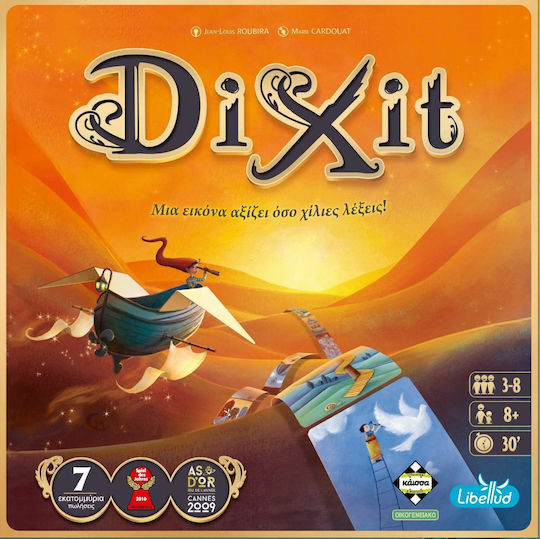
Dixit has no board, no dice, no resource tracks, and almost no rules. What it has instead is 84 of the most beautifully strange illustrations ever printed on a card, and a deceptively clever prompt: say something that will make some people guess correctly and others guess wrong. That single mechanic, wrapped in Marie Cardouat's dreamlike art, won the Spiel des Jahres in 2010 and quietly became one of the best-selling card games in history.
It belongs in a different category from most games reviewed on this site. Dixit is not about tactics, resource management, or winning through superior play. It is about how people think, what images they associate with words, and what that reveals about the people sharing your table. Every session produces a moment where someone says a clue and half the room bursts out laughing because they immediately understood something the other half missed entirely — and that moment tells you more about your friends than most conversations will.
Overview
Dixit is a storytelling card game designed by Jean-Louis Roubira, illustrated by Marie Cardouat, and published by Libellud (now distributed by Asmodee). Players take turns as the Storyteller, giving a clue — a word, phrase, sound, or any verbal expression — that describes one card from their hand. Everyone else submits a card from their own hand that might match the clue, the cards are shuffled and revealed, and players vote on which card belongs to the Storyteller. Scoring rewards the Storyteller only if some players guessed correctly — not all, not none.
| At a glance | |
|---|---|
| Designer | Jean-Louis Roubira |
| Illustrator | Marie Cardouat |
| Publisher | Libellud / Asmodee |
| Year | 2008 |
| Players | 3–6 (Odyssey edition: up to 12) |
| Play time | 30 minutes |
| Age | 8+ |
| Weight | Very light (BGG ~1.2/5) |
| Awards | Spiel des Jahres 2010 |
Components & The Setting
The Setting: There is no setting in the traditional sense — no characters, no narrative thread carried between turns. Instead, Dixit's world lives entirely within the illustrations on the cards: surreal, gentle, often melancholic images of rabbits in diving suits, children walking tightropes over clouds, towers made of books, and doors into impossible places. The theme is imagination itself. Players are not roleplaying anything; they are lending their personal associations to images and hoping those associations resonate — or strategically misfire — with the people they know.
This is one of the most unusual things about Dixit: the "theme" deepens the more you know the other players. Playing with strangers is fine. Playing with close friends is extraordinary, because the clues and guesses become a conversation about how your minds work that no amount of actual conversation would surface.
Component quality is where Dixit genuinely earns its price. The 84 base cards are large-format (120 × 80mm), on thick quality stock, with the kind of artwork that rewards extended staring. Marie Cardouat's illustrations are layered with symbols, hidden figures, and visual puns — which is exactly what you want from cards that need to inspire creative clues at a moment's notice. The cardboard scoring track is a charming curved rabbit path; the wooden scoring rabbits are painted and tactile. Voting tokens are large plastic numbered tiles in player colours. Everything is well-produced for a game at its price point.
How to Play
The goal is to reach 30 points first (or have the most points when the deck runs out). Points come from both correctly guessing the Storyteller's card and from tricking other players into voting for your own submission.
Each round, one player is the Storyteller. They look at their six cards, choose one, and give a clue — any verbal expression they like: a single word, a song lyric, a made-up word, a sound, a quote, a gesture described aloud. The clue should be neither too obvious (everyone guesses correctly) nor too obscure (no one does). The optimal clue lands in the middle: some players get it, others don't.
All other players choose a card from their own hand that could plausibly match the clue, and pass it face-down to the Storyteller. All submitted cards — the Storyteller's plus one from each other player — are shuffled and laid face-up. Players then vote privately using their numbered tokens on which card they believe belongs to the Storyteller.
Scoring:
- If all players guess correctly, or none do: the Storyteller scores 0; all other players score 2.
- If some (but not all) players guess correctly: the Storyteller and each correct guesser each score 3.
- Any player whose submitted card received votes from other players scores 1 bonus point per vote.
The scoring rule is the mechanical heart of Dixit. It punishes clues that are too obvious and rewards calibrated communication — knowing your audience well enough to be understood by some and not by others. This is a genuinely original design idea that most party games never attempt.
Gameplay Feel
Pacing & Tension: Dixit is one of the most relaxed games in the hobby. There is no elimination, no real confrontation, and almost no analysis paralysis because the decisions (what clue to give, which card to submit, which to vote for) are instinctive and immediate. The energy at a typical Dixit table is warm, contemplative, and frequently funny — very different from the competitive heat of Catan or Ticket to Ride. It suits mixed groups, post-dinner play, and sessions where you want everyone engaged without anyone feeling outgunned.
Player Interaction is indirect but constant. Every clue is a bid for attention; every successful trick scores a bonus point. The interaction is social rather than adversarial — you are not blocking opponents or stealing resources, you are trying to understand and occasionally outmaneuver the way they think.
Luck vs. Strategy Balance: There is very little luck in Dixit. Card draws introduce variance — a weak hand makes finding a matching card difficult — but the skill layer, which is entirely about reading people, sits above any card-draw variance. The player who best understands the group's shared references and knows how to calibrate their clues will consistently outscore less attentive players. It is a social skill game, not a card game with social flavoring.
Rule Overhead: The rules can be taught in three minutes. Children grasp it faster than adults, because children have not yet learned to overthink the clue. There is no iconography to learn, no turn structure to memorize, and no edge cases that arise in normal play. It is one of the most frictionless games in the hobby to introduce to complete non-gamers.
Mechanics Deep-Dive
The Calibration Problem
Dixit's central mechanic is unique in the hobby: it asks you to communicate partially. Most games reward clear communication or secret information. Dixit rewards the space in between — the clue that resonates with some minds and slips past others. This creates a design elegance that is easy to miss: the game is simultaneously about shared understanding and the gaps in it.
Experienced players learn to exploit group dynamics. Giving a clue in an inside language — a reference that only two of five players will catch — is a valid and rewarding strategy. Giving a clue that sounds personal but actually describes the card literally will fool the table into searching for hidden meaning. These layers of bluffing and calibration give Dixit a genuine skill ceiling that its simple rules don't advertise.
The Decoy Layer
Non-Storyteller players are not passive. Choosing which card from your hand to submit as a decoy is a creative and strategic act: you want to pick something plausible enough to attract votes, which means understanding the Storyteller's clue deeply and reading the room. Bonus points from successful decoys are not negligible — at a competitive table, the player who consistently picks strong decoys will finish several points ahead of one who plays passively.
The Art as a Shared Language
Because the same 84 cards cycle through every player's hand over a session, the group develops a shared visual vocabulary. A card that appeared in round two as a decoy becomes a meaningful reference in round eight. Clues start folding back on previous rounds. This emergent continuity — entirely absent from the rulebook and entirely present in practice — is one of the most charming features of long Dixit sessions with consistent groups.
Player Count Analysis
Solo — Not supported. Dixit's engine is entirely social. There is no meaningful single-player variant and no competitive AI to substitute for human interaction. It is simply the wrong tool for one player.
2 Players — Not supported by base rules. The standard rules require at least three. The two-player experience has no meaningful decoy layer (there is only one non-Storyteller card) and the voting system breaks down entirely. Skip it at two.
3 Players — Playable, with caveats. At three, each Storyteller round has two decoy cards plus the Storyteller's, which gives the voting minimum viability. The issue is transparency: with only two other players, you often know immediately whose decoy is whose, which reduces the bluffing layer. Still enjoyable, but the game plays thin. A house rule requiring two submitted decoy cards per player at three players improves it substantially.
4–5 Players — The sweet spot. Four to five is the optimal range. There are enough decoys that voting becomes genuinely uncertain, the Storyteller has real calibration decisions to make, and the game completes in 30–40 minutes without anyone sitting idle. Social dynamics are rich enough to generate the memorable moments the game is built on.
6 Players — Excellent. The base game supports six comfortably and it works beautifully at this count. More players means more diverse guesses, richer post-round discussion, and more opportunities for the emergent inside-references that define great Dixit sessions. The game lengthens to about 45 minutes but stays fully engaging throughout.
7–12 Players — Odyssey edition only. The Dixit Odyssey edition includes components for up to 12 players and a modified voting mechanism (chalkboard-style individual boards instead of tokens) that scales the reveal phase. At 8+ players the game becomes genuinely chaotic — in a good way — and works well as a large-group icebreaker. Play time extends to 60+ minutes.
Replayability
Dixit's base replayability is high, but it changes character over time in an interesting way. With a new group, every card produces fresh associations and every clue reveals something surprising. With a well-worn group, the game becomes richer and more layered — not thinner — because you accumulate shared references, inside language, and knowledge of how specific players think. A group that has played Dixit 30 times is having a fundamentally different and deeper experience than one playing for the first time.
The practical limit to replayability is card familiarity. Once all 84 base cards are deeply familiar, the Storyteller's ability to surprise the table diminishes — you know the whole deck and can predict which cards are plausible decoys. This usually takes 15–25 sessions with a consistent group, at which point an expansion deck (which introduces 84 entirely new cards) fully refreshes the experience without requiring any rules changes.
For groups that play frequently, Dixit is one of the most cost-effective games to maintain via expansions. Each new deck costs roughly a third of the base game, introduces a new artist and visual identity, and completely resets the card-familiarity ceiling.
Learning Curve
Ease of teaching: Dixit is the easiest game in this review series to teach. Setup takes two minutes, rules take three, and the first round teaches the rest. It has no turn structure more complex than "give a clue, submit a card, vote." The only point that requires emphasis is the scoring incentive for partial guessing, and a single demonstration makes this click immediately.
Rulebook quality: The rulebook is a single two-sided sheet with clear diagrams. It has never produced a question that required checking BoardGameGeek. Edge cases essentially do not exist in normal play. The rulebook is effectively irrelevant after a first read.
First-game experience: Almost universally positive, and notably different from most gateway games. Non-gamers who feel intimidated by Catan or confused by Ticket to Ride are immediately comfortable in Dixit because there is nothing to optimize — just something to express. Children regularly outperform adults in their first session because they approach the clue-giving intuitively rather than analytically. The first game almost always ends with someone wanting to play again immediately.
Who It's For
Casual players and non-gamers: Dixit is one of the most reliably successful games you can bring to a non-gaming audience. It requires no prior experience, produces no player elimination, generates consistent laughter, and ends before anyone gets tired. If you can only own one game to introduce non-gamers to the hobby, Dixit and Catan are the two strongest candidates — Dixit for groups that are more social, Catan for groups that want more competitive structure.
Families: Outstanding from age 8 upward. The age rating is accurate — children understand the core loop immediately and bring an uninhibited creativity to clue-giving that adults often lose. Multigenerational tables work especially well because Dixit does not disadvantage older or younger players the way strategy games do. A grandparent and a ten-year-old are playing on genuinely equal footing.
Hobbyist gamers: Dixit has an unusual place in the hobby gamer's collection: it is not the kind of game that scratches the strategy itch, but it is the game you reach for when you need something that works for everyone at a mixed table. Most hobbyist gamers own a copy and use it specifically in that role — the reliable bridge game between non-gamers and the heavier titles.
Creative and artistic groups: Dixit rewards people who think metaphorically and associatively. Writers, artists, teachers, and therapists consistently report it as one of their favourite games. If your group enjoys language, stories, or images, this game was designed for you.
Comparisons: Mysterium is the closest relative and the natural upgrade for groups who want a cooperative, narrative-driven version of the "interpret abstract art" experience. Codenames scratches a similar word-association itch with more competitive structure and lower buy-in. Wavelength replaces images with a spectrum dial but preserves the social-reading element. Dixit Harmonies (the latest standalone edition) is the best single-box entry point for new players in 2026.
Pros & Cons
What Dixit does brilliantly:
- The most accessible game in the hobby for mixed groups — no experience, no strategy knowledge, no special skills required to have a great time.
- The unique calibration mechanic (reward partial understanding, not total clarity) is genuinely original and produces a social dynamic no other game replicates.
- Cards are artwork-quality illustrations that reward repeated viewing and generate endless associations.
- Sessions produce memorable, personal moments — the table learns something about itself every time.
- Scales effectively from 4 to 6 players with no rule adjustments; the Odyssey edition scales to 12.
- Expansion model is elegant: each new deck refreshes the game completely for a fraction of the base game cost.
- 30-minute play time is exactly right — long enough to develop group rhythm, short enough to play twice.
Where Dixit falls short:
- Does not support 2 players in any meaningful form; 3 players is technically functional but feels sparse.
- Base card deck familiarity becomes a ceiling around session 20 for regular groups — expansions are not optional once you reach this point.
- Very low strategy ceiling — competitive players who want to optimize will find little to dig into beyond social reading.
- The scoring incentive is counterintuitive and must be re-explained every time new players join; groups that don't internalize it play a lesser game.
- Completely dependent on group chemistry — with the wrong mix of players (high-analysis, low-creativity, or highly competitive) the game can feel flat.
Expansions & Ecosystem
Every Dixit expansion is a standalone deck of 84 cards from a different artist, fully compatible with the base game. There are no new rules to learn — just a new visual vocabulary. This makes expansion decisions simple: buy them when your group has exhausted the base deck, in any order, based purely on which art style appeals to your table.
1. Dixit Odyssey — Also a standalone for larger groups ★★★★☆
The first major expansion doubles as a standalone game supporting up to 12 players with modified voting components. The art maintains Cardouat's dreamy style while introducing new figures and environments. The revised voting boards (individual chalkboard-style panels) are a genuine quality-of-life improvement over token voting and are worth using even in smaller games once you own this expansion.
2. Dixit Journey — Travel and motion ★★★★☆
Illustrated by Xavier Collette, Journey leans into themes of maps, paths, and transition. The art is slightly more grounded than the base game — still surreal, but with more recognizable reference points. A great second deck for groups whose play style tends toward concrete word associations rather than pure abstraction.
3. Dixit Revelations — Mystical and intricate ★★★★★
Illustrated by Marina Coudray, Revelations is consistently cited as the most beloved expansion deck among experienced Dixit players. The art is dense with symbolism — tarot-adjacent imagery, hidden figures, elaborate layered compositions — making every card a rich source of multiple simultaneous associations. Harder to clue than the base game, which is exactly what long-term players want.
4. Dixit Harmonies — Nature and interconnection ★★★★☆
The most recent major standalone edition. Illustrated by Piero with a warm, nature-focused palette, Harmonies doubles as the best entry point for new players in 2026 — the art is accessible and evocative without being aggressively surreal. For groups starting fresh, Harmonies is now a stronger recommendation than the original base game.
Quick Buyer's Guide
| Expansion | Best For | Art Style | Rating | Priority |
|---|---|---|---|---|
| Revelations | Experienced, creative groups | Dense, symbolic | ★★★★★ | 🥇 #1 for veterans |
| Odyssey | Large groups (7+) | Classic Cardouat | ★★★★☆ | 🥈 #1 for large groups |
| Harmonies | New players, families | Warm, natural | ★★★★☆ | Best standalone entry point |
| Journey | Concrete thinkers | Grounded surreal | ★★★★☆ | Solid third or fourth deck |
Value for Money
Dixit retails for approximately $35–$45 USD (€30–40 in Europe), slightly below the mid-tier of hobby board games. For that price you receive 84 large-format illustrated cards, a scoring track, rabbit pawns, and voting tokens — and a game that will run at any gathering where four to six people need something social and inclusive. Sessions cost almost nothing per play once you account for shelf-life, which for a well-maintained copy with regular expansions extends indefinitely.
- Mixed or non-gamer groups: Exceptional value. No other game in this price range produces such reliable, broad engagement across age groups and gaming backgrounds.
- Regular hobby gamers: Good value as a social utility game — the one you reach for when the group is wrong for your heavier games. Budget for one or two expansion decks over the first year.
- Solo player or couple: Poor value. The game only exists as a group experience.
- Families with children 8–14: Outstanding value. Games are short, setup is minimal, and children are genuinely competitive with adults — a rare quality in hobby games.
Expansion decks at roughly $15–20 each represent some of the best value in the hobby. You are paying for 84 pieces of original illustrated art plus the play experience they enable — the math is hard to argue with.
Accessibility
Color blindness: Dixit has minimal color-coding in its core mechanics. Player scoring pawns and voting tokens are color-differentiated, but the shapes are also distinct enough that color blindness does not significantly impair play. The cards themselves are not color-dependent — the images communicate through composition and subject, not color coding. One of the more accessible games in this regard.
Language dependence: Very low. Clues are verbal and therefore can be given in any language, dialect, or non-verbal form (humming, gestures described aloud). The cards have no text. Dixit is one of the few board games that works naturally in a multilingual group — each player can give clues in their own language, with translation provided socially.
Cognitive accessibility: Excellent across a wide range. The turn structure is minimal and repetitive, and the core task — look at a picture, say something about it — is intuitive for almost any cognitive profile. Players with expressive language challenges may find the Storyteller role more difficult; they can participate fully as voters and decoy submitters while others take more Storyteller turns. There is no mechanical penalty for this informal accommodation.
Physical accessibility: Cards are large and easy to handle. The scoring track requires no fine motor precision. The voting tokens are large plastic tiles that can be placed without difficulty by players with limited dexterity. One of the most physically accessible games in the hobby.
Age range: The 8+ rating is conservative for active play and generous as a spectator. Children as young as six participate successfully with minor guidance. There is no violent, dark, or adult content in the base game or any official expansion.
Verdict
Dixit is one of those rare games that is simultaneously easy to dismiss and impossible to replace. On paper it is almost nothing: show a card, say a thing, vote. In practice it is one of the most socially intelligent games ever published — a calibration mechanism for human understanding dressed up in the most beautiful artwork in the hobby. It will not satisfy a player looking for tactical depth, economic systems, or competitive strategy. But for the specific job it does — bringing any group of people into a shared, warm, creative experience in thirty minutes — nothing does it better.
Buy it if: you want a game that works for everyone at any table, reliably produces laughter and conversation, and gets better the more you know the people you play with.
Skip it if: you are building a collection for two players, or you specifically want competitive strategic depth.
Upgrade it with: Revelations for experienced groups wanting richer art, or Odyssey if you regularly play at 7 or more.
Score Breakdown
Love board game night? Explore our tools, score calculators, and strategy guides — everything you need to play better and have more fun.
Browse All Articles →