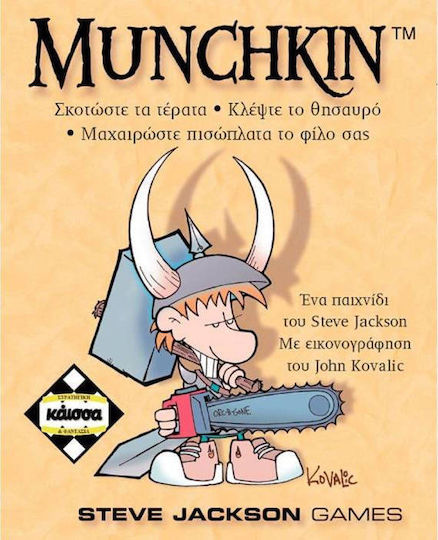
Munchkin Review
Dungeon Crawl Comedy with a Ruthless Political Core
Hook / First Impression
Munchkin arrived in 2001 with a simple, disreputable promise: take everything sacred about Dungeons & Dragons — the epic quests, the noble heroes, the collaborative spirit — and gut it entirely. What remains is a game about kicking down doors, stabbing monsters in the back, and cheerfully betraying the friend sitting next to you the moment they get within one level of winning. It became one of the best-selling card games in the world not despite that premise, but because of it.
The question this review asks honestly: is Munchkin actually good, or is it just a vehicle for the jokes on the cards — a product that sells on charm and carries frustration in the box?
Overview
Munchkin is a competitive card game designed by Steve Jackson and illustrated by John Kovalic, published by Steve Jackson Games in 2001. Players are dungeon-crawling adventurers levelling up from Level 1 to Level 10 by killing monsters, collecting loot, and actively sabotaging each other's progress. The humour is built into the cards themselves: monsters include the Potted Plant and the Plutonium Dragon, treasures include the Boots of Butt-Kicking, and the rules gleefully encourage reading the fine print on cards to find loopholes.
| At a glance | |
|---|---|
| Designer | Steve Jackson |
| Illustrator | John Kovalic |
| Publisher | Steve Jackson Games |
| Year | 2001 (current edition: 2022) |
| Players | 3–6 |
| Play time | 60–120 minutes |
| Age | 10+ |
| Weight | Light (BGG ~1.7/5) |
| Victory condition | First to reach Level 10 by killing a monster |
Components & The Setting
The Setting: Munchkin is a loving parody of fantasy dungeon crawl RPGs — specifically the min-maxing, loot-hoarding, rules-lawyering side of the genre that D&D veterans know well. The theme is a joke, and that's intentional. Every card is a punchline. The Unspeakably Awful Indescribable Horror has a footnote reading "we weren't kidding." The Gazebo references a famous RPG horror story. John Kovalic's cartoonish illustrations carry the humour perfectly — his characters are expressive, absurd, and immediately recognisable across dozens of Munchkin editions.
Component quality is basic. The base game is a deck of 168 cards divided into a Door deck (monsters, curses, classes, races) and a Treasure deck (loot, items, level-up cards). Cards are standard quality — serviceable but not premium, and they will show wear quickly without sleeves in heavy rotation. There is no board, no dice (in the base game), no miniatures, and no play mat. Everything happens through card play and verbal negotiation. The instruction sheet is a single folded pamphlet, which undersells how many special cases and loophole arguments actually arise during play. The official FAQ on the Steve Jackson Games website has grown to dozens of pages as a result.
The minimal component footprint is genuinely a feature: Munchkin fits in a small box, sets up in two minutes, and travels well. For a group that wants a carry-anywhere game that generates conversation and laughter, the physical package is exactly right.
How to Play
The goal is to be the first player to reach Level 10 — but only by killing a monster on your turn. You cannot buy, steal, or negotiate your way to Level 10; you must earn it in combat.
On your turn you Kick Down the Door — flip the top card of the Door deck. If it's a monster, you fight it. Your combat strength is your level plus bonuses from equipped items, race, and class cards in front of you. If your strength exceeds the monster's, you win: take its treasure and go up a level. If you can't win alone, you can Ask for Help — offer a bribed ally some of the treasure in exchange for their combat bonus. Negotiating that split is where most of the game lives.
If the monster's strength exceeds yours and no ally steps in, you must Run Away — roll a die, and on a failure, suffer the monster's Bad Stuff (lose a level, lose a hand, lose your headgear, etc.). Death resets your hand but not your equipped items. The Curse cards drawn from the Door deck can strip away equipment or classes at the worst possible moment.
Between combat, players may Loot the Room (draw a face-down Door card as loot) or Look for Trouble (play a monster from hand to fight voluntarily). Both actions generate the same levelling opportunities but with more player control over timing.
Gameplay Feel
Pacing & Tension: Early turns are breezy. Low-level monsters fall easily, loot accumulates, and the table shares jokes about card names. The game accelerates as players approach Level 9 — the notorious chokepoint at which everyone in the game becomes your enemy. A player at Level 9 cannot take a single turn without the entire table throwing every curse, monster enhancement, and backstab card they've been hoarding. That late-game political siege is genuinely thrilling and is responsible for most of Munchkin's fondest memories. It is also responsible for most of its longest, most frustrating sessions.
Player Interaction: Near-constant and entirely adversarial. Munchkin is a take-that game at heart — almost every interesting card either helps you or hurts someone else. Unlike Catan's negotiation, which has cooperative elements, Munchkin's table politics are zero-sum. Alliances exist only until they stop being useful, and betraying an ally the moment their monster is dead is not only legal but correct play. Groups who find this hilarious will love Munchkin. Groups who experience betrayal as genuinely upsetting should not play it.
Luck vs. Strategy Balance: The variance here is high, and unlike Catan's visible dice, Munchkin's luck arrives from an opaque deck. Drawing a Level 20 Plutonium Dragon on your Level 2 character's first turn is funny the first time and demoralising the fifth. The strategic layer is real — hand management, timing your level advances to avoid the Level 9 siege, and reading the table's political state all matter — but they can be entirely negated by a well-timed curse from a player who happened to draw one.
Rule Overhead: The printed rules are short, but the game generates a constant stream of edge cases. What happens when two cards contradict each other? Can you use an item that requires being a warrior if you're a half-warrior via a class modifier? These questions arise multiple times per session. Experienced groups navigate them fluently; new groups spend significant time arguing the fine print. The game tacitly encourages this — "it's all in the rules" is something Munchkin veterans say with a grin — but it can derail momentum significantly.
Mechanics Deep-Dive
The Combat Negotiation Engine
When a player faces a monster they cannot beat alone, they offer help — and what follows is a rapid-fire social negotiation. The helper wants maximum treasure; the fighter wants the cheapest possible help. Meanwhile, every other player at the table is silently calculating whether letting this fight succeed brings the fighter dangerously close to Level 10, and if so, whether to play one of their monster-enhancement cards to make the fight harder.
This creates a three-way tension: the fighter needs an ally, potential allies want payment, and the rest of the table wants the fighter to fail. Resolving that tension cleanly in a few seconds is Munchkin's best designed moment — it requires reading loyalty, estimating hand contents, and bidding under time pressure all at once.
The Strategic Layer
Munchkin's low BGG weight rating undersells the tactical thinking that distinguishes good players from average ones. The key levers:
- Hand economy: Cards in hand are leverage. Never help someone for free when you can demand treasure; never spend a high-value interference card on a fight the table is already willing to sink without your contribution.
- Equipment timing: Equipping gear publicly reveals your combat strength to the table. Sometimes holding a key item in hand and playing it as a combat bonus at the last second is more valuable than wearing it openly all game.
- Race and Class synergies: Certain combinations — Elf Wizard, Dwarf Warrior — create powerful ongoing bonuses. Knowing which combinations your opponents are building toward lets you time curses for maximum disruption.
- Volunteer fights: Looking for Trouble to fight a monster voluntarily lets you choose timing. Attack weak monsters you can definitely win rather than risking a random door flip when your hand is thin.
- Level 9 optics: Getting to Level 9 without anyone noticing is nearly impossible. Getting to Level 8 with a full hand and a fast-win combo available is the closest thing to a reliable win condition the game offers.
Player Count Analysis
Solo — Not supported. Munchkin has no solo mode and no meaningful solo variant. The entire game depends on negotiation, interference, and real-time social pressure. Without other players, there is no game.
2 Players — Poor. Two players technically works but strips out the game's entire political dimension. Without a third party to bribe or to play spoiler, combat becomes a simple numbers race. The take-that interference is sharper and more personal — every curse lands on the same target. It can feel relentlessly hostile rather than chaotically fun. Not recommended.
3 Players — Functional, fast. Three players is the minimum for politics to work. Alliances are thin — there's only one other person to deal with at any time — but the smaller player count keeps sessions to a reasonable 60–75 minutes. The Level 9 siege is manageable because only two players can pile interference on the leader. Works well as a filler or when you can't assemble a full group.
4–5 Players — The sweet spot. Four or five players is where Munchkin becomes the game it was designed to be. There are enough potential allies for meaningful negotiation, enough interference cards across the table to make combat genuinely uncertain, and enough political complexity that reading the room becomes a real skill. Sessions run 90–120 minutes with experienced players. This is the count the game was designed for.
6 Players — Chaotic, potentially very long. Six players amplifies everything — more chaos, more interference, more politics, and considerably more downtime between turns. The Level 9 siege can become a marathon with six players all sitting on interference cards. Budget 2+ hours. Worth it if your group loves maximum pandemonium; avoid it if session length matters to anyone at the table.
Replayability
Munchkin's deck shuffles differently every game, so the specific cards you encounter vary — but the overall experience follows a recognisable arc. After 10–15 sessions, the jokes on the cards stop landing as fresh punchlines; the humour that drove early play becomes background noise. The mechanics themselves are not complex enough to generate strategic novelty on their own. What keeps games feeling different is the people — the specific alliances, betrayals, and negotiation dynamics of your particular group on that particular night.
This is a meaningful distinction. Mechanical replayability is low; social replayability is higher, because the stories that come out of Munchkin sessions — "remember when you stabbed me at Level 9 with the Boots of Butt-Kicking?" — are genuinely memorable and group-specific. The game functions as a social lubricant more than a strategic puzzle, and as a social lubricant it has a long shelf life as long as the group's composition keeps changing.
The expansion ecosystem is enormous — over 200 products across fantasy, sci-fi, spy, zombie, and other themes — but the base-game mechanics remain identical across all of them. Expansions add new cards and jokes, not new gameplay depth. The most popular additions are the Munchkin Expansions 2–6 (more dungeon cards) and Super Munchkin (superheroes theme). Munchkin Legends and Munchkin Pathfinder are community favourites for blending themes from different sets.
Learning Curve
Ease of teaching: The core loop — kick door, fight monster, take loot, level up — can be explained in five minutes. New players are functional within two turns. The game does not demand strategic planning from day one; you can play reactively and still have fun. This low entry bar is a genuine strength for mixed-experience groups.
Rulebook quality: The physical rulebook is short and readable, but it deliberately leaves edge cases unresolved in favour of the principle "if it's funny, do it." This works for casual play and falls apart the moment someone at the table has a rules-lawyer personality. The Steve Jackson Games FAQ is essential reading for groups who want definitive answers — but consulting it mid-session kills momentum. Most experienced groups develop house rules that resolve the three or four most common conflict points in their play group, and stick to those consistently.
First-game experience: Almost universally positive for casual players. New players laugh at the card names, enjoy the chaos, and leave wanting to play again. The frustrations — runaway interference on the leader, rule disputes, long sessions — typically only emerge after several plays when the novelty has worn off and the structural issues become visible. This delayed frustration curve is part of why Munchkin remains a polarising game in the hobby: casual players who play it rarely love it; dedicated gamers who play it frequently often grow exasperated with it.
Who It's For
D&D players and tabletop RPG fans: Munchkin was built for this audience and it shows. Every card is a reference, a trope subversion, or an inside joke that lands harder if you've sat through a dungeon crawl with a rules-lawyer in the party. The humour is sharper, the parody is richer, and the game is simply more fun if you've spent time at a gaming table rolling dice for real.
Casual party game groups: A strong choice if your group wants a laugh and doesn't care who wins. The light rules, the card jokes, and the constant social noise make Munchkin a reliable evening filler. Manage expectations about session length and the game delivers consistently.
Families with older children: Works well for ages 12 and up, particularly families where the adults enjoy gentle ruthlessness. Younger children (10–11) can participate but will struggle with the negotiation complexity and may take the betrayal mechanics personally. The humour skews toward RPG culture references that land better with a gaming-literate audience.
Competitive gamers: A poor fit. The high variance, the take-that interference, and the absence of a robust strategic layer will frustrate players who want meaningful decisions to produce consistent outcomes. For competitive card game players who enjoy dungeon themes, Dominion or Star Realms offer far more decision depth in similar session times.
Comparisons: For lighter social chaos, Exploding Kittens is faster and more portable. For dungeon themes with actual strategic depth, Clank! delivers an excellent push-your-luck deck-builder. For take-that card games with more consistent game length, Coup or Love Letter are tighter designs. For the specific Munchkin experience — dungeon parody, maximum betrayal, extended negotiation — nothing else quite replicates it.
Pros & Cons
What Munchkin does well:
- Genuinely funny card design — John Kovalic's art and Steve Jackson's writing produce consistent laughs, especially for the RPG-literate audience it was built for.
- Minimal setup — a shuffled deck, five cards each, and you're playing in under two minutes with no board to assemble.
- Accessible rules that new players absorb within one or two turns, making it easy to introduce to mixed groups.
- The Level 9 political siege, when it works, is one of the most memorable and chaotic moments any card game can produce.
- Enormous expansion ecosystem — if your group loves the base game, there is an almost unlimited supply of new cards in compatible themes.
- Portable: fits in a bag, plays anywhere, requires no table space beyond room for a few card layouts.
Where Munchkin struggles:
- Session length is genuinely unpredictable — a game that should run 90 minutes can hit three hours if the table is determined to siege every leader at Level 9.
- High variance means a player can spend most of a session drawing curses and weak monsters with no path to recovery — not losing because they played badly, but because the deck was unkind.
- Rule disputes are frequent and the rulebook does not resolve them cleanly. Groups without an agreed framework for edge cases will argue the same points repeatedly across sessions.
- The humour fades. The first time you read the Potted Plant card it's funny; by the twentieth game it's wallpaper. The cards don't change, and neither do their jokes.
- No solo mode, poor two-player experience, and a structure that breaks down without at least three players who are all genuinely willing to engage with the politics.
- The runaway-leader problem is built in: reaching Level 9 makes you the table's target, which can feel exhausting rather than exciting if the pile-on lasts too long.
Expansions & Ecosystem
Munchkin has one of the largest expansion libraries in all of tabletop gaming — Steve Jackson Games has released over 200 Munchkin products since 2001. Most of them are small card packs (around 30–60 cards) that shuffle into your existing decks rather than standalone games. The practical question for a new buyer is not "which expansion is best?" but "how much Munchkin do you actually want?"
Core Expansions (1–6) — More of the same, reliably ★★★★☆
The six numbered Munchkin expansions add 112 cards each of new monsters, treasures, classes, and races to the base fantasy setting. They don't change the rules — they just make the deck larger and the jokes more varied. For groups who love the base game and want to extend its lifespan without learning new rules, these are the obvious first purchase. Shuffle all six in at once for a sprawling, chaotic, nearly unpredictable deck.
Munchkin Deluxe — The version to buy if buying new ★★★★☆
Munchkin Deluxe adds a game board for tracking levels (replacing the informal "remember what level you are" system of the base game) and custom six-sided dice. Both additions are quality-of-life improvements rather than mechanical changes. The level board eliminates disputes about where players are, and the custom dice are a nice tactile addition. If you're buying Munchkin new in 2026, this edition is the one to get.
Alternate Theme Sets — Same game, different jokes ★★★☆☆
Steve Jackson Games has released Munchkin in sci-fi (Star Munchkin), spy (Munchkin Spy), Western (The Good, the Bad, and the Munchkin), zombie (Munchkin Zombies), and dozens of other themes. Each is mechanically identical to the base game with reskinned cards and new jokes for its specific genre. Worth buying if your group has strong affinity for a particular theme — a Star Wars-obsessed group will get more mileage from Munchkin Star Wars than from expansions 2–6.
Quick Buyer's Guide
| Product | Best For | Changes Rules? | Priority |
|---|---|---|---|
| Munchkin Deluxe | New buyers | No (QoL only) | 🥇 Buy this edition first |
| Expansions 2–6 | Regular groups wanting variety | No | 🥈 One or two at a time |
| Alternate Theme Sets | Theme-specific groups | No | 🥉 If the theme fits your group |
| Munchkin Legends / Pathfinder | Mixing sets for max chaos | No | Optional — experienced groups only |
Value for Money
Munchkin retails for approximately $25–$35 USD for the base game — well below the mid-tier of hobby board games. Munchkin Deluxe runs slightly higher at $35–$45 with the board and dice included. For that price you get a complete game with high portability and fast setup, making the per-session cost low even for groups that play it infrequently.
The value calculus changes by group type:
- Casual groups and party game buyers: Good value. The low price, the laughs, and the accessibility mean the box pays for itself in one or two sessions of a group that just wants something fun and social.
- Families and gift buyers: Reliable choice. The RPG references are a bonus for gaming families; non-gaming families will still enjoy the chaos without needing context. Easy to gift.
- Hobbyist gamers: Moderate value at best. The strategic ceiling is low enough that the per-session value drops quickly as you move into heavier games. Worth owning as a quick filler, not as a primary game.
- Solo players or strict two-player households: Skip it. The money is better spent on a game designed for those contexts.
Used copies are widely available and frequently in good condition — the cards are the entire game, and a gently used set is functionally identical to new. A second-hand copy for $10–15 is excellent value for groups who want to try Munchkin before committing to a full-price purchase.
Accessibility
Language dependence: High. Unlike many board games, Munchkin's cards are almost entirely text-based — the comedy is written, not iconographic. Non-English speakers will lose most of the humour and some of the rules clarity. Localised editions exist in German, French, Spanish, and several other languages; playing in your native language is strongly recommended.
Color blindness: Low concern. Card distinction relies on text and illustration content rather than color coding. The card backs for Door and Treasure decks are different art (easily distinguishable by shape and design), not just different colors. Accessibility here is better than most card games.
Cognitive accessibility: The core rules are simple and the turn structure is repetitive, which helps players who struggle with complex rule sets. The challenge comes from the continuous negotiation and improvised card interactions, which require following verbal agreements and remembering informal deals. Players with attention difficulties may find the open-ended negotiation phase hard to track. Sessions can run long with no natural break points, which is worth considering for players who tire easily.
Physical accessibility: The game is entirely card-based with no fiddly small components beyond the cards themselves. Standard card sleeves fit all Munchkin cards. No physical dexterity is required beyond holding and playing cards. Munchkin Deluxe adds a board and custom dice, both of which are large enough to handle comfortably.
Social accessibility: The take-that mechanics and constant betrayal are the main social accessibility concern. Players who experience in-game hostility as personally upsetting rather than playfully competitive will have a poor time. This is less about game design and more about player fit — Munchkin self-selects for groups that find friendly antagonism fun.
Verdict
Munchkin is not a great game in the sense that it rewards deep thinking, consistent strategy, or elegant design. It is a great social experience for a specific kind of group — one that finds betrayal funny, enjoys dungeon crawl humour, and doesn't mind if the session runs long because something ridiculous happened at Level 9. In that context it delivers reliably and cheaply, and its place on millions of shelves is genuinely earned.
The frustrations are also real: the variance is brutal, the session length is unpredictable, the humour fades with repetition, and the rules disputes are endemic. None of these are fixable through expansions — they're inherent to the design. Knowing this in advance is the most useful thing this review can offer a prospective buyer.
Buy it if: your group wants cheap, portable, RPG-flavoured chaos and laughs more than it cares about strategy or consistent session length.
Skip it if: you want a dungeon crawl with actual mechanics, a reliable 90-minute session, or a game that rewards careful planning over lucky card draws.
Upgrade it if: your group loves Munchkin's energy but wants depth — Clank! delivers dungeon-crawl fun with a proper strategic layer that won't frustrate players who like to think.
Score Breakdown
Love board game night? Explore our tools, score calculators, and strategy guides — everything you need to play better and have more fun.
Browse All Articles →