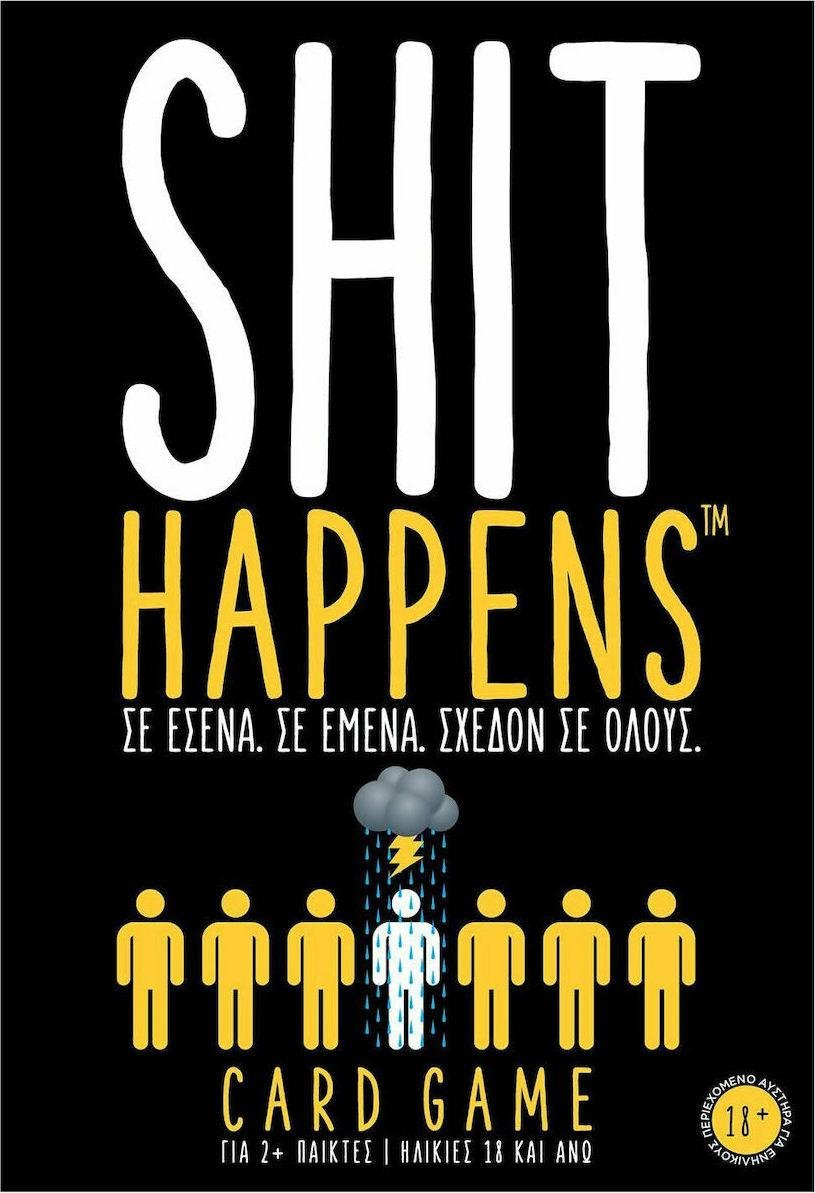
Shit Happens Review
The Party Card Game Where Every Disaster Has a Number
Hook / First Impression
Somewhere between "stepping on a Lego" and "losing your phone down a sewer drain," there is a precise, scientifically dubious number — and the entire point of Shit Happens is to figure out where that number sits. This is a game about ranking human misery. From mild inconveniences to genuine catastrophes, every bad thing in the deck has been assigned a Misery Index score, and your job is to guess where a newly revealed disaster lands on your existing line of cards.
It is dumb, fast, funny, and surprisingly hard. Released by Cyanide & Happiness and published in card game form in 2016, Shit Happens has become a staple of booze-fuelled game nights, bachelorette parties, and any group that finds shared suffering funnier than any card they could write themselves. It does not take itself seriously for a single moment — and neither should you.
Overview
Shit Happens is a party card game built around a single mechanic: ordering disasters on a numbered scale. Players compete to build the longest correctly ordered line of misfortune cards. The humour does all the heavy lifting; the mechanics exist to give the jokes a structure.
| At a glance | |
|---|---|
| Designer | Matt Melvin, Rob DenBleyker |
| Publisher | Breaking Games / Cyanide & Happiness |
| Year | 2016 |
| Players | 2–6 players (plays best at 3–6) |
| Play time | 30–60 minutes |
| Age | 18+ (adult content) |
| Weight | Very light (BGG ~1.1/5) |
| Victory condition | First player to correctly place 10 disaster cards wins |
Components & The Setting
The Setting: There is no theme in any meaningful sense. Players are themselves — fallible humans with strong opinions about whether "getting a paper cut on your tongue" is worse or better than "accidentally liking a photo from 2014 while stalking an ex." The game's premise is that all human misery can be quantified, ranked, and compared. The Misery Index is the authority. Your instincts are your only tool. The conceit is cheerfully absurd, and the game commits to it completely.
The production is minimal but appropriate. The box contains a deck of 200 disaster cards (each featuring a scenario on the front and its hidden Misery Index number on the back), plus a handful of reference cards explaining the rules. The card stock is solid, the printing is clear, and the Cyanide & Happiness stick-figure art style gives the cards a consistent, darkly comic identity. There is nothing here beyond what the game needs — and nothing is missing.
How to Play
Setup: Shuffle the deck. Deal each player three cards, face-down. Players look at the Misery Index numbers on the back of their cards and arrange them in numerical order in a line in front of them — these are placed face-up (scenario side visible) so other players cannot see the numbers. Your personal line of disasters is now your "timeline" of misery. The deck sits in the centre as a draw pile.
On your turn:
- The player to your left draws the top card from the deck and reads the scenario aloud — "Getting a colonoscopy from a doctor with cold hands."
- You decide where that scenario fits in your current misery line — before the least miserable card, between two existing cards, or after the most miserable card.
- The reader flips the card to reveal the Misery Index number on the back.
- If you placed the card correctly (the number sits in the right position relative to your neighbours), you keep the card and your line grows by one. If you were wrong, the card is discarded.
- First player to correctly place their tenth card wins.
That is the entire game. There are no further rules of consequence. Some editions include minor variants, but the core loop is this: read a disaster, guess where it ranks, find out if you were right. The Misery Index numbers run from 1 (barely inconvenient) to 100 (existential catastrophe), so the scale is intuitive even if the precise placement is anything but.
Gameplay Feel
Pacing & Tension: The game moves fast. Turns take fifteen to forty-five seconds once players are familiar with the format — read card, think briefly, place, reveal. There is very little dead time between turns, which keeps energy high around the table. The tension is low-stakes in the best sense: the stakes are social rather than strategic. Nobody is silently calculating; everyone is loudly disagreeing about whether getting stung by a wasp is worse than being stuck in a lift for an hour.
Player Interaction: High and constant. Even though only one player is placing a card on each turn, everyone else is shouting their opinion. The game actively invites argument — not structured debate, but the cheerful, unresolvable argument of people with wildly different pain thresholds and life experiences comparing notes on catastrophe. These debates are funnier than the game itself, and that is by design.
Luck vs. Strategy Balance: Almost entirely luck-dependent, and that is fine. The only genuine skill is accumulated common sense about what makes things worse or better, and even that is constantly subverted by the Misery Index's occasionally baffling rankings (which is the point — the joke is that the number is both authoritative and absurd). Players who "win" at Shit Happens win because their disasters happened to be easy to place, not because they out-thought anyone. Do not play this game if you need to feel like skill is being rewarded.
Rule Overhead: Negligible. The game can be taught in ninety seconds to a group that has never played anything. First-time players are fully functional by their second turn. There is no complexity here, no exception-tracking, no hidden systems. Shit Happens is emphatically not a game you need to learn — it is a game you simply play.
Mechanics Deep-Dive
The Misery Index as Game Engine
The entire mechanical structure of Shit Happens is borrowed from timeline-ordering games — most directly from Frédéric Henry's Timeline series, which uses the same "place a card in your ordered line, reveal whether you're right" mechanic with historical dates. What Shit Happens contributes is the subject matter and the tone. The difficulty in a historical timeline game is knowledge — you either know when the printing press was invented or you don't. The difficulty in Shit Happens is empathy calibration: you need a shared model of human suffering that turns out to vary wildly across people, cultures, and life experiences.
This calibration gap is what generates the humour. When the Misery Index reveals that "accidentally calling your teacher 'Mum'" scores a 34 while "getting fired in front of your entire team" scores a 31, the table erupts. The game is engineered to produce these moments — scenarios that feel comparably bad but land at surprisingly different numbers, or scenarios that seem monstrous but score lower than everyday embarrassments. The perceived injustices are the content.
Growing Difficulty
There is a natural difficulty curve built into the game's structure: as your line grows, placing new cards correctly becomes harder. With three cards, you have four possible positions; with nine cards, you have ten. Players who are ahead face more placements per card than players who are behind, which creates a mild rubber-band effect that keeps games competitive longer than you might expect. It is not a sophisticated balancing mechanism — but it is a real one, and it works.
Player Count Analysis
2 Players — Functional but flat. Two players can complete a game of Shit Happens, but much of the social texture evaporates. The table debate that makes the game entertaining requires at least three voices. At two, it becomes a straightforward guessing exercise that wears thin faster. If you want a two-player party-adjacent game, there are better choices.
3–4 Players — The sweet spot. Three or four players gives the game its ideal shape: enough voices to generate argument, fast enough for everyone to feel involved, and a game length that lands comfortably under an hour. This is the configuration the game was designed for and where it performs best.
5–6 Players — Very good, slightly slower. Five or six players adds more opinions and more chaos to each card reveal, which suits the game's temperament perfectly. The added inter-turn wait time is the only cost, and at a party setting this barely registers — there is always something to react to.
Replayability
The base deck of 200 cards is generous for a game this simple, and memorising Misery Index scores is unlikely after a handful of plays — the scenarios are too numerous and too similar in tone for rote memorisation to become a problem. For casual groups who play once a month, the same deck will run fresh for a year or more.
The game's deeper replayability ceiling is its social content rather than its mechanical content. The same card can generate entirely different conversations depending on who is at the table. A scenario about medical embarrassment lands differently with doctors at the table. A scenario about relationship failure lands differently after a breakup. The cards are fixed; the reactions are not. This variability is not a designed replayability feature — it is a social one — but it extends the game's longevity significantly for groups who enjoy it.
Multiple expansion decks exist (covering topics like work, travel, and celebrity misfortune), which functionally extend replayability. The core deck alone is sufficient for most groups, but the expansions are worth acquiring if the game becomes a regular rotation fixture.
Learning Curve
There is no learning curve. The rules take ninety seconds to explain and the game is fully comprehensible from the first turn. This is one of Shit Happens' primary strengths as a party game: it can be introduced to a new group mid-evening without stopping the flow. The instructions fit on one side of a reference card. Nobody will ask for a rules clarification after round two.
The only edge case that occasionally needs clarification is what happens when a card's number exactly matches an existing card in your line — most groups rule that ties are placed adjacent in either direction, and either convention works consistently. The official rules address this, but it comes up rarely enough that many groups never encounter it.
Who It's For
Party crowds and social groups: Shit Happens is built for groups who want to laugh together rather than compete seriously. It suits game nights that start late, groups that have been drinking, and gatherings where the objective is social bonding rather than strategic play. It is a game that serves as background to conversation rather than replacing it.
Cards Against Humanity burnouts: If your group has played CAH until the cards feel memorised and the shock value has worn off, Shit Happens offers a structurally different experience with a similar comedic sensibility. The interactive mechanic means everyone is engaged per turn rather than just laughing at the winning answer.
Ice-breaker settings: Because the game provokes opinion-sharing about subjective experiences of misery, it works unusually well for groups of people who do not know each other well. "Which is worse — a bee sting or a terrible haircut?" is a low-stakes way to find out what kind of people you're playing with.
Who it is not for: Players who need mechanics to reward skill will find Shit Happens frustrating. Anyone who finds the adult humour juvenile rather than funny will not enjoy the content regardless of the mechanic. Players who are going through genuinely difficult times may find the casual treatment of serious misfortune tone-deaf. And players under 18 should not be playing this — the content is explicitly adult, and the age rating is not advisory.
Pros & Cons
What Shit Happens does well:
- Teaches in ninety seconds — zero barrier to entry for new players mid-evening.
- Consistently funny across many sessions because the social reactions vary even when the cards do not.
- Fast, low-friction play — turns resolve in under a minute with no analysis paralysis.
- Compact and portable — fits in a coat pocket, plays anywhere.
- Works as a conversation-starter with strangers in a way that more competitive games do not.
- 200 cards in the base deck provides genuine longevity for casual groups.
Where Shit Happens falls short:
- Almost no skill involved — winning is primarily a function of lucky card draws rather than better judgement.
- Shock humour has a ceiling: groups with extensive party game experience may find the content less surprising after repeated sessions.
- Two-player experience is significantly weaker than group play.
- 18+ content makes it unsuitable for mixed-age gatherings or family game nights.
- No genuine strategic depth — players looking for a game that rewards thinking will not find it here.
- The Misery Index rankings occasionally feel arbitrary enough to frustrate rather than amuse, particularly late in competitive play.
Expansions & Ecosystem
Shit Happens has spawned several expansion decks that can be shuffled into the base game or played standalone. Notable additions include thematic sets covering work and office life, travel and holiday disasters, celebrity and pop-culture misfortune, and relationship and dating horror stories. Each expansion maintains the same Misery Index structure and card format as the base game.
The expansions are functional additions rather than transformative ones — they add volume and topical variety rather than mechanical depth. If your group plays the base game regularly and finds the deck running stale, one expansion deck is worth acquiring. The work-themed expansion plays particularly well with groups of colleagues who share context for the scenarios. Beyond the first expansion, the law of diminishing returns applies: more cards means less novelty per card, not a meaningfully different game.
Value for Money
Shit Happens retails for approximately $20–$25 USD (€15–22 in Europe). For a party game with a 200-card deck, that is a reasonable ask. It will not rival the laugh-per-dollar of a game like Avalon — which generates its entertainment from human interaction rather than card content — but for a content-driven party game, the base deck provides solid value before the joke pool noticeably shrinks.
- Party game collections: Good value. A different comedic register from CAH, and the mechanic gives it a structure that CAH lacks. Worth having both if you host varied groups.
- One-time purchase: Solid. The base deck runs fresh for longer than the price implies. You will get your money's worth from the first three or four sessions alone.
- Gift purchase: Excellent for the right recipient — someone who appreciates irreverent humour, hosts regularly, and does not already own it. A poor choice for anyone conservative about adult content.
Accessibility
Color blindness: No colour-dependent mechanics. Cards are distinguished by text and graphic content only. Fully accessible to colour-blind players.
Language dependence: Very high. The entire game is text-based — the humour of each scenario depends on reading and understanding nuanced English (or whichever language edition you own). Non-native speakers comfortable with casual adult English can participate; players with limited English will struggle with both the scenarios and the jokes. Non-English editions are available.
Cognitive accessibility: The decision required each turn is extremely simple — place one card in one of several positions. No complex rules, no track to manage, no hidden information to hold. Players with cognitive challenges that affect complex reasoning can participate fully. The only barrier is language comprehension.
Content sensitivity: The scenarios deal with embarrassment, physical pain, social humiliation, and various adult situations in a comedic register. Some cards touch on topics — job loss, relationship failure, medical scenarios — that may be uncomfortably close to lived experience for some players. The game's tone assumes shared distance from the disasters described; for players currently experiencing something on the cards, that distance may not exist. Know your group.
Age range: The 18+ rating is accurate and important. This is not a game for children or mixed-age family settings. The adult content is the product, not incidental to it.
Verdict
Shit Happens is exactly what it says on the tin — a fast, funny, adult party game with a single clever mechanic wrapped around two hundred absurd disasters. It is not trying to be a strategic game, does not pretend to be a sophisticated one, and succeeds entirely on its own terms. For groups who want to laugh together over shared judgements about the hierarchy of human misery, it delivers consistently and without pretension.
The game's honesty about what it is makes it easy to recommend in the right context. The mechanic gives it a small but real advantage over passive card-reading games: you are always doing something, not just reacting to what someone else read. Even when the placement is obvious, the debate around the right answer is the point. The Misery Index is not a game-balancing tool — it is a conversation prompt disguised as a scoring system, and it works.
Buy it if: you host social evenings with adults who enjoy irreverent humour and want something fast, easy to explain, and reliably funny. It earns its place on the shelf without demanding much from it.
Skip it if: your group wants meaningful strategic choices, is sensitive to adult content, or skews mixed-age. This is a niche product for a specific kind of game night, and it is excellent at serving that niche.
Score Breakdown
Enjoyed this review? Explore more honest board game reviews, score calculators, and strategy guides — everything you need for a better game night.
Browse All Reviews →