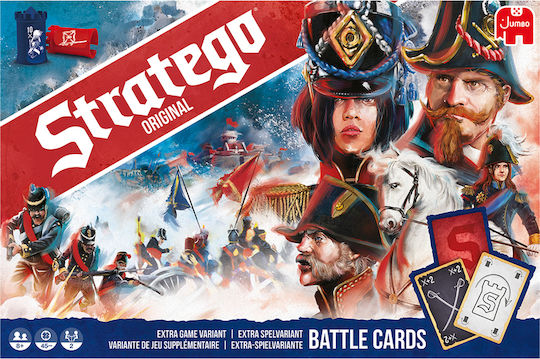
Stratego Review
The Hidden-Information Wargame That Never Gets Old
Hook / First Impression
Most board games wear their mechanics on their sleeve. Stratego doesn't. It places 40 face-down pieces in front of you, slides an identical army across the table to your opponent, and asks you to wage war while knowing almost nothing about what you're fighting. That single design decision — hidden ranks — turns a simple combat grid into a psychological battlefield where deduction, memory, and deliberate misdirection matter as much as tactical positioning.
Originally published in the Netherlands in 1946 and globalised through the 1960s, Stratego has outlasted dozens of challengers without changing its fundamental formula. This review asks whether that formula is timeless or just familiar — and whether it holds up in an era of sophisticated modern designs.
Overview
Stratego is a two-player hidden-information abstract wargame. Each player commands an army of 40 ranked pieces, placed secretly at the start of the game on opposite ends of a 10×10 grid divided by two impassable lake zones. The objective is to capture the opponent's Flag — a stationary piece buried somewhere in their formation — before they capture yours.
| At a glance | |
|---|---|
| Designer | Jacques Johan Mogendorff (original 1946) |
| Publisher | Jumbo (NL) / Hasbro (US) / various editions worldwide |
| Year | 1946 (current edition: 2008 refresh) |
| Players | 2 |
| Play time | 30–60 minutes |
| Age | 8+ |
| Weight | Light-medium (BGG ~2.1/5) |
| Victory condition | Capture the opponent's Flag, or leave them with no mobile pieces |
Components & The Setting
The Setting: Players command opposing armies locked in a fog-of-war engagement across a contested field split by two central lakes. The theme is military without being graphic — rank badges and regimental colour are the extent of the warfare aesthetic. Unlike deeply thematic wargames, Stratego's military dressing is purely functional: the ranked hierarchy (Marshal down to Scout) provides intuitive vocabulary for what is essentially an abstract rule system. The theme sticks just enough that new players understand why a Marshal beats a Colonel and a Miner defuses a Bomb, even before they've played a single turn.
Component quality varies significantly by edition — Stratego has been printed by dozens of publishers across eight decades. The current Hasbro Classic edition uses durable plastic pieces in red and blue with printed rank insignia that holds up to heavy play. The game board is a foldable cardboard grid; quality ranges from serviceable to creased-and-flimsy depending on how carefully it has been stored. Older metal-piece versions from Jumbo are widely regarded as superior builds and can be found affordably second-hand.
The piece storage trays in most modern editions are functional but not elegant — pieces sort loosely by rank into two-sided trays, which works for setup but won't satisfy those who appreciate premium packaging. The two opaque setup screens (used during initial placement) are a thoughtful inclusion that makes the placement phase feel appropriately secretive. Overall: the components serve the game's needs without adding anything beyond them.
How to Play
The goal is to capture the opponent's Flag piece. Each player arranges their 40 pieces face-down across the four rows of their side of the board, hidden behind a setup screen. Once both armies are positioned, the screen is removed and the battle begins.
Players alternate moving one piece per turn. Most pieces move one square orthogonally. The exception is the Scout, which may move any number of squares in a straight line — a powerful information-gathering tool that also reveals itself as a Scout the moment it moves more than one space.
When one piece moves onto a square occupied by an opponent's piece, combat is initiated: both pieces are revealed simultaneously. The higher-ranked piece wins and remains on the board; the lower-ranked piece is removed. Ties result in mutual elimination. Three special rules break the hierarchy:
- Bombs (rank: immovable) defeat any attacking piece — except Miners, who defuse them.
- The Spy (rank: lowest) defeats the Marshal (rank: highest) if the Spy attacks first. If the Marshal attacks the Spy, the Spy is eliminated.
- The Flag is immovable and defenceless. Capturing it ends the game immediately.
A player also wins if the opponent has no legal moves remaining — either because all mobile pieces have been eliminated or all paths are blocked.
Gameplay Feel
Pacing & Tension: Stratego games have a natural three-act structure. The opening is a slow, deliberate probe — both players advance cautiously, testing opponent responses with expendable pieces and trying to identify high-value targets without committing their own. The mid-game erupts into a series of skirmishes as armies collide, ranks are revealed, and the strategic picture snaps into focus. The endgame becomes a surgical hunt: you know roughly where the Flag is, you know which of your opponent's remaining pieces are threats, and you are racing to reach the objective before they find yours. This structure makes every game feel narratively satisfying even when the outcome is lopsided.
Player Interaction: Every single move in Stratego is directed at the opponent. There are no neutral elements, no shared resource pool, no engine to build — just your army and theirs, locked in a duel across a grid. The interaction is intimate and relentless in a way that distinguishes Stratego from multiplayer games where players often spend turns on their own affairs. The tension of watching your opponent deliberate over a move — trying to infer from their hesitation whether they've identified your Marshal or are bluffing their way toward your Flag — is singular.
Luck vs. Strategy Balance: Stratego is among the most skill-dominant games in its weight class. There is no dice, no card draw, no randomness beyond the initial setup. The only element of chance is that you don't know your opponent's setup — but neither do they know yours, and both setups are equally unknown. Across many games, preparation quality, deductive memory, and bluffing skill consistently separate strong players from weak ones. A novice can stumble into a victory against a veteran through an unreadable setup, but it is the exception rather than the rule.
Rule Overhead: The rules fit on a single index card. Setup takes 5 minutes once both players know what they're doing; teaching a new player takes 3 minutes. The only rules that require a reminder are the Spy's attack-direction restriction and the Scout's reveal mechanic. Once those are clear, the game teaches itself through play.
Mechanics Deep-Dive
The Setup as a Game Within the Game
Most players underestimate how much of Stratego is decided before the first move. Placement is not random — it is a design problem with real optimal and suboptimal solutions, and the depth here is greater than it first appears. Strong setups balance three competing demands:
- Flag defence: Surrounding the Flag with Bombs is obvious; disguising which Bombs are near the Flag is less so. Flags placed in corners surrounded by Bombs and a Marshal are more defensible than Flags placed centrally, but corner Flags are also more predictable.
- Miner placement: Miners are your only way through enemy Bombs, making them as strategically important as high-rank pieces. Scattering them mid-formation rather than frontlining them protects this crucial utility.
- Marshal protection: Your Marshal (rank 10) defeats everything except Bombs and a first-striking Spy. Keeping the Marshal's identity hidden for as long as possible extends its threat. Many strong players back their Marshal with a Colonel, so even if the Marshal is baited into revealing itself, a second threat remains immediately behind.
Information Management
Stratego is fundamentally a game of asymmetric information that slowly equalises. Every combat reveals one rank. Every Scout that moves far reveals itself as a Scout. Every piece that retreats from engagement is probably not your Marshal. The mental model you build of your opponent's army — mapping known ranks to board positions — is the primary strategic resource of the mid-game. Players who track revealed ranks and cross-reference them against unmoved pieces narrow the search space for the Flag dramatically.
Bluffing and Misdirection
The richest layer of Stratego strategy is active deception. Because pieces don't reveal their rank until combat, every piece can be moved as though it were something it's not. A Scout moved one space at a time looks like a high-rank piece, delaying your opponent from routing around it. A Marshal retreated from a forward position looks like a lesser piece avoiding conflict, baiting opponents into attacking it with pieces they'd rather not sacrifice. A cluster of Bombs around an empty corner looks like a Flag formation, drawing Miners away from the real objective.
This bluffing layer is what distinguishes Stratego from pure abstract games. You're not just optimising a position — you're constructing a false picture in your opponent's mind and acting consistently enough to make it believable. The best Stratego players think several moves ahead not in tactical terms but in psychological ones: what does this sequence of moves communicate, and how will my opponent respond to that signal?
Player Count Analysis
Solo — Not supported. Stratego requires an opponent; there is no solo mode and no meaningful solitaire variant. The entire game depends on the hidden-information tension that only exists when two players have secrets from each other. A solo Stratego player would simply know all the answers.
2 Players — The only mode, and it's excellent. Stratego is a pure duelling game and makes no apologies for it. The 2-player dynamic is intimate, focused, and deeply replayable with the right opponent. Unlike multiplayer games where eliminating one player is a social event, Stratego's aggression is direct and personal — which suits players who want a focused competitive experience rather than a social one.
Team variants — Unofficial, but viable. Some editions and online communities propose team variants where two players share an army, discussing moves openly. This adds a cooperative communication layer that can be entertaining for groups of four who want to engage with the game together, though it is not part of any standard ruleset and dramatically alters the hidden-information core of the experience.
Replayability
Stratego's replayability is high against the right opponent and low against the wrong one. The key variable is your opponent's range. An opponent who always places their Flag in the back-right corner surrounded by an identical Bomb formation will not challenge you after the third game. An opponent who actively experiments with setups — feint formations, unconventional Flag placements, mixed scout patterns — keeps the game fresh indefinitely because you're always solving a new puzzle.
Against a committed opponent, Stratego's setup space is large enough to sustain years of play. The 40-piece army can be arranged in millions of distinct configurations, and the meta-game of "what setup does this opponent prefer, and how do I counter it?" creates an evolving arms race that is one of the most unique long-term dynamics in any two-player game. Regular opponents begin to read each other's tendencies, which forces both players to develop new setups to stay unpredictable — a self-reinforcing replayability loop that most board games never achieve.
Learning Curve
Ease of teaching: Stratego can be explained in under five minutes to an adult who has played Chess or Checkers. The concept of ranked pieces eliminating lower ranks is immediately intuitive; the three special rules (Bombs, Miners, Spy) are memorable because they have thematic logic behind them. The game almost never requires a mid-game rules consultation after the first play.
Rulebook quality: Most editions include a brief, clear rulebook. The rules are simple enough that first-time players rarely consult the rulebook after setup — they learn by playing. The most common first-game confusion is whether the Spy beats the Marshal when the Marshal attacks, which is a single clear sentence in any edition's rules but feels counterintuitive until you've seen it play out once.
First-game experience: Beginners almost always enjoy their first game, even if they lose badly. The moment of first contact — revealing an opponent's piece for the first time and finding out what it was — delivers a distinctive emotional payoff that immediately communicates what the game is about. Losses are instructive rather than frustrating because you can usually identify the moment your setup was compromised or your Marshal was baited into elimination. The game punishes predictability directly and clearly, which makes improvement feel accessible.
Who It's For
Chess players and abstract game fans: Stratego is an excellent companion to Chess for players who want a two-player duel with a distinct feel. Where Chess is perfectly transparent, Stratego is deliberately opaque — and that opacity is what creates its specific flavour of tension. If you love Chess but wish its strategic depth could be combined with genuine uncertainty, Stratego delivers that combination without adding rules complexity.
Casual players: The rules are accessible enough to work as a gateway to strategy gaming. The military theme is broadly understandable, setup is quick, and games are short enough to squeeze into a 45-minute window. It works well as an introduction to hidden-information mechanics for players who find games like Battlestar Galactica or Secret Hitler too heavy.
Competitive two-player gamers: Stratego has a real competitive scene and a strong online community on platforms like Stratego.com and BrettspielWelt. Tournament-level play reveals genuine strategic depth that casual players never access. If you're looking for a competitive two-player game with a high skill ceiling and a low ruleset burden, Stratego belongs in serious consideration alongside Chess and Go.
Families: Works well from age 8 upward. Children younger than 8 struggle with the memory requirements and may not yet appreciate the deduction layer, but 10-year-olds typically engage fully with the bluffing and misdirection. The game avoids graphic violence and generates memorable shared moments — the "I can't believe you had the Spy there" conversation happens in almost every first session.
Comparisons: If you want more randomness and multiplayer support, Risk fills a similar warfare niche with very different mechanics. If you want pure deduction without combat, Mastermind or Battleship scratch adjacent itches. For hidden-information games with more complexity, Twilight Imperium or Root go much deeper — at the cost of significantly higher rules overhead.
Pros & Cons
What Stratego does well:
- Generates genuine psychological tension through hidden information — the feeling of playing against an unknown opponent never fully goes away even after hundreds of games.
- Near-zero luck. Outcomes are almost entirely determined by setup quality, deductive reasoning, and bluffing skill — among the most skill-pure games in its weight class.
- Exceptionally fast to learn. Rules take three minutes to explain; strategic depth unfolds over years.
- Replayability scales with opponent quality — grows richer the more you know your opponent, not thinner.
- Inexpensive and widely available. Second-hand copies are plentiful and often in excellent condition.
- Works in short sessions (30 minutes) without feeling rushed — ideal for lunch breaks or quick evenings.
Where Stratego struggles:
- Two players only — with no meaningful solo or multiplayer variant. Groups of three or more cannot use this game without house rules that significantly alter the experience.
- Highly dependent on opponent quality. A predictable opponent makes Stratego repetitive very quickly; an unwilling or disengaged opponent makes it pointless.
- The endgame can degenerate into a slow hunt when both Flags are heavily protected and most mobile pieces have been eliminated — late-game stalls are less common than in Catan but can still drag.
- Memory overhead is real and unassisted. Unlike games that track information for you, Stratego requires players to remember revealed ranks across 40 positions throughout the game. Players who don't track this actively play at a significant disadvantage without knowing why they're losing.
- Component quality is inconsistent across the many editions. Buying a specific edition matters, and the wrong edition produces a noticeably inferior physical experience.
Expansions & Ecosystem
Stratego's ecosystem is fragmented by edition rather than expanded by add-ons. There are no official expansions to the base game, but several notable variants and spin-offs are worth knowing about.
Stratego Waterloo — Historical scenario with asymmetric armies ★★★★☆
A Napoleonic Wars variant that introduces asymmetric army compositions — the French and Allied forces have different unit mixes — and historical terrain elements. The asymmetry adds meaningful variety to setup strategy and gives experienced players a fresh problem to solve. Harder to find than the base game but rewarding for players who have exhausted standard Stratego configurations.
Stratego Legends — Fantasy reskin with special abilities ★★★☆☆
Replaces the military ranks with fantasy creatures (Dragons, Elves, Wizards) and adds special ability cards that modify standard combat rules. The thematic refresh appeals to players who find the military aesthetic dry. However, the special abilities introduce a luck element absent from the base game, which undermines one of Stratego's core strengths. Worth trying if the theme appeals, but purists will prefer the original.
Digital / Online Play — stratego.com and board game apps ★★★★★
The strongest extension of the Stratego ecosystem is its online presence. Stratego.com offers rated competitive play against a global opponent pool. The digital implementation automates piece tracking and combat resolution, reducing cognitive overhead and allowing players to focus on setup and deduction. For players who want to improve, online play against a range of opponents is significantly more valuable than any physical expansion. The platform also supports saving setups and reviewing past games — a feature unavailable in the physical version.
| Variant | Best For | Complexity | Rating |
|---|---|---|---|
| Stratego Waterloo | Experienced players wanting asymmetry | Medium | ★★★★☆ |
| Online Play | Competitive improvement, global opponents | Standard | ★★★★★ |
| Stratego Legends | Fantasy theme fans | Medium | ★★★☆☆ |
Value for Money
Stratego retails for $25–$40 USD depending on edition (€20–35 in Europe), placing it well below the mid-tier of hobby games. For that price you receive a game with effectively infinite replayability against a motivated opponent and a strategic ceiling that takes years to reach. The per-session cost for regular players is negligible.
- New to the hobby: Excellent value. Stratego costs less than many gateway games and offers comparable depth for two-player groups. If you primarily play with one consistent partner, this is among the best investments in board gaming at any price point.
- Casual group that plays in pairs: Worth it. A copy on the shelf is usable on any evening where two players want a focused, engaging 40-minute game without setup complexity.
- Groups of 3 or more: Skip it. There is no version of Stratego that comfortably serves three or more players. Your money is better spent on something like Ticket to Ride or Catan if group size is the primary consideration.
- Second-hand: One of the best-value second-hand board game purchases available. Copies are abundant, prices are low, and pieces are typically undamaged because Stratego components don't wear out. A $10 second-hand copy plays identically to a new one.
Accessibility
Color blindness: Most standard editions use red and blue armies distinguished by colour alone. Players with red-green color blindness may find the pieces difficult to distinguish in low light. Modern editions use plastic pieces with distinct unit artwork on each rank, which provides a secondary visual differentiator beyond colour. The digital version is fully accessible regardless of colour perception.
Language dependence: Very low. The rank symbols are numeric (1–10) or iconographic. Once piece abilities are learned, no reading is required during play. Suitable for mixed-language groups.
Cognitive accessibility: The rules are straightforward, but the memory demands of mid-game information tracking are real and unassisted. Players with working memory difficulties may find it harder to retain the positions of all revealed enemy pieces. A simple house rule — players may keep a small written log of revealed enemy ranks — preserves the strategic engagement without the memory burden, though it changes the game's feel for experienced players.
Physical accessibility: The plastic pieces are handled easily by most players. Moving pieces requires only basic dexterity — pieces are placed and slid rather than stacked or sorted. Players who struggle with fine manipulation can use a stylus or piece-moving aid without any impact on gameplay. The game produces no hidden physical actions; all moves are fully visible to both players.
Age range: The 8+ rating is appropriate. Children below 8 can learn the rules but often lack the patience for the deliberate deductive pacing of the mid-game. Children 10 and older typically engage fully with the bluffing and misdirection, which are the game's most appealing elements for younger players.
Verdict
Stratego does one thing — hidden-information two-player duelling — and does it better than almost anything else in the hobby at its price and complexity level. Its brilliance is structural: the same rules that make the game immediately learnable are the ones that create its deepest strategic tensions. Every piece is a secret. Every move is both an action and a signal. Every session builds a richer model of how your opponent thinks.
It is not without limitations. Two players only, memory overhead without mechanical assistance, and a heavy dependence on opponent quality all constrain its versatility. But within those constraints, Stratego delivers a duel that no other game quite replicates — one that has sustained the interest of two players across 80 years without changing its fundamental mechanics, and that continues to reward every additional hour you invest in it.
Buy it if: you have a regular two-player opponent who enjoys focused, skill-driven games with genuine psychological depth.
Skip it if: your gaming group is three or more, you want a social multiplayer experience, or you need mechanical assistance tracking information.
Try online first if: you're curious but unsure — stratego.com offers free play against real opponents and will tell you within two games whether the hidden-information duel is the kind of tension you enjoy.
Score Breakdown
Love board game night? Explore our tools, score calculators, and strategy guides — everything you need to play better and have more fun.
Browse All Articles →