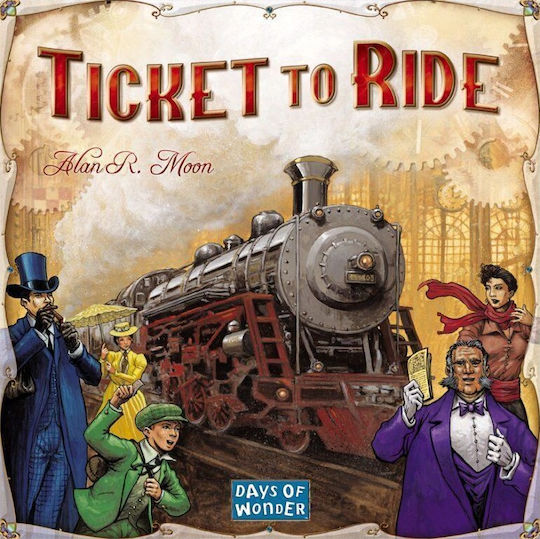
Ticket to Ride Review
The Smoothest On-Ramp in Board Gaming — Still Running Strong
Hook / First Impression
If you've ever introduced a non-gamer to hobby board gaming, there's a reasonable chance you reached for Ticket to Ride. Alan R. Moon's 2004 masterpiece won the Spiel des Jahres — Germany's most prestigious board game award — and then proceeded to sell over 10 million copies across the planet. It remains, two decades later, the clearest answer to a deceptively difficult question: how do you make a game complex enough to be engaging but simple enough that anyone can learn it in ten minutes?
This review gives it an honest assessment: what makes it so enduringly good, where it falls short, and whether it still earns its place at your table in 2026.
Overview
Ticket to Ride is a competitive route-building and set-collection game designed by Alan R. Moon and published by Days of Wonder. Players collect coloured train car cards, claim routes between cities across a map of North America, and score points by completing secret destination tickets — the longer the route, the more points it's worth.
| At a glance | |
|---|---|
| Designer | Alan R. Moon |
| Publisher | Days of Wonder |
| Year | 2004 |
| Players | 2–5 |
| Play time | 45–75 minutes |
| Age | 8+ |
| Weight | Light (BGG ~1.9/5) |
| Victory condition | Most points from routes, tickets, and longest continuous route |
Components & The Setting
The Setting: It's 1900. You are a wealthy rail entrepreneur racing fellow tycoons to build the most impressive transcontinental network across the United States and Southern Canada. The theme is light but cohesive — every route you claim feels like laying track, the coloured trains are satisfyingly tangible, and the destination tickets evoke the romance of early rail travel. That said, this is emphatically a themed abstract. No freight contracts, no timetables, no economic simulation. The map is the game, and the trains are colourful pawns. Players seeking deep narrative immersion won't find it; players who want a clean, handsome puzzle with a warm visual identity will be thoroughly satisfied.
Component quality is where Days of Wonder has always excelled, and Ticket to Ride is no exception. The 225 wooden train car miniatures are chunky, satisfying, and come in five distinct colours. The map board is large, vibrant, and printed on thick, durable stock. The city and route artwork is clean and legible from across the table — an often-overlooked detail that matters enormously during play. Destination ticket and train car cards are standard-weight cardboard; they will benefit from sleeving after heavy use. The card layout is unambiguous: clear colour identification, no small-print confusion.
The overall presentation is premium for its price point. Days of Wonder consistently produces some of the best-looking game components at this tier, and the Ticket to Ride box is no exception. Opening the box and laying out the map is itself a pleasurable ritual before a session begins.
How to Play
The goal is to score the most points when any player's train car supply drops to two or fewer — at which point the current round completes and the game ends. You score points from claimed routes (longer routes are worth disproportionately more), completed destination tickets (bonus points for connecting two specified cities), and the single bonus for the player with the longest continuous route.
On your turn you do exactly one of three things:
- Draw train car cards: Take two cards from the five face-up cards or the blind draw deck. Locomotives (wild cards) displayed face-up cost both draws to take. A hand of matching-colour cards is how you fund route claims.
- Claim a route: Play the required number of same-colour cards (or locomotives) to claim a coloured route segment on the board, placing your trains on it. Grey routes accept any single colour. Once claimed, a route is yours permanently.
- Draw destination tickets: Draw three destination tickets from the deck and keep at least one. Tickets award bonus points if you connect the two named cities via your network — and penalise you if you fail.
The game ends the moment any player places their last (or second-to-last) train car. The current round finishes, scores are tallied — completed ticket bonuses added, failed ticket penalties subtracted — and the Longest Continuous Route bonus of 10 points is awarded. Final scores are often very close, which keeps tension alive until the very last reveal.
Gameplay Feel
Pacing & Tension: Ticket to Ride's early game has a relaxed, almost meditative quality — you're quietly collecting cards, planning your network, watching the board. The tension begins to mount in the mid-game as popular routes start disappearing and the first route blocks land. By the late game, every claimed route carries potential consequence for another player, and the rush to place remaining trains before the end-game trigger creates real, palpable urgency. Few games handle this arc as cleanly: accessible in opening, tense in the middle, and thrilling at the close.
Player Interaction: Interaction in Ticket to Ride is mostly indirect — you're racing and blocking, not negotiating or trading. A well-placed route can completely ruin a rival's ticket without a single word exchanged. This is both a strength and a limitation. The game is socially pleasant and conflict-averse enough for family play, yet competitive enough for hobbyists. But players who love the loud social theatre of games like Catan will find it comparatively quiet.
Luck vs. Strategy Balance: The card draw introduces genuine variance — sometimes the colour you desperately need simply won't surface. But unlike dice-based luck, card draw luck is manageable: a large hand reduces exposure, and drawing from the face-up display gives meaningful choice over blind draws. In our experience, skilled players win significantly more often than beginners over a series of games, confirming that strategy dominates luck over time.
Rule Overhead: Essentially zero. The turn structure is a single forced choice from three options. After one demonstration round, even first-time players are fully independent. Ticket to Ride is one of the very few hobby games where you can genuinely say: "Watch me take one turn, then you'll know how to play."
Mechanics Deep-Dive
The Route-Scoring Curve
One of Ticket to Ride's most elegant design decisions is its route-scoring curve. Short routes (1–2 train cars) score 1–2 points each. Long routes (6 train cars) score 15 points — a massive, disproportionate reward. This creates a constant strategic tension: claim many short routes quickly and safely, or save train cars for a few long, high-value routes and risk running out of time?
The Destination Ticket System
Destination tickets are Ticket to Ride's secret weapon. Each ticket is a city pair with a point value — complete the connection, earn the points; fail, lose those same points. This creates a risk-reward calculus that shapes every decision. Do you take an ambitious long ticket with a high bonus, knowing a route block could strand you? Do you play conservatively with short, easily achievable tickets? Do you take additional tickets mid-game to gain more paths to points, or is your network already stretched thin?
The real genius is that tickets stay hidden until final scoring. You never know which routes matter desperately to your opponents — which makes every route claim a simultaneous statement of intent and a potential ambush. That hidden information layer is what separates experienced Ticket to Ride players from novices.
The Strategy Layer
- Efficiency over quantity: A network of well-chosen routes connecting your tickets is worth far more than a sprawling web of disconnected short routes. Every train car you place should serve at least one ticket.
- Watch the board: Opponents drawing cards is information. If someone is consistently drawing red cards, they want a red route. Act before they do.
- Hold your locomotives: Wildcard locomotives are invaluable for plugging gaps when a needed colour won't appear. Don't spend them on routes that are easily achievable with regular cards.
- Time the end-game trigger: You control when the countdown starts. If you're ahead, place your last trains strategically to end the game before an opponent completes a big ticket. If you're behind, delay — draw tickets and extend the game.
- The Longest Route bonus is 10 points: It's worth actively contesting, but not at the cost of ticket completion. Treat it as a secondary objective, not a primary plan.
Player Count Analysis
Solo — Not officially supported. The base game has no solo mode. Fan-made solo variants exist online, but they fundamentally change the game into a puzzle rather than a race. For solo play, look elsewhere.
2 Players — Surprisingly good. Two-player Ticket to Ride is tenser and more adversarial than you might expect. With only one opponent, every block is deliberate and personal. The board stays relatively open for longer, which rewards ambitious long-route strategies. The downside: with no third party to contest routes organically, the game can become a direct two-player duel that feels less dynamic than higher counts. Still a very solid two-player experience.
3 Players — Excellent. Three players is a great count. The board sees meaningful competition without becoming claustrophobic. Routes start disappearing at a pace that creates regular pressure without the chaos of four or five. The three-way balance prevents the "one player blocks you while the other wins" dynamic that can emerge at higher counts.
4 Players — The sweet spot. Four is the design optimum. The board fills at exactly the right pace — open enough in the early game to build freely, contested enough in the mid-game to demand planning. Player interaction peaks, the blocking decisions feel consequential, and the end-game tension is at its highest. This is the count the game was designed around.
5 Players — Works, with caveats. Five players is supported and functional, but the North America map gets crowded. Popular corridors — particularly through the Midwest — become fiercely contested very early, and a player with unlucky initial tickets may find key routes gone before they're ready to claim them. The game also slows noticeably with five. Consider the Europe map (which adds train stations to soften blocking) if you frequently play at five.
Replayability
Ticket to Ride's replayability comes from two sources: the destination ticket shuffle and the human element. No two hands of tickets produce the same network, which means no two games develop identically. A session where everyone is building westward is a completely different game from one where three players are fighting over the southern routes.
The base game sustains a casual group for 20–30 sessions before the North America map starts feeling familiar. For dedicated groups who play regularly, the point where the base board begins to feel predictable arrives sooner — perhaps 15 sessions — at which point the map expansions are a near-mandatory purchase. The good news: Days of Wonder has produced an enormous library of maps, each introducing new mechanics, and the base train components work with all of them.
The game's Map Collection series is where true Ticket to Ride longevity lives. Each map introduces rules tweaks — tunnels and ferries in Europe, technology cards in Pennsylvania, locomotives in India — that fundamentally change how routes are contested and claimed. The base game is the foundation; the maps are the long-term investment.
Learning Curve
Ease of teaching: Ticket to Ride is the gold standard for teachable hobby games. The rules fit comfortably in five minutes. A single demonstration turn is enough for most people to understand the turn structure. The iconography is intuitive — colour-coded cards match colour-coded routes, numbers on routes match the number of cards required. There is almost no setup complexity and no hidden rules that emerge after the first few turns.
Rulebook quality: Excellent. The Days of Wonder rulebook is lavishly illustrated and clearly sequenced. It walks through every component, the turn structure, and all edge cases (double routes, wildcard rules) without confusion. New players can read it cover-to-cover in ten minutes and be ready to play.
First-game experience: Almost universally positive. New players feel competent almost immediately — the turn structure is simple enough that cognitive load stays low, leaving mental energy for actual decisions. The tension of watching routes disappear before you're ready to claim them lands naturally, without needing explanation. First-time players win regularly, which keeps casual participants engaged and willing to play again. It is, arguably, the best first-game experience in the hobby.
Who It's For
Families with children 8+: This is the best family board game published in the past 25 years. The rules are accessible to children, the play time fits a family evening, and the hidden ticket mechanic creates genuine drama at the reveal without requiring sophisticated strategy. It's one of the few hobby games where adults and children are genuinely competitive with each other.
Non-gamers and casual players: Ticket to Ride is the smoothest gateway into hobby gaming available. If Catan is sometimes too confrontational for very casual groups (the Robber and direct trading refusals can feel personal), Ticket to Ride's indirect interaction makes it universally accessible. Anyone who has ever played a card game can learn this in one session.
Hobbyist gamers: The base game will satisfy veterans for roughly 10–20 sessions before it starts feeling solved. The strategic ceiling is real. But the Map Collection keeps the game fresh for years, and the game's social pleasantness makes it a reliable pick-up even for experienced groups who want something approachable after a heavier main event.
Comparisons: If Ticket to Ride's indirect conflict frustrates competitive players who want more confrontation, Catan delivers that social tension in spades. Wingspan offers a similarly accessible set-collection experience with more depth. For players drawn to the map and network feel but wanting significantly more weight, Age of Steam or Brass: Birmingham are the natural graduation points. For pure route-building without the hidden-ticket layer, Tsuro is the ultra-light variant.
Pros & Cons
What Ticket to Ride does well:
- The smoothest, most universally accessible rules in hobby gaming — literally anyone can learn in five minutes.
- Hidden destination tickets create meaningful strategic depth behind a simple exterior — you're never just placing trains, you're managing a secret plan.
- The scoring curve rewards bold, long-route strategies while keeping short-route play viable — no dominant opening exists.
- Component quality is exceptional for the price tier: vivid board, satisfying wooden trains, legible card design.
- Works at 2, 3, 4, and 5 players with only minor quality variation — genuinely versatile.
- Massive, high-quality map expansion library extends shelf life for years.
- The end-game timing mechanic creates genuine urgency without abrupt or unfair cutoffs.
Where Ticket to Ride struggles:
- The North America base map becomes familiar after 20–25 sessions; dedicated groups will need expansions to maintain freshness.
- Card draw luck can occasionally lock a player out of a critical colour for several consecutive turns, with no mechanical escape.
- Player interaction is indirect and comparatively quiet — groups who want loud negotiation or confrontation will find the atmosphere too passive.
- Five-player games on the base North America map can feel cramped, with popular corridors claimed very early.
- No solo mode in any official release.
- The strategic ceiling is low by hobbyist standards — experienced players will feel limited by the base game within a relatively small number of plays.
Expansions & Ecosystem
Days of Wonder has built one of the most expansive libraries in the hobby around the Ticket to Ride system. Every map introduces new mechanics layered onto the same core rules — new players can always play with the base ruleset while experienced players add the map's specific twists. All maps use the same train car components from any base game edition.
1. Ticket to Ride: Europe — The definitive upgrade ★★★★★
The community's near-unanimous recommendation for the first map purchase. Europe adds Tunnels (routes that may require additional cards drawn randomly, adding exciting risk), Ferries (routes requiring locomotives), and — most importantly — Train Stations: each player has three station tokens that allow them to borrow one route from an opponent's network to complete a ticket. Stations elegantly soften the most frustrating blocking scenarios while adding a new tactical decision (when to use a station vs. when to contest the route).
2. Ticket to Ride: Rails & Sails — The ambitious overhaul ★★★★☆
The most mechanically ambitious map in the library. Rails & Sails introduces a dual-resource system — train cars and ship hulls — and separate decks for each. The two world maps included (the globe, and the Great Lakes) are massive, and routes span oceans as well as continents. The game at this scale feels meaningfully heavier than the base game and rewards experienced players who want strategic depth without abandoning the Ticket to Ride framework.
3. Map Collection Series — Targeted variety packs ★★★★☆
Days of Wonder has released numerous smaller map packs, each containing one or two maps and a focused new mechanic. Highlights include Pennsylvania (technology cards that grant permanent bonuses), India (circular routes creating new ticket-completion strategies), United Kingdom (technology tree unlocking route colours), and Japan & Italy. These are generally cheaper than standalone releases and designed for groups who want variety without committing to a full new system.
Quick Buyer's Guide
| Map / Expansion | Best For | Complexity | Rating | Priority |
|---|---|---|---|---|
| Europe | All groups — the superior base map | Low+ | ★★★★★ | 🥇 #1 — buy first |
| Rails & Sails | Experienced groups wanting depth | Medium | ★★★★☆ | 🥈 #2 — best depth upgrade |
| Map Collection | Groups wanting variety | Low–Med | ★★★★☆ | 🥉 #3 — best for variety |
Value for Money
Ticket to Ride retails for approximately $45–$55 USD (€40–50 in Europe), putting it in the mid-tier of hobby games. For that price you get a complete, polished game with enough variability to sustain a casual group for a year or more. The per-session cost drops below a dollar within the first month of regular play — outstanding value by any standard.
- First board game for a family or couple: The single best purchase available at this price. Nothing else combines this accessibility, production quality, and long-term entertainment value as reliably.
- Gift for a non-gamer: Near-perfect. It's visually impressive, easy to explain, and generates the kind of table moments that turn non-gamers into gamers. Arguably the best gift-purchase in the entire hobby.
- Addition to a hobbyist library: Worth owning as a reliable, accessible option for mixed groups. The base game alone may feel thin after 20 sessions, but Europe or a map collection extends the value significantly.
- Solo player: Skip the base game. No official solo mode exists, and the money is better spent elsewhere.
Used copies are widely available and usually in excellent condition — the components are durable and the game rarely sees enough play at any one home to show significant wear. A used copy for $20–25 is one of the best-value board game purchases you can make.
Accessibility
Color blindness: Ticket to Ride has a notable color-accessibility limitation. Train car cards and routes are distinguished primarily by colour — red, orange, yellow, green, blue, purple, black, and white — with no secondary symbols or patterns. Red-green color blindness in particular can make several colours difficult to distinguish. Days of Wonder has not released an official colour-blind-friendly edition, though third-party sticker overlays and marker solutions exist online. The player train car tokens also rely solely on colour.
Language dependence: Minimal. Destination ticket cards name cities, which requires reading — but city names are also printed on the board itself, so players can point rather than read. The train car cards are purely visual (colour only). Suitable for mixed-language groups with minor adaptation.
Cognitive accessibility: Excellent. The turn structure (choose one of three actions) is among the simplest in the hobby. Players with attention difficulties will appreciate the short, focused turns and the visible, concrete game state — everything is on the board and in your hand, with no complex information management. The destination ticket penalty system can cause anxiety for players who worry about failure; the teaching tip of starting with fewer tickets helps here.
Physical accessibility: The train car miniatures are satisfying but small — players with limited hand dexterity may find placing individual trains on routes fiddly. A card tray or component organiser makes card management easier. The board is large and clear enough to read comfortably from any seat at a standard table. The destination ticket cards are standard playing-card size.
Age range: The 8+ rating is accurate. Children 6–7 can participate with adult guidance, particularly if an adult manages the destination ticket math. The game contains no dark themes — it's trains, maps, and colours.
Verdict
Ticket to Ride is not the deepest game in the hobby, and it was never designed to be. What it does — with remarkable precision — is deliver an engaging, tension-filled, visually beautiful experience to almost any group of players, regardless of age or gaming experience, in under 75 minutes. In over two decades of play, no competitor has reliably replaced it at that specific job. The base game's strategic ceiling is a genuine limitation for hobbyists, but the map expansion library addresses this so thoroughly that the game remains in active rotation across thousands of tables worldwide.
Buy it if: you want a game that works for everyone — from grandparents to competitive hobbyists — and delivers a consistently enjoyable session without a long rules explanation.
Skip the base map if: you already own it and have 20+ sessions logged — go straight to Europe or a Map Collection that matches your group's preferred weight.
Skip it entirely if: you want direct confrontation, loud negotiation, or significant strategic depth. Ticket to Ride is a gentle game — it's not trying to be anything else.
Score Breakdown
Love board game night? Explore our tools, score calculators, and strategy guides — everything you need to play better and have more fun.
Browse All Articles →