Viticulture Review
The Worker Placement Game That Actually Earns Its Reputation
Hook / First Impression
Worker placement games have a reputation problem. Too many of them feel identical at their core: place a meeple, collect a resource, repeat. Viticulture by Jamey Stegmaier breaks that mould by wrapping the genre's familiar mechanics inside a system that has genuine texture — a seasonal rhythm that forces you to plan a full year in advance, visitor cards that create explosive asymmetric turns, and a production chain that rewards patience in a way few board games manage to pull off.
The premise is simple: you inherit a run-down Tuscan vineyard and must build it into a flourishing wine estate before your rivals do. But the execution is anything but simple. Viticulture is the rare game that feels immediately accessible and reveals new strategic layers every time you play it.
Overview
Viticulture Essential Edition is a competitive worker placement and engine-building game designed by Jamey Stegmaier and Alan Stone, published by Stonemaier Games. Players manage Tuscan vineyards across multiple years — planting vines, harvesting grapes, ageing wines, and fulfilling orders — racing to be the first to reach 20 Victory Points.
| At a glance | |
|---|---|
| Designer | Jamey Stegmaier & Alan Stone |
| Publisher | Stonemaier Games |
| Year | 2013 (Essential Edition: 2015) |
| Players | 1–6 |
| Play time | 45–90 minutes |
| Age | 13+ |
| Weight | Medium (BGG ~2.9/5) |
| Victory condition | First to reach 20 Victory Points |
Components & The Setting
The Setting: Each player inherits a modest Tuscan estate with a farmhouse, a small cellar, and enough workers to get started. The theme is deeply integrated in a way that few Eurogames achieve. The seasonal structure — Spring, Summer, Autumn, Winter — is not just flavour; it governs the entire flow of the game. You plant vines in Spring, harvest grapes in Autumn, and bottle wine in Winter. Every mechanical step maps directly onto how winemaking actually works, making rules intuitive to learn and easy to remember. This isn't a game wearing a wine costume — the vineyard theme is load-bearing.
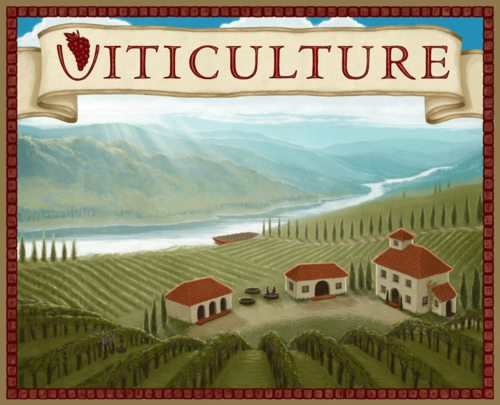
Component quality in the Essential Edition is excellent for the price. The large player boards are thick and colourful, with clear iconography that communicates the production chain at a glance. The wine and grape tokens are satisfying chunky cubes in shades of red and white. Visitor cards feature gorgeous original artwork — each one is distinct enough that veteran players name them fondly. The Grande Worker is a noticeably larger meeple, which makes it easy to track on the crowded action board. Lira coins are cardboard discs but feel premium. The main board is double-sided for different player counts and features warm Tuscan landscape art that makes the table look genuinely inviting.
One minor note: the player boards benefit from being elevated slightly during play, as they can slide on smooth tables. A sheet of craft foam under each board costs almost nothing and solves this completely. Everything else about the physical production sets a high standard for the price.
How to Play
The goal is to be the first player to accumulate 20 Victory Points, earned primarily by fulfilling Wine Orders — contracts that pay VP when you deliver the right type of wine at the right age. Getting there requires building a complete production chain from vine to bottle.
Each game year is divided into four seasons. In Spring, players secretly choose their wake-up position on a Rooster Track numbered 1–7. Lower numbers act first but receive no bonus; higher numbers act later but gain increasing rewards (a Lira coin, a card draw, a Victory Point). This single decision sets the strategic tone for the entire year — acting first is often worth more than any bonus, but not always.
In Summer and Winter, players alternate placing their workers on action spaces on the central board. Classic worker placement rules apply: take the action shown, and if someone else is already there, you cannot place. Actions include:
- Summer actions: Draw or plant Vine cards, build structures (a Tasting Room, a Medium Cellar, a Large Cellar), give tours for Lira, draw Summer Visitor cards.
- Winter actions: Harvest grapes, make wine, fill Wine Orders, train new workers, draw Winter Visitor cards.
Each player also gets to play one Summer Visitor card (in Summer) and one Winter Visitor card (in Winter) — powerful one-off effects that can bend the rules in significant ways, from gaining bonus VP to stealing resources to ageing all your wines simultaneously. Visitor cards are where Viticulture's variance lives, and where most of its best stories come from.
In Autumn, each player draws a card — Vine, Wine Order, or Visitor — and applies a small bonus. Then Winter proceeds, workers return home, and a new year begins.
Gameplay Feel
Pacing & Tension: Viticulture moves at an unusually comfortable pace for a medium-weight Eurogame. Early years feel low-stakes — you're building infrastructure, planting vines, figuring out your engine. By mid-game the tension sharpens dramatically: action spaces fill up, rival engines come online, and the gap between what you want to do and what you can do becomes the game's defining pressure. The final stretch toward 20 VP can be electric — players within a few points of each other racing to complete orders while blocking critical actions is Viticulture at its best.
Player Interaction is indirect but present. There is no direct conflict — you cannot destroy another player's vineyard or steal their wine. But blocking an action space your opponent desperately needed, sniping the Wine Order they were racing to fill, or using your Grande Worker to claim a space they assumed was safe: these are the moments that generate Viticulture's table talk. It's competitive without being confrontational — a balance that makes it work exceptionally well with mixed groups.
Luck vs. Strategy Balance: Visitor cards introduce variance, and the draw of your initial Vine and Wine Order cards can give you a more or less favourable starting hand. But Viticulture's engine is forgiving enough that a bad card draw rarely feels fatal, and the depth of the planning puzzle rewards skill consistently over a session series. The Rooster Track decision in Spring is the game's highest-skill moment — it requires reading the table, assessing your own needs, and anticipating what rivals will do. Getting consistently good at that decision separates experienced players from novices.
Rule Overhead: The rulebook is clean and clearly structured, but there is one gotcha: the sheer variety of Visitor card effects. Each card is a small exception to the normal rules, and new players often need to pause and read cards carefully. After a few sessions the most common cards become familiar and the pace picks up significantly. The first game runs about 20 minutes longer than subsequent ones for this reason.
Mechanics Deep-Dive
The Seasonal Production Chain
At its core, Viticulture is about building and executing a production pipeline across multiple game-years. The chain runs: Plant Vine → Harvest Grape → Make Wine → Age Wine → Fill Order. Each step requires an action space, which requires a worker, which requires planning ahead by at least one full season. Missing a harvest because you ran out of workers in Winter, or being blocked out of a Make Wine action with a cellar full of ripe grapes, creates the game's most satisfying and maddening moments in equal measure.
The cellar upgrade progression adds a crucial constraint: you start with a basic cellar that can only store wines up to value 3. To fill the high-VP orders that win games, you need a Medium Cellar (wines up to 6) or a Large Cellar (wines up to 9). Building these costs Lira and an action space, which means early game is always a balancing act between investing in infrastructure and generating short-term income to survive.
The Visitor Card System
Visitor cards are Viticulture's wild card in every sense. Each player draws from the Summer deck (characters who appear during the growing season) and the Winter deck (harvest-time visitors) and can play one per season. Effects range from mundane (draw an extra card) to game-swinging (gain 3 VP if your wine cellar is at capacity; immediately fill any single open Wine Order). The variance they introduce is occasionally frustrating — a player who draws the Merchant three turns in a row and chains 9 VP from it is the beneficiary of luck, not skill.
But visitor cards also generate the game's most memorable narratives, and their asymmetry forces adaptation. Good Viticulture players do not build a rigid plan; they build a flexible engine and then exploit whatever visitors they draw. The skill lies in recognising which cards are immediately playable and which require specific setup — a distinction that takes a few games to internalise but becomes second nature.
The Rooster Track
Spring's wake-up order selection is deceptively deep. The seven positions offer these bonuses (in approximate terms): nothing; a card; a Lira; two cards; a VP; and a VP plus a bonus. Taking position 1 is not necessarily bad — acting first in Summer means getting first pick of contested action spaces before anyone blocks you. Taking position 7 costs you first-mover advantage but banks a Victory Point and extra resources.
- In tight games, players often cluster in positions 4–6, making positions 1–2 surprisingly attractive as a counter-play.
- If you have a Summer Visitor card that needs a specific action space that will be contested, position 1 is almost always correct regardless of the bonus you miss.
- The VP bonuses at positions 6–7 compound over a full game — a player who takes position 6 or 7 for six straight years effectively gets two to three free Victory Points from this system alone.
Player Count Analysis
Solo — Excellent. The Essential Edition includes the Automa solo system — a card-driven AI opponent that competes for action spaces and generates VP at a convincing rate. The Automa is among the best solo implementations in the hobby: it requires almost no overhead to run, plays quickly, and creates genuine tension at higher difficulty settings. If you ever want to play Viticulture at midnight alone with a glass of wine, this is the game for it.
2 Players — Very good. Two-player Viticulture is tighter and more tactical than larger counts. With fewer rivals and a smaller board, the action-blocking dynamic sharpens. Both players know exactly what the other needs and can apply precise pressure. Some find the experience almost adversarial; others love the head-to-head intensity. A solid choice for couples or gaming partners.
3–4 Players — The sweet spot. This is where Viticulture sings. The board fills at a natural pace, the action economy creates meaningful friction without constant gridlock, and the social dynamics of the Rooster Track become genuinely interesting. Three and four players both work excellently; four is marginally preferred for the fuller table presence.
5–6 Players — Works, but slower. Viticulture supports up to six players and remains enjoyable at this count, but play time stretches and downtime between turns increases. The action board can feel gridlocked in the early seasons, pushing everyone toward the Grande Worker as an emergency valve almost every round. Manageable with experienced players; potentially slow with a mixed group. Budget 90–120 minutes and ensure your table is comfortable with that.
Replayability
Viticulture's replayability is exceptional for its weight class. The combination of randomised Vine, Wine Order, and Visitor card draws means that no two games start with the same strategic landscape. The Wine Order deck in particular creates enormous path variation: a game where high-value red-wine orders appear early rewards a completely different vineyard build than one where white-wine orders dominate the early pool.
Beyond card variance, the Rooster Track decisions accumulate into emergent narratives that shift every session. A player who commits early to a touring-income engine plays a completely different game from one who chains aggressive early orders. These strategic identities do not feel imposed — they arise naturally from the cards you draw and the actions you take, which makes revisiting Viticulture feel genuinely fresh.
The Tuscany Essential Edition expansion substantially extends the game's shelf-life for groups that have mastered the base game, adding a board expansion, a new season system, and special worker types. For groups that play regularly, Tuscany is the natural next step — but the base game has enough depth to sustain well over 30 sessions before it starts feeling thin.
Learning Curve
Ease of teaching: Viticulture is one of the most teachable medium-weight games available. The production chain (plant → harvest → make → fill) is intuitive once explained, the seasonal structure makes the turn order memorable, and the board's iconography communicates most actions visually without needing a verbal description. An experienced teacher can run through the core rules in 20 minutes. The first game adds another 20 minutes of learning overhead — mainly from visitor card questions — which disappears entirely by the second session.
Rulebook quality: The Stonemaier rulebook is excellent: colour-coded, illustrated with examples, and structured logically from setup through full play. The FAQ section anticipates the most common corner cases. The companion Learn-to-Play booklet (available separately) is even better as a first-time teaching tool. Stonemaier publishes a detailed errata page online, and the Board Game Geek forum for Viticulture is one of the most helpful and well-moderated rule-question resources in the hobby.
First-game experience: Near-universally positive. New players report feeling engaged from their first harvest and rarely describe the rules as intimidating. The main first-game pitfall is under-investing in cellar upgrades — new players often spend Lira on workers and structures while ignoring the cellar, then find themselves unable to fill high-value orders late in the game. A single teaching tip prevents it.
Who It's For
Intermediate hobbyists: Viticulture is the ideal step-up game for groups who have outgrown Catan or Ticket to Ride but are not ready for Agricola or Brass. It delivers genuine strategic depth without the anxiety of a punishing ruleset, and the wine theme is inviting to people who would otherwise avoid words like "worker placement."
Solo players: The Automa system makes Viticulture one of the best solitaire experiences in the hobby at this weight. If you frequently play alone, this belongs near the top of your list.
Mixed groups: The indirect conflict and warm theme make Viticulture accessible to people who dislike confrontational games, while still providing enough strategic texture to satisfy experienced gamers in the same group. It is one of the rare games that works equally well with your gaming group and your family.
Comparisons: Wingspan offers a similar "welcoming medium-weight" experience with more variance and lighter interaction. Agricola is deeper and more punishing — the same genre at a higher difficulty tier. Lords of Waterdeep is simpler and faster if your group wants a lighter worker placement experience. Everdell has a comparable feel with a fantasy theme and a more complex card engine.
Pros & Cons
What Viticulture does well:
- The seasonal structure creates a natural, intuitive planning rhythm that makes the game feel effortless to follow even as the decisions underneath get complex.
- Excellent solo mode — one of the best Automa implementations in the hobby.
- Wide player count range (1–6) all work well, with 2–4 being genuinely excellent across the board.
- Visitor cards generate memorable swings and surprising narratives without making the game feel random overall.
- Thematic integration is genuinely strong — the rules feel like winemaking, not a reskinned abstract.
- Stonemaier's production quality is industry-leading for an independent publisher — thick boards, distinctive artwork, satisfying tokens.
- Teaches in 20 minutes; a group is fully functional by Turn 2.
Where Viticulture struggles:
- Visitor card variance occasionally produces swingy outcomes that feel outside the loser's control — drawing powerful combo cards repeatedly is luck, and it shows.
- First-game play time is longer than stated; budget 30 minutes over the box estimate for a learning game.
- At 5–6 players, downtime between turns is noticeable and the action board can gridlock in uncomfortable ways.
- The endgame can feel sudden — a player hitting 20 VP catches rivals off-guard if they weren't tracking the score closely, and there is no "last turn" catch-up mechanism.
- The base game's strategic depth plateaus around 20–30 sessions for experienced gamers; the Tuscany expansion is needed for continued long-term engagement.
Expansions & Ecosystem
Viticulture's expansion ecosystem is small but well-curated. Stonemaier focuses on quality over quantity — each release is meaningfully different rather than simply adding more of the same.
1. Tuscany Essential Edition — More board, more seasons, more decisions ★★★★★
The flagship expansion and the most commonly recommended first purchase after the base game. Tuscany adds three major modules that can be mixed and matched: an extended map that adds regions of Tuscany each providing unique bonuses, a revised season structure that gives each of the four seasons its own worker-placement board, and special workers — six unique meeple types (the Merchant, the Shepherd, the Innkeeper, and others) each with a distinct power. Any combination of these modules meaningfully deepens the base game without adding excessive complexity.
2. Moor Visitors — Additional visitor cards for variety ★★★☆☆
A small card expansion that adds new Summer and Winter Visitor cards to the decks. The new cards feature darker, more complex effects and interact with Tuscany's special workers in interesting ways. Designed primarily to expand the visitor pool for groups that have memorised the base card set and want surprises restored.
Quick Buyer's Guide
| Expansion | Best For | Complexity Added | Rating | Priority |
|---|---|---|---|---|
| Tuscany Essential | Regular groups, experienced players | Low–Medium | ★★★★★ | 🥇 #1 — essential upgrade |
| Moor Visitors | Veterans wanting card variety | None | ★★★☆☆ | Optional — after 30+ plays |
Value for Money
Viticulture Essential Edition retails for approximately $60–$70 USD (€55–65 in Europe) — slightly above the mid-tier of hobby games, but the component quality and Stonemaier's production standards justify the premium. For a game that plays 1–6, includes a genuine solo mode, and holds up across 30+ sessions, the per-play cost drops below a dollar within a few months for a regular gaming group.
- New to medium-weight games: An excellent investment. Viticulture will be the reference point your group returns to when comparing new games — "is it as good as Viticulture?" is a common table standard.
- Solo player: Outstanding value. Few games at this price point deliver as satisfying a solo experience as the Automa system here.
- Group that plays monthly: Unambiguously worth it. The combination of variability and depth means you will not exhaust it quickly, and the warm theme means people ask to play it again rather than moving on.
- Looking for a gift: One of the safest premium board game gifts available. The production quality looks impressive on the shelf, the theme is universally appealing, and it plays well with almost any group.
Stonemaier Games' direct store frequently runs discounts and bundles — buying Viticulture and Tuscany together is often meaningfully cheaper than purchasing separately. Worth checking their site before buying from a retailer.
Accessibility
Color blindness: Viticulture uses colour as a primary differentiator for grape and wine types (red vs. white) and player colours. The red/white grape distinction could be difficult for players with red-green colour blindness in low-light conditions. The tokens are clearly labelled with "R" and "W" symbols, which mitigates this significantly — the symbols carry the information independently of colour. Player pieces are distinguished by shape, not colour, which is a thoughtful design choice.
Language dependence: Moderate. Visitor cards contain text that must be read to understand their effects, and there are over 40 unique visitor cards in play. Non-English speakers will need a translated edition. Stonemaier publishes Viticulture in multiple languages and keeps editions in print; this is rarely a practical obstacle.
Cognitive accessibility: The planning requirements are real — Viticulture rewards thinking two to three seasons ahead, which can be demanding for players with attention or working-memory limitations. The seasonal structure provides helpful signposting, and the physical action board makes your options visible at all times. A patient group that doesn't rush turns makes the game accessible to a wider range of players.
Physical accessibility: The components are well-sized and the board iconography is clear. Grape and wine tokens are small cubes — players with limited dexterity may benefit from using a small tray to manage their token supply. Cards are standard poker size and easy to handle. No fine motor precision is required during play.
Age range: The 13+ rating is appropriate. Players aged 10–12 who enjoy planning games can often handle Viticulture with a patient teacher. The wine theme is mild — grapes, labels, and harvest, not drinking — and is unlikely to raise concerns with parents.
Verdict
Viticulture Essential Edition is one of the finest worker placement games ever published. It achieves something genuinely difficult: delivering meaningful strategic depth without complexity overhead, in a theme that draws in players who would normally avoid the genre, with a solo mode that holds up on its own merits. The visitor card variance will occasionally frustrate you; the sudden endgame will occasionally catch you off-guard. Neither flaw is fatal, and neither undermines what Viticulture does consistently and brilliantly — create a satisfying planning puzzle that feels different every time and rewards the investment you put into it.
Buy it if: you want a medium-weight game with genuine strategic depth, excellent solo support, and a warm enough theme to play with a wide variety of people.
Skip it if: you want direct conflict, high-stakes negotiation, or a truly light family experience. Viticulture is neither a party game nor a war game — it is a planning game with a serene Tuscan soul.
Expand it when: your group has 15–20 plays on the base game and wants more. Tuscany Essential Edition is the clear answer and transforms an already-excellent game into a genuine shelf staple.
Score Breakdown
Love board game night? Explore our tools, score calculators, and strategy guides — everything you need to play better and have more fun.
Browse All Articles →