Counting Time in Chess
Time Controls, Increments, and the Art of the Clock
Why the Clock Is Half the Game
Chess is often described as a battle of ideas, but at every level above the most casual kitchen-table game, it is equally a battle against the clock. A brilliant position means nothing if your flag falls before you can play the winning move. Conversely, a player who manages time masterfully can outmanoeuvre a stronger opponent simply by forcing difficult decisions in the final seconds.
Understanding how time is counted - and more importantly, how to spend it - is one of the most underrated skills in chess. Most beginners focus entirely on piece activity and tactics, treating the clock as a bureaucratic nuisance. Experienced players treat it as a weapon. This guide walks through every major time control format, the add-on systems that modify them, and the practical habits that help you get the most out of every second.
Quick Reference: Time Control Formats at a Glance
Use this table to identify any time control you encounter in club play, online platforms, or tournaments, and understand instantly what kind of game it produces.
| Format | Total time per player | Typical use | Dominant skill |
|---|---|---|---|
| Bullet Fast | < 3 min | Online speed play, stream entertainment | Pattern recognition, reflexes |
| Blitz Quick | 3 – 10 min | Club evenings, casual tournaments | Intuition + clock management |
| Rapid Mid | 10 – 60 min | Weekend Swiss events, online rated | Strategy + preparation |
| Classical Deep | 90 min+ (often +30s inc.) | FIDE tournaments, World Championship | Deep calculation, endgame technique |
| Correspondence | Days per move | Online correspondence leagues | Research, engine-free depth |
A common shorthand you'll see: G/10+5 means "Game in 10 minutes, with 5 seconds added per move." The G/ prefix stands for Game/- meaning the entire game, not just a phase. Once you decode the prefix and the separator, every time control becomes readable.
Increment and Delay: The Two Add-On Systems
Raw time-per-player figures rarely tell the full story. Two additional mechanisms - increment and delay - fundamentally change how time behaves during a game, and confusing the two is one of the most common sources of clock mismanagement.
Increment (also called Fischer increment, after Bobby Fischer who popularised it) adds a fixed number of seconds to your clock after every move you make. A control written as 5+3 means five minutes on the clock plus three seconds added each time you press the button. Increment prevents games from ending on pure flagging: as long as you move quickly enough, you can never completely run out of time.
Delay (also called Bronstein delay) works differently: the clock does not start counting down until the delay period has elapsed. In a 5+3 delay format, pressing the clock starts a three-second freeze before your opponent's time begins decreasing. Delay does not accumulate - unused delay time is lost - while increment does accumulate if you move faster than the added time.
Concrete example: Imagine you have 8 seconds left on a 5+3 game. With Fischer increment, playing 10 fast moves of 2 seconds each nets you 30 added seconds - you'd have 38 seconds by the end. With Bronstein delay under the same 5+3 conditions, those same 10 moves would give you only the 3-second buffer per move, leaving you at around 8 seconds still - the delay absorbs your panic but doesn't accumulate a reserve.
Reading a Time Control Notation
Tournament pairings and online lobbies often display time controls in shorthand that can be cryptic to newcomers. Once you know the pattern, it becomes second nature. The general format is base time + increment, where both figures are in minutes unless stated otherwise.
- 3+0 - Three minutes, no increment. Pure blitz. Every second counts from move one.
- 3+2 - Three minutes plus two seconds per move. More forgiving; the increment rewards decisive play.
- 10+0 - Ten minutes each, no increment. Standard rapid; endgame time pressure is common.
- 15+10 - A hybrid that plays more like 30-minute chess. The generous increment rewards deep opening thinking.
- 90+30 - The FIDE Classical standard. Games routinely last four to five hours.
When you see formats like 40/90, SD/30 +30 in over-the-board tournament literature, it means 40 moves must be completed in 90 minutes, then remaining moves in a sudden-death 30 minutes with a 30-second increment from move 41. These multi-phase controls are standard in classical Swiss tournaments.
Time Management as a Skill
Strong players do not simply play moves and press the clock. They actively budget their time across the arc of the game. A useful rule of thumb: spend roughly a third of your total thinking time in the opening and early middlegame, a third on the critical position (usually the moment where plans diverge significantly), and keep the final third in reserve for endgame conversion.
One of the clearest markers of an improving player is the shift from reactive time use - thinking only when uncertain - to proactive time use, where you also spend time when you are fairly confident to double-check candidate moves. The number of blunders made in the final minutes of a game is staggering. Most are not caused by lack of chess knowledge; they are caused by making a move in two seconds that deserved twenty.
Time Pressure: Surviving and Exploiting It
Severe time pressure - under two minutes in a rapid game, under thirty seconds in blitz - changes the nature of the game entirely. When your opponent is in time trouble, the correct strategy often shifts toward finding the move that poses the most practical difficulty: multiple threats, complex responses required. A sacrifice that requires your opponent to calculate a seven-move sequence is far more dangerous when they have twenty seconds than when they have twenty minutes.
When you are the one in time pressure, the single most important habit is to have a plan before your clock becomes critical. Players who enter time pressure without a clear plan spend their final seconds reorienting - asking what they should even be trying to do. Players who committed to a plan earlier can shift to autopilot.
Physical clock habits matter too. Press the clock with the same hand every time - standard tournament etiquette - and prevents the fumbling pause that costs precious tenths of a second. In bullet chess, those tenths add up to seconds, and seconds are games.
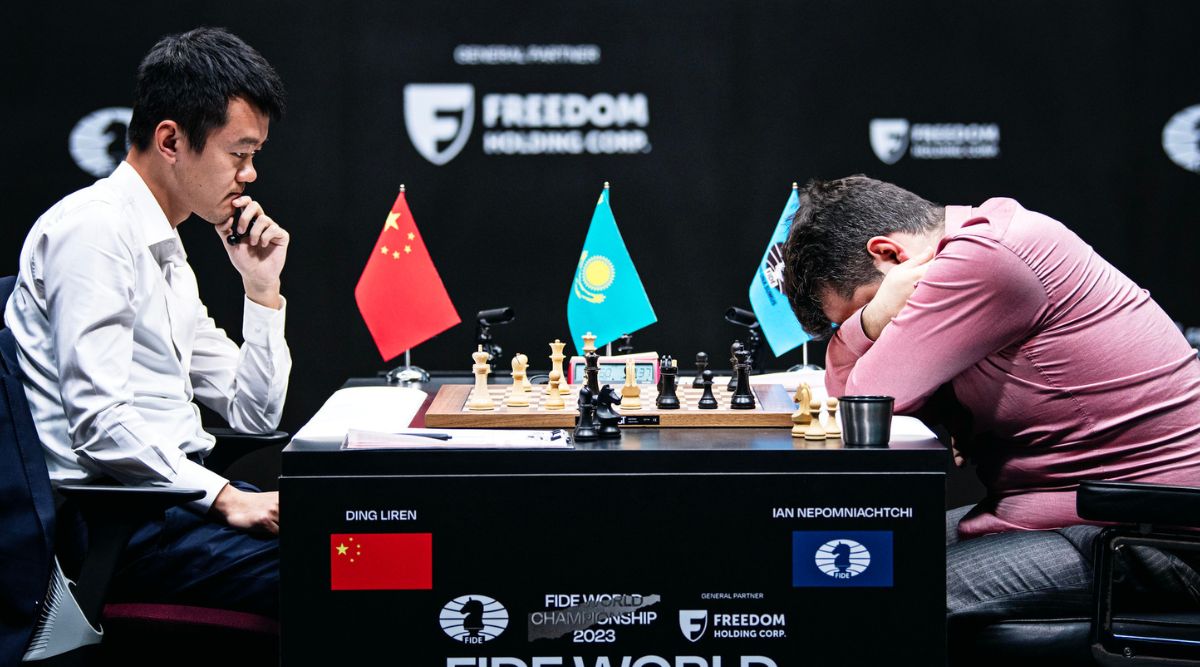
In Game 12 of the 2023 FIDE World Chess Championship, Russian Grandmaster Ian Nepomniachtchi showed exactly how time pressure reshapes decision-making at the highest level. Despite navigating a volatile middlegame to reach a functionally winning position against China's Ding Liren, Nepomniachtchi let the accumulated tension of the match accelerate his pace at precisely the moment a slow, calculated approach was required.
The disaster came on move 34: he impulsively played 34...f5?? - missing that it immediately gave away a vital pawn and stripped his king's last defensive cover. Ding recognised the blunder instantly and launched an unstoppable assault. Nepomniachtchi sat in visible despair for his remaining 17 minutes before resigning. The collapse levelled the match and ultimately handed Ding Liren the World Championship crown - a stark reminder that knowing what to play counts for nothing if the clock has already won the psychological battle.
Digital Clocks vs. Physical Clocks
The analogue chess clock - two mechanical faces connected by a see-saw button - was the standard for over a century. It works only for fixed time controls with no increment, which limits its usefulness in modern tournament play but makes it perfectly adequate for friendly games at home.
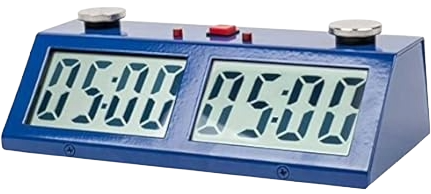
Digital clocks, widespread from the 1990s onward, support increment, delay, and multi-phase time controls. The DGT 3000 and the Chronos are the most common in serious over-the-board tournaments. Both can be programmed with any combination of phases, base time, and increment.
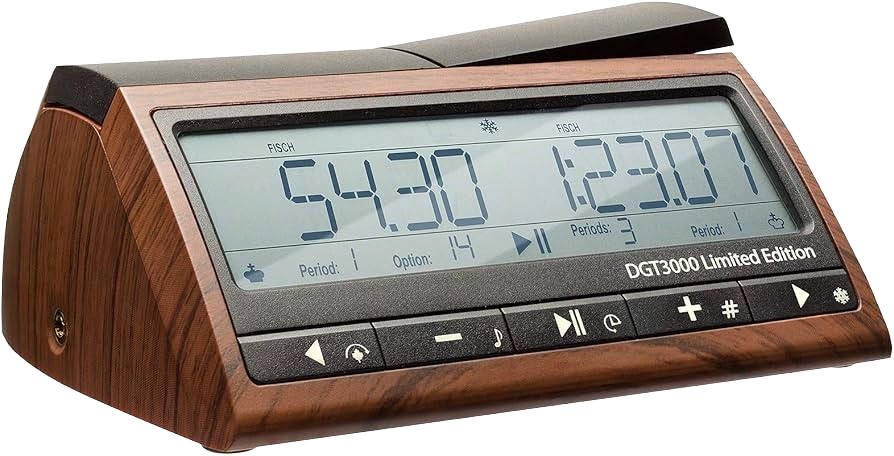
You're playing classical OTB club games, prefer tactile buttons, or your club requires certified equipment.
You're playing casually at home, want instant configuration of any time control, or forgot your physical clock at a friend's house.
Introducing beginners to time controls. The labelled interface makes it easy to explain exactly what each setting does.
Common Clock Mistakes (and How to Fix Them)
Even experienced players make these time management errors regularly. Review the list before your next rated game.
- Spending 15+ minutes in a memorised opening line. If you know the theory, move confidently. Save clock for the moment theory ends.
- Confusing increment with delay. Increment accumulates; delay does not. Check your clock settings before the game starts, not during.
- Entering time pressure without a plan. Decide on your strategic direction while you still have 10+ minutes. Don't wait until you're in crisis mode.
- Using two hands to press the clock. Move piece with one hand, press clock with the same hand. Two-handed clock pressing is technically illegal in FIDE events.
- Assuming bullet = blitz strategy. In bullet, pre-moves and pattern recognition dominate; deep calculation is rarely possible. Adjust your playstyle to the format.
- Not setting increment on a casual home clock. A simple 5+3 vs 5+0 difference radically changes the game experience. Always ask your opponent about increment preference before starting.
Frequently Asked Questions
What Players Actually Choose: Time Control Preferences by the Numbers
While there is no single monolithic study covering every local chess club, major chess platforms and organisations have run massive data surveys capturing exactly how club and recreational players prefer to manage their clocks. The data reveals a stark divide between online/casual play and traditional over-the-board (OTB) environments.
1. Online Play: The Supremacy of 10+0
A data deep-dive analysing tens of millions of active games over a 24-hour period reveals what players default to when given total freedom of choice. The results show a massive preference for sudden-death formats without increments:
- 10+0 (Rapid) is the undisputed king, accounting for over 41% of all games played. Players favour it because it allows enough time to formulate clean tactical plans without forcing a multi-hour commitment.
- Fast Blitz & Bullet (3+0, 1+0, 5+0) follow closely behind, each capturing over 10% of the player pool.
- Increment controls are significantly less popular online - 3+2 and 15+10 lead the small fraction of players who prefer safety time added back to their clocks.
2. Casual & Over-the-Board Play
When players were surveyed specifically on their preferences for casual OTB play - pubs, clubs, and home games - the dynamic flipped significantly:
- No clock (36%): A massive portion of casual OTB players prefer playing completely untimed, prioritising social interaction over clock discipline.
- Rapid (4–10 min): The most popular choice for players who do use a clock casually. It hits the sweet spot for a club night, letting players squeeze six to ten high-energy games into a single evening.
- Classical (30–60+ min): Preferred almost exclusively by dedicated club regulars who use club nights to simulate official tournament conditions.
3. Summary: Preferred Formats & Use Cases
| Category | Common format | Player mindset |
|---|---|---|
| Online Rapid | 10+0 | Dominant (41%+) - the universal default for balanced thinking time |
| Club Blitz | 3+2 or 5+0 | High volume - maximises the number of opponents faced in one evening |
| Training Rapid | 15+10 or 30+0 | The improvement standard - recommended by coaches to eliminate blunders and build positional habits |
| Official Classical | 90+30 or G/60 d5 | The tournament anchor - standard for formal championships and serious calculation training |
4. The Modern Club Dilemma
Internal surveys and discussions within local chess clubs highlight a constant structural tension. Club organisers generally find their player base split into three distinct camps:
- The Improvers frequently vote for 15+10 or 30+0. They want enough time to avoid basic blunders and analyse their games thoroughly afterward.
- The Traditionalists push for G/60 or 90+30. They view short time controls as "junk chess" and want to simulate serious, FIDE/USCF-rated classical matches.
- The Social Scene prefer 3+2 or 5+0 blitz tables. They want a lively atmosphere, rapid turnover, and enough games that everyone gets a seat.
Ready to put your time management to the test? Our free Chess Clock supports every format - from bullet to classical - with increment and delay built in. No setup, no download, works on any phone.
⏱️ Open the Chess Clock →