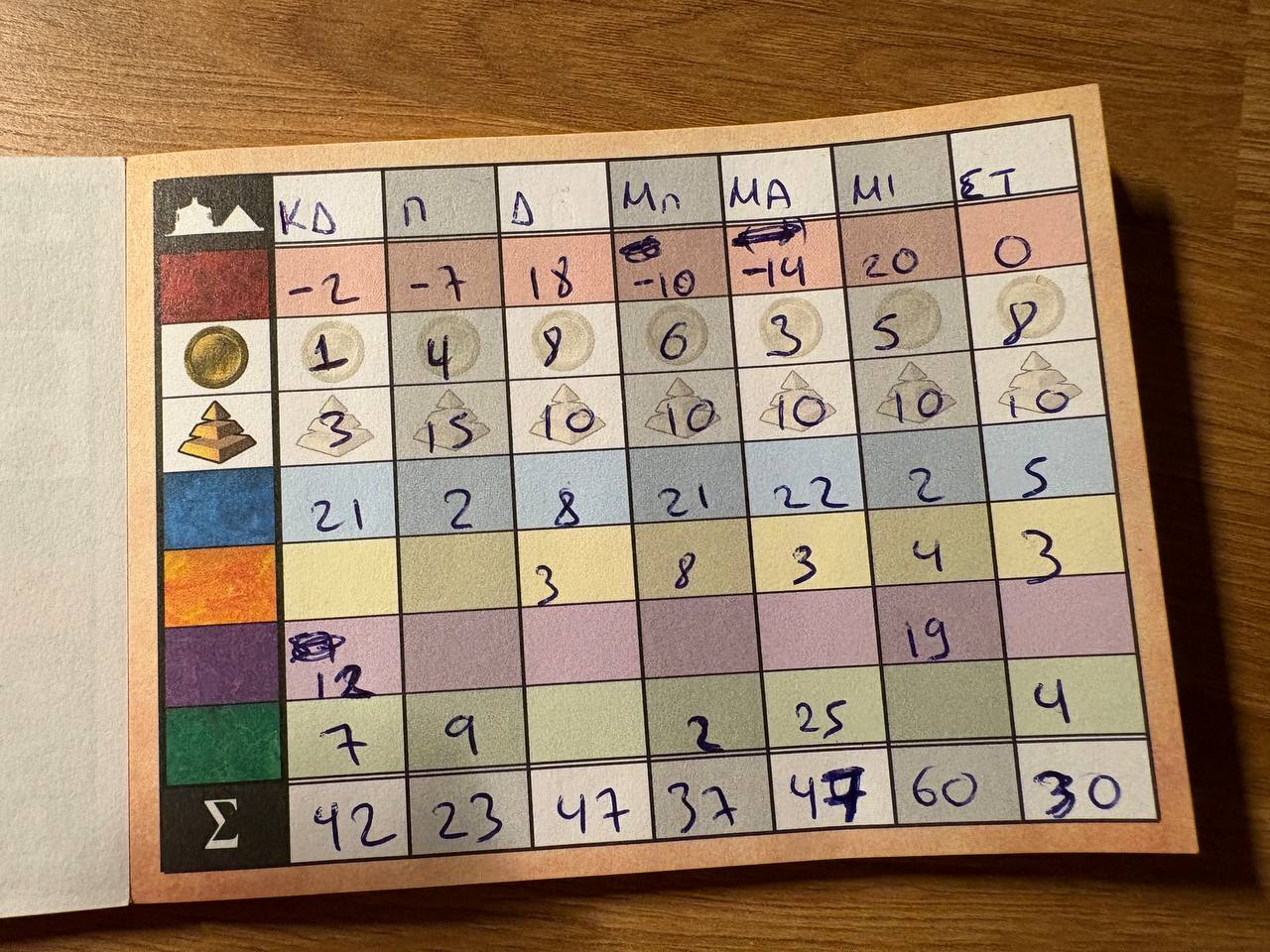
Digital Board Game Scoring
When to Go Digital, Why It Matters - and When Paper Is Still Fine
This Is Advice, Not Advocacy
Let's be clear from the start: paper scoring is not broken. It's worked at game tables for decades and it still works fine for the right games in the right contexts. This article isn't an argument that everything should go digital - it's an honest look at where friction actually lives in a game night, which specific problems digital tools solve better than paper, and just as importantly, where paper is still the better choice.
The goal is a better game night. Sometimes that means an app. Sometimes it means a well-organised notepad. Often it means knowing the difference before you sit down.
When Analog Is Still the Right Choice
Paper scoring has genuine advantages in specific situations, and acknowledging them makes the cases for digital tools more credible, not less.
- Your game has fewer than 4–5 scoring categories and all values are simple integers. Rummy, Hearts, Cribbage, and most trick-taking games fall here.
- The social ritual of the scorekeeper matters. Some groups have a designated scorekeeper role that carries genuine social texture - the slow reveal, the dramatic announcement. Paper supports this; a phone screen doesn't.
- You're playing with tech-averse players or older guests for whom a phone on the table feels alienating. The most frictionless tool is the one everyone is comfortable with.
- It's a casual game you've played hundreds of times and the scoring is automatic muscle memory. You don't need a template to score Catan after 200 games.
- The game scoring intentionally involves players - like counting components publicly - and the tabulation is part of the experience, not separate from it.
- Nobody has a charger and phones are at 12%. Paper never dies.
Real Friction Points Digital Tools Actually Solve
These are specific friction points from real game nights - not hypothetical inconveniences. Each one has a digital solution that genuinely removes the problem.
-
✗ The ProblemScoring a 5-player Terraforming Mars game at midnight. Someone totals TR, another totals cities, a third handles milestones and awards. Three separate calculations, manual addition, and at least one person disagrees with the total. The review takes 18 minutes and ends with mild distrust.
-
✓ Digital SolutionOne person opens the Score Keeper template. Each player enters their own values per category. The total updates automatically. Disputes are resolved by scrolling back to any individual entry. Total time: 90 seconds. Atmosphere: still good.
-
✗ The ProblemA "7" on the score pad looks like a "1" under dim lighting after 11pm. Both players remember entering different numbers. The argument has no resolution and leaves a sour note.
-
✓ Digital SolutionDigital entry is unambiguous. A 7 is a 7. No interpretation required, no backlighting needed.
-
✗ The ProblemYour group plays Viticulture every few weeks. After six months, you have no idea who's been improving, whether the same person always wins, or what the average winning score at 4 players looks like.
-
✓ Digital SolutionEvery session in the Score Keeper is logged automatically. After six months, the data tells you who's improving, who dominates which games, and what a competitive score actually looks like at your table count.
-
✗ The ProblemYou're hosting a spontaneous game night. Someone pulls out a game you haven't played in eight months. Nobody can find the scoring pad that came in the box. There's one pen and it's running low.
-
✓ Digital SolutionA bookmarked web tool in your browser is always with you. No physical equipment required. Takes ten seconds to open. Works on anyone's phone.
The Psychological Burden of Mental Math
After two or three hours of strategic play, your working memory is depleted. Holding a running tally in your head while simultaneously planning your next turn is a form of cognitive multitasking that actively degrades both tasks. Cognitive load research consistently shows that offloading arithmetic to an external tool frees up mental bandwidth for the fun part: decision-making and strategy.
Modern point-salad games deliberately pile on scoring categories precisely because the complexity creates a meaningful puzzle. But that puzzle should be about strategy, not arithmetic. A digital tracker keeps the strategy front and centre.
Which Game Types Benefit Most from Digital Scoring
Not every board game has the same scoring complexity. Here's an honest breakdown of where digital tools provide the most value - and where paper still works fine.
-
🥇 High BenefitPoint-salad engine builders
Wingspan, Terraforming Mars, Viticulture - 6+ scoring categories, conversion chains, hidden card bonuses. Mental math errors here can shift results by 10+ points. -
🥇 High BenefitCivilisation & economic games
Through the Ages, Scythe, Agricola - multi-phase scoring, military/culture conversion, and multiple tie-breaker conditions make paper scorecards error-prone even for experienced players. -
🥈 Moderate BenefitArea control with VP tracks
Dominant Species, Twilight Imperium - the VP track reduces arithmetic burden, but mid-game score projections and objective bonuses benefit from a dedicated tracker. -
🥈 Moderate BenefitWorker placement with varied end-game cards
Feast for Odin, Caverna - the end-game penalty and bonus system rewards a tracker, even if the turn-by-turn scoring is simple. -
🥉 Low BenefitElimination/last-player-standing games
Risk, Coup, Blood on the Clocktower - no running score to track. Paper or mental noting is sufficient. -
🥉 Low BenefitSimple trick-taking and card games
Rummy, Hearts, Skat - scores are small integers that add up cleanly. A notepad works perfectly well here and the social texture of handwritten scoring can add to the charm.
How Scoring Errors Undermine Competitive Integrity
Manual scoring errors are far more common than most groups acknowledge. A misremembered Guild card or a squared-number mistake can silently shift the winner by 5–10 points - a margin that matters in tight games. The frustration isn't just about fairness; it's about trust.
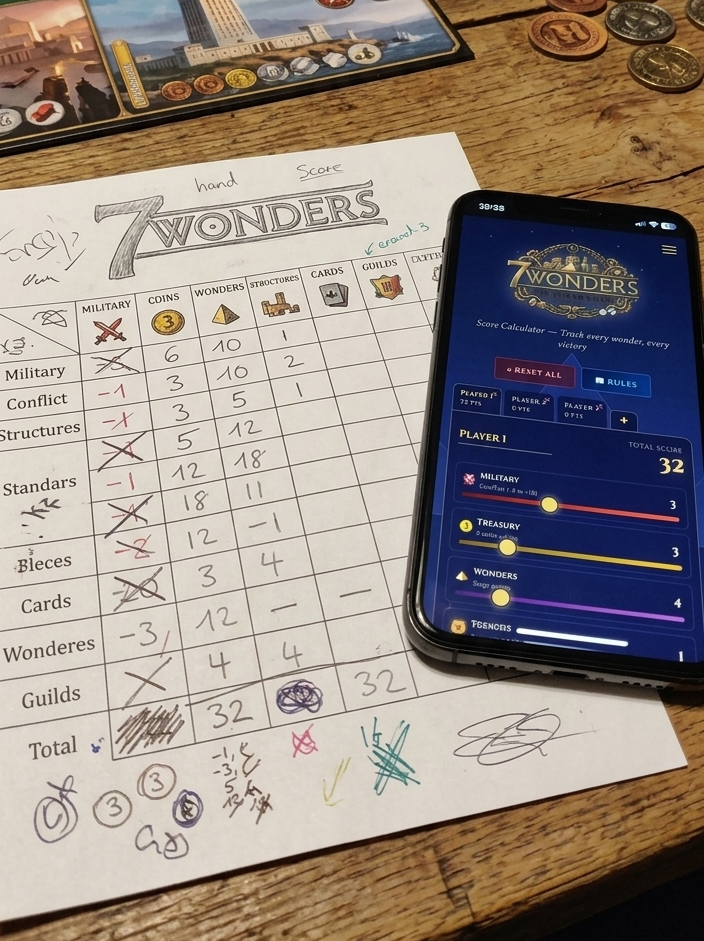
Paper vs. digital: a 7 Wonders scoresheet beside a phone tracker - the comparison that motivated this experiment.
Concrete case - 7 Wonders: In a 4-player 7 Wonders game, the final scoring covers military conflicts, treasury coins, wonder stages, civilian structures, scientific symbols (with set-bonus calculation), commercial structures, and guild cards. That's seven distinct passes - several with non-linear scoring. In our own game nights, we started logging our paper scores against digital totals as an experiment: across 12 sessions, we found at least one arithmetic error in 7 of them. The average error was 4 points - and in two sessions it changed the winner.
| Session | Manual Time (min) | Digital Time (min) | Time Saved | Manual Error? |
|---|---|---|---|---|
| 1 | 12 | 3 | 9 min | ✗ Science miscalculated |
| 2 | 10 | 3 | 7 min | - |
| 3 | 11 | 2 | 9 min | ✗ Guild VP missed |
| 4 | 11 | 4 | 7 min | ✗ Coin total off by 3 |
| 5 | 13 | 3 | 10 min | - |
| 6 | 10 | 2 | 8 min | ✗ Military conflict double-counted |
| 7 | 14 | 5 | 9 min | - |
| 8 | 9 | 3 | 6 min | ✗ Science set bonus wrong |
| 9 | 11 | 4 | 7 min | - |
| 10 | 8 | 2 | 6 min | ✗ Wonder stage VP skipped |
| 11 | 12 | 4 | 8 min | |
| 12 | 10 | 3 | 7 min | ✗ Commercial card missed |
Digital tools create an auditable record. Every entry is visible and editable. If a dispute arises, you scroll back rather than arguing from memory. The moment someone says "wait, are you sure that's right?" at a handwritten score sheet, the atmosphere at the table shifts. A digital record eliminates that moment entirely.
There's also a consistency argument: a digital tool applies formulas identically every game. The same science scoring calculation, the same tie-breaker logic, the same total every time. Human scorekeepers - even careful, experienced ones - introduce noise.
The Speed Benefit: 10–15 Minutes per Session
Timed studies of board game end-phases consistently find that manual scoring for complex games takes 10 to 15 minutes - sometimes more for first-time players. That's time you could use for another game, a post-game discussion, or simply getting to bed on a Tuesday night.
A well-designed digital tracker reduces end-game scoring to under two minutes. Over a year of weekly game nights, that's over eight hours of game time recovered. If you play Wingspan every other week for a year, that's 13+ hours of extra time returned to your group across 26 sessions.
How the Game Night Pro Score Keeper achieves this: Categories for each game are pre-defined in a template. You enter each player's values per category - no formulas to remember, no totalling required. The running total updates as you enter numbers. Final results display in a ranked leaderboard. For a four-player Wingspan game, scoring takes roughly 90 seconds once the template is set up.
Historical Score Data: Tracking Improvement Over Time
One under-appreciated benefit of digital scoring is the history it creates. When every session is logged, you can review your average score by game, identify which categories you consistently under-perform in, and track how your performance changes as you learn a game more deeply.
Group-level data is equally valuable: who tends to win at which game, what the average winning score is at your table count, and whether certain player pairings produce closer games. These patterns reveal your group's meta - the ecosystem of strategies and counter-strategies that emerges from your specific mix of players.
Concrete case: After six sessions of Viticulture logged in the Game Night Pro Score Keeper, one player noticed she consistently scored low on visitor card VPs but high on wine order fulfilment. That data-point reshaped how she approached her summer visitor choices. Two sessions later, she won with her highest score yet. The tracker didn't give her the strategy - it surfaced the pattern that let her find it herself.
Some gaming groups have been playing together for decades. A digital archive of every session - who played, who won, the scores, the date - is a genuine artefact of shared history. When a group member moves away, the record remains. When a new player joins, they can see the group's history. Paper evaporates; data persists.
Why 'Point Salad' Games Are Designed for Complexity
Game designers intentionally design multi-pathway scoring systems because they create strategic depth and replayability. When there are six ways to score points, no single dominant strategy emerges, and each player can find their preferred path. Games like Wingspan, Terraforming Mars, and Viticulture are beloved precisely because of this richness.
But richness in strategy should not mean richness in arithmetic burden. Digital tools honour the designer's intent by preserving the strategic complexity while eliminating the clerical tedium.
Consider what the designer of Terraforming Mars intended when they created 11 ways to score points across the board, your hand, milestones, and awards. They wanted you thinking about strategic trade-offs - not struggling to remember whether you've already counted your greeneries.
Shared Screens and the Social Dimension
One underappreciated feature of digital scoring is how it changes the social dynamic at the table. A shared screen displaying the running total creates a communal focal point. Everyone can see where everyone stands, which generates natural table talk - "wait, you're only 4 points behind?" - that paper sheets rarely produce because they're usually held by a single scorekeeper.
Transparency in scoring is also an expression of good faith between players. When the scoresheet is visible to everyone simultaneously, there's no room for suspicion or "are you sure you counted that right?" moments. The openness of a digital leaderboard builds the trust that makes competitive play feel fair and fun.
What to Look for in a Good Digital Scoring Tool
Not all scoring tools are created equal. Here's a checklist of features that separate genuinely useful tools from clunky gimmicks:
- Pre-defined game templates - Categories should match your game's specific end-game scoring sheet, not a generic set of blank fields.
- Automatic formula calculation - Science sets, majority scoring, and conversion chains should be handled by the tool, not computed by the player.
- Multi-player support - All player scores should display on the same screen for comparison and transparency.
- Session history - Your data should persist beyond a single night and be reviewable by any player.
- Clean mobile interface - Scoring happens on someone's phone at the table. One-tap entry and a visible running total are essential.
- Custom game mode - For titles not yet in the database, you should be able to define categories freely.
Honest Tradeoffs: When Digital Isn't Always Better
Credibility requires acknowledging that digital scoring tools aren't universally superior. Here's a balanced look at where each approach genuinely wins:
| Scenario | Digital | Paper / Verbal |
|---|---|---|
| 6+ scoring categories (Wingspan, TM) | ✓ Faster, more accurate | ⚠ Error-prone at volume |
| Simple card or trick-taking games | ⚠ Overkill for small numbers | ✓ Faster to jot than open an app |
| Tech-averse group or older players | ⚠ May feel alienating | ✓ Lower barrier, more social |
| Group wants historical data / analysis | ✓ Searchable, shareable records | ✗ Discarded after each session |
| No phone charger / low battery | ⚠ Device dependency | ✓ Always available |
| Disputed score mid-game | ✓ Auditable history | ✗ Relies on memory |
| Teaching a new player scoring | ✓ Shows all categories clearly | ⚠ Category list lives in the rulebook |
The bottom line: for games with 5+ scoring categories, digital tools are objectively better. For simple games with a tech-averse group, paper is still a perfectly respectable choice. The best scoring tool is the one your whole group will actually use - and Game Night Pro's Score Keeper is designed to have low enough friction that anyone at the table can pick it up in 30 seconds.
The Game Night Host Checklist
Use this before every session to decide how to handle scoring - and to make sure the logistics are covered regardless of which approach you choose.
- Identify your game's scoring complexity. Fewer than 5 categories? Paper is fine. 5 or more? Use the Score Keeper.
- Bookmark the Score Keeper on the hosting phone. Don't wait until you're mid-game to find it. gamenight.pro/tools/score-keeper
- Check phone battery on the hosting device. If below 30%, plug in before the session or designate a backup device.
- Prepare any paper backup just in case. A notepad and pen on the table is a 10-second insurance policy for tech failure.
- Confirm scoring rules before the game starts. Review the end-game scoring section of the rulebook at setup, not during the game. Save the template categories now.
- Nominate a scorer for paper games. If you're going analog, designate one person as the keeper. Rotating mid-game creates confusion.
- Agree on tie-breaker rules before you start. Nothing derails a session like discovering you don't know the tie-breaker after a 3-hour game ends in a draw.
- After the session, save the history. Whether digital or paper, note the winner and score. Data you don't keep has no value later.
Ready to eliminate manual math from your game nights? The Score Keeper handles the arithmetic so you can focus on strategy - free, no account required, works on any phone.
📊 Open the Score Keeper →