7 Wonders Scoring Explained
Navigating the Science, Guilds, and All Seven Categories
The Seven Scoring Categories at a Glance
7 Wonders awards points across seven distinct categories. Missing even one can swing the outcome by 10 or more points - enough to flip the winner in most games. Here is what each category contributes and when it is scored:
| Category | When scored | Typical range | Key rule |
|---|---|---|---|
| ⚔️ Military | End of each Age | −6 to +18 VP | +1/+3/+5 per win, −1 per loss |
| 💰 Treasury | End of game | 0 – 9 VP | 1 VP per 3 coins, round down |
| 🏗️ Wonders | End of game | 0 – 15 VP | Fixed per stage; read your board |
| 🏛️ Civilian (Blue) | End of game | 3 – 22 VP | Sum printed values |
| 🟡 Commercial (Yellow) | End of game | 0 – 12 VP | Most give coins; some give VP |
| 🟣 Guilds (Purple) | End of game | 0 – 20 VP | Based on neighbours' tableaux |
| 🔬 Science (Green) | End of game | 1 – 48 VP | Squared formula + 7 VP per full set |
Understanding the interplay between these categories is the difference between a beginner and an intermediate player. Experienced players don't chase points in isolation - they read the board and optimise for the combination their position naturally supports, given the draft and their neighbours' strategies.
What a Typical Winning Score Looks Like
In a competitive 7-player game, a winning score usually lands between 52 and 65 VP. The breakdown below shows a realistic distribution for a science-leaning winner - a useful reference for estimating mid-game whether your position is competitive.
Example: science-focused winner, 7 players, total 59 VP
The Science Formula: Squared Sets + Complete Sets
Science scoring is 7 Wonders' most misunderstood mechanic. You have three symbols: Compass, Gear, and Tablet. The formula has two components that are added together:
- Squared sets: Count how many of each symbol you have. Square each count individually. Add all three squared results.
- Complete sets: How many sets contain one of each symbol? Each complete set = 7 VP.
Example: 4 Compass, 2 Gear, 2 Tablet → Squared: (4² + 2² + 2²) = 16 + 4 + 4 = 24 VP. Complete sets: 2 × 7 = 14 VP. Total science: 38 VP.
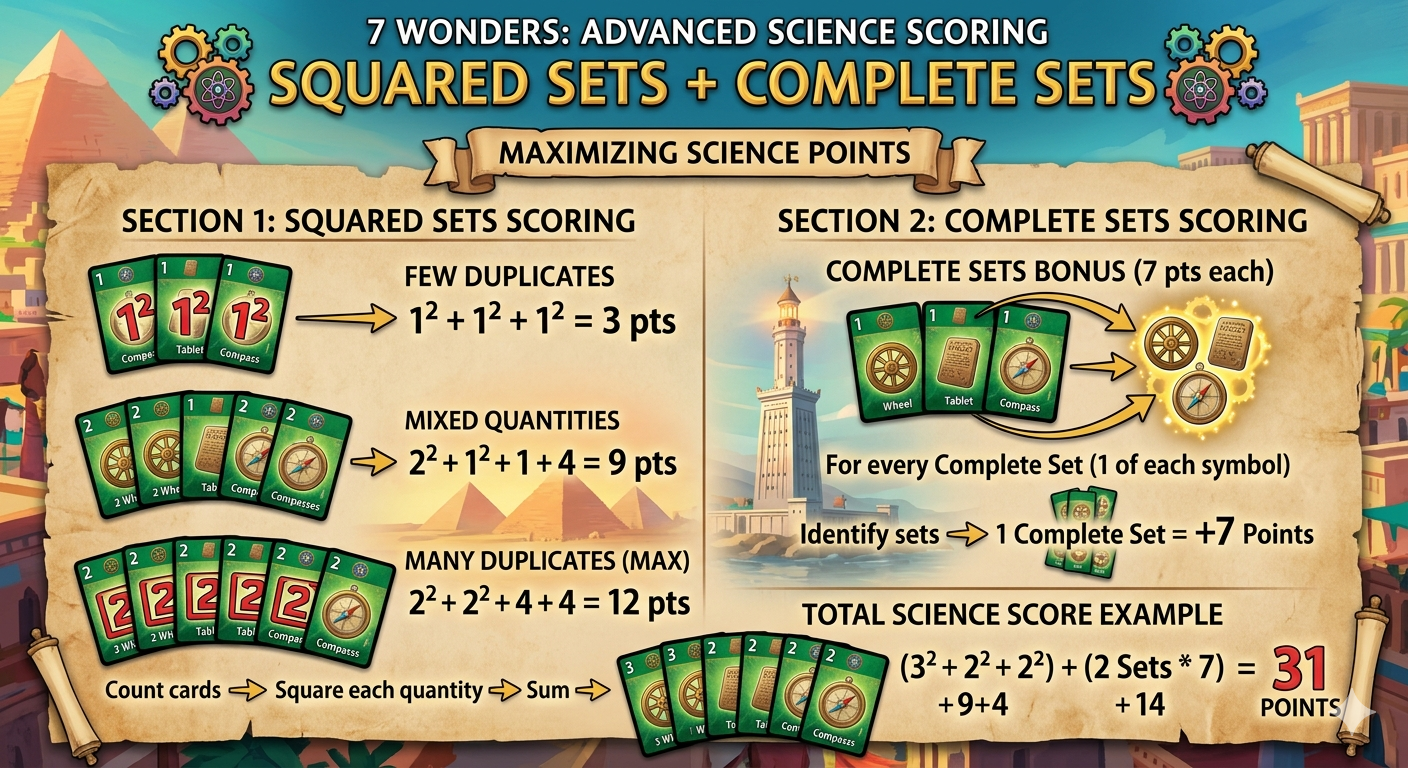
This exponential growth is why a player with six green cards can score 40+ points from science alone. The sweet spot: breadth and depth both matter simultaneously. Four of one symbol (16 VP) beats two of two symbols (8 VP), but two of each of three symbols (4+4+4 + 7 = 19 VP) beats four of one. Never ignore a wild science symbol from the Scientists Guild - it fills whichever gap is most valuable.
When deciding between adding depth versus breadth, a useful rule of thumb: each new copy of a symbol you already have is worth twice the current count plus 1 additional VP from the squared component alone. If you have 3 Compasses, a fourth is worth 7 more squared points (4² − 3² = 7), on top of any set bonuses it triggers. That marginal value calculation is why the last green card you draft each Age matters more than the first.
Tallying Guild Cards Efficiently
Guild cards (purple) score based on what you, your left neighbour, or your right neighbour have built. Before the final tally, lay out all purple cards on the table and announce each one. Work around the table systematically: read the Guild, identify whose structures it references, count, and record.
Common Guilds include the Traders Guild (1 VP per yellow card among neighbours), the Philosophers Guild (1 VP per grey card among neighbours), and the powerful Scientists Guild which grants a wild science symbol. The quickest approach: have the Guild owner read aloud while neighbours count their relevant cards simultaneously. Record before moving to the next Guild.
A practical tip: before Age III begins, quickly count your neighbours' existing yellow and grey cards. You'll have a rough Guild estimate heading into the final draft, helping you decide whether a late Guild card is worth more than a direct VP card.
Organising Your Tableau for Fast Scoring
Sort your cards by colour as you play. Keep blue Civilian cards together, green Science cards grouped by symbol, and purple Guilds separate. At end-game, each colour block is already sorted. Place coins above your tableau in stacks of three so Treasury scoring takes seconds.
For Science, arrange green cards in columns by symbol - all Compasses, all Gears, all Tablets. A quick glance tells you your counts. Yellow commercial cards that give end-game VP often get overlooked - keep them slightly separated from pure resource-yellow cards. It's surprisingly common to play a VP-giving commercial card mid-game and forget it at the tally because it's buried in a stack of browns.
The Most Common Scoring Errors
These are the errors that most frequently flip the winner at the final tally:
- Science treated linearly: Applying 1 VP per symbol rather than squaring per symbol type.
- Forgetting military losses: −1 VP per loss per Age compounds - six total losses = −6 VP, a swing of up to 24 vs. a full-win player.
- Overlooking commercial VP cards: Cards like the Lighthouse and Arena grant end-game VP, not just coins. Count them.
- Misreading Guild adjacency: Some Guilds reference only one neighbour, not both. Re-read the card.
- Treasury rounding: 1 VP per 3 coins, rounding down. Seven coins = 2 VP, not 2.33.
- Wonder stages with non-VP bonuses: Some stages give resources or extra turns. Don't add them to your point total.
A Reliable End-Game Scoring Sequence
This sequence moves from simplest to most complex, so any errors surface early:
- Military: Flip conflict tokens. Sum +VP and −1 losses per player.
- Treasury: Count coins, divide by 3, round down. Record per player.
- Wonders: Each player reads their stage VP aloud. Record.
- Civilian (Blue): Each player sums their blue cards. Record.
- Commercial (Yellow): Identify yellow cards with end-game VP. Record.
- Guilds (Purple): Work through each Guild systematically with neighbours. Record.
- Science (Green): Count columns, apply squared formula plus set bonus. Record.
Following this order every game builds muscle memory. Within five sessions you'll complete scoring in under three minutes. Pair this habit with the digital calculator for zero-error totals and a permanent record of every session.
Expert Strategy Tips
Beyond scoring correctly, securing the win requires smart tactical play. Drawing from expert community advice, here are the core strategies to elevate your game:
- Master your Wonder's strengths: Identify the resources needed for your Wonder stages immediately and secure them during Age I. Completing your Wonder early allows you to leverage its unique benefits throughout the rest of the game.
- Play interactively and deny neighbors: 7 Wonders is not a solitaire game. Watch your neighbors' tableaux carefully. If your downstream neighbor is monopolizing Science or needs a specific rare resource, use that exact card to build a stage of your Wonder to bury it forever.
- Pace your resource engine: Aim to cap your basic resources (brown/grey cards) and trading cards (yellow) at around 5 to 6 total. Also, check your neighbors' production before playing a Trading Post-there is no point in securing discounts for goods they aren't even making.
- Avoid ruinous arms races: Winning military conflicts is helpful, but fighting a dedicated military player card-for-card is a waste of turns. If you can't realistically beat both neighbors, gracefully accept the minor negative points and use your turns on high-value Civilian or Science cards instead.
- Track the drafting flow: Remember that the passing direction changes each Age (Left, Right, Left). You will pass cards to your left neighbor twice during the game, giving you significant power to choke their options or feed them what they least need.
What Wonder Should I Pick?
Choosing your Wonder board at the start of the game is your first and most lasting strategic decision. Each Wonder shapes what you need to build, how you interact with neighbours, and which scoring categories you can realistically target. Here is a breakdown of every Wonder and the style of play it rewards:
| Wonder | Side | Best for | Key strength |
|---|---|---|---|
| 🏛️ Alexandria | A | Flexible builders | Stage 2 produces any resource — frees you from tight resource planning. |
| 🏛️ Alexandria | B | Science & Civilian | Two wild resources plus a late VP stage; strong all-rounder. |
| 🗼 Babylon | A | Science specialists | Stage 2 lets you play a 7th card each Age — massive card-advantage for green chains. |
| 🗼 Babylon | B | Science specialists | Stage 3 awards a wild science symbol — directly turbocharges the squared formula. |
| 🌊 Ephesus | A | Coin-economy players | Stage 2 gives 9 coins; funds commercial yellow chains and removes resource dependency. |
| 🌊 Ephesus | B | Civilian + VP racers | Stages award VP directly — one of the highest raw VP outputs of any board. |
| 🦁 Giza | A | Beginners & VP racers | All three stages give VP; simple, predictable, and hard to misplay. |
| 🦁 Giza | B | High-VP specialists | Four stages, higher total VP ceiling — best raw VP board in the game with a strong draft. |
| 🧅 Halikarnassos | A | Disruption players | Stage 2 lets you build a card from the discard pile — recovers buried green or purple cards. |
| 🧅 Halikarnassos | B | Advanced players | All three stages pull from the discard — extreme flexibility and denial tool. |
| 🦅 Olympia | A | Resource-lean players | Stage 2 lets you build one free card per Age — eliminates a resource requirement every round. |
| 🦅 Olympia | B | Trading players | Buy resources from neighbours at cost 1 permanently — strong in resource-rich neighbourhoods. |
| 🗽 Rhodes | A | Military players | Stage 3 gives +3 shields — can swing military decisively in Age III without card investment. |
| 🗽 Rhodes | B | Aggressive military | Stages 2 and 3 combine shields with coins or VP — best military board for contested tables. |
How to Choose at the Table
Wonder selection is usually random or drafted, but when you have a choice, three factors should guide you:
- Know your neighbours before committing: Olympia B is weak if neighbours produce nothing worth buying. Halikarnassos is weak if the table plays efficiently and little ends up discarded.
- Match the board to your preferred category: Science players should lean Babylon. VP racers want Ephesus B or Giza B. Military players benefit most from Rhodes B.
- Consider the player count: In a 3-player game the card pool is smaller and guild interactions are limited. Boards that rely on neighbours (Halikarnassos, Olympia B) are less powerful; Giza and Ephesus are more consistent.
- Assess the resource cost of each stage: If your board's Stage 3 requires four different raw resources and no neighbour produces them, you may never complete it. Factor in trading costs before counting those VP.
Frequently Asked Questions
How does the tie-breaker work in 7 Wonders?
If two or more players share the same total VP at the end of the game, the player with the most coins wins. Coins are counted at the moment of the tie-break - not divided by three as they are for Treasury scoring. This means holding onto a few extra coins in the final round can be a legitimate strategic choice when you're in a tight race. A single unspent coin can mean the difference between first and second place.
Does the Scientists Guild wild symbol count for both the squared sets and the complete-set bonus?
Yes, fully. The Scientists Guild grants you one wild science symbol that you assign to whichever symbol type is most valuable at scoring time. It contributes to the squared total of that symbol type and can complete or extend a set for the 7 VP bonus. You assign it optimally at the end of the game, so there is no commitment during play - always resolve it last when calculating science.
Can military VP go negative overall?
Yes. If you lose all six conflict tokens across three Ages (two neighbours, three Ages), you accumulate −6 VP from military alone. Combined with a dominant opponent who wins all six tokens, that is a 24-point swing between the two players. Losing one or two conflicts is generally acceptable; losing all of them signals you over-invested in non-military cards without compensating elsewhere.
What is the highest realistic score in a standard game?
In a 7-player game without expansions, exceptionally strong science combined with competitive Civilian and Guild scores can push a winner above 70 VP, though scores above 65 are rare outside highly experienced groups. In smaller player counts (3–4 players), winning totals tend to be lower since there are fewer guild interactions and the card pool is smaller. A score that dominates in a 3-player game might finish mid-table in a 7-player session.
Do all Wonder stages award victory points?
No - many stages grant other benefits such as free card constructions, extra resource production, immunity to military losses, or the ability to play a seventh card each Age. Only stages with a printed VP shield icon contribute to your end-game total. This is one of the most common sources of over-counting: players see a completed Wonder stage and assume it is worth points when it grants a resource or a special ability instead. Always read the stage icon carefully before recording it.
Is it worth building all three Wonder stages?
Not always. The third stage frequently has the highest resource cost relative to its return, and the cards you bury to fund it are gone permanently. If your third stage awards only 3 VP but burying a strong Civilian card would cost you 5 VP, you are net negative on that trade. Evaluate each stage individually rather than treating Wonder completion as an automatic goal. That said, some third stages - particularly those offering free construction or VP multipliers - are almost always worth the investment.
Ready to put these insights into practice? Use our free 7 Wonders scoring calculator for instant, error-free results at your next session.
Open the 7 Wonders Calculator →