
The Impact of Tie-Breakers
How Modern Board Game Design Handles the Deadlock
Why Tie-Breakers Matter More Than You Think
It happens at nearly every game night: two players reach the final tally and land on exactly the same score. The room goes quiet. Someone reaches for the rulebook. Someone else confidently states a rule that turns out to be half-remembered. What follows can be a two-minute friendly disagreement or a ten-minute dispute that colours the entire evening.
Tie-breakers are not an afterthought in modern board game design - they are a deliberate design statement. How a game resolves a deadlock tells you a great deal about what the designer believes constitutes superior play. Treasury tie-breakers reward efficiency. Placement tie-breakers reward breadth. The complete absence of a tie-breaker is itself a philosophical position: that truly equal play deserves a shared victory.
Understanding the tie-breaker system of every game you play regularly is one of the highest-leverage bits of knowledge an experienced player can carry. It changes how you spend your last action, how aggressively you pursue a lead in the final round, and how you interpret your opponent's late-game moves.
Common Tie-Breaker Systems Compared
The most common tie-breaker in board games is treasury: the player with the most coins or resources remaining wins. This approach appears in 7 Wonders, Agricola, and dozens of others. Its appeal is obvious - it's intuitive, requires no additional tracking, and resolves instantly. Every player already knows their coin count at the end of the game.
The treasury rule also has strategic elegance: it implicitly rewards players who achieved the same point total while spending fewer resources to do it. You built the same score more efficiently, so the tie-breaker recognises that efficiency.
A second common approach is "most of a specific resource" - Wingspan uses bird count, while some games use completed objectives or region control majorities. A third common resolution is player order: the player sitting closest to last in turn order wins, on the logic that they had a slight disadvantage throughout.
| Type | Examples | What It Rewards | Risk |
|---|---|---|---|
| 💰 Treasury | 7 Wonders, Agricola | Resource efficiency | Rewards hoarding late coins |
| 🐦 Specific metric | Wingspan (bird count) | Thematic consistency | May reward luck over skill |
| 🔢 Player order | Various euros | First-player disadvantage | Feels arbitrary to many players |
| ♾️ Cascading chain | Through the Ages | Always produces a single winner | Complex to remember |
| 🤝 No tie-breaker | Concordia | Shared excellence | Can feel anticlimactic casually |
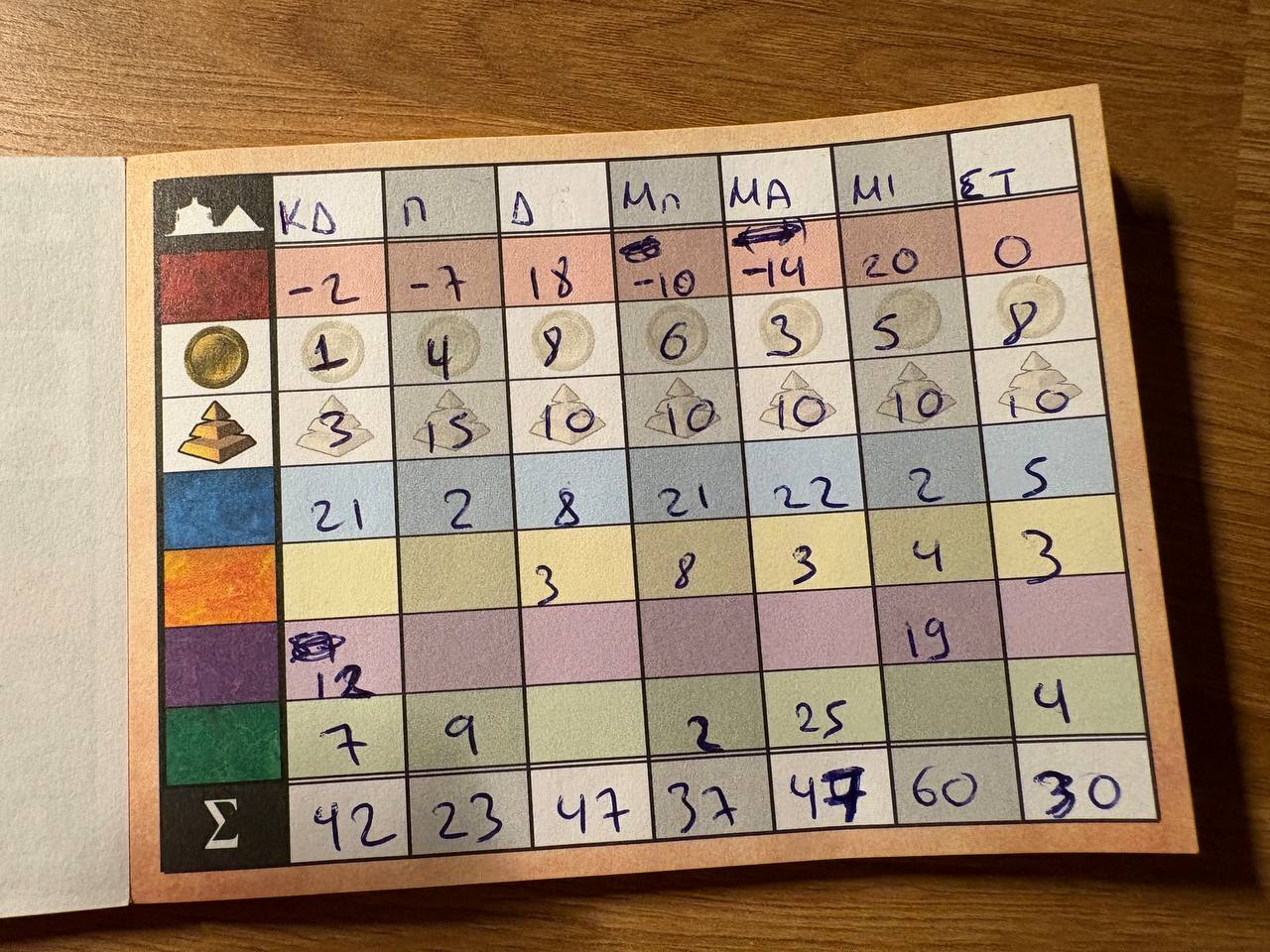
Concrete example: The scoring sheet above is from a real 7-player game. The outright winner finished on 60 VP - no controversy there. But two players, Δ and ΜΑ, both landed on exactly 47 VP. With the main score identical, the treasury tie-breaker kicks in: Δ had 9 coins remaining; ΜΑ had just 3. Δ wins. Six coins hoarded across three Ages - not a single extra card built - separated first from second place. The moment ΜΑ spent down their treasury in Age II was, in hindsight, the losing move.
Cascading Chains vs. Shared Victory
Some games, like Through the Ages, define multiple cascading tie-breakers - if treasury ties, check culture points, then military strength, then player order. These "infinite" chains ensure that someone always wins outright. The design philosophy here is firmly competitive: there must always be a single winner, and the chain of criteria will eventually find a differentiator.
Building a cascade requires careful thought. Each subsequent criterion must be something independently tracked during the game, and each must be meaningfully distinct from the primary score so that it actually differentiates frequently tied players rather than almost always resolving to the same player who was narrowly ahead on VP anyway.
Other games, like Concordia, deliberately provide no tie-breaker at all. The rules simply state that tied players share the victory - a philosophical statement that if two players have played so skillfully that their scores are mathematically identical, declaring co-winners is the most elegant outcome. For groups who genuinely enjoy cooperative energy even within a competitive framework, shared victory is actually a warm and satisfying conclusion.
Intentionally Playing for Tie-Breaker Advantage
Advanced players consciously bank coins in the final round precisely because they know the treasury tie-breaker exists. The decision calculus is subtle but real: if you can achieve the same point outcome by spending three coins or two, spending two and holding the third is correct strategy - not in terms of points, but in terms of tie-breaker positioning.
In 7 Wonders specifically, this manifests in decisions about trading with neighbours for resources rather than paying your own production cost, even when your own production is available. Borrowing a resource from a neighbour for one coin preserves your treasury; using your own production costs nothing monetarily. But if your coin count is already identical to a neighbour's and you're likely to tie on VP, that extra coin could drop you from first to second.
Recognising tie-breaker potential requires tracking both your score and your opponent's score simultaneously - which is much harder to do mentally while also planning your moves. This is one of the clearest practical benefits of a digital scoring companion: seeing that you and a neighbour are within two VP of each other in real time tells you that the tie-breaker may well decide the game tonight.
- Know your game's tie-breaker criteria before the first card is dealt
- In the final Age, track your treasury alongside your VP - not just your VP
- If two routes to the same VP are available, take the one that costs fewer coins
- Watch for moments when trading with a neighbour preserves coins vs. using your own production
- If you suspect a tie is likely, shift your final-turn priority to the tie-breaker metric
How Digital Tools Handle Complex Tie-Breakers
A well-designed digital scoring tool can automatically apply multi-level tie-breaker rules after calculating totals. Rather than manually comparing treasuries after a five-minute tally, the app flags a tie instantly and resolves it through the configured rule chain. This prevents disputes and ensures consistency across every session, regardless of who at the table best remembers the rulebook.
The practical workflow is straightforward: before your first session with a new game, spend two minutes entering the tie-breaker sequence into your scoring app. First criterion: treasury. Second: bird count. Third: player order. From that point forward, every game resolves correctly and automatically.
For tournament play, this consistency becomes even more important. A tournament where different tables apply the tie-breaker differently is fundamentally unfair, and the awkward moments where players disagree about rule order can create lasting bad feeling. Documenting your tie-breaker rules digitally once, distributing them to all tables, and applying them through a consistent tool eliminates this problem entirely.
The Most Creative Tie-Breakers in Top Games
Terraforming Mars uses terraforming rating first, then number of played cards. Viticulture uses remaining workers on your board. Scythe uses a complex formula based on popularity and remaining stars. Concordia simply provides none - ties are shared victories.
Ark Nova resolves ties by appeal track position, which has the elegant property of being something players genuinely competed over throughout the entire game. If your appeal track performance was better, you were the stronger zoo-builder in the categories that matter - the tie-breaker feels earned rather than arbitrary.
Wingspan's bird count tie-breaker is interesting because bird count is also a primary strategic variable. Players who spread across habitat types and prioritise high-bird-count rows will naturally accumulate more birds. The tie-breaker reinforces the game's core strategic tension - a design choice worth appreciating.
The most unusual tie-breaker I've encountered is in The Gallerist, where the player who visited the most gallery spaces throughout the game wins a tie. It's entirely thematic - the busiest gallery owner wins - and tracks a dimension of play that never feels like mere tie-breaker prep. That kind of integration is the hallmark of sophisticated design.
Top 20 Board Games: Official Tie-Breaker Rules
Use this table as a quick-reference directory on game night. All rules listed are the official printed rules as of the most recent edition of each game. Where a game has multiple editions with differing rules, the most widely played edition is used.
| Game | Primary Tie-Breaker | Secondary (if needed) | Notes |
|---|---|---|---|
| 7 Wonders | 💰 Most coins remaining | 🤝 Shared victory | Coins are counted after the final Age III tally, including any earned from Wonder stages |
| Catan | 🤝 Shared victory (no official tie-breaker) | - | The rules explicitly state tied players share the win; common house rule is most cities, then roads |
| Ticket to Ride | 🚂 Most completed Destination Tickets | 🌆 Player with the Longest Continuous Path bonus | Applies to all base editions (USA, Europe, etc.); Europe edition: Stations built count against you, not for you in a tie |
| Pandemic | 🤝 Cooperative - all players win or lose together | - | No individual tie-breaker; if scoring by difficulty variant, most cards remaining in the Player Deck is the tiebreak |
| Carcassonne | 🤝 Shared victory (no official tie-breaker) | - | Many groups use "most meeples on the board at game end" as a house rule; not in the official rules |
| Wingspan | 🐦 Most birds in your habitat (total bird cards played) | 🥚 Most eggs on birds | If still tied after eggs: most food tokens cached on birds, then most cards in hand. Cascading chain until resolved |
| Agricola | 💰 Most food tokens remaining | 🤝 Shared victory | Food only - not all resources. Goods tokens (wood, clay, etc.) are not counted in the tie-breaker |
| Terraforming Mars | 🌡️ Highest Terraforming Rating (TR) | 💰 Most MegaCredits (MC) remaining | If TR is also tied, MC wins. Still tied: most steel + titanium. Still tied: most heat. Then shared victory |
| Scythe | 🏅 Most stars deployed | 🌾 Most territories controlled | If territories tie: most total resources on territories. Still tied: most coins. Finally: shared victory |
| Dominion | 🔄 Fewest turns taken | 🤝 Shared victory | The player who reached the same score in fewer turns wins. Track turn count carefully in close games |
| Splendor | 💎 Fewest development cards purchased | 🤝 Shared victory | Fewer cards = more efficient engine. If still equal: shared victory. No noble or gem token count used |
| Viticulture | 🍷 Most residual payments remaining (lira) | 🤝 Shared victory | Count lira on your player board, not total earned. Essential Edition uses the same rule |
| Azul | 🔵 Most complete rows on your board | 🤝 Shared victory | Count fully completed horizontal rows only. Columns and colours already scored during the game don't apply here |
| Brass: Birmingham | 💰 Most money remaining | 🤝 Shared victory | Count pounds on income track plus any cash in hand after final scoring. Lancashire uses the same rule |
| Ark Nova | 🎡 Higher position on the Appeal track | 🤝 Shared victory | Appeal is tracked throughout the game - it reflects zoo-building quality, making this tie-breaker feel earned |
| Everdell | 🍬 Most leftover resources (berries + resin + pebble + twig) | 🤝 Shared victory | All four resource types combined. Occupied workers, cards in hand, and Residents do not count |
| Race for the Galaxy | 🃏 Most cards in hand | 🤝 Shared victory | Cards in hand at end of final round, before any discard. Cards under worlds and chips do not count |
| Concordia | 🤝 Shared victory - no tie-breaker | - | A deliberate design decision: exactly equal scores means exactly equal play. Both players are declared winners |
| Through the Ages | 🏛️ Most culture points (CP) generated during the game | ⚔️ Highest military strength | Still tied: most science. Still tied: most food. Still tied: most resources. Fully cascading - always produces a single winner |
| Pandemic Legacy (Season 1) | 📅 Highest total score across all months | 🏅 Most funded objectives completed | Legacy scoring is cumulative; individual session ties are resolved by remaining cards in the Player Deck |
Practical Recommendations for Your Game Night
Before any competitive session, confirm the tie-breaker rules with the full table. Read them directly from the rulebook rather than from memory. If the rulebook is ambiguous or provides no tie-breaker, agree on a house rule in advance and write it down.
- Read the tie-breaker rule aloud from the rulebook before the game starts - never rely on memory
- Write your house tie-breaker on an index card and tape it inside the box lid
- For games you play repeatedly, configure the tie-breaker in your scoring app once and use it every time
- If a cascade tie-breaker applies, list all criteria in order so no one has to remember mid-tally
- For tournaments: distribute the tie-breaker rule in writing to all tables before round one
Finally, appreciate tie-breakers as what they are: a designer's judgment call about what distinguishes two otherwise equal players. When you understand that judgment, you're playing a deeper game than the person who only knows how points are scored. Tie-breaker awareness is a genuine skill, and one that rewards study.