
Mastering the Mid-Game
How to Estimate Your Score Before the Final Tally
Rough-Counting Your Points
You don't need an exact number - you need to know if you're ahead or behind. Develop a habit of rough-counting at the end of each Age. Blue cards are easy: read the VP values aloud as you glance at them. Military is visible immediately. Science: count your symbol columns and multiply mentally using the simplified rule that two matching symbols ≈ 4 VP, three ≈ 9 VP.
A quick sum gives you a rough total. Compare it to your gut feeling of your opponents' positions. If you're trailing by more than 10 estimated points entering Age III, you need to shift gears - fast. Conversely, if you're comfortably ahead, your priority should shift to protecting your lead rather than maximising your score in isolation.
Concrete example: You enter Age III with 3 blue cards (11 VP), two Age I–II military wins (+4 VP), and three Compasses (9 VP). Your rough tally is ~24 VP before Age III even begins. At a 7-player table where the average winning score is 52 VP, you need roughly 28 more points from six cards - approximately 4.7 VP per card on average. That's a precise, actionable target, not a vague hope.
The goal of mid-game estimation isn't precision - it's directional clarity. Am I building toward a win, or am I heading for a loss I still have time to prevent? That binary question is the most valuable strategic information you can have at the halfway mark.
End-of-Age II Rough-Count Checklist
- Sum blue card VP values (read them aloud, don't guess)
- Count military tokens: +1/+3 per win, −1 per loss across both Ages
- Science: total each symbol type, square each, add together
- Wonder stages built: note their printed VP
- Coins on hand: divide by 3 for a treasury estimate
- Compare your rough total to the group's typical winning score
Worked Example: Estimating From a Real Tableau
Below is a real end-of-Age-II tableau for a Rhodes player. Let's walk through every pile and arrive at a rough score - the same mental process you should run at the table in about thirty seconds.
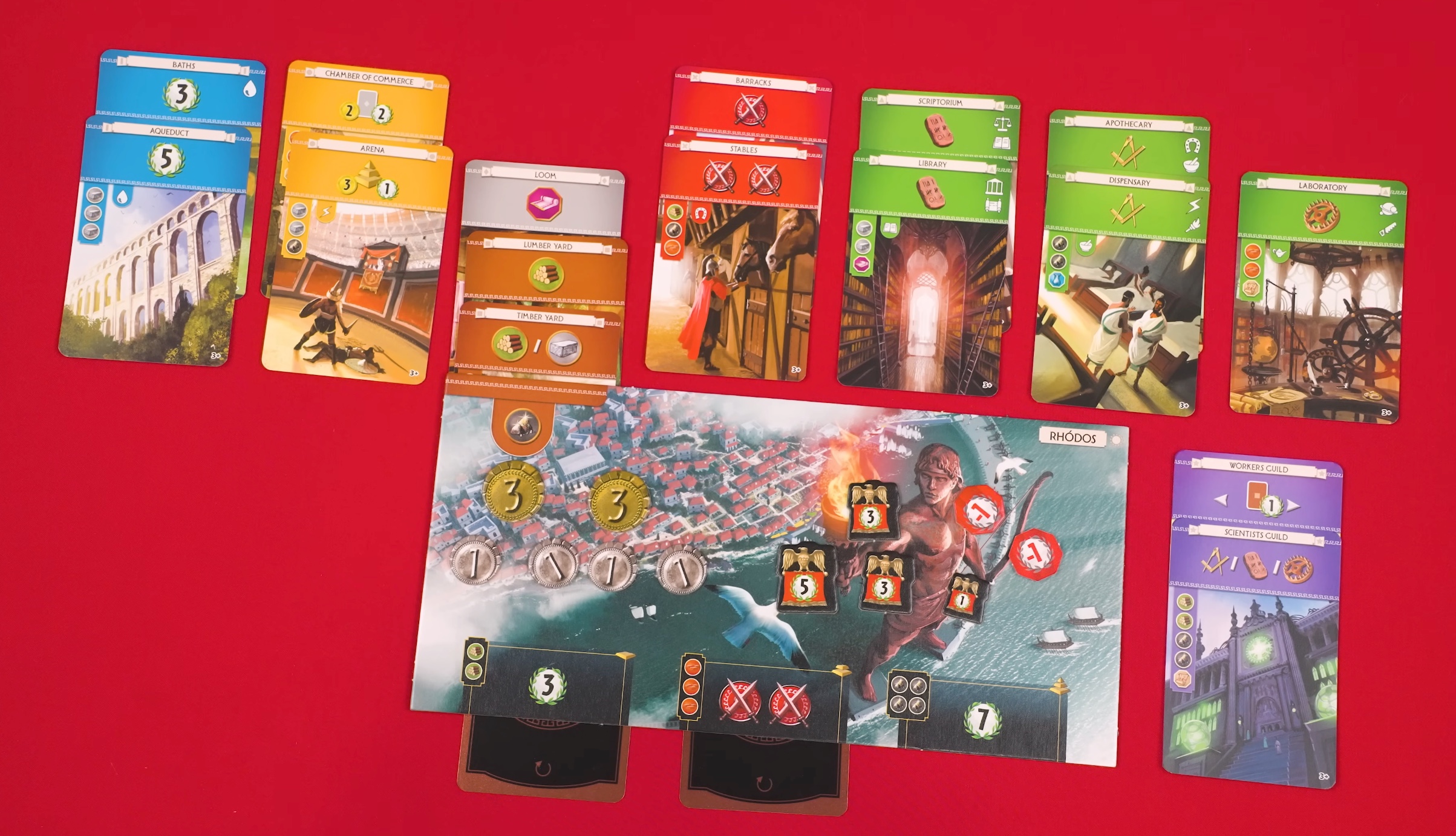
Rhodes at the Age II boundary - blue civilian cards (left), military (centre-left), science (right), and coins on the board.
Step 1 - Blue Civilian Cards
Two blue cards are visible on the left: one is worth 5 VP (the Aqueduct), the other 3 VP (the Baths). Read the printed numbers - no formula required.
Step 2 - Military Tokens
The board shows the military token stack. We have one military token of (+5 VP), two tokens of (+3 VP), one token of (+1 VP) and two red defeat tokens of (−1 VP each). Count the tokens, don't guess.
Step 3 - Science (the key calculation)
Four green cards sit on the right. Identifying the symbols on each card is the only step that requires a moment of attention. The science image below shows the exact seven cards in detail - we'll use three of them here (the rest are worked through separately in the next section).
In this tableau the four Age I–II science cards show: 2 Compasses, 1 Gear, and 1 Tablet. Apply the formula - square each symbol count, then add 7 for every complete set of all three symbols:
Step 4 - Treasury
The coin tokens on the board count 2x3 coins and 4x1 coin, for a running total of 10 coins. At 1 VP per 3 coins, that's 3 VP - easy to forget, easy to round down.
Step 5 - Wonder Stage
The Rhodes board shows one completed stage built so far, worth 3 VP (the printed value on the stage).
Running Total at Age II Boundary
At a 7-player table the average winning score is around 52 VP. This player needs approximately 19 more points from six Age III cards - about 3.2 VP per card on average. That's achievable, but only if every Age III pick is direct VP: blue cards, guilds, or one more science card to boost the squaring formula. A commercial card that gives 2 coins and 0 VP is not an option this player can afford.
The Science Formula, Card by Card
Science is the category most players underestimate - or estimate wrong - mid-game. The squaring rule creates non-linear growth that is genuinely counter-intuitive until you see it worked out on real cards.
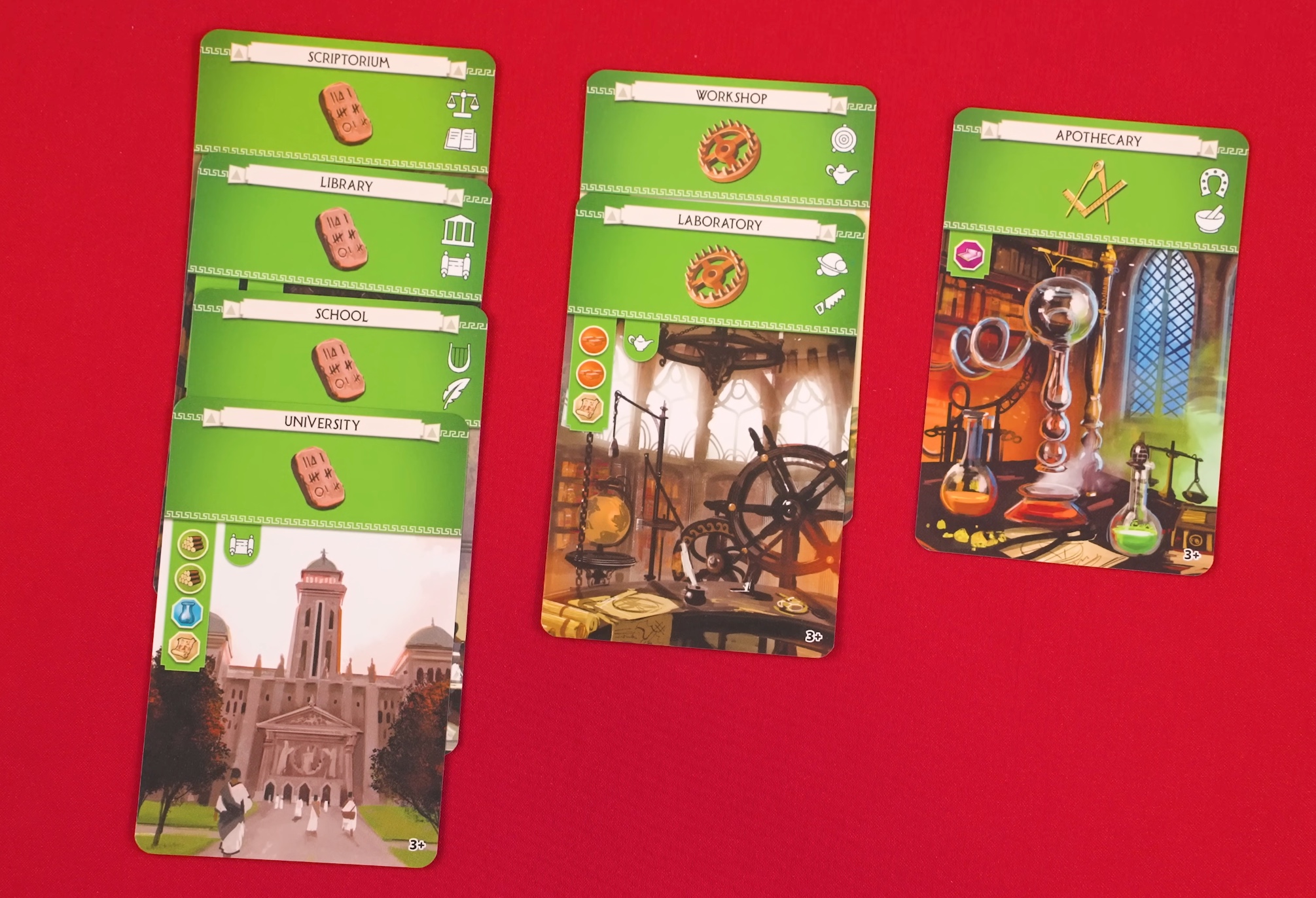
Seven science cards: four Tablets, two Gears, one Compass - a powerful stack that rewards the exact math.
The cards in the photo are, from left to right: Scriptorium (Tablet), Library (Tablet), School (Tablet), University (Tablet) - four Tablet cards stacked; then Workshop (Gear) and Laboratory (Gear) side by side; and finally Apothecary (Compass) on the right. Let's calculate the exact VP for this seven-card science stack.
Now watch what happens if this player drafts a single additional Compass in Age III - bringing the stack to 4 Tablets, 2 Gears, 2 Compasses:
One card. +10 VP. That is why experienced players hate-draft science cards even when they're not running science themselves - and why any player who doesn't track the symbol counts mid-game will routinely underestimate a neighbour's green stack by 10–15 VP.
Identifying Your Pivot Point
A Pivot Point is the moment in a game where continuing to build your engine stops being optimal and pivoting to pure point-gathering becomes correct. For most 7 Wonders strategies, this happens at the end of Age II. By then, your resource base is largely set; Age III should be dedicated to converting resources into VP through blue, purple, and green cards.
Concrete example: Suppose you hold the Caravansery (a yellow resource card) and a Senate (5 VP blue card) in your Age III hand. Your existing resources already cover all affordable Age III builds. Taking the Caravansery produces 0 direct VP and resources you won't use - the Senate is the correct pick. Recognising this is recognising your Pivot Point.
| Strategy | Typical Pivot Timing | Why |
|---|---|---|
 Blue civilian Blue civilian | End of Age II | Age III blue cards are direct VP with no diminishing returns |
 Military Military | Mid Age II | Military scoring locks at each Age boundary - no late gains |
| Science | Late Age III | Each added symbol triggers exponential VP growth |
| Guilds | Age III only | Guilds are exclusively Age III; build tableau first |
New players often keep building infrastructure long after the returns have diminished, leaving VP on the table in the final Age. The Pivot Point also varies by strategy. Science players pivot later - adding one more symbol in Age III can trigger exponential gains. Military players should pivot earlier, since military scoring is locked in at each Age boundary.
Estimating Your Opponents' Standings
Watching your neighbours' tableaux is just as important as building your own. Count their blue cards mid-game. Notice whether they're accumulating green science cards. If a neighbour has three Guilds entering Age III, they're likely aiming for 15–20 VP from purples alone.
You don't need to track every card - focus on the category that seems to be their primary engine. Adjust your own choices accordingly: blocking a critical science card by drafting it away can be worth more than its face value. In 7 Wonders, you draft from a shared pool, which means every card you take is also a card your neighbours don't get. Hate-drafting - taking a card specifically to deny it to a rival - is a legitimate and often decisive strategy.
The Danger of Points Traps
A Points Trap is an action that appears high-value in isolation but costs you tempo relative to alternatives. Building a Wonder stage that gives 6 VP sounds great - unless the cost requires two resources you could have used to play three civilian cards totalling 9 VP. Always compare the opportunity cost, not just the face value.
Commercial cards with coin income are a classic trap for new players. Coins convert to 1 VP per three at game end - never chase coins at the expense of direct VP unless you're also using them to fund expensive cards you couldn't otherwise afford. A card that gives you 3 coins sounds like future VP, but in practice those coins often go unspent or buy a card worth fewer points than a direct VP card would have.
- The Wonder Trap: Building a stage for 6 VP when three cheap blue cards would give 9 VP in the same Ages
- The Coin Trap: Accumulating coins beyond what you can spend on VP-generating cards
- The Resource Trap: Over-building production in Age III when resources are already abundant
- The Military Trap: Contesting military in Age III when the enemy is too far ahead to catch
The antidote to Points Traps is systematic mid-game estimation. When you've developed the habit of counting your approximate score at Age transitions, you naturally start comparing the VP value of your alternatives rather than grabbing whatever looks most appealing in the moment.
Time-Pressure Decisions and Score Estimation
Many games impose a turn count that creates pressure in the final rounds. Wingspan ends after four rounds; 7 Wonders ends after three Ages of six cards each. Knowing your approximate score at the midpoint allows you to prioritise time-sensitive actions correctly.
If you're entering Age III in 7 Wonders trailing by 12 points, you know that no incremental improvement will win - you need a high-ceiling play, even a risky one. That might mean pivoting entirely to science when you only have two green cards, banking on drafting three more in Age III. It's unlikely - but trailing by 12 points with no pivot is a certain loss, and a risky pivot is a possible win.
Time-pressure decisions made without score context tend to be reactive. Decisions made with a rough score in mind tend to be strategic. The difference is the habit of estimation.
Using a Scoring App as a Live Companion
A scoring app can serve as a live companion during play, not just at the end. After each Age, spend sixty seconds entering your military results and any Wonder stages completed. This gives you a partial score that helps calibrate your estimation instincts.
The running tally won't be complete until end-game, but it grounds your rough-counting in reality. Over many sessions, you'll find your estimation accuracy improves dramatically - because you're constantly comparing your mid-game guesses to the final results. Within a month of this practice, you'll be able to estimate the final standings within 5 points just by looking at the tableaux.
How to use the Score Keeper mid-game on Game Night Pro: open the tool before Age I begins, enter player names, and log military results immediately after each Age boundary. The partial totals visible on-screen give everyone at the table a live leaderboard. Scores that aren't yet calculable - science, guilds - simply stay at zero until end-game entry, but military and wonders alone are enough to tell you whether you're in the race.
Common Mid-Game Estimation Mistakes
- Optimism bias: Assuming you're ahead without actually counting - leads to complacency in Age III
- Ignoring military losses: −1 VP per loss compounds; six losses across three Ages = −6 VP, a swing of up to 24 vs. a full-win player
- Linear science counting: Estimating science as 1 VP per symbol rather than squaring - leads to dramatically undervaluing a neighbour's green stack
- Forgetting coin VP: Treasury converts at 1 VP per 3 coins - easy to omit from a rough mid-game estimate
- Overlooking yellow end-game VP: Cards like the Lighthouse and Arena give VP at game end, not just coins - count them in your estimate
Try the Tool
Put mid-game estimation into practice. Open the 7 Wonders Calculator, enter military results after each Age, and let the running tally calibrate your instincts in real time.
🏛️ Open the 7 Wonders Calculator →