
Eurogames vs. Ameritrash
Scoring Philosophies, Player Psychology, and Which Genres Actually Need a Calculator
Scoring Is Not Accounting - It's Design Intent
Every board game's scoring system is a philosophical statement. It tells you what the designer believes victory should mean: whether winning is a story you can tell, a number you optimised, a performance under pressure, or a combination of all three. Before comparing Eurogames and Ameritrash at the genre level, it's more useful to understand what different scoring systems are actually trying to accomplish - because that's what determines whether you need a calculator, a tracker, or nothing but your memory.
There are roughly four distinct scoring philosophies at work in modern board games, and they cut across genre lines more than the Euro/Ameri divide suggests:
- Deterministic point accumulation - Every action has a defined point value. The winner is whoever optimised most efficiently. (Agricola, Wingspan, Through the Ages)
- Existential/elimination scoring - The score is binary: you're in the game or you're not. (Risk, Coup, most deduction games)
- Hidden VP with revelation - Points accumulate secretly and reveal creates a social moment. (Coup objectives, Concordia, some engine builders)
- Narrative scoring - Winning is defined by completing a story objective, not accumulating the most. (Pandemic, most co-ops, thematic Ameritrash)
The Eurogame Scoring Experience: Precision as Satisfaction
European-style games - Catan, Agricola, Carcassonne, Viticulture - are characterised by point-based victory conditions, low luck, high strategy, and minimal player elimination. Their scoring systems are typically multi-layered: resources convert to buildings convert to VP; workers placed convert to actions convert to points. The chain of causality is traceable and plannable.
"I can see exactly where I fell behind. I over-invested in yellow cards in Age II and gave up the science lead in III. Next time I'll pivot earlier."
"I was one action away from escaping the cultists. That story will be told at this table for years. I'd lose again tomorrow if it meant another moment like that."
Neither loss experience is inherently better. But they produce fundamentally different player relationships to the score. Eurogame players often want to understand the final margin: who was ahead going into the last round? Which category decided it? A 3-point loss in Viticulture can feel like a chess post-mortem - instructive and motivating. This is exactly the environment in which score history and traceable per-category data has the most value.
The determinism in Eurogame scoring is also part of the genre's appeal. In Agricola, every animal, crop, and family member has a precise point value that feeds into a web of interconnected conditions. Mastering that web is the game - and tracking your mastery over time is meaningful. When you lose a Eurogame, you rarely blame luck. You can almost always identify the specific decisions that cost you the win, which makes you want to play again and fix them.
Ameritrash Scoring: Drama Over Arithmetic
American-style games - Risk, Axis & Allies, Descent, Arkham Horror - prioritise narrative, theme, and dramatic moments over mathematical optimisation. Traditional American games often used elimination: the last player standing wins. There's no VP tally; the scoring system is existential. Either you're in the game or you're not.
Modern Ameritrash has evolved to include victory conditions (completing objectives before the game eliminates you), but the emphasis remains on story and drama rather than score optimisation. Losing in a thematic Ameritrash game often feels better than losing in a Eurogame, because you can point to a dramatic moment rather than a suboptimal decision tree.
Concrete example: In a session of Arkham Horror: The Card Game, one player's character was devoured by an elder god in the penultimate act. She lost - definitively - but she spent the next hour recounting the scene to anyone who'd listen. In a Viticulture session the same week, a different player lost by 2 points and spent the same hour quietly reviewing which wine orders he should have prioritised. Both are valid forms of engagement; they're just driven by entirely different scoring philosophies.
This explains why Ameritrash games rarely benefit from sophisticated scoring apps: the score either doesn't exist (elimination) or is binary (completed objective / didn't). The drama is the tracker.
The Genre Landscape: Luck, Strategy, Theme & Mechanics
Plotting popular titles on two axes reveals why the Euro/Ameritrash divide is a spectrum, not a binary. The horizontal axis runs from pure luck (left) to pure strategy (right). The vertical axis runs from mechanics-first (bottom) to theme-first (top). The quadrant a game occupies tells you more about its scoring philosophy than any genre label.
Two Hybrids Under the Microscope
Rather than name-drop games as genre examples, it's worth spending real time inside two of the most studied hybrids on the market. Both Scythe and Blood Rage sit in the top-right quadrant of the matrix above - but they get there by completely different routes, and their scoring systems reflect that difference precisely.
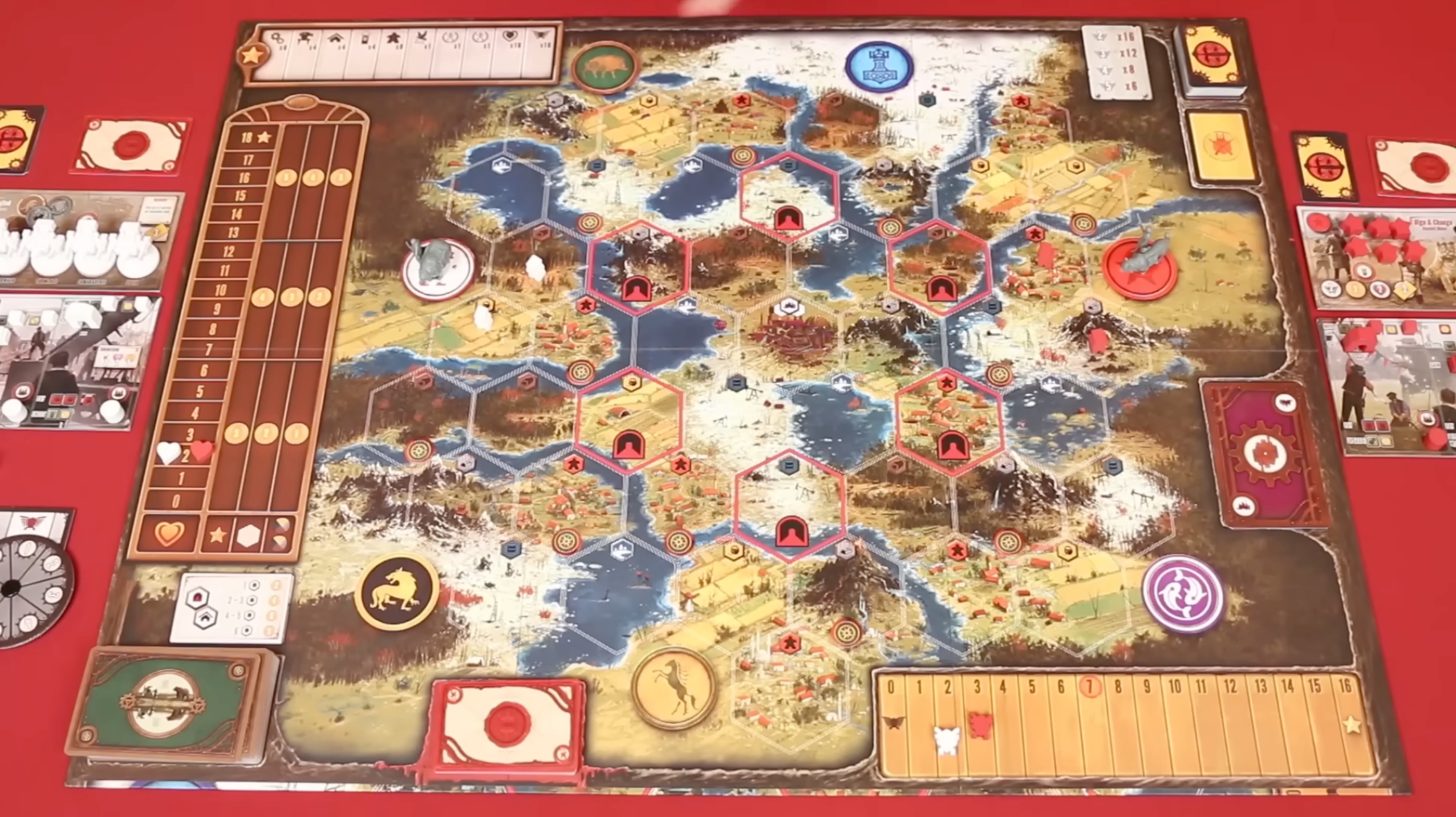
Everything except raw coins is multiplied by your final popularity tier (1×, 2×, or 3×). This single multiplication step is responsible for the majority of final-score calculation errors at the table.
Scythe's genius - and its scoring trap - is the popularity multiplier. Your score is not a simple sum; it is a product. Stars, territories, and resources are each multiplied by a popularity tier you spend the whole game shaping. This means a player with fewer territories but higher popularity can outscore someone who controlled the board for three-quarters of the game. That inversion is intentional design: it forces players to manage two parallel economies (raw output and soft power) simultaneously.
From a Euro perspective, Scythe is extremely pure. The encounter cards inject occasional narrative flavour, but the combat system - the most "Ameritrash" feature on the surface - is actually resolved without dice. You secretly commit resources; the higher bid wins. Luck is nearly absent. What looks like a war game plays like a resource optimisation puzzle wearing a war game's coat.
Why it needs a digital tracker: The popularity multiplier is the specific moment where pen-and-paper scoring breaks down. In the 30+ sessions our community has tracked, the most common error is players calculating stars × territories × resources first, then applying popularity - instead of applying popularity to each category separately. A pre-built template that handles the multiplication per-category eliminates that error entirely and typically saves 8–12 minutes of end-game arithmetic per session.
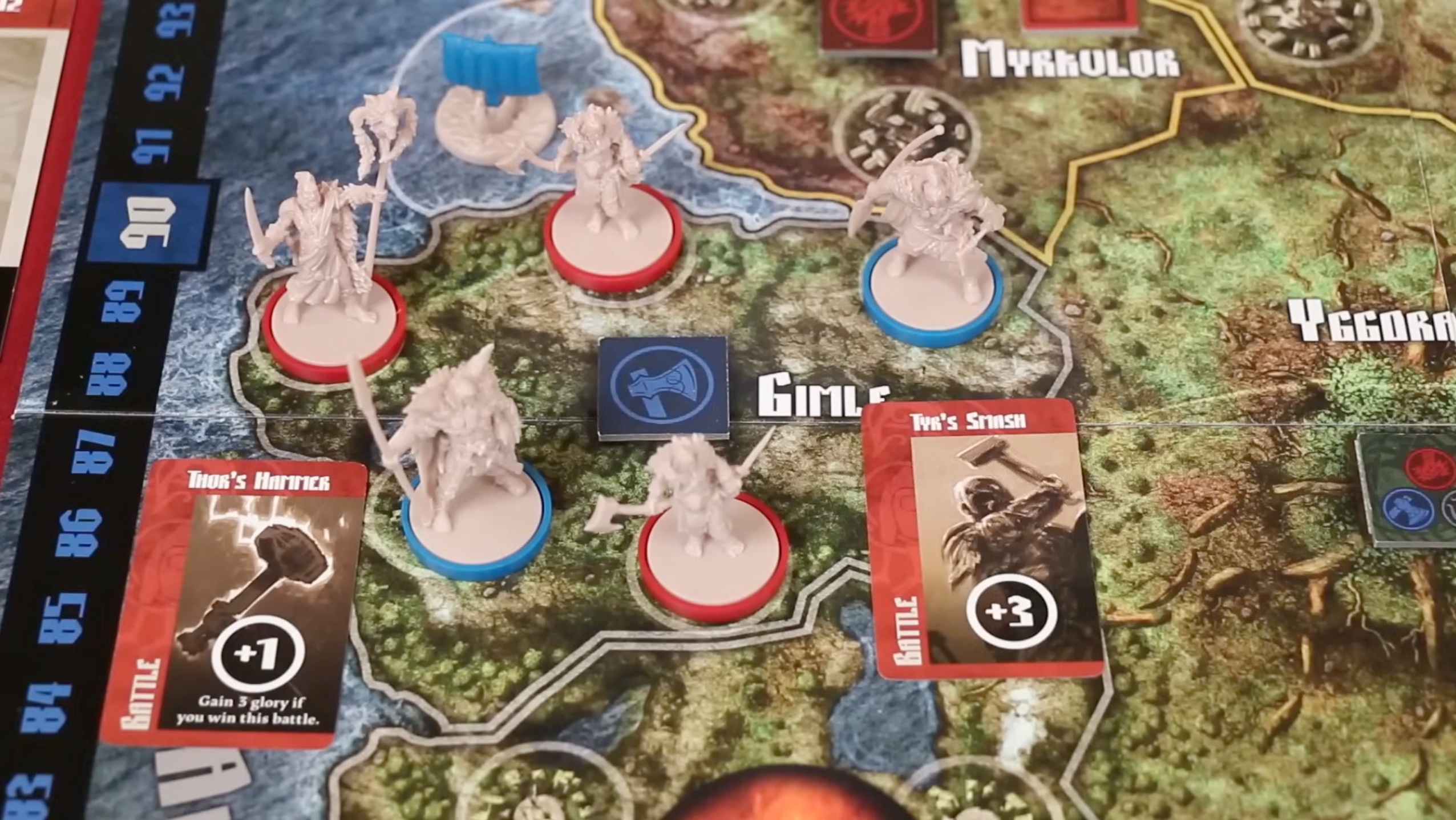
Glory accumulates incrementally across three Ages rather than in a single end-game tally, making running totals visible - a rarity in games this thematic.
Blood Rage's most subversive design decision is its combat system: there are no dice. Combat strength is the sum of your clan's base strength plus cards you secretly play from your hand. The player who commits the higher total wins. This means every "battle" is actually a bluffing and resource management decision made in the drafting phase, two steps earlier. By the time miniatures clash, the strategic decisions are already locked in.
This creates a paradox that defines the hybrid experience: the game looks like the most Ameritrash product on your shelf - 100+ detailed plastic Viking miniatures, a blazing Norse map, monsters from legend - and yet the decisions driving every outcome are as coldly logical as any Euro. You draft the cards that will win your battles before you decide which battles to fight. The narrative is ornamental; the engine underneath is deterministic.
Blood Rage also weaponises what most games treat as failure. Certain drafted cards reward you for losing battles or having your warriors destroyed by Ragnarök. A skilled player can draft a "glorious death" engine, deliberately lose every confrontation, and win the game on glory accumulated through defeat. No other scoring system so completely inverts the intuitive relationship between the board state and the score.
Why scoring tracking matters differently here: Unlike Scythe's end-game multiplication, Blood Rage scores incrementally - glory is awarded after each Age. This makes running totals meaningful throughout the game, and it's exactly the scenario where mid-game score visibility changes strategy. A player noticing they're 8 glory behind after Age I should be drafting differently for Age II. Without a visible tracker, that signal is invisible until too late.
Hybrid Games: Where Scoring Complexity Gets Expensive
The most exciting category in modern board game design is the hybrid: games that blend Eurogame scoring precision with Ameritrash thematic drama. Scythe is the canonical example - deep VP accumulation mechanics (classic Euro) wrapped in an alternate-history world of giant mechs and conflict (classic American). Blood Rage awards points for combat victories (American) through a hand-drafting engine-building system (Euro).
Hybrid games are where scoring tools earn their keep most decisively. The problem: they combine multiple VP sources (action points, card effects, end-game objectives) with event-driven score modifications (battles, quests, drama). A digital tracker handles this gracefully where paper scorecards struggle. When your game has three different scoring phases and two categories that only activate conditionally, a pre-built template is worth far more than a blank sheet of paper.
Concrete case - Scythe: End-game scoring in Scythe involves coins in hand, multiplied by popularity tier for stars earned, territory controlled, and resources on the board. The multiplication by popularity tier is the specific step where handwritten scoring goes wrong in nearly every session we've tracked. A digital template handles the multiplication automatically, removing the one step most prone to error.
Which Genres Actually Need a Calculator - and Why
Here's the framework for thinking about digital tool necessity by genre and scoring type:
| Genre / Scoring type | Tool need | Reason |
|---|---|---|
| Complex Eurogames (6+ scoring categories) | High | Multi-category end-game tabulation; error rates high without tools |
| Hybrid games (Scythe, Blood Rage) | High | Conditional multipliers and cross-category interactions compound errors |
| Mid-weight Euros (Catan, Carcassonne) | Medium | Simple enough for paper but digital saves 5–7 minutes and prevents disputes |
| Hidden VP games (Concordia) | Medium | Reveals are social; a tracker preserves the revelation while ensuring accuracy |
| Thematic Ameritrash (Arkham Horror) | Low | Narrative/objective scoring; no running tally to manage |
| Elimination games (Risk, Coup) | Low | Scoring is existential - alive or eliminated. No arithmetic required. |
What the Scoring System Says About a Game's Soul
A game's scoring system is one of the most revealing design choices its creator makes. Point salad says: "We want everyone to feel they're contributing, and we want the result to be uncertain until the end." Elimination scoring says: "We want maximum drama and genuine stakes." Hidden VP says: "We want bluffing and uncertainty to be strategic tools."
Understanding this helps you choose the right game for the right night. A group of competitive, analytical players will usually prefer a precise Eurogame where skill determines the outcome. A mixed group that includes casual players and non-gamers often has more fun with a thematic Ameritrash game where everyone has a story to tell at the end, regardless of who won.
The practical implication for your game library: stock at least one title from each scoring philosophy. A point-salad Euro like Viticulture, a narrative game like Arkham Horror, and a hybrid like Scythe covers most groups and moods. And use your scoring tool strategically - bring it out for the Viticulture, skip it for the Arkham Horror, let the drama speak for itself.
Choosing the Right Scoring Tool for Your Style
Here's a checklist for evaluating whether a scoring tool fits your gaming style:
- Does it support pre-defined game templates, not just blank fields? (Critical for complex Euros)
- Can you add custom categories for hybrid games that mix standard and event-driven scoring?
- Does it display all players' scores simultaneously, supporting mid-game visibility?
- Is the interface usable one-handed at a crowded table at 11pm?
- Does it preserve session history so your Viticulture losses are actually instructive?
- Can you skip using it for a simple Ameritrash session without losing your previous data?
Ready to put these insights into practice? The Score Keeper handles Eurogame complexity, hybrid scoring, and everything in between - free, no account required.
🎲 Open the Score Keeper →