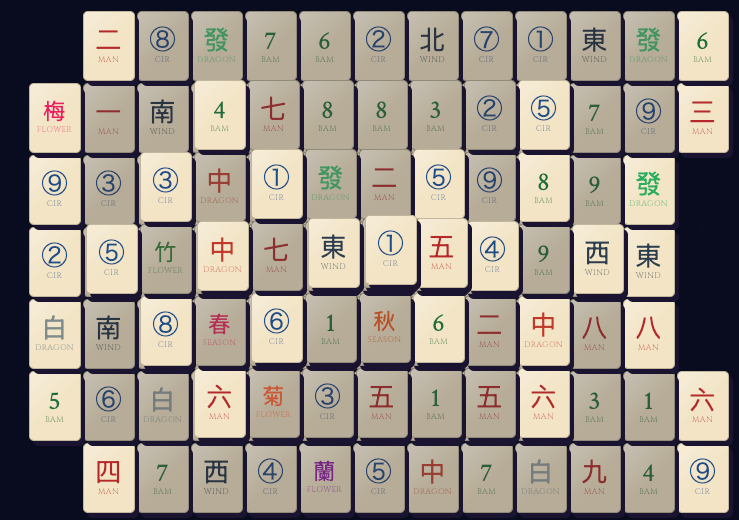
Mahjong Strategy Guide
Hand Efficiency, Defensive Play, Yaku Tactics & the Mental Game
More Than Luck, Less Than Chaos
Mahjong is often dismissed as a luck game by people who lose at it consistently. It isn't. Like poker, it sits in the precise space where variance is real but skill is decisive over a session. The tiles you draw matter — but how you read the table, build your hand, protect your points, and manage pressure determines whether you finish in profit or ruin.
This guide covers the four pillars that separate consistent winners from perpetual losers: hand efficiency, defensive awareness, tactical decision-making, and the psychological discipline to execute your strategy when the table turns against you. Whether you play Riichi Mahjong, Hong Kong rules, or a Western variant, the underlying principles apply universally.
A Brief History of Mahjong
Mahjong's precise origins are contested, but the game most likely emerged in China during the mid-19th century, probably in the Jiangsu or Anhui provinces around the 1870s. The most widely cited tradition credits its invention to Chen Yumen, a nobleman from Ningbo, though no definitive historical record confirms a single inventor. What is certain is that by the 1880s the game had spread rapidly through the merchant and official classes of the Qing dynasty, played with carved bamboo and bone tiles that closely resemble those used today.
The tile set reflects a world steeped in Chinese culture. The three suit tiles — bamboo (bams), circles (dots), and characters (cracks) — represent units of traditional Chinese currency: cash coins strung on rods, the coins themselves, and the written denomination. The winds (East, South, West, North) and dragons (Red, Green, White) echo cosmological and philosophical traditions stretching back centuries. The flower and season tiles, present in many regional variants, were added later as decorative bonuses.
The game reached the West in the early 1920s following an explosive export campaign. American businessman Joseph Park Babcock learned Mahjong in China during a Standard Oil posting, simplified the rules for Western play, and published an English rulebook in 1920. His version — sold under the brand name "Mah-Jongg" — became a cultural phenomenon in the United States by 1922–23. Mahjong sets became fashionable accessories; department stores could not keep them in stock. The craze was so intense that Chinese craftsmen reportedly worked day and night to supply enough tiles, sometimes substituting calf bones for the traditional materials. The American craze peaked around 1924 before fading, but the game never fully disappeared.
Japan received Mahjong around 1909, and the Japanese variant evolved the most distinctly. Riichi Mahjong — now the dominant competitive format globally — introduced the riichi declaration mechanic (staking a bet when your hand reaches tenpai), the dora bonus tile system, and a codified scoring structure built entirely around yaku (valid scoring patterns). The Japanese Professional Mahjong League (JPML), founded in 1981, legitimised competitive play. Today, Riichi Mahjong is played internationally, streamed live, and featured in major e-sports adjacent tournaments — while across Asia, dozens of regional variants (Cantonese, Taiwanese, Singaporean, American) continue to thrive side by side.
1. Hand Efficiency — The Engine of Winning
Every winning hand starts as a pile of unconnected tiles. The question is how quickly and reliably you can convert those tiles into a complete hand — and that question is answered almost entirely by how you manage your discards and evaluate your draws.
Prioritise early discards ruthlessly. Isolated terminals (the 1s and 9s of each suit) and honours (winds and dragons you have no triplet interest in) are the biggest hand-efficiency killers. They almost never form the middle of a sequence, they can only connect in limited ways, and holding them early gives you false comfort while your shanten count stagnates. Discard them in the opening turns unless you have a specific reason — honour triplets in a hand targeting a high-value yaku — to keep them.
Understand shanten and play to reduce it. Shanten is the number of tiles you still need to reach tenpai (one tile from winning). A hand at 0-shanten is in tenpai. Every discard decision should be evaluated through the lens of: does this bring my shanten number down, hold it steady, or — worst — increase it? Tiles that can "float" across multiple partial sequences (a 4 of bamboo connecting with both 2–3 and 5–6, for example) are disproportionately valuable because they keep multiple pathways to tenpai open simultaneously. Discard tiles that serve only one narrow purpose before tiles that serve several.
Calling discipline is a silent skill. Chii (claiming a discard to complete a sequence) and Pon (claiming a discard to complete a triplet) accelerate your hand but impose costs many players underestimate. Every call reveals partial information about your hand structure to opponents, narrows your yaku options (in Riichi Mahjong, a called hand cannot declare riichi and loses access to several yaku entirely), and closes off defensive pivots. The general rule: only call when the tile advances you meaningfully toward a yaku you're already committed to, and you've weighed the intelligence cost. A called hand that has no valid yaku cannot win — calling into a dead end is one of the most common beginner mistakes.
2. Defensive Play — The Art of Survival
In most competitive Mahjong formats, dealing into an opponent's winning hand costs you points — sometimes catastrophically. Defence is not passive; it is an active, skilled discipline that determines whether you minimise your losses or haemorrhage your lead.
Read the table continuously. Every discard your opponents make is a data point. A player who discards early bamboo tiles and holds middle characters is likely building a character flush (honitsu) or a full-flush hand (chinitsu). A player discarding honours and low terminals is probably chasing a clean, fast hand. Track what has been discarded from each suit and update your threat model each turn. The player who is the most dangerous is not always the one who called last — it's the one whose discard pattern suddenly went quiet.
Build a safe-tile buffer. Any tile that has already been discarded by all players is a completely safe discard — no one holding a partial set containing that tile type can be waiting for another. As the round develops, identify your safe tiles and hold at least one or two if the threat level rises. Tiles that have been discarded three times in full view of the table are nearly safe; wind and dragon tiles that have been played and claimed as honours are contextually safe against specific opponents. This buffer is your insurance policy for the moment you need to fold.
Know when to fold. Folding — deliberately discarding safe tiles to avoid dealing in, rather than continuing toward your own win — is a legitimate and important strategy. If an opponent declares riichi, you are mathematically guaranteed they are in tenpai. If your own hand is multiple shanten away and your remaining tiles are dangerous to discard, fold without hesitation. The goal is not to win every hand; it's to maximise your total point differential across the full session. A dealer win costs you far more than a round you escape with a draw. Practising on our Mahjong table is a good way to build the instinct for when folding is the correct call without the pressure of real stakes.
3. Tactical Decision-Making — Speed vs. Value
Every hand presents a fundamental strategic choice that most players never consciously make: am I building for speed or for value? Getting stuck between these two goals — pursuing a slow, high-scoring hand without committing to the patience it requires, or playing fast with no scoring pattern — is where most hands go wrong.
Commit early. By turn four or five, you should have a clear direction: a fast tanyao (all simples, no terminals or honours) hand to close the round quickly, a value hand targeting multiple yaku, or a flush build targeting a large payout. Switching directions mid-hand is expensive in shanten. The tiles you've discarded to support one direction are gone; re-routing means effectively starting over with a smaller hand.
Positional awareness changes everything. Your optimal strategy depends entirely on where you sit in the score table and the dealer rotation. If you are in first place with a comfortable lead, fast low-scoring hands protect your position — ending rounds quickly limits the opportunities your opponents have to close the gap. If you are in last place approaching the final dealer rotation, you need a high-scoring hand, which means accepting higher risk and taking calculated gambles on building complex yaku. General principles of improving game strategy apply here: always know your win condition before choosing your approach.
Never play without a yaku in Riichi Mahjong. This sounds obvious, but called hands that inadvertently block all scoring patterns are extremely common. Before any Pon or Chii call, verify that your target hand will still have at least one valid yaku after the call. Tanyao (all simples) is the most forgiving — it survives most calls. Yaku that depend on a closed hand (riichi, menzen tsumo, iipeiko) are destroyed the moment you call. Know your yaku before you build toward them, not after.
4. Psychological & Mental Aspects
Mahjong rounds are long, variance is high, and bad runs happen to everyone. The mental game is not a soft supplement to the technical game — it is half of it.
Variance is not injustice. Mahjong has a higher short-term variance component than chess or Scrabble. A skilled player can lose three consecutive hands to legitimate bad draws and still be making every correct decision. The worst response to a bad run is to abandon your strategy and chase a high-risk hand you wouldn't otherwise build — what poker players call "tilt." Tilt does not recover lost points; it accelerates the loss. Your strategy is correct or it isn't — evaluate that question across sessions, not within a single bad round.
Observe the table's rhythm. Beyond tile-reading, pay attention to the pace and pattern of how specific players draw and discard. A player who pauses significantly before each discard is often reassessing a complex hand — they may be closer to tenpai than their call history suggests. A player discarding quickly in a late round is often folding. A player who has won two consecutive hands as dealer is statistically in a hot streak that may create overconfidence — watch for ambitious hands that are slightly under-defended. These are soft reads, not guarantees, but they compound correct technical decisions.
Stay patient with slow hands. Some of the highest-value hands in Mahjong — sanshoku (three-colour straight), ittsu (pure straight), or any flavour of flush — require twelve or thirteen specific tiles and significant patience. Players who abandon these hands at the first sign of slow development miss the point: the size of the winning payout is compensation for the time invested. If your hand is genuinely progressing and the threat environment is manageable, stay the course. Using Game Night Pro's Score Keeper to track cumulative points across an evening makes the long-game payoff visible in real time and reinforces the discipline of playing out a high-value hand rather than bailing early.
A Round in Detail: Four Players, Final East Round
It's East 4 — the final round before the South rotations. You are sitting in second place, 8,000 points behind the leader. Your starting hand has two pairs of bamboo tiles (3–3 and 7–7), a partial character sequence (4–5), and a mix of isolated terminals. The dealer to your left has already won two consecutive hands.
The temptation: Chase a complex hand to close the gap in one strike. You have the pairs, and a tanki (single-tile) wait on multiple pairs could theoretically deliver chiitoitsu (seven pairs) — a fixed 25-point hand in Riichi rules.
The correct read: Chiitoitsu requires collecting seven distinct pairs. With four turns elapsed and only two pairs confirmed, you are at minimum 2-shanten from that yaku. The dealer is hot and likely to win again before you get there. Your fastest realistic route to tenpai is abandoning one pair, extending the 4–5 character run, and targeting a simple tanyao hand you can close quickly.
On turn seven you discard the isolated terminals, reach tenpai on a 3–6 character wait, and win on a self-draw on turn nine. The hand closes the round with a modest but real 1,000-point gain — not the 8,000 you needed, but you've preserved second place and given yourself another rotation. This is Mahjong's core tension: the correct play is usually the one that gives you more turns, not the one that promises the biggest single payout.
Pre-Discard Checklist
Before every discard, run through this checklist. It takes two seconds once internalised and prevents the most common strategic errors.
- Does discarding this tile reduce my shanten, or does it increase it?
- Is this tile dangerous to discard right now — has it appeared fewer than two times in the discard pile?
- If I call on the next discard, will my hand still have a valid yaku?
- Do I have at least one confirmed safe tile in hand if I need to fold this round?
- Am I still on the correct speed/value track — fast close or high-value build?
- Is any opponent's discard pattern signalling tenpai or a flush that my discard feeds?
- Does my current position in the score table justify the risk level of my chosen hand?
Ready to put these strategies into practice? Play a full game on Game Night Pro's Mahjong table and test your hand efficiency and defensive reads in a real session.
Play Mahjong Now →