How to Win at Scrabble
Rack Management, Bingo Strategy, Short Words, and Board Control
The Game That Rewards Vocabulary Less Than You Think
Scrabble has an undeserved reputation as a game for people who know big words. It isn't. It's a game about geometry, probability, and resource management — and most of the vocabulary that matters fits on a single page. Knowing obscure ten-letter words is almost useless if you're handing your opponent Triple Word Score squares, playing tiles that leave you with UUUVWW, or ignoring the 50-point bonus for using all seven tiles.
The Collins guide 101 Ways to Win at Scrabble makes this clear from the start: the players who improve fastest aren't the ones who memorise the dictionary. They're the ones who understand how to manage their rack, how to read the board, and how to balance short-term score against long-term position. This article covers each of those pillars in depth, grounded in real game-night scenarios you'll recognise from the Scrabble table.
A Brief History of Scrabble
Scrabble was invented by Alfred Mosher Butts, an unemployed American architect, during the Great Depression. In 1938 he designed a game he called Criss-Cross Words — a tile-placement game that combined the structure of a crossword puzzle with the hand-management of anagram games. Butts hand-crafted sets and sold them to friends, but no manufacturer was interested.
The game's fortunes changed in 1948 when entrepreneur James Brunot licensed the design, renamed it Scrabble (from the Dutch word meaning "to scratch or scrape"), and began small-scale production. Sales were modest until 1952, when the president of Macy's department store played the game on holiday and returned to New York puzzled that his stores didn't stock it. Macy's placed a large order, and within a year Scrabble had become a national phenomenon — more than 35 million sets were sold in the two years that followed.
Selchow and Righter acquired the North American rights in 1953. The game passed through several corporate owners over the decades — Coleco in 1986, then Hasbro in 1989, who still hold the North American trademark today. Outside North America, Mattel owns the rights. This split explains why competitive Scrabble has two parallel ecosystems: the North American OSPD/TWL word list and the Collins Scrabble Words list used in international and British play, which includes around 276,000 valid words — roughly 100,000 more than the North American edition.
The first North American Scrabble Championship was held in 1978. The World Scrabble Championship launched in 1991 and has been held biennially ever since, contested entirely under Collins rules. Today, competitive Scrabble is played in over 30 countries, with particularly strong traditions in the United Kingdom, Nigeria, Malaysia, and Thailand — nations where English is a second language but whose top players routinely defeat native English speakers, underlining the point that Scrabble rewards strategic thinking over raw vocabulary far more than most people expect.
Board Vision: Hooks and Parallel Play
Most players scan the board looking for a place to fit a word they already have in mind. Expert players do the opposite: they scan the board for opportunities first, then find words that exploit them. Two of the most important opportunities to spot are hooks and parallel plays.
Hooks are letters that can be added to the beginning or end of an existing word to form a new one. The word TRAIN on the board? Adding S makes TRAINS — but you also score points for TRAINS, not just for the S. The word FAME? The hook B turns it into BLAME, landing on a fresh set of squares entirely. Hooks multiply your scoring options by treating existing board words as launching pads rather than obstacles.
Learning a small set of high-value hooks dramatically expands your board vision. Words that take an S hook are obvious; the more powerful skill is knowing words that take unusual front hooks. EARN takes a Y (YEARN), a L (LEARN), and a T (TERN via the stem — careful here). OWL takes a B (BOWL), a C (COWL), a F (FOWL), a G (GOWL), a H (HOWL), a J (JOWL). That's six front-hook options from a single three-letter word.
Parallel play is placing a word alongside an existing word so that multiple new two- or three-letter words are formed in the perpendicular direction. A single parallel word can score points from four or five separate word completions simultaneously. It's one of the most powerful scoring techniques in the game and is invisible to players who only think linearly.
Rack Management: Balance, Leave, and When to Exchange
Your rack at any point in the game is both your current hand and your future probability engine. Managing it well means thinking not just about what you can play now, but about what you'll be holding after you play.
The concept of the "leave" — the tiles you keep when you make a play — is central to advanced Scrabble. A play that scores 28 points but leaves you with UUIC is usually worse than a 22-point play that leaves you with AEINR. The second leave contains three of the most common consonants in English and two vowels in excellent proportion. It is statistically far more likely to combine with new tiles into a high-scoring or bingo-enabling play next turn.
Tile values to internalise: The letters S, blank, E, A, I, O, N, R, T, and L are the backbone of English vocabulary. Holding too many of the low-frequency tiles (V, W, J, Q, Z, X) or vowel-heavy racks (three or more vowels) creates dead turns. The goal is a roughly balanced rack of three vowels and four consonants, with high-frequency letters dominating.
When to exchange: The general rule is that exchanging becomes correct when your rack is so imbalanced that no reasonable draw will rescue it. A rack of AAAUUV with no vowel-heavy words available is often better served by exchanging five tiles than by playing a low-scoring two-letter word and keeping the damage. You lose a turn, but you rebalance. The exception is late game, when the bag has fewer than seven tiles — exchanges stop being available, so plan ahead.
Bingo Strategy: The 50-Point Bonus That Changes Everything
A bingo — using all seven tiles in a single play — earns a 50-point bonus on top of the word's face value. In a typical game, playing one bingo more than your opponent is often enough to win. Two bingos is nearly decisive. This makes bingo-hunting one of the highest-leverage skills in Scrabble, and it's more learnable than most players realise.
The key insight from the Collins guide is that bingos don't come from knowing long words — they come from knowing stems. A stem is a five- or six-letter combination that forms many seven- and eight-letter words when combined with common tiles. The classic six-letter stems include SATINE, RETINA, ARSINE — each combines with dozens of common letters to form valid bingos. If your rack contains one of these stems plus one other tile, you may well be holding a bingo you haven't spotted yet.
Common prefixes and suffixes are equally powerful bingo-finding tools. -ING, -ED, -ER, -EST, -TION, -NESS, RE-, UN-, OUT-, OVER- — if your rack contains one of these fragments and the remaining letters form a plausible base word, check for the full combination. Learning to recognise these patterns is far more efficient than memorising individual seven-letter words.
Rack management for bingo hunting: Keep your rack bingo-ready by prioritising the letters SATINERLOUD and their combinations. Avoid building racks dominated by consonant clusters (RSTCL) or double-letter gluts (AAEEI). A rack of AEINRST is a bingo waiting to happen — it forms RETINAS, NASTIER, ANESTRI, ANTSIER, and RATINES, among others.
The Power of Short Words: Twos, Threes, and Why They Win Games
Nothing separates casual players from serious ones more visibly than knowledge of two- and three-letter words. These short words are not just fallback plays for bad racks — they are precision instruments for board control, bonus square access, and parallel play scoring.
There are 127 valid two-letter words in the Collins Scrabble Words list. You don't need all of them. Mastering thirty to forty high-utility two-letter words transforms the board from a maze into a structured set of opportunities. Start with these high-payoff categories:
- Vowel-heavy twos: AA, AE, AI, OE, OI, OU — essential for playing off awkward vowel-heavy racks without wasting a turn.
- J, Q, X, Z helpers: JO, QI, XI, XU, ZA, ZO — the single-letter plays that turn high-value tiles into immediate points without needing a long word.
- Versatile connectors: ER, RE, EN, ES, ET, TE, EL, EE — these attach to almost anything on the board and enable parallel plays that generate multiple word scores simultaneously.
Three-letter words extend this toolkit. QAT, QI, SUQ make the Q playable without a U. ZAX, ZEP, ZIT, ZAG, ZAP give the Z flexible placement options. OWT, UPO, EME, AWE, OWE, AWL handle unusual vowel-consonant combinations. The practical goal is not exhaustive memorisation — it's knowing enough two- and three-letter words that you always have a viable play, even with a difficult rack, and that you can always access a premium square somewhere on the board.
A Concrete Rack Scenario
Your rack: E, I, N, R, S, T, A. The board has COLD running horizontally with the C on a Double Letter Score. It's your turn and there's open space above and below COLD.
The instinctive play might be to hook an S onto COLD to make COLDS (5 points) and play a separate word with the remaining tiles. But look again: AEINRST is one of the richest bingo stems in the Collins word list. It forms NASTIER, ANTSIER, RETINAS, RATINES, ANESTRI, all valid seven-letter bingos.
If you can place NASTIER or RETINAS through the D in COLD (making RETINAS cross the D to form RETINAS with D as part of a longer structure), you've played a bingo, scored the full word across whatever bonus squares it covers, and earned the 50-point bonus. That's likely 70–90 points from a rack that a less experienced player would have wasted on a 12-point play.
The lesson: before you play anything, ask whether your rack contains a bingo stem. AEINRST is the most famous, but SATINE + any common letter, and RETINA + any vowel or common consonant, will fire similarly. Check first. Play second.
Defensive vs. Offensive Play: Managing the Board
Scrabble board strategy has two modes — offensive (opening the board to maximise your own scoring opportunities) and defensive (closing lanes to deny your opponent premium squares). Knowing when to switch between them is one of the highest-leverage skills in the game.
Offensive play favours opening positions: playing words that create new Triple Word Score approaches, leaving vowel-rich hooks, and building a board with many intersecting opportunities. This is the right strategy when you have a strong rack, a lead you can build on, or tiles that are bingo-ready.
Defensive play favours closing the board: avoiding plays that open Triple Word Score lanes, placing words that block high-value hooks, and keeping the board "tight" with few open spaces. This is correct when your opponent has a significant tile advantage (they've drawn the blanks and S tiles), when the score is close in the endgame, or when you're holding a strong bingo and want to wait for the right lane without letting your opponent score first.
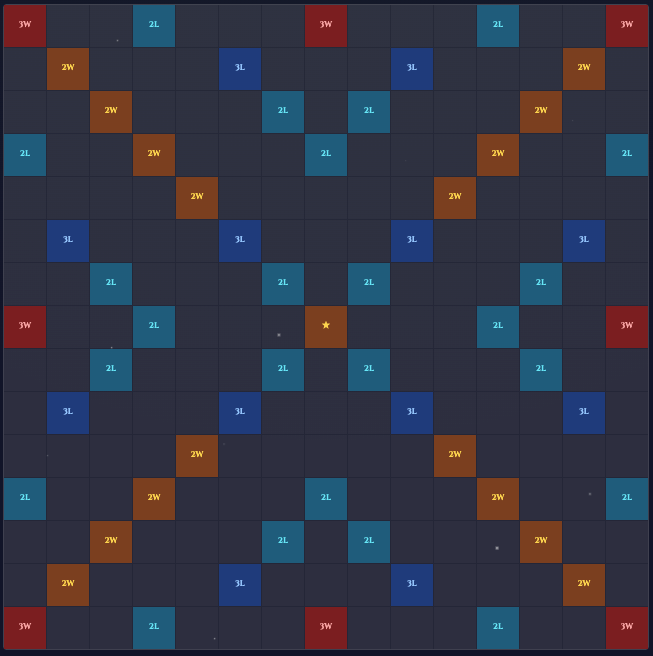
The critical insight is that Triple Word Score squares are the fulcrum of the whole decision. A Triple Word Score in the corner with a Double Letter Score adjacent can produce 50–80 point single turns. Never open a lane to a TW/DW intersection without having a clear plan for either using it yourself next turn or being confident your opponent can't exploit it immediately.
The "fishing" trap: Many players hold back, playing low-value tiles and hoping to draw into a bingo. This is correct sometimes but wrong often. If you're scoring 12–15 points per turn while fishing and your opponent is scoring 30–40, you're losing ground even if you eventually get the bingo. The better discipline is to stay productive — aim for 25+ points per turn — while keeping your rack bingo-ready. That means playing tiles that don't fit your stem and keeping the tiles that do, rather than hoarding the whole rack.
Pre-Play Checklist: Every Turn
Run through this before committing to any Scrabble play:
- Bingo check first: Does my rack contain a seven-letter word or a known stem + one tile? Check before anything else — the 50-point bonus changes every calculation.
- What's my leave? After this play, what tiles am I keeping? Are they balanced (3 vowels / 4 consonants roughly), high-frequency, and bingo-friendly?
- Am I opening or closing? Does this play create a lane to a Triple Word Score? If yes, can I use it next turn — or will my opponent?
- Hook check: Can I place this word as a hook onto an existing word and score both the new word and the old word extended?
- Parallel play check: Can I place a word alongside an existing word to score multiple perpendicular two-letter words simultaneously?
- Short word coverage: If I have no obvious play, do I know a two- or three-letter word that places my highest-value tile (J, Q, X, Z) on a premium square?
- Exchange threshold: Is my rack so imbalanced that any reasonable play leaves me worse off? If three or more tiles are dead weight and the bag has tiles, consider exchanging.
- Score the board, not the word: Would a slightly lower-scoring word leave me in a better board position or better leave than the highest-scoring option? Sometimes 24 points beats 30.
Limitations and What This Guide Won't Do For You
This guide covers the strategic principles that generate the most improvement the fastest. It does not replace a full word list. There are roughly 276,000 valid words in the Collins Scrabble Words dictionary (the standard for international and UK Scrabble), and no article can substitute for gradual vocabulary building over time.
- Word list study is still necessary. Knowing the two-letter words is non-negotiable for competitive play. At a minimum, print and study the official two-letter word list before your next game.
- These strategies assume turn-by-turn play. Speed Scrabble variants and some house rules change the calculus significantly — especially around exchange rules and challenge procedures.
- Dictionary edition matters. Collins (international) and OSPD/TWL (North American) have different valid word sets. QI is valid in Collins but not in all editions. Confirm your group's edition before playing.
- Online play vs. physical play: Digital Scrabble tools often have built-in dictionaries and show you word validity in real time, which removes the challenge word dynamic entirely. Physical play requires knowing your words — or accepting challenges.
Common Mistakes That Cost You Scrabble Games
- Playing the highest-scoring word without checking the leave: A 35-point play that leaves UUVWW is almost always worse than a 25-point play with a balanced leave.
- Ignoring bingo potential: Playing off five tiles when your rack contains a bingo stem costs you 50 points plus the word score. Always check for bingos first.
- Opening Triple Word Score lanes needlessly: One uncontested TW lane can flip a 20-point lead into a 30-point deficit in a single opponent turn.
- Hoarding S tiles and blanks too long: Play them when they earn a meaningful premium (8+ extra points or enable a bingo). Hoarding costs rack quality.
- Forgetting two-letter words under time pressure: Players who "blank" on their two-letter words in pressure situations make unnecessary exchanges. Drill them until they're automatic.
- Playing defensively when you should attack: A tight, closed board favours whoever has the better vocabulary. If you have a strong tile set, open the board and use your advantage.
Related Game-Night Scenarios
Scrabble fits specific game-night contexts particularly well:
- The long evening with 2–4 players: Scrabble's natural pacing (60–90 minutes for a full game) suits a relaxed evening where the group wants depth without complexity. Pair it with a round of Wavelength afterward for a lighter cooldown.
- Teaching a new player: Introduce short-word strategy first. One session focused only on two-letter words and hooks is far more valuable than explaining bingo strategy upfront. Use the Game Night Pro teaching guide to structure the onboarding.
- Tracking improvement over a season: Scrabble is one of the few word games where score tracking genuinely reveals skill trends. Log your average score per game and your bingo frequency using the Game Night Pro score tracker — two bingos per game is a meaningful benchmark for a developing player.
- Competitive evenings: If your group plays multiple rounds, add the Collins challenge rule — a successfully challenged word means the player who played it loses their turn. This adds a risk-management layer that rewards knowing your words and punishes bluffing.
Ready to put this into practice? Open Scrabble, set up a board, and spend your first five turns doing nothing but the pre-play checklist above — bingo check, leave quality, board control. One focused session with these habits will do more than an hour of reading.
Play Scrabble Now →