Minesweeper Strategy Guide
Logic Techniques, Tactics, and Winning Methods for All Difficulties
The Enduring Logic Challenge of Minesweeper
Minesweeper has been challenging players since 1989, bundled with Windows, yet it remains one of the most misunderstood games. Most players approach it as a guessing game-clicking randomly and hoping not to hit a mine. In reality, Minesweeper is pure logic. Ninety percent of wins are deducible. You can know where the mines are without guessing. The other ten percent involves calculated probability on large boards where hidden information requires an informed choice, not blind luck.
The game's elegance lies in its constraint: you have a grid, a number on each revealed cell (indicating adjacent mines), and the task of using those numbers to deduce mine locations. Every number is a logical statement. A "2" touching four unopened cells means exactly two of those four contain mines. A "1" touching two unopened cells means exactly one contains a mine. String these statements together, find contradictions, and you unlock the board.
The difference between a casual player (win rate 40–50%) and a disciplined player (win rate 85%+) is systematic thinking. Not luck. Not memory. Logic discipline.
Core Mechanics: Numbers, Flags, and Logic
Before strategy, master the mechanics. Minesweeper is deceptively simple on the surface.
Numbers and adjacency: Each revealed cell displays a number from 0 to 8, indicating how many mines are in the eight surrounding cells (orthogonal and diagonal). A "0" (blank) means all adjacent cells are safe. The number is an absolute guarantee-if a cell reads "3," exactly three of its neighbors contain mines, not two, not four.
Flagging: You can flag cells you believe contain mines. Flagged cells cannot be clicked. The flag is not a guess-it's a commitment to logic. Never flag a cell you're not confident about. A false flag corrupts your reasoning chain.
The win condition: Reveal all non-mine cells. You don't need to flag every mine; you only need to avoid clicking them. Many players over-flag, wasting mental energy. Flag strategically-when the flag clarifies a logic chain, not when it's merely a hypothesis.
Difficulty and mine density: Small boards (8×8, 10 mines) have low mine density (15%). Medium boards (16×16, 40 mines) rise to 15%. Large boards (16×30, 99 mines) reach 20%+. Higher density means fewer free deductions and more situations where probability guides your choice.
The Opening Move: Why Your First Click Matters
The first click is guaranteed safe. On a standard game, the first click often reveals a cluster of 0s and low numbers, giving you an information-rich starting position. The center of the board is statistically slightly safer than edges, but the difference is negligible. What matters is not where you click first, but what you do next.
After your first click, scan for instant deductions. Look for any cell that has a number equal to the count of unopened adjacent cells. For example, a "3" touching exactly three unopened cells means all three are mines. Flag them immediately. This opens a cascade: once you flag those mines, neighboring cells' numbers drop, triggering new deductions.
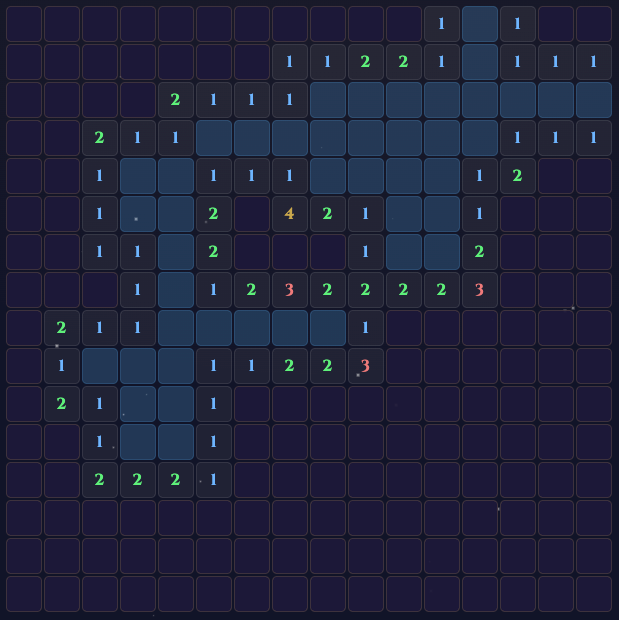
Real example from the board above: Notice the orange "4" near the center - it sits adjacent to exactly four unrevealed cells, which means all four are mines. Flag them. Now look at the red "3"s flanking that zone: each already has two of its mine-requirements met by the flags you just placed. Each red "3" now needs only one more mine from its remaining unrevealed neighbors, dramatically narrowing the candidates. Follow the chain outward through the "2"s and "1"s: every flag you plant resolves a neighboring number and potentially unlocks a fully safe cell to click. The top-right cluster of "1 1 1" cells, for instance, shows three mines locked into a tight boundary - the cells beyond them, surrounded only by already-satisfied numbers, are provably safe.
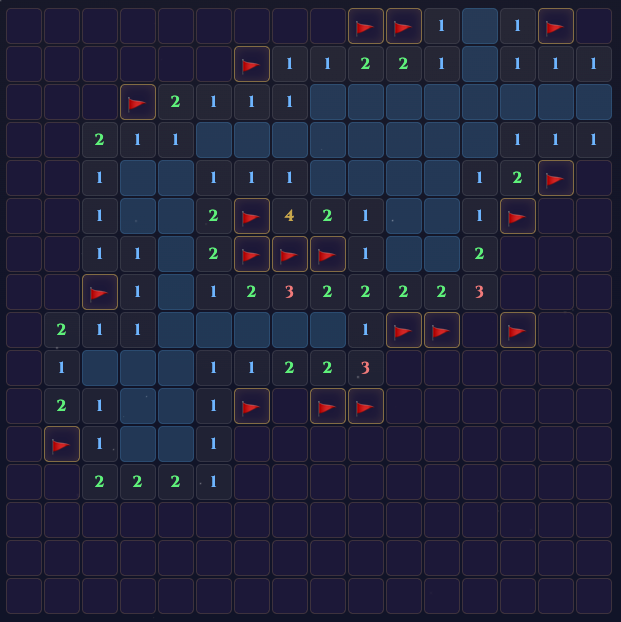
After applying the logic: The flags above are not guesses - every one is a logical certainty. The "4" forced four flags immediately. Each top-right "1" touches a single unrevealed cell, so those flags follow trivially. The row of three flags in the middle-left stems from the "3" on that row whose three remaining unrevealed neighbors account for its full count - all three must be mines. The two flags in the lower section are resolved by "1" cells that each have only one unrevealed neighbor left, making them unambiguous. Notice how the flagged cells form a kind of boundary: the unrevealed cells on the far side of each flag are shielded from the numbers behind it, which means those outer cells can now be clicked safely once neighboring numbers confirm they have no remaining mine requirement. This is cascade logic in action - one deduction unlocks the next.
Beginners skip this step. They clear a few safe cells and then guess randomly. Experienced players hunt for these chains immediately, often solving half the board from a single cascade.
Constraint Propagation: The Core Technique
Constraint propagation is the hidden engine of Minesweeper success. It sounds technical; it's practical.
Here's the process:
- Identify a constraint: A cell with a number N adjacent to exactly N unopened cells. All those unopened cells are mines.
- Apply the constraint: Flag those mines. Remove them from all neighboring cells' "still needs" counts.
- Check for new constraints: Now that you've removed mines from counts, other cells might have become constrained. A "2" that needed two mines from five unopened cells, but you just flagged one mine nearby, now needs one from the remaining four.
- Propagate forward: Keep scanning. Each flag you plant potentially unlocks new deductions elsewhere on the board.
The cascade often solves 60–80% of small boards in one chain. You click, a zero appears, it spreads to adjacent cells, those spread to their neighbors, and within seconds, half the board is revealed. The key is not panicking when you have unopened cells that resist deduction-those are your guesses, handled last.
The Minesweeper Tactical Checklist
Use this mental framework for every board:
- Hunt for instant deductions: Scan for numbers matching unopened cell counts. Flag all. Propagate.
- Use boundary logic: Edge and corner cells touch fewer neighbors, creating tighter constraints. Start deductions there.
- Track mine budgets: On medium/large boards, count total mines placed vs. mines remaining. Use this to assess probability in ambiguous zones.
- Flag strategically, not reflexively: Flag only when logic demands it. A hypothetical flag muddies your reasoning.
- Look for overlapping constraints: Two "2"s sharing unopened cells create powerful intersections. Three of four shared cells are unopened and one numbered cell is a "2"? All three are mines.
- Isolate guessing zones: When deduction stalls, identify the region where logic breaks. Keep that region small. Guess there, never in proven-safe zones.
- Verify before clicking: Before revealing a cell, ask: "Have I logically confirmed this is safe?" If not, is it a calculated guess?
Small vs. Medium vs. Large Boards: Scaling Your Strategy
Small boards (8×8, 10 mines): These are pure logic. Mine density is low (15%). The first cascade solves most of the board. Your strategy: maximize that cascade. Click toward the center to trigger the biggest zero-zone. Let constraint propagation do the work. Rarely do you need to guess. A win rate below 95% on small boards means you're making logical errors, not unlucky guesses.
Medium boards (16×16, 40 mines): Logic solves 70–80%, then you hit a bottleneck. You've flagged 30–35 mines, revealed safe cells, and now face 5–10 unopened cells where logic is silent. This is where probability enters. Count remaining mines. Assess which zone has the densest mine ratio. If 2 mines remain and 5 unopened cells form one cluster while 3 unopened cells form another, the first cluster is statistically riskier. This is not guessing-it's probabilistic reasoning. A 60% win rate on medium boards is solid.
Large boards (16×30, 99 mines): Mine density climbs to 20%+. Logic solves perhaps 50%, then sprawling regions remain where you must play probability. Advanced large-board players use techniques like "Bayesian inference"-updating probability assessments as new information emerges-but for most players, the strategy is: solve everything deducible, then pick the safest remaining cell based on mine-budget ratios. Expect 50–60% win rates on large boards. That's respectable.
Pattern Recognition and Visual Scanning
Experienced Minesweeper players develop visual pattern recognition. You learn to spot common configurations instantly:
The "1-2-1" pattern: A "1," a "2," and another "1" in a row. The "2" in the center sits between the two "1"s. If all are adjacent to the same unopened cells, you can often deduce which cells are safe and which are mines from the pattern alone.
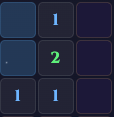
In the example above, the "1" cells each need exactly one mine from the two unrevealed cells above them, while the "2" in the center needs both. Since each outer "1" can only claim one mine and they share the same column of unrevealed cells, the mines must sit directly above the two "1"s - the cell above the "2" is safe.
The corner trap: A "2" near an edge touching mostly revealed cells, leaving just two or three unrevealed neighbors. You know two of them are mines, but not which configuration. Don't guess. Wait for adjacent numbers to constrain the answer.
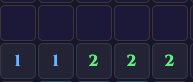
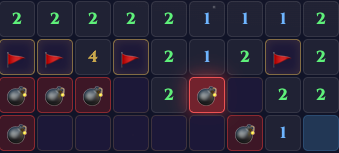
Here a row of "1 1 2 2 2" runs along the bottom edge with a single row of unrevealed cells above. The two "1"s on the left each need one mine from one neighbor - straightforward. The three "2"s share overlapping unrevealed cells; the intersections tell you exactly which cells must be mines without any guessing. Edge rows like this are often the easiest to fully resolve.
The zero-zone cascade: When a "0" is revealed, all adjacent cells are automatically safe and opened. If they're also "0"s, the cascade spreads. A board with a large zero-zone in the opening is typically easier to solve than one with scattered low numbers.
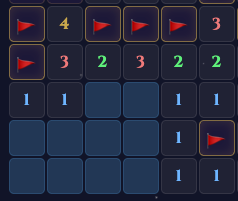
The screenshot above shows a zero-zone after it has fully expanded. The blank interior cells cost you nothing - they opened automatically. All the logical work concentrates on the numbered boundary: the "4," "3," and "2" cells at the top, whose flags were placed because each had no remaining unrevealed neighbors beyond the ones already accounted for. The flagged cells form a clean perimeter separating the solved interior from the still-unknown outer region. This is the ideal board state: a large safe interior and a narrow, well-defined frontier to reason about.
These patterns emerge after 20–30 games. You stop reading each number individually and start seeing clusters of constraints. Speed improves. Accuracy rises.
The Most Common Mistakes That Derail Wins
These errors cost otherwise winnable games:
- Misreading number-to-unopened-cell ratios: A "3" adjacent to four unopened cells is not "three of them are mines." Only three are. The fourth might be safe. Confusing this costs lives.
- Over-flagging: You flag 10 cells confidently, but one flag is wrong. That error cascades through your logic, corrupting everything downstream.
- Ignoring already-satisfied numbers: A "2" with two mines already flagged nearby still needs zero more. Forgetting this leads to false deductions about unopened cells.
- Guessing before exhausting logic: You have unopened cells in a region where logic is silent, and you guess. But you overlooked a constraint elsewhere that would have solved the region. Slow down. Scan the whole board.
- Clicking instead of flagging: You're confident a cell is a mine. Flag it. Don't click it "to verify." A click is irreversible; a flag is reversible if you realize you're wrong.
- Psychology trap on large boards: You've solved logically to a bottleneck and must guess. You second-guess yourself and do nothing. Indecision burns time. Once you've exhausted logic, pick the mathematically safest cell and commit.
Probability and Informed Guessing
On medium and large boards, probability is not cheating-it's advanced strategy. Once logic is exhausted, probability decides your next move.
Mine budget reasoning: You've flagged 38 mines on a board with 40 total. Two mines remain. One region has 8 unopened cells, another has 3. The second region has a 2/3 ≈ 67% mine density. The first has 2/8 = 25%. Click in the first region. Statistically, you're twice as safe.
Clustering: Unopened cells that form a tight cluster are often safer than scattered singles. When the board "opens up" and reveals a large zero-zone, the remaining unopened cells cluster in specific areas. These clusters often contain the remaining mines concentrated, which paradoxically makes the interiors of those clusters less likely to hit mines (because the edges do).
Boundary bias: Mines are randomly distributed, so there's no true "bias" toward edges or centers. However, revealed information creates effective bias. If a region is bordered by many "0"s, it's statistically safer than a region bordered by "2"s and "3"s.
Master-level players internalize these heuristics and often achieve 65%+ win rates on large boards. That's not luck. That's probability assessment refined through practice.
Minesweeper as Collaborative Logic Training
Minesweeper collaborative sessions are goldmines (pun intended) for teaching logical thinking. Unlike 2048's time-pressure cascade, Minesweeper is methodical. Players can debate and reason.
When a group plays collaboratively-one person controls the mouse, others discuss each move-several pedagogical moments emerge:
Assumption surfacing: A player says, "That's definitely a mine." The group asks, "Why?" If the player can't articulate a logical reason, the assumption gets questioned. This surface-level thinking that hidden solo play might conceal.
Error detection: One player spots a logical error: "Wait, that '2' over there already has two mines flagged. Why are we treating the adjacent unopened cell as potentially a mine?" The group corrects course before a wrong flag propagates.
Confidence building: Newer players watch experienced players decompose a complex board into simple logical pieces. They internalize the methodology. Within 3–4 collaborative games, a novice develops the pattern-recognition skills that usually take 15+ solo games.
Game Night Pro's original insight: Minesweeper collaborative sessions are logic puzzles disguised as games. They teach deductive reasoning, constraint satisfaction, and systematic problem-solving-skills that transfer to math, science, and programming. A group that plays Minesweeper together builds a shared vocabulary for logical argument. "That's a chain reaction," they'll say. Everyone knows what that means.
Where to Play Minesweeper
Game Night Pro hosts a free web-based Minesweeper game with difficulty levels ranging from beginner to expert. Play solo to master the techniques, or gather a group and play collaboratively. Discussing logic chains aloud accelerates learning and prevents the mental shortcuts that bury mistakes in solo play.
Ready to apply these techniques? Open Minesweeper and start small. Play five games on beginner to internalize constraint propagation. Then move to medium. Track your win rate. You'll notice it climbing as logic discipline replaces guessing. When you're ready, invite a group to play collaboratively and watch learning accelerate.
Play Minesweeper Now →