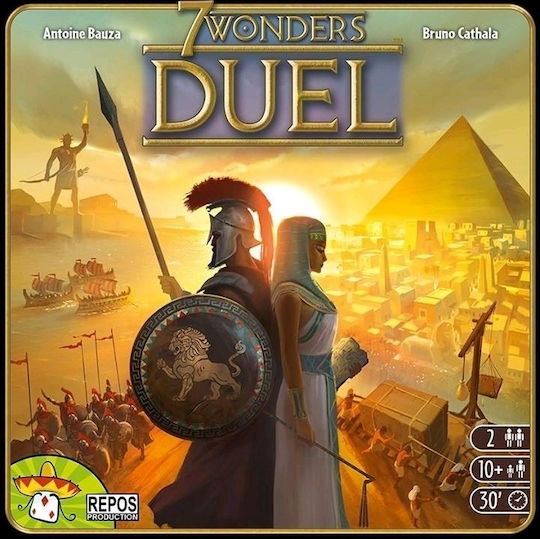
7 Wonders Duel Review
The Civilisation Race That Belongs on Every Couple's Shelf
Hook / First Impression
There is a moment in most games of 7 Wonders Duel — usually somewhere in Age II — when you realise that your opponent is three science tokens from winning the game right now, your military token is pushing into your territory, and the card you desperately need is buried under two face-down cards you can't yet reach. All of this is visible on the table. Nothing is hidden. And yet the tension is almost unbearable.
That is what makes 7 Wonders Duel the extraordinary game it is. Designed by Antoine Bauza and Bruno Cathala as a dedicated two-player adaptation of the beloved 7 Wonders, it does not simply shrink the original — it reimagines it as a taut duel of competing civilisations where every draft choice ripples outward in three directions simultaneously. It is, for many experienced players, the single best two-player board game ever made. After hundreds of sessions, it is hard to argue.
Overview
7 Wonders Duel is a two-player civilisation card-drafting game designed by Antoine Bauza and Bruno Cathala, published by Repos Production in 2015. Players lead rival ancient civilisations across three Ages, drafting cards from a shared pyramid structure to build up resources, science, military power, and commerce — all while racing toward one of three distinct victory conditions.
| At a glance | |
|---|---|
| Designers | Antoine Bauza & Bruno Cathala |
| Publisher | Repos Production / Asmodee |
| Year | 2015 |
| Players | 2 only |
| Play time | 25–35 minutes |
| Age | 10+ |
| Weight | Medium (BGG ~2.2/5) |
| Victory conditions | Military supremacy, Science supremacy, or most points at end of Age III |
Components & The Setting
The Setting: You and your opponent each lead an ancient civilisation — think Rome versus Carthage, Athens versus Sparta — competing across three historical Ages. The theme is not purely decorative here. Resources feel like genuine supply chains: you need wood and stone before you can build military structures, and you cannot construct a library without papyrus. The Wonders — the Pyramids, the Lighthouse, the Colosseum — are real monuments with mechanical power that match their historical prestige. Theme and mechanics are unusually well integrated for a card game at this complexity level.
Components are clean and functional. The 73 Age cards are clear and well-iconographed, though small enough that new players will spend the first game squinting at resource costs. The 12 Wonder tiles are thick, double-sided, and visually striking — each with its own construction cost and unique power. The military conflict pawn and the progress tokens are simple but perfectly adequate. The coin supply is a mix of 1- and 3-value tokens; the metal coins feel premium, a small premium touch that elevates table presence.
The card layout pyramid — rebuilt each Age from a specific diagram — is the standout structural element. It is not just a shuffled deck; it is a face-up/face-down pattern where accessibility cascades as cards are removed. That architecture is central to the game's tension and it is visually dramatic: a full Age I pyramid spread across the table looks immediately engaging before a card has been drafted.
How to Play
The goal is to win by any of three conditions — and you must watch all three simultaneously. Win immediately by pushing the military conflict pawn six spaces into your opponent's territory (military supremacy), by collecting six different science symbols (science supremacy), or — if neither player triggers an instant win — by scoring the most points at the end of Age III (civilian victory).
Each Age, a specific pyramid of cards is laid out face-up and face-down according to a diagram. Only accessible cards — those not covered by other cards — may be drafted. On your turn you do one of three things:
- Construct the card by paying its resource cost (resources come from your own cards or from trading coins to the bank at a cost influenced by your opponent's production).
- Discard the card to gain coins from the bank.
- Build a Wonder by placing the card face-down beneath one of your unfilled Wonder spaces and paying the Wonder's construction cost.
Taking a card exposes cards beneath it in the pyramid, which may now become accessible to both players. This cascading exposure is what makes the drafting system feel nothing like a standard hand-of-cards draft — every removal changes the board state for both players.
Age I uses 20 cards, Age II 20 cards, and Age III 20 cards (plus the 3 guild cards drawn randomly). Between Ages, the military track is not reset — any advantage carries over, applying a coin penalty to the trailing player at the start of each new Age. After Age III, remaining progress tokens, Wonders, civilian cards, commerce bonuses, guild cards, coins, and military supremacy margin are all scored.
Gameplay Feel
Pacing & Tension: The game moves briskly. Each turn is a single card action; experienced players make decisions in under a minute. Age I tends to be measured — both players are establishing resource foundations and exploring the card layout. Age II introduces military cards and science tokens; the pace of decision-making accelerates as threats multiply. Age III is frequently frantic, with both players aware that the end is imminent and that the civilian victory margin can shift dramatically in the final five cards.
The tension is almost always present. Unlike most euro games, where the winner often becomes clear by the midgame, 7 Wonders Duel can flip direction rapidly. A player who seemed to be winning on points can lose instantly if their opponent completes six science symbols, and the military track can swing three spaces in a single Age. No lead is safe. That quality — the sense that the game is never decided until it is over — is one of the most valuable things a two-player game can have.
Player Interaction: Extremely high, and entirely direct. Every card removed from the pyramid is denied to your opponent. Building a Wonder might give you an extra turn (the Mausoleum, the Piraeus). Taking a specific guild card might strip points your opponent was counting on. Commerce cards lower the trade cost of resources your opponent is selling to you — which means that if they have lots of wood and you need wood, their own production works against them. The entire game is interaction, even when you are "just building."
Luck vs. Strategy Balance: The card shuffle and Wonder selection introduce variance, but the experienced player wins the overwhelming majority of sessions. The face-down cards create genuine uncertainty — you do not know what lies beneath until a covering card is removed — but over three Ages this averages out. Progress tokens, drawn randomly at the start of each game, create the most significant variance: a token that powers a science strategy is transformative if you draw it and devastating if your opponent does. This is the one design element where luck can feel genuinely unfair in a short session. Over a series of games, it balances.
Rule Overhead: Moderate. The three victory conditions, the commerce system (trade cost = 2 + opponent's production in that resource), the accessible-card rule, and the progress tokens each require explanation. Most groups need 20–25 minutes of teaching and one partial walkthrough turn to feel comfortable. The rules are not complex — they are layered. By game three, the interaction of all systems feels natural.
Mechanics Deep-Dive
The Three Victory Conditions
The game's genius is that it forces both players to pursue and simultaneously defend against three different winning states. Military supremacy ends the game immediately — if the pawn reaches the sixth space on your side, you lose regardless of points. Science supremacy ends the game immediately too — six unique science symbols (collected from Age cards and progress tokens) ends it on the spot. Civilian victory is the default: whoever has more points wins at the end of Age III.
This structure means you cannot ignore any threat. A player who focuses entirely on points while ignoring military can be run over by Age II. A player who ignores science might find their opponent quietly assembling five symbols while they watch. And a player who focuses only on one instant-win path is often denied it by an alert opponent — making them weaker in the civilian scoring race.
The Commerce System
Trade in 7 Wonders Duel works differently from most games. You can always afford any card if you have enough coins — you simply pay the bank for missing resources at a rate of 2 coins per resource, plus 1 additional coin for each copy of that resource your opponent produces. This means that if your opponent has built three stone quarries, stone costs you 5 coins per cube instead of 2. Their economic growth literally hurts your purchasing power.
This creates a fascinating incentive: taking a resource card your opponent was building toward doesn't just improve your own production — it also lowers their trade prices for you. Yellow commerce cards, which reduce trade costs or generate coins, exist specifically to counteract this system. Players who ignore yellow cards often find themselves coin-starved by Age III when resource costs have climbed.
Progress Tokens
At game start, five progress tokens are drawn randomly from a pool of ten and placed face-up, available to be claimed by collecting pairs of matching science symbols. Tokens range from Agriculture (6 points and 6 coins) to Architecture (free Wonders) to Theology (extra turns). The token draw dramatically shapes each game's strategic texture. A game with Urbanism and Mathematics on the board rewards a very different approach than one with Strategy and Law.
This is the game's primary randomness driver at a strategic level. Learning to read the token pool and adjust your strategy accordingly is one of the key skills that separates intermediate players from experts. Do not ignore the tokens; they define the game's value landscape from the first turn.
The Wonder Draft
At the start of the game, four Wonders are drafted from eight — players alternate picking. Wonders vary enormously in power: The Sphinx grants an extra turn; The Great Library draws three random progress tokens and keeps one; The Hanging Gardens gives coins and an extra turn; The Colosseum can deprive your opponent of a card from their city. Mastering the Wonder draft — knowing which Wonders synergise with which strategies and which to deny your opponent — is a deep layer of play that only becomes apparent after 10+ sessions.
Player Count Analysis
2 Players — The only option, and it is exceptional. 7 Wonders Duel is designed exclusively for two players and is one of those rare games where the constraint is also the strength. The entire system — the pyramid drafting, the military track, the commerce pricing, the science race — is calibrated for exactly two competing civilisations. Every decision is direct, personal, and consequential. There is no dilution of strategy across multiple opponents and no kingmaking dynamic to worry about.
For couples, roommates, or gaming partners who play primarily at two, this is an essential game. The 25–35 minute session length means it fits naturally into an evening with time for two or three rematches — which is exactly how it tends to get played. Few two-player games produce the same combination of meaningful decisions, readable board state, and genuine moment-to-moment tension.
Replayability
7 Wonders Duel has outstanding replayability for its weight class. The Wonder selection (8 Wonders, 4 chosen), the progress token draw (10 tokens, 5 available), the card shuffle within each Age, and the face-down positions in the pyramid all combine to ensure that no two games feel identical. The emergent strategic landscape — which sciences are available, which Wonders are in play, which military cards appear early — varies enough to sustain hundreds of sessions without feeling repetitive.
The deeper replayability comes from strategy evolution. Early games are spent learning the rules. Then come games spent learning to balance the three win conditions. Then games spent mastering the commerce system. Then games spent optimising the Wonder draft. Then games spent reading your opponent's strategy and pivoting aggressively. Each layer reveals itself naturally over a series of sessions, and the game rewards the investment with genuine skill growth that is perceptible and satisfying.
Even after 100+ plays, the game does not feel exhausted. The combination of a short session length, the rematch pull, and the evolving meta between two regular opponents keeps it vital far longer than its 35-minute runtime would suggest.
Learning Curve
Ease of teaching: Moderate. The rules are not complex but they are layered — the commerce pricing formula, the accessible-card rule, and the three win conditions each need to be explained before the first turn. Most new players need one partial walk-through of Age I with commentary to understand how the pyramid works in practice. By Age II they are making confident decisions; by Age III they are engaged. First games rarely feel confusing after the teaching; they feel exploratory.
Rulebook quality: Good. The rulebook is concise, illustrated with clear examples, and handles edge cases (what counts as a science symbol, how extra turns interact with Age endings) adequately. The accessible-card rule diagram is particularly well done. The main teaching gap is the commerce system: the rulebook describes it correctly but new players often don't feel its strategic implications until they've been stung by a 7-coin resource purchase.
First-game experience: Almost universally positive. The 35-minute runtime means the stakes of getting rules wrong are low, and the immediate rematch culture the game produces means that first-game mistakes are corrected quickly. Players who end their first game unsure of strategy tend to end their second game with a clear sense of what they should have done differently — which is the ideal learning curve.
Who It's For
Couples and two-player gaming partners: This is the primary audience and for good reason. 7 Wonders Duel is one of the finest relationship games in existence — short enough for a weeknight, strategic enough to feel meaningful, and tense enough to generate genuine excitement. It does not require prior board game experience to enjoy and it rewards mastery with genuine competitive satisfaction. If you play games regularly with one other person, this is close to a mandatory purchase.
Strategy gamers looking for a light-ish option: The game's depth-to-runtime ratio is exceptional. Veterans of heavy eurogames will find a 35-minute experience that still rewards genuine strategic thinking, makes demands on attention and planning, and produces satisfying skill expression — without the three-hour commitment. It works as a warm-up game before heavier plays and as a standalone evening activity with equal grace.
Fans of the original 7 Wonders: The Duel version is not a smaller copy of the original; it is a distinct design that shares theme and some card types but plays completely differently. The draft is direct and contentious rather than pass-and-keep; the win conditions are explicit and immediate rather than emergent; the interaction is high rather than minimal. Players who enjoy 7 Wonders for the civilisation building will love the Duel version. Players who enjoy 7 Wonders specifically for the multiplayer simultaneous-play feel should know they are getting a different experience.
Comparisons: Splendor is lighter and faster; excellent if you want zero rule overhead. Patchwork is gentler and puzzle-like; better for players who prefer a low-confrontation two-player experience. Twilight Struggle is deeper and harder; the gold standard for two-player conflict games but requires a significant time and rules investment. For the combination of accessible rules, genuine depth, and direct tension, 7 Wonders Duel sits at the top of the two-player market.
Pros & Cons
What 7 Wonders Duel does brilliantly:
- Three simultaneous win conditions create permanent multi-directional tension that never lets either player relax — one of the most effective game tension mechanics in the hobby.
- The pyramid card layout is genuinely innovative: face-down cards, cascading accessibility, and the need to uncover cards for your opponent as well as yourself generate constant interactive drama.
- The commerce system is elegant — opponent's resources raise your costs, creating a direct economic competition layered beneath the card drafting.
- A 25–35 minute runtime that fits in an evening without feeling trivial — the game uses its time with remarkable efficiency.
- Extremely high replayability from randomised Wonders, progress tokens, and card pyramids — no two games feel identical even after hundreds of plays.
- Skill expression is high and perceptible — improving at this game feels genuinely rewarding across dozens of sessions.
Where 7 Wonders Duel has limits:
- Strictly two players — no way to scale up for a group of three or more. This is a design constraint, not a flaw, but it limits when the game can be played.
- The progress token draw introduces meaningful strategic variance — a token pool heavily weighted toward science or military can make certain strategies dominant regardless of player choice.
- The teaching time (20–25 minutes for new players) is not trivial for a 35-minute game — the first session effectively costs double the runtime.
- The iconography on cards is dense; new players will frequently need to re-read cards during their first game. A quick-reference card would help and is absent from the base game box.
- Military supremacy can feel brutal and sudden to newer players — being marched into and losing without warning is deflating if you didn't understand the threat level.
Expansions & Ecosystem
7 Wonders Duel has two expansions that each add a distinct new system to the base game without replacing any of the existing mechanics. Both are designed to be mixed with the base game and with each other.
1. Agora — The Senate expansion ★★★★★
Agora adds a Senate board with six chambers and 10 senator cards drafted alongside the regular pyramid. Senators provide ongoing abilities and influence within chamber categories; controlling a majority in a chamber at the end of the game scores points or bonuses. A new fourth win condition — Political supremacy, achieved by controlling the Senate's Conspirators chamber — adds another immediate-win threat to track. Agora deepens the game significantly and is broadly considered essential by experienced players. The new cards integrate cleanly with the existing system and the political layer adds strategic texture without bloating the ruleset.
2. Pantheon — The gods expansion ★★★★☆
Pantheon adds a mythology board with five divine favour tokens representing Greek, Roman, Egyptian, Phoenician, and Celtic gods. Players can acquire divine favour during each Age and invoke a god's power — ranging from extra coins to bonus military to guild card copies — at the cost of the token. It adds flavour and additional turn options without fundamentally altering the core competition. Less universally praised than Agora but enjoyable, particularly for players who find the base game just slightly too sparse in Age I options.
Quick Buyer's Guide
| Game | Best For | Complexity Added | Rating | Priority |
|---|---|---|---|---|
| 7 Wonders Duel (base) | All two-player situations | — | ★★★★★ | 🥇 Start here |
| Agora | Players who've mastered the base | Medium | ★★★★★ | 🥈 First expansion, near-essential |
| Pantheon | Players wanting more Age I options | Low-Medium | ★★★★☆ | Third purchase |
Value for Money
7 Wonders Duel retails for approximately $35–$40 USD (€30–38 in Europe) — firmly in the mid-range for hobby games, and outstanding value for what you receive. The game's 25–35 minute runtime, combined with its rematch culture, means that a regular two-player pairing will easily log 50–100 sessions from a single copy. At that play rate, the per-session cost approaches zero within six months of purchase.
The component quality is appropriate but not exceptional — cards are standard weight, the conflict pawn and coins are functional rather than premium, and the insert is serviceable. None of this detracts from play, but players expecting the tactile premium of Splendor's poker chips will find the production more understated. The game sells on its design, not its components, and the design more than justifies the price.
- First two-player game purchase: One of the strongest possible choices at this price point. Broad strategic depth, immediate replayability, and a session length that suits any evening.
- Gift for a gaming couple: Excellent. The teaching time is acceptable, the theme is accessible, and the competitive dynamic is engaging without being hostile.
- Used copies: Cards see moderate handling, so inspect before buying used — worn cards in an information-sensitive game can create marking issues. Otherwise a used copy at $15–20 is a strong purchase.
Accessibility
Color differentiation: The game uses colour coding across resource types (brown for raw materials, grey for manufactured goods, yellow for commerce, red for military, green for science, blue for civilian points, purple for guilds). The resource icons are shaped distinctly as well as coloured, providing redundant differentiation for colour-blind players. The military conflict track is red and blue at its ends; the conflict pawn itself is distinguishable by position rather than colour. Generally accessible, with the colour-coded resource system being the most challenging element for deuteranopes.
Language dependence: Low to minimal. Progress tokens and some Wonder powers have text, but a bilingual or translated reference card addresses this entirely. The Age cards themselves are icon-based. The game is very playable in mixed-language editions with a simple token reference sheet.
Cognitive accessibility: Moderate demands. The three win conditions must all be tracked simultaneously, which requires sustained attention across the game. Players who prefer single-objective games may find the cognitive load higher than expected. That said, the board state is fully visible and nothing is hidden — all information is available; it is simply complex to process all at once. Players who enjoy chess or other full-information strategy games will feel at home.
Physical accessibility: The cards are standard size, easy to handle. The coins are small but not fiddly. The conflict pawn slides easily along its track. The main physical interaction is the card pyramid construction at the start of each Age, which requires arranging overlapping cards precisely — a minor challenge for players with significant dexterity limitations, though the pattern is diagrammed clearly in the rules.
Age range: The 10+ rating is accurate. The three win conditions require conceptual juggling that younger children may find overwhelming on a first play, but motivated 10–12 year olds with some board gaming experience can engage meaningfully. The game has no dark themes, no player elimination, and no text dependency during play.
Verdict
7 Wonders Duel is one of the finest board games ever designed for two players, and the argument that it is the finest is not a stretch. It takes the civilisation-building satisfaction of the original 7 Wonders and distills it into a direct, personal confrontation where every turn matters, every choice ripples into the future, and neither player is safe until the game is over. Three simultaneous win conditions create permanent tension. The pyramid drafting produces genuinely interactive decisions. The commerce system creates an elegant economic competition layered beneath the card game. And the whole thing wraps up in 35 minutes — short enough for a rematch, deep enough to deserve one.
Its limitations are real but minor. It plays only at two. The teaching investment is non-trivial relative to the session length. The progress token variance can occasionally feel arbitrary. None of these are fatal, and none of them diminish the essential experience: sitting across from someone you know well, watching a pyramid of ancient history unfold between you, and trying to build a civilisation faster, smarter, and more ruthlessly than they do.
Buy it if: you play games with one other person and want the best two-player experience your shelf can offer.
Skip it if: you primarily play in groups of three or more, or if you want a light, zero-teaching game for casual evenings. This is not the most accessible entry-point game in the hobby — it rewards the investment but requires it.
Expand it with: Agora as soon as you have 10–15 base games under your belt. It is close to essential and improves an already excellent game.
Score Breakdown
Love board game night? Explore our tools, score calculators, and strategy guides — everything you need to play better and have more fun.
Browse All Articles →