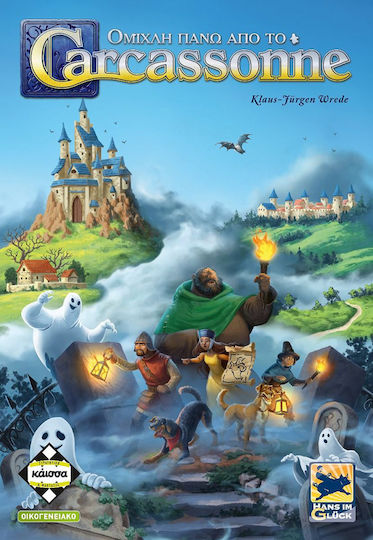
Carcassonne Review
The Tile-Laying Classic That Defined a Genre
Hook / First Impression
In 2001, Klaus-Jürgen Wrede introduced a mechanic so intuitive that it has been imitated dozens of times since but rarely matched: draw a tile, place it, claim a feature. Carcassonne is the game that taught a generation how tile-laying works, and it did it with nothing more than 72 landscape tiles and a handful of wooden figures called meeples — a word the hobby invented specifically for this game.
Over two decades later, Carcassonne still wins converts at every game table it reaches. It won the Spiel des Jahres 2001, spawned more than a dozen major expansions, and sits comfortably in the BGG top 100. The question isn't whether it's a classic — it clearly is — but whether it still earns a place on your shelf when so many newer tile-layers have refined the formula. Our answer is yes, and not just for nostalgia's sake.
Overview
Carcassonne is a tile-placement game designed by Klaus-Jürgen Wrede and originally published by Hans im Glück in 2000 (widely distributed in English by Z-Man Games). Players collaboratively build a medieval landscape of cities, roads, monasteries, and fields — but compete to score the most points by claiming features with their meeples before opponents can complete or crowd them out.
| At a glance | |
|---|---|
| Designer | Klaus-Jürgen Wrede |
| Publisher | Hans im Glück / Z-Man Games |
| Year | 2000 |
| Players | 2–5 |
| Play time | 30–45 minutes |
| Age | 7+ |
| Weight | Light (BGG ~1.9/5) |
| Awards | Spiel des Jahres 2001, Deutscher Spiele Preis 2001 |
| Victory condition | Most points after all 72 tiles are placed |
Components & The Setting
The Setting: You are a medieval land surveyor building the countryside around the fortified city of Carcassonne in southern France — a real place, whose distinctive walled citadel is visible in the game's artwork. You don't play a character in the game world so much as shape it: cities rise tile by tile, roads wind between them, monasteries appear in open fields, and the farmers who claim those fields grow richer as the landscape fills in. The theme is light but coherent enough to give every tile placement a satisfying narrative logic. When you extend your opponent's city with a tile that happens to block your own road, it feels like medieval politics in miniature.
Component quality in modern printings is solid for the price. The 72 landscape tiles are sturdy cardboard with clear, functional artwork — not beautiful in the way Cascadia's Pacific Northwest illustrations are, but distinctive and immediately readable at a glance. The meeples are wooden standees in five player colours plus a natural colour for the neutral scoring marker; they are small, satisfying to handle, and have become one of the most iconic component designs in the hobby. The scoring track runs around the box insert and works well; the tile art is consistent enough that legal placements are obvious even to new players. A second edition updated some tile artwork for cleaner readability — the modern editions are noticeably more legible than first-print copies.
The base box offers excellent value for money. There is nothing flashy about the components, but nothing fragile either. The main limitation is purely cosmetic — Carcassonne looks functional rather than luxurious on the table, especially when compared to newer games at the same price point.
How to Play
The goal is to score the most points by completing and claiming landscape features: cities, roads, monasteries, and fields. Points are scored immediately when a feature is completed, and again at the end of the game for incomplete features and farmers.
On your turn you do three things in order: draw one tile from the face-down stack, place it adjacent to any existing tile so that all touching edges match (city to city, road to road, field to field), and optionally deploy one of your meeples onto a feature of the tile you just placed. A meeple placed on a city becomes a knight; on a road, a highwayman; on a monastery, a monk; on a field, a farmer.
You cannot place a meeple on a feature that already contains another player's meeple — but if a city expands later to connect two previously separate segments, those two players' meeples can end up in the same city and must share (or split) the points when it completes.
Scoring on completion: finished cities score 2 points per tile plus 2 per pennant shield. Finished roads score 1 point per tile. Completed monasteries (surrounded on all 8 sides) score 9 points. At game end, incomplete features score at reduced rates (1 point per tile for cities and roads), and farmers score their field bonuses.
Gameplay Feel
Pacing & Tension: Carcassonne plays fast once everyone knows the rules — turns are quick and the game rarely stalls. The tension is structural: it lives in the growing map and the meeples on it. Early turns feel loose and exploratory as players stake out different regions of the board. Mid-game is where Carcassonne shines brightest: cities have grown large enough that completing them feels consequential, road networks intersect in ways nobody planned, and the tile draw starts to feel either fortunate or catastrophic depending on what you need. Late-game is a scramble to complete features before the tile stack runs out.
Player Interaction is direct and unapologetic. You can expand your opponent's city to make it harder to complete. You can join a city they've already claimed if the tiles happen to connect. You can block a road they were building toward a lucrative monastery. Carcassonne's interaction is never violent but it is pointed — the game rewards attention to what opponents are building as much as it rewards building your own features. This is what distinguishes it from purely solo-puzzle tile-layers: the map is shared, and every tile placed by anyone affects everyone.
Luck vs. Strategy Balance: Carcassonne is more luck-dependent than it appears. The tile draw is random, and a run of unusable tiles at the wrong moment can strand your meeples in incomplete features. Experienced players manage this by hedging — claiming features that can score partially rather than gambling on a large city — and by tracking which tiles remain in the stack. But newcomers will occasionally feel that the draw is simply unkind, and they are sometimes right. The strategic ceiling is real, but luck sets the floor.
Rule Overhead: Very low. The turn structure is three steps. The only rule that requires repeated explanation is the farmer scoring at end game — specifically, which fields connect and which cities count. First-game groups invariably miscount farmer scores. This is worth flagging before play begins rather than discovering mid-endgame.
Mechanics Deep-Dive
The Shared Map
The most radical thing about Carcassonne — still unusual after 25 years — is that every player builds the same map. There are no individual player boards, no personal tableaux. The landscape grows outward from a single starting tile, shaped by the collective decisions of every player at the table. This creates a game that is simultaneously cooperative (everyone is building something) and competitive (everyone is building it for themselves).
The shared map produces emergent storytelling. A city that started as a modest two-tile claim in the corner of the board can sprawl into an eight-tile behemoth if players keep extending it for their own roads and field placements. That behemoth might then be jointly claimed by two players who each placed a knight when the city was disconnected. The map produces surprises that no single player planned — and those surprises are almost always more interesting than anything a fixed game board could offer.
Meeple Economy
Each player has exactly seven meeples (in the base game). Meeples deployed on incomplete features are unavailable for future turns. This limited supply is the central resource management challenge in Carcassonne — not tile placement, which is constrained by legal adjacency, but meeple deployment, which requires constant evaluation of what to claim, what to ignore, and when to harvest meeples back by completing features.
- Knights in cities offer the highest scoring ceiling but require the most meeple commitment — a large city can tie up a meeple for 10+ turns.
- Highwaymen on roads are the safest deployment: roads complete quickly, return meeples fast, and are hard for opponents to steal. Low ceiling, high reliability.
- Monks at monasteries require patience — a monastery needs 8 adjacent tiles to complete, which can take many turns — but score a flat 9 points with no competition possible if placed correctly.
- Farmers in fields are the highest-variance play. A well-placed farmer connected to multiple cities is worth more than almost any other deployment. But the meeple never comes back, and the payoff is entirely deferred to end-game scoring.
City Joining and the Stolen Feature
The most controversial mechanic in Carcassonne is city joining: when two previously separate city segments expand to connect, the meeples of both claimants end up in the same city. If the counts are equal, both players score full points. If one player has more meeples in the city (by having placed multiple knights during its growth), that player scores all the points and the minority player scores nothing.
This mechanic produces the most memorable moments in Carcassonne — and the most arguments. The ability to "join" a city someone else has claimed and either share the points or steal them outright is the game's most direct form of aggression. It rewards map-reading and punishes players who grow cities they cannot defend. It also generates the clearest expression of Carcassonne's core tension: every city on the map belongs to whoever can claim it last.
Player Count Analysis
2 Players — Tense and strategic. Two-player Carcassonne is the most cutthroat experience the base game offers. With only two players, every tile placement and meeple deployment is a direct interaction — city joins are more deliberate, road blocking is more pointed, and farmer wars become genuinely decisive. Games play in 25–35 minutes and feel like a focused duel. Highly recommended for competitive pairs, though the limited number of contested features can occasionally produce parallel games where both players simply develop separate corners of the map.
3 Players — The sweet spot. Three players adds enough map complexity and interaction variety to make the shared landscape feel genuinely alive. City conflicts and road races develop more organically; farmer scoring becomes harder to track, which adds late-game surprise. Three-player games tend to produce the most memorable stories. Our strongest recommendation for groups that want both interaction and reasonable play time.
4 Players — Lively, slightly chaotic. Four players makes the map expand quickly and feature competition becomes fierce. Meeple supply is more constrained per player relative to the number of contested features. This can feel overwhelming for new players — it is harder to track what opponents are doing when there are three of them — but the social energy is higher and unplanned city merges become spectacular. Play time stretches to 45–60 minutes.
5 Players — Works, with caveats. Five players is technically supported and playable, but the game starts to feel crowded. Downtime between turns is noticeable, feature competition can produce analysis paralysis in decision-heavy players, and the combined meeple count on the board makes scoring complicated. We recommend 2–4 as the optimal range; five works best with experienced groups who play fast.
Replayability
Carcassonne's replayability is driven almost entirely by the randomness of the tile draw and the unpredictability of shared map development. No two games produce the same landscape — the 72 tiles can theoretically arrange in an astronomical number of configurations — and the strategic choices that follow from early placements cascade in ways that make each game feel like a different puzzle. The game never plays the same way twice, even with the same players.
That said, the base game's replayability has a ceiling that experienced players hit after 20–30 sessions. The scoring mechanisms are fixed, the features are always the same, and the optimal strategies become familiar. Carcassonne's long-term replayability depends heavily on expansions — and it has many of them, which is both a strength and a consideration when budgeting shelf space and money.
The variant options in the base game are modest: you can choose which starting tile to use and whether to include the River mini-expansion (included in most modern editions, which extends the starting setup with a river tile chain). These add minor variety but don't dramatically change the experience.
Learning Curve
Ease of teaching: Among the easiest in the hobby. The tile placement rule (edges must match) is immediately intuitive — players "see" legal placements without needing to reference the rulebook. The scoring rules take longer to internalise, particularly the farmer mechanism, but the game is playable at a functional level after a three-minute explanation. Non-gamers consistently find the first game approachable and ask for a second game by the time the final tiles are placed.
First-game experience: Universally positive in our testing. New players enjoy the physical act of building the landscape before they fully understand the scoring — the map growing tile by tile has genuine tactile satisfaction regardless of competitive outcome. The first game typically ends with at least one player having committed a farmer in an unhelpful location and learning, painfully, what field scoring means. This is Carcassonne's best teaching moment: the farmer rule makes sense instantly once you've been on the wrong side of it.
Deeper mastery: Recognising which tiles are left in the stack (tile tracking), reading which cities are claimable versus undefendable, and knowing when to sacrifice a meeple to block an opponent's monastery are skills that develop over many sessions. The gap between a first-game player and an experienced one is large enough to make competitive play among equals interesting for dozens of sessions.
Who It's For
Casual players and non-gamers: Carcassonne is one of the all-time great gateway games for exactly the same reason it won the Spiel des Jahres in 2001 — it is approachable without being trivial, competitive without being hostile, and fast enough to play twice in an evening. If someone at your table enjoyed Ticket to Ride and wants more interactivity, Carcassonne is the natural next step.
Families: Excellent for families with children from around age 7. The turn structure is minimal, the visual nature of tile matching makes legal moves self-evident, and the medieval theme has universal appeal. The competitive elements — city joining, road blocking — may need light-touch framing for younger players sensitive to direct interference, but the game generally avoids the confrontational spikes that upset young players in heavier titles.
Competitive groups: Carcassonne rewards attention to the map and opponents' meeple supply in ways that keep experienced players engaged well past the point where the rules are fully understood. The city-stealing mechanic and farmer wars create genuine competitive pressure that distinguishes it from more passive tile-layers.
Comparisons: For players who want a tile-layer with no direct conflict and a more personal puzzle feel, Cascadia is an excellent alternative. For deeper strategic tile-placement with more complex scoring, Castles of Burgundy offers a heavier experience. For a game with a similar medieval theme and more complex buildings, Architects of the West Kingdom goes significantly deeper. Carcassonne's niche is interaction + accessibility + speed — it does all three better than most competitors at its weight.
Pros & Cons
What Carcassonne does well:
- Universally accessible rules that scale naturally from first-time players to strategic veterans — one of the best teach-to-play ratios in the hobby.
- Genuine, meaningful player interaction through city joining and blocking that stays friendly in tone while producing competitive outcomes.
- Shared map construction creates emergent storytelling and memorable moments that no fixed game board can replicate.
- Plays in 30–45 minutes at 2–4 players, making it one of the fastest competitive games that still rewards genuine decision-making.
- Vast expansion ecosystem with over a dozen major expansions — the game grows with your group's appetite for complexity.
- Excellent value: low price, durable components, and thousands of possible game states from a single box.
Where Carcassonne struggles:
- Tile draw luck can feel punishing — a run of inaccessible tiles while opponents keep completing features is visible, frustrating, and not fully compensated by skill.
- Farmer scoring is opaque to new players and frequently miscounted, especially in games with complex field connectivity. The rulebook explanation is one of the weakest in the hobby for this specific mechanic.
- Base game replayability plateaus for experienced players — the expansion ecosystem is rich but requires additional investment to maintain long-term freshness.
- Five players is technically supported but noticeably inferior to 2–4; the box rating is optimistic.
- Component aesthetics are dated compared to modern productions — the game looks utilitarian on the table rather than beautiful, which matters for players who care about visual presentation.
Expansions & Ecosystem
Carcassonne has one of the most extensive expansion ecosystems in the hobby. At last count there are over 11 numbered "Big Box" expansions plus numerous mini-expansions, standalone variants, and themed editions. The breadth is staggering — and slightly intimidating. Here are the expansions we recommend and in what order:
Inns & Cathedrals — The essential first expansion ★★★★★
Adds Inns along roads (doubling road scores if completed, zeroing them if not) and Cathedrals in cities (adding 1 point per tile to the city and all adjacent tiles). Also adds a sixth player colour and a large meeple per player. Inns & Cathedrals is so well-integrated that many groups treat it as part of the base game from the second session onward. The risk/reward mechanics for inns and cathedrals add meaningful new decisions without complicating the turn structure.
Traders & Builders — More scoring texture ★★★★☆
Adds trade goods (wine, grain, cloth) that accumulate when cities containing them complete, and a Builder meeple that grants an extra tile draw when you extend a feature containing your builder. Traders & Builders rewards long-term city investment and makes the builder a subtle but powerful engine piece. Excellent second expansion for groups looking to deepen strategy.
The Princess & the Dragon — Chaos injection ★★★☆☆
Adds a dragon that moves around the board eating meeples, and a fairy that protects one meeple per player. High variance and high fun for casual groups; frustrating in competitive play because meeple removal feels arbitrary. Recommended for groups that specifically want more chaos and less control — not for players who value the strategic depth of meeple economy.
The Tower — Direct conflict escalated ★★★☆☆
Adds tower tiles that let players capture opponents' meeples from the board and hold them for ransom. Raises the conflict level considerably — too much so for family groups, but appreciated by competitive players who want Carcassonne's interaction dialled up to its maximum. Use with care based on group temperament.
| Expansion | Best For | Complexity Added | Rating |
|---|---|---|---|
| Inns & Cathedrals | All groups — buy first | Minimal | ★★★★★ |
| Traders & Builders | Strategic groups (10+ base plays) | Low–Medium | ★★★★☆ |
| Princess & Dragon | Casual / chaos-friendly groups | Medium | ★★★☆☆ |
| The Tower | Competitive groups only | Medium | ★★★☆☆ |
Value for Money
The base game retails for approximately $35–$45 USD (€30–40 in Europe), making it one of the most affordable competitive games in the hobby. For that price you get a complete, replayable, award-winning game with thousands of possible tile arrangements. The Big Box editions bundling the base game with Inns & Cathedrals and Traders & Builders retail for $60–$75 and represent the best value entry point for new buyers — you get the two expansions that have the highest impact on long-term enjoyment at a significant discount over buying separately.
- New to the hobby: Outstanding value as a first purchase. The base game teaches the concepts of area scoring, resource economy, and shared map construction that appear in dozens of more complex games.
- Experienced gamers: Worth owning as a crowd-pleaser and fast competitive option. The interaction is sharper than most games at this weight and the 30-minute play time makes it a strong filler choice.
- Gift buyers: A safe, universally liked gift for anyone interested in board games. The tile-laying concept needs no prior gaming experience and the medieval theme has broad appeal.
Second-hand copies are plentiful and typically in excellent condition — the components wear well and the game is so widely produced that used copies often include extra expansions for little cost. That said, the base game price is low enough that buying new for the benefit of clean, unmarked tiles is easy to justify.
Accessibility
Color blindness: Carcassonne's terrain types use distinct colours (yellow for cities, green for fields, grey for roads, tan for monasteries) that some players with colour vision deficiency may find difficult to distinguish. Newer editions have improved the visual differentiation with more distinct terrain textures, but this remains the game's most notable accessibility limitation. Coloured meeples are distinguished by player colour — players with red-green colour blindness may need house rule markers or replacement meeples. Check the specific edition's tile art before purchasing for a player with CVD.
Language dependence: Very low. There is no text on any tile or meeple. The rulebook is the only language-dependent component, and the rules themselves are simple enough to learn from a visual walkthrough. Suitable for multilingual groups and players with limited literacy.
Cognitive accessibility: Well-suited to a wide cognitive range. The turn structure is minimal (draw, place, optionally deploy), the tile placement rule is visually obvious, and the game requires no hidden information management. The farmer scoring at end game is the primary complexity spike — this can be handled by a designated scorer rather than requiring every player to track it. Overall one of the more cognitively accessible competitive games in the hobby.
Physical accessibility: The tiles are large (approximately 2.5" square) and easy to handle. Meeples are small standees that require fine motor control to place precisely; players with dexterity limitations may prefer having a helper assist with placement without affecting the decision-making. The game requires no shuffling and no significant physical action beyond tile placement. Suitable for most players with mobility limitations.
Age range: The 7+ rating is accurate in our experience. Children from around age 6 engage with the tile-matching aspect instinctively; the scoring rules benefit from adult guidance until around age 9. The game has no mature content and is appropriate for all ages.
Verdict
Carcassonne deserves its classic status — not because it defined a genre (though it did) but because it remains genuinely excellent at what it does. Few games produce interactive shared-map storytelling this efficiently or accessibly. The city-stealing mechanic alone has generated more memorable gaming moments at our tables than most games three times its complexity. And at 30–45 minutes with minimal rules overhead, it fits into game nights where heavier titles simply do not.
Its weaknesses are real. The tile draw luck is meaningful and occasionally punishing. The farmer scoring explanation in the rulebook is poor. The base game runs dry for experienced players without expansions. And the component aesthetics lag behind modern productions at a similar price point. None of these are fatal flaws — but they are the genuine gaps between Carcassonne and a perfect game.
Buy it if: you want a fast, accessible, interactive game that works for non-gamers and experienced players simultaneously — and especially if you want a game that generates genuine conflict and memorable moments without requiring heavy rules investment.
Skip it if: your group specifically dislikes direct interference (city stealing, road blocking) and prefers purely individual puzzle-solving. Cascadia or Azul will serve you better.
Add Inns & Cathedrals if: your group has played three or more base games and wants more strategic texture. It is the single best investment in the Carcassonne ecosystem and should be in every copy of the game.
Score Breakdown
Love board game night? Explore our tools, score calculators, and strategy guides — everything you need to play better and have more fun.
Browse All Articles →