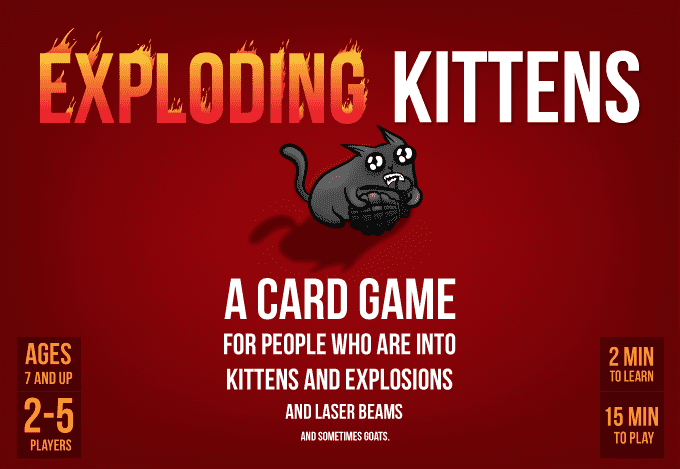
Exploding Kittens Review
Russian Roulette with Better Artwork and Worse Odds
Hook / First Impression
In 2015, a Kickstarter campaign from The Oatmeal creator Matthew Inman asked for $10,000 to print a card game about exploding cats. It raised $8.7 million from 219,000 backers in 30 days, breaking crowdfunding records and becoming one of the most-backed projects in Kickstarter history. Exploding Kittens is, on its face, a joke — absurdist cat artwork, a silly premise, and a rulebook you can read in three minutes. But that joke has sold over 15 million copies in 30+ languages, and it's not hard to see why.
This is not a deep game. It does not pretend to be. What it is — when the crowd and context are right — is one of the most reliably chaotic, laughter-generating party experiences in a box this small. The question is whether that experience holds up over time, and for whom.
Overview
Exploding Kittens is a card game designed by Elan Lee, Matthew Inman, and Shane Small, published by Exploding Kittens Inc. in 2015. Players take turns drawing cards from a shuffled deck, hoping not to draw an Exploding Kitten. If you draw one and have no Defuse card, you explode — and you're out. Last player standing wins.
| At a glance | |
|---|---|
| Designers | Elan Lee, Matthew Inman, Shane Small |
| Publisher | Exploding Kittens Inc. |
| Year | 2015 |
| Players | 2–5 (up to 9 with Party Pack) |
| Play time | 15–20 minutes |
| Age | 7+ |
| Weight | Very light (BGG ~1.1/5) |
| Victory condition | Last player standing |
Components & The Setting
The Setting: There is no setting, really. Players are people drawing from a deck of cards that may or may not contain a kitten that will kill them. The charm is entirely in the artwork — Matthew Inman's signature absurdist illustrations cover every card, depicting scenarios like a Tacocat (a cat made of taco, which is also a palindrome), a Hairy Potato Cat, and a Zombie Kitten that refuses to stay dead. The game makes no attempt at worldbuilding or theme immersion. It is a visual comedy vehicle first, a card game second.
Component quality is adequate for what it is. The cards are standard thickness — not premium, but durable enough for regular play and worth sleeving if the deck sees heavy use. The tuck box is compact and travel-friendly, one of the game's genuine practical virtues. The NSFW edition (sold separately, adults only) swaps out the artwork for cruder illustrations without changing any rules. Component variety is narrow by design: the entire game lives in 56 cards.
How to Play
The goal is to be the last player alive. Each player starts with a hand of cards including exactly one Defuse card. Exploding Kittens are shuffled into the draw pile equal to the number of players minus one, guaranteeing that at least one player will explode every game.
On your turn you may play as many cards as you like from your hand, then must draw one card from the deck. If you draw an Exploding Kitten and have a Defuse card, you spend it and secretly reinsert the Exploding Kitten anywhere in the deck — which is where the only real strategic moment in the game lives. If you have no Defuse, you explode and you're eliminated.
The action cards create the game's texture:
- Skip — end your turn without drawing.
- Attack — end your turn without drawing and force the next player to take two turns.
- See the Future — secretly look at the top three cards of the deck.
- Shuffle — randomise the deck.
- Nope — cancel any action card played by another player (including another Nope, which re-cancels).
- Cat cards — played in pairs to steal a random card from another player's hand; in triplets to demand a specific card.
Gameplay Feel
Pacing & Tension: Exploding Kittens opens loose and ends tight. Early turns are low-stakes — the bomb is buried deep and players cycle through cards freely. As the deck shrinks, the tension becomes visceral. Every draw is a potential elimination, and the table falls silent for a half-second every time someone reaches for the deck. That compression of stakes into a single draw is the game's best design trick.
Player Interaction is present but mostly indirect. You can steal cards, cancel actions, and stack attacks to force a player into multiple draws — but you cannot directly threaten someone or build a coalition. Most interaction is reactive rather than planned, which means the social dynamics stay light and rarely turn personal. This is by design: the game wants you laughing, not strategising.
Luck vs. Strategy Balance: The balance is very heavily weighted toward luck. See the Future and careful Defuse placement offer the game's only meaningful skill ceiling, and both are shallow. An experienced player is perhaps 10–15% more likely to survive an average session than a complete beginner. That gap is too small to produce consistent results over a session, which means the game can and regularly does eliminate its best player in the first round. Whether that is a flaw or a feature depends entirely on why you're playing.
Rule Overhead: Essentially zero. The entire ruleset is printed on a single folded card. Any adult or older child is fully functional within one practice round. There is nothing to teach — you simply play, and the game explains itself through its first few card interactions.
Mechanics Deep-Dive
The Russian Roulette Loop
The core loop is elegant in its simplicity: the deck is a shared countdown, the Exploding Kittens are landmines, and every card played either moves someone closer to drawing or pushes that danger onto someone else. Attacks chain beautifully — a player burdened with six forced draws while everyone else laughs is a set piece the game reliably delivers, and few other card games produce that specific comedy of mounting doom as efficiently.
The Nope card is the game's social wildcard. Because it can cancel any action and be itself cancelled by another Nope, a well-timed Nope cascade — three players overriding each other in rapid succession over a single Shuffle card — generates disproportionate table energy relative to its mechanical weight. It is a card that exists to create moments, not decisions.
The Strategy Ceiling
For a game with almost no strategy, Exploding Kittens does reward a handful of consistent habits that genuinely improve survival rates:
- Hold your Defuse card: Never spend it to reinsert a bomb near the top of a short deck. If you have one Defuse left and the deck has three cards, placing the bomb at position two is a near-guaranteed second chance — use it wisely.
- See the Future before drawing: Even one use per turn reduces your personal variance significantly. If you see an Exploding Kitten on top, play a Skip or Attack immediately; do not gamble.
- Nope priority targets: Cancel Shuffles when you know the bomb placement (either through your own Defuse or a See the Future). Letting an opponent randomise a deck you have mapped is a costly mistake.
- Attack the leader: Force a player with no Defuse card into multiple draws late in the game. This is the closest the game gets to meaningful target selection.
Player Count Analysis
Solo — Not supported. The game has no solo mode and makes no attempt at one. As a pure multiplayer social game, it cannot function without other players.
2 Players — Functional, but thin. Two-player games are tense because one Exploding Kitten sits in a short deck and both players know it. Defuse placement becomes more nakedly tactical. The problem is that with no group energy, no one to laugh with, and no alliance dynamics, the game loses most of its personality. It works mechanically, but it is a noticeably less fun experience than the game at higher counts. Better two-player options exist in Stratego or Coup.
3–4 Players — The sweet spot. Three and four players strike the right balance between chaos and manageability. The deck length is appropriate, eliminations happen at a pace that keeps the finale interesting, and the group energy gives the Nope chains and Attack pile-ons the audience they need. Four players is our recommended count for the most consistent fun.
5 Players — Good, but watch for downtime. Five players produces the most chaotic, loudest games, and the elimination of the first few players can generate spectacular moments. The downside is that early-exit players wait longer, and a 5-player game with one impatient eliminated participant can drag. With the right group it is the most entertaining count; with the wrong one it overstays its welcome.
6–9 Players (Party Pack) — Party mode only. The Party Pack edition supports up to nine players and is purely a crowd-pleaser format. Games run longer, eliminations pile up, and the remaining players eventually forget who is still in. Fine for large gatherings where the game is background noise; not recommended if people actually want to compete and care about outcomes.
Replayability
Exploding Kittens' replayability ceiling is honest about itself: it is a 15-minute game with near-random outcomes, and it plays like one. Within a single session you will typically play two to four rounds, each producing a different winner through a different chain of accidents. Because the card interactions are always the same and the deck is small, the novelty of the game's mechanics exhausts itself after perhaps 20–30 total plays.
What sustains the game beyond that threshold is not mechanical variety but social ritual. Many groups play it as a palette cleanser between heavier games, or as a warm-up before the main event. In that role — brief, chaotic, requiring nothing from its players — it is nearly infinitely replayable because the entertainment does not come from the game itself but from the people playing it.
The expansions add new card types that extend the mechanical lifespan modestly, but none of them fundamentally change what the game is. If the base game's randomness frustrated you, the expansions will not fix that.
Learning Curve
Ease of teaching: Exploding Kittens may be the single easiest game in the hobby to teach. Deal hands, shuffle the bomb into the deck, explain that drawing the bomb kills you and Defuse saves you — that is the entire lesson. The action cards explain themselves through play, and the first round functions as a perfectly adequate tutorial. No new player has ever looked confused at the end of turn one.
Rulebook quality: The rulebook is written in the same absurdist voice as the card artwork — informative, irreverent, and surprisingly clear. It covers every edge case (what happens when two people play Nope simultaneously, whether a Defuse can be Noped) without becoming dense. Reading it is an enjoyable five minutes even outside the context of learning the game.
First-game experience: Universally positive. The simplicity means that new players are never lost, the artwork generates immediate table chatter, and the first explosion — someone drawing a bomb and watching their Defuse card save them — delivers a moment of genuine drama without requiring any prior game knowledge to appreciate. It is the ideal first game to break out with strangers or reluctant participants.
Who It's For
Non-gamers and reluctant participants: This is Exploding Kittens' highest-value use case. For groups that resist board games, resist rules, or resist anything that feels like effort, this is the best entry point in the hobby. It asks nothing of them except to draw a card and possibly scream. It almost always works.
Families with children (ages 7+): An excellent family pick. Children grasp the rules immediately, the elimination format keeps sessions short enough to manage attention spans, and the artwork is designed to be funny to kids without alienating adults. The NSFW edition, obviously, is not for family play.
Hobbyist gamers: Use it as a session opener or closer, not as the main event. Experienced players will exhaust its mechanical depth within a few plays, but they will still enjoy it when the social context is right — it is too well-designed at what it does to dismiss entirely.
Comparisons: Uno is the closest spiritual predecessor — both are light take-that card games best experienced with a vocal group. Exploding Kittens wins on component quality, laugh-per-minute ratio, and the genuinely clever Defuse mechanic, but loses to Uno on widespread familiarity and rule universality. Coup offers a similarly compact footprint with significantly more strategic depth for groups who want more meat from their short-form card game. Sushi Go! replaces the elimination format with simultaneous drafting for players who dislike sitting out after an early exit.
Pros & Cons
What Exploding Kittens does well:
- Teaches in under two minutes — the lowest barrier to entry of any game in the hobby.
- Compact, travel-friendly, and cheap — a complete game in a pocket-sized box for under $25.
- The artwork and card names generate genuine laughs independent of the gameplay — it is funny before the first card is played.
- Creates reliable high-energy moments: the Nope cascade, the multi-Attack death spiral, the last-card-in-the-deck standoff.
- Rounds resolve in 15 minutes, which means a bad session never overstays its welcome and a good one invites replays immediately.
- Works as a brilliant palette cleanser between heavier games, requiring zero mental recharge between sessions.
Where Exploding Kittens struggles:
- Luck dominates so thoroughly that skilled play offers only marginal survival advantage — you can and will lose on the first draw of the game through no fault of your own.
- Player elimination leaves early-exit participants idle for the remainder of a round, which at 5+ players is a meaningful wait.
- Mechanical depth exhausts quickly — within 20–30 plays the card interactions cease to produce novelty, and the game's entertainment becomes entirely dependent on the energy of the group.
- Games with quiet or unengaged players fall flat — the fun is in the reaction, and the reaction is a social variable the game cannot control.
- No comeback mechanic — once you are out of Defuse cards, you are drawing blind and hoping. The gap between a well-stocked hand and an empty one is insurmountable.
Expansions & Ecosystem
Exploding Kittens has generated a healthy ecosystem of standalone games and expansions. All expansions are designed to be mixed with the base game or played standalone.
1. Imploding Kittens — More cards, a new death type, and a spectator role ★★★★☆
The first and most popular expansion. It adds the Imploding Kitten — a face-up bomb that gives eliminated players a ghost-hand spectator role, addressing the downtime problem. Also introduces streaking kittens (skip drawing), blind draw, and the cone of shame (loser must wear a cone while passing cards under their chin). The cone alone is worth the price.
2. Streaking Kittens — Secret card mechanics and hidden bomb transport ★★★☆☆
A smaller expansion that introduces the Streaking Kitten — a card you can hold secretly alongside an Exploding Kitten in your hand without dying, enabling a new layer of bluffing and hidden information. Niche, but interesting for groups who want slightly more deception in their games.
3. Barking Kittens — Team mode ★★★☆☆
Introduces a two-team competitive format using a secret handshake card to reveal team identity. A fundamentally different game mode that works well with even numbers of players. Changes the social dynamics completely — suddenly you want your teammate to know the bomb location, and bluffing opponents becomes collaborative.
Quick Buyer's Guide
| Expansion | Best For | Priority |
|---|---|---|
| Imploding Kittens | Everyone — patches early elimination | 🥇 #1 — buy immediately |
| Barking Kittens | Even groups wanting team play | 🥈 #2 — excellent variety |
| Streaking Kittens | Dedicated fans wanting deception | Optional |
Value for Money
Exploding Kittens retails for approximately $20–$25 USD (€18–22 in Europe), making it one of the cheapest complete gaming experiences in the hobby. For a box this compact and a game this immediately playable, the price is an easy recommendation for almost any buyer type.
- Non-gamers and gift buyers: The single best-value gateway game purchase. You will not overpay for it, it requires no investment to learn, and the artwork alone justifies the price for fans of absurdist humour.
- Family buyers: Excellent. The game will survive years of play, travels easily, and occupies children across a wide age range without losing adults.
- Hobbyist gamers building a library: Worth owning as a filler at this price point, especially if you regularly host mixed-experience groups or need a quick option between heavier games.
- Competitive or strategy-focused players: The price is low but the return may still disappoint — if you play games to exercise your brain, this will feel unsatisfying at any price.
Second-hand copies are also widely available, though the original price is low enough that it rarely makes sense to hunt for a used copy over a new one.
Accessibility
Color blindness: Exploding Kittens has no player-color components — everything is card-based with illustrated artwork. The cards are distinguished by name and illustration rather than color coding, making this one of the more accessible games in the hobby for players with color vision deficiencies.
Language dependence: Low-to-moderate. Card names are written in English on the base edition, and while the card effects are printed in text, the artwork makes most functions guessable. Non-English localisations are widely available in over 30 languages, and the rulebook's structure makes the game very teachable verbally without needing to read the cards during play.
Cognitive accessibility: Excellent. The rules are simple enough for young children and players with cognitive disabilities to participate fully. There are no hidden tracks, complex scoring systems, or multi-step turn sequences to remember. Turn structure is always the same: play cards optionally, draw one card, survive.
Physical accessibility: The cards are standard size and easy to handle for most players. The deck is thin enough that shuffling is manageable even with limited hand dexterity. A card holder accommodates players who struggle to fan a hand. The Imploding Kittens expansion includes a physical cone of shame which requires some manual dexterity to wear and pass — skip that prop for players with dexterity limitations while keeping all other expansion cards.
Age range: The 7+ rating is accurate and conservative. Children as young as five can participate with a minor rules simplification (remove cat pair mechanics). The game contains no dark or violent themes — the "exploding" is entirely cartoon-level and played for laughs.
Verdict
Exploding Kittens is not a game for people who want strategy, depth, or consistent skill expression. It is a game for people who want to draw a card, possibly scream, and laugh at whoever just exploded. Within that mandate it succeeds brilliantly — few games of any complexity generate as reliable a laugh-per-minute ratio for groups with no gaming background.
Its weaknesses are structural and honest: luck is nearly absolute, early elimination stings, and the mechanical novelty burns off quickly. None of these are problems if you understand what you are buying. The Imploding Kittens expansion patches the worst of them for a few extra dollars and is an almost mandatory companion purchase.
Buy it if: you want a no-barrier, high-energy game that works for anyone, travels easily, and produces a good time in under 20 minutes regardless of gaming experience at the table.
Skip it if: you are looking for strategic depth, consistent outcomes, or a game where skill regularly determines the winner.
Upgrade it with: Imploding Kittens immediately — the ghost role for eliminated players and the physical cone of shame elevate the experience noticeably for regular groups.
Score Breakdown
Love board game night? Explore our tools, score calculators, and strategy guides — everything you need to play better and have more fun.
Browse All Articles →