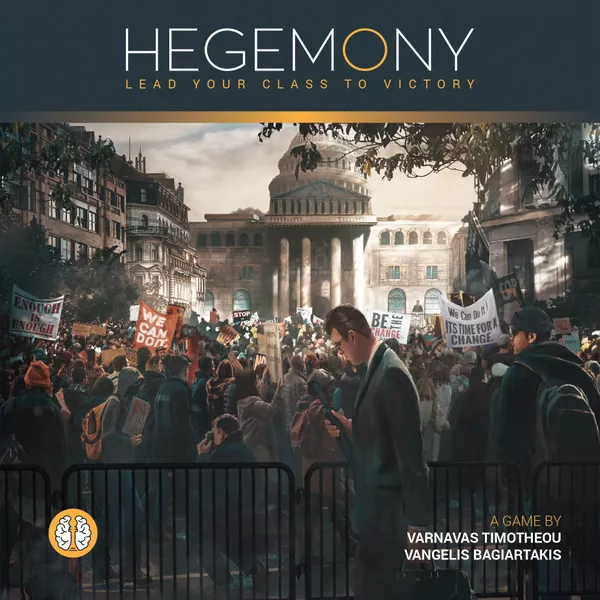
Hegemony Review
Lead Your Class to Victory — The Political Economy Game That Plays Like History
Hook / First Impression
Most board games ask you to be a wizard, a merchant, or a zoo director. Hegemony: Lead Your Class to Victory asks you to be a social class. You sit down as the Working Class, the Middle Class, the Capitalist Class, or the State — and you spend the next three to four hours pursuing the ideological and material goals of that class within a shared economy that all of you are simultaneously building, exploiting, and fighting over. It is one of the most intellectually ambitious designs in the history of modern tabletop gaming, and it delivers on that ambition.
Designed by Vangelis Bagiartakis and published by Hegemonic Project Games, Hegemony arrived via Kickstarter in 2022 and rapidly climbed to the upper echelons of BoardGameGeek's rankings. Its premise — model the tension between capital, labour, and the state in an abstracted modern nation — sounds like a university lecture. At the table it plays like a political thriller: alliances form and fracture across ideological lines, the economy lurches between boom and recession, and the winning player is frequently determined not by who accumulated the most but by who shaped the rules of the game itself through policy votes.
Overview
Hegemony: Lead Your Class to Victory is a heavy asymmetric political economy game for 2–4 players in which each player controls one social class in a fictional modern nation-state. The game models taxation, labour markets, production, welfare policy, and foreign trade through interlocking mechanical systems. Each class has its own victory conditions, its own action set, and its own relationship to the shared national economy — meaning that the same action (a minimum wage increase, for example) is a direct benefit to the Working Class player and a direct cost to the Capitalist Class player.
| At a glance | |
|---|---|
| Designer | Vangelis Bagiartakis |
| Publisher | Hegemonic Project Games |
| Year | 2022 |
| Players | 2–4 (best at 4) |
| Play time | 90–240 minutes |
| Age | 14+ |
| Weight | Very Heavy (BGG ~4.5/5) |
| Victory condition | Each class has unique victory conditions; highest influence score at game end wins |
Components & The Setting
The Setting: Players govern a fictional nation called Nea Demokratia — a deliberately generic modern democracy that serves as a blank canvas for the game's political economy. The four classes each occupy a distinct structural role: the Working Class provides labour and consumes goods; the Middle Class runs small businesses and occupies the swing-vote position between labour and capital; the Capitalist Class owns large companies and drives industrial output; and the State sets policy, collects taxes, and provides public services. The theme is not a coat of paint — every mechanical decision maps coherently onto the political-economic concept it represents.
The production quality is excellent and appropriately dense. The main board depicts the national economy: a production zone, a foreign market, a labour market, a consumer goods market, and a policy track around which the game's political decisions accumulate. Each player has a personal player board that tracks their class-specific resources, victory point conditions, and available actions — and each player board is substantially different from the others. The policy card deck is the heart of the game's political system: cards representing economic policies (tax rates, minimum wage, welfare spending, trade tariffs) are drafted, proposed, and voted upon over the course of play.
The company tiles, worker tokens, and resource cubes are well-produced and colour-coded. The iconography is dense and requires learning, but the player boards provide clear action references that reduce rulebook lookups after the first session. One production highlight: the asymmetric player boards are genuinely different objects — the Working Class board feels like a labour union ledger, the Capitalist board like a corporate balance sheet. This visual differentiation reinforces the thematic immersion in a way that most asymmetric games fail to achieve.
How to Play
Hegemony is played over a series of rounds, each divided into four phases: the Action Phase, the Foreign Phase, the Policy Phase, and the Population Phase. The game ends after a fixed number of rounds (typically four in the standard game), and the player with the highest influence score — calculated according to their class-specific victory conditions — wins.
In the Action Phase, each player takes turns performing actions from their class's unique action set. The four classes have meaningfully different available actions:
- Working Class — recruit workers from the population, negotiate wages, buy consumer goods, go on strike, and organise politically to push policy proposals.
- Middle Class — found and operate small businesses, hire workers, produce goods for the consumer market, and vote on policies as a swing bloc.
- Capitalist Class — build large companies, hire workers in bulk, produce industrial goods, export to the foreign market, lobby the State for favourable policy, and invest in automation that displaces workers.
- State — collect taxes, set the budget, fund public services (healthcare, education, social security), build infrastructure, propose and pass legislation, and manage the national debt.
The Foreign Phase resolves exports and imports: goods produced in the domestic market can be exported for foreign currency, and foreign goods can undercut domestic producers if trade policy has been set to favour open markets. This phase creates the game's economic feedback loop — protectionist policy keeps domestic producers solvent but raises consumer prices; free trade benefits exporters but exposes domestic workers to wage competition from abroad.
The Policy Phase is Hegemony's most distinctive element. Players draft policy cards from a shared display and vote on them as a legislative body. Each policy card represents a real policy instrument: a minimum wage increase, a corporate tax cut, a welfare expansion, a trade tariff. Each class has voting power proportional to its political influence, which fluctuates based on economic outcomes and actions taken during the Action Phase. The player who controls the State proposes legislation; the other classes vote for or against based on whether the policy serves their interests.
The Population Phase resolves welfare: workers who could not find employment consume welfare resources from the State budget. If the State cannot pay, dissatisfaction rises, political instability increases, and the game's victory condition calculations shift against the State player.
Gameplay Feel
Pacing & Tension: The first round of Hegemony is slow and unfamiliar — players are establishing their economic positions, and the consequences of early decisions are not yet visible. By the second round, the economy has warped enough that class interests are diverging sharply: the Capitalist may be automating jobs away, the Working Class may be organising a strike, and the State is running a budget deficit. The mid-game creates constant pressure: every policy vote is contested, every economic decision has visible consequences for other players, and the negotiation table operates continuously alongside the mechanical game. The final round is a race to convert accumulated resources and influence into victory points before the scoring calculation locks in.
Player Interaction: Hegemony has the highest player interaction of any game reviewed on this site. There is no parallelism — every action one player takes has consequences for every other player, because they all inhabit the same economy. A Capitalist who fires workers increases the Working Class player's unemployment and costs the State player welfare spending. A State player who raises the minimum wage increases labour costs for the Capitalist and the Middle Class. The game is an ecosystem of interdependence, and strategic play requires modelling your opponents' incentive structures as carefully as your own.
Luck vs. Strategy Balance: Hegemony is almost entirely skill-driven. There are minor randomness elements in the policy card draw and certain event cards, but the overwhelming determinant of outcomes is decision quality. This is one of the game's great strengths — experienced players consistently outperform new ones, and the skill ceiling is genuinely high. It also means that a player who misunderstands their class's victory conditions in the first round may find themselves in an unwinnable position by round three. The asymmetric learning curve between classes is steeper than in most asymmetric games.
Rule Overhead: Very high. The asymmetric rule sets mean that every player needs to learn not just the shared rules but their class's full action set and victory conditions — effectively four different games simultaneously. Teaching time is 45–60 minutes even with an experienced teacher. The rulebook is well-organised but long, and the interaction between economic systems (tax brackets, wage tiers, production chains, welfare thresholds) creates a web of rules that takes multiple sessions to fully internalise. Player aids are effectively mandatory for the first two to three sessions.
Mechanics Deep-Dive
The Political Economy Loop
The central mechanical achievement of Hegemony is that its economic simulation actually works — the feedback loops between labour, production, taxation, and welfare behave in ways that are recognisably analogous to real political economy. When the Capitalist Class invests in automation, worker unemployment rises; rising unemployment increases State welfare spending; increased welfare spending requires higher taxes; higher taxes reduce corporate investment; reduced investment decreases production; decreased production raises consumer prices. Each step of this chain is mechanically modelled and creates cascading consequences that force every player to react.
This is not a simulation for its own sake. Each loop creates decisions with genuine strategic weight: the Capitalist must decide whether the short-term gain from automation is worth the political cost of the unemployment spike it causes; the State must decide whether to fund welfare through debt or through tax increases that antagonise the productive classes; the Working Class must decide whether to accept a low-wage job or hold out for better terms and risk losing influence in the next policy vote.
Asymmetric Victory Conditions
Each class pursues influence through entirely different means, and their victory conditions are not fungible:
- Working Class scores influence by achieving high employment rates, high wages, access to social services, and a strong welfare state. Their ideal world is full employment with robust public services — a high-tax, high-welfare social democracy.
- Middle Class scores influence through business ownership, moderate taxation, stable consumer demand, and a balanced economy that neither fully favours capital nor fully empowers labour. They are the game's natural coalition-builders because their interests span both sides of the capital-labour divide.
- Capitalist Class scores influence through profit, market share, low taxation, minimal regulation, and access to cheap labour or automation. Their ideal world is a low-tax, low-regulation, high-output economy — even if the social costs are borne by others.
- State scores influence by maintaining economic stability, funding public services, managing the national debt, and achieving policy goals that serve the population broadly. The State player is the game's referee and the player most likely to win or lose based on macro-level outcomes rather than class-specific accumulation.
The Policy Card System
Policy cards are the game's most distinctive and memorable mechanical element. The policy display is a shared market from which players draft cards representing economic legislation. Cards are categorised by political leaning — left-wing policies tend to favour Working Class and State; right-wing policies tend to favour Capitalist and Middle Class — and drafting a card both makes it available for proposal and signals your class's political agenda to the table.
When a policy is proposed (an action available primarily to the State, but also to other classes with sufficient political influence), all players vote. Voting power is proportional to political influence, which is a tracked resource that rises and falls based on economic outcomes. A class with high unemployment and low wages may gain political influence from worker dissatisfaction; a class running successful businesses may gain influence from economic prestige. The vote can be won by building temporary coalitions — agreeing to support an opponent's policy in exchange for their vote on yours — creating a genuine legislative negotiation layer above the economic simulation.
Passed policies modify the game's core parameters: tax rates, wage floors, trade terms, and welfare spending levels. These are not temporary bonuses — they change the fundamental rules of the economy for the remainder of the game. A minimum wage increase passed in round two affects every subsequent employment action. A trade liberalisation policy passed in round one shapes the entire foreign market for the game's duration. Policy decisions have permanent, compounding consequences, which is exactly what makes them worth fighting over.
The Labour Market
The labour market is the game's economic heartbeat. Workers (represented by tokens belonging to the Working Class player) must be hired by businesses (owned by the Capitalist and Middle Class players) at wages negotiated or set by policy. The supply and demand dynamics of this market — too many businesses competing for too few workers drives wages up; automation and recession drive wages down — produce emergent economic storytelling that feels genuinely reactive rather than scripted.
The Working Class player's core tension is between accepting employment at low wages (which generates income but concedes ground on their victory conditions) and holding out for better terms (which risks unemployment and welfare dependency). The Capitalist's core tension is between paying high wages to attract workers (which raises costs but maintains production) and investing in automation (which reduces labour costs but generates political opposition). This labour market dynamic is the most elegant mechanical expression of the game's central theme.
Player Count Analysis
4 Players — Essential. Hegemony is designed for four players, and the four-player game is the only version that fully realises the game's political economy model. Each of the four classes is present, the coalition dynamics operate as intended, and the Policy Phase produces the negotiation layer that makes Hegemony unique. Every session at four players feels like a complete and coherent political drama. Do not introduce this game at any other count until you have played it at four.
3 Players — Functional, but compromised. With three players, one class is removed and replaced by a mechanical dummy faction — typically the Middle Class, as it is the most mechanically neutral. The three-player game plays faster and remains intellectually engaging, but the absence of the fourth class removes one of the primary coalition-building vectors. The Policy Phase loses complexity without the Middle Class swing vote. Three-player Hegemony is a satisfying economic game; it is not the full political experience.
2 Players — A different game. Two-player Hegemony — Working Class vs. Capitalist Class, with the State and Middle Class managed as a shared neutral mechanism — functions as a direct ideological confrontation. It is faster, more focused, and reveals the game's core capital-labour tension without the coalition complexity of the fuller game. Experienced players who want a quicker, sharper experience can find real value in the two-player mode, but it should not be used as an introduction to the game — the full four-player experience should come first.
Solo — Not available. Hegemony has no solo mode and, given its design philosophy — a political economy requires political actors — there is no natural way to simulate one. This is a game that requires at least two players and ideally four.
Replayability
Hegemony's replayability derives from two sources: the asymmetric class roles and the emergent economic storytelling that results from different player combinations and strategic choices. Playing as the Working Class in session one and the Capitalist in session two are fundamentally different experiences — different action sets, different victory conditions, different relationships to every other player at the table. Most dedicated groups report that each class requires three to five sessions to begin playing competently, meaning the base game alone sustains fifteen to twenty sessions of genuine exploration before any class feels fully mapped.
Beyond class asymmetry, the policy card draw creates variability in the available legislative agenda each game. A game where free-trade policy is available early evolves differently from one where protectionism dominates the policy display. Event cards (present in some variants) introduce further variability. And the negotiation dynamics — who allies with whom and on what terms — are never the same twice, because they depend on the specific people at the table and the specific economic situation that develops.
Learning Curve
Ease of teaching: Hegemony is among the hardest games in the hobby to teach. The challenge is not that any single rule is complex — the turn structure is clear and the phases are logically ordered — but that players need to understand four different sets of class-specific rules simultaneously, and the interactions between the economic systems only become apparent through play. The best approach is to assign classes before teaching so that each player only needs to learn their own faction's mechanics deeply, trusting the other players to understand theirs. A teaching game where all players commit to playing their class straightforwardly — no complex negotiations in the first session — is strongly recommended.
Rulebook quality: Above average. The Hegemony rulebook is logically structured and uses consistent iconography throughout. Class-specific rules are clearly separated. The examples of play are helpful and numerous. The community has also produced high-quality player aids and quick-reference cards (available on BGG) that distil the most commonly referenced rules to a single sheet per class. These are essential for the first three sessions.
First-game experience: Almost universally positive in retrospect but confusing during play. New players frequently miss the implications of economic decisions until after the consequences arrive — a Capitalist who automates jobs in round one may not understand why the Working Class player is politically powerful in round three. This delayed feedback is accurate to the game's theme but demands patience from new players. Teachers should pre-empt this by narrating the economic consequences of major decisions as they happen: "When the Capitalist builds that automation tile, three workers lose their jobs — that increases the State's welfare obligation and gives the Working Class political influence."
Teaching tip: Before the first game, walk every player through the scoring track for their specific class using a concrete example. New players frequently misunderstand their victory conditions — particularly the State player, whose scoring is the most diffuse and the least immediately legible. A five-minute walk through "what does a winning State look like at the end of round four?" before the game begins saves significant confusion.
Who It's For
Political and economic thinkers: Hegemony is, to an unusual degree, a game that rewards real-world knowledge. Players who understand concepts like wage floors, tax incidence, trade deficits, and welfare dependency will find that their intuitions transfer directly to strategic decisions. The game is not a textbook — it is an abstraction — but the abstractions are coherent enough that economic literacy provides a genuine advantage. This is rare and valuable.
Fans of asymmetric heavyweights: If you love Root and wish it were longer and more mechanically complex, or if you have played Twilight Imperium and want the same political negotiation layer at a smaller scale, Hegemony occupies a unique design space that no other published game currently fills. It is the definitive political economy board game.
Groups who enjoy talking during games: Hegemony rewards groups who are comfortable negotiating, arguing, making and breaking deals, and engaging with the game's themes as a shared intellectual exercise. Silent play is not just suboptimal — it misses the point. The best Hegemony sessions involve genuine debate about policy, accusation, coalition-building, and betrayal. Groups who prefer quiet parallel games will not find what they are looking for here.
Who it is not for: Casual players or groups who want a game finished in under two hours; groups with fewer than four engaged players; players who want clean, solvable puzzles rather than messy political negotiation; anyone who is uncomfortable with games that explicitly model class conflict. For groups who want asymmetric play without the political weight, Root or Cosmic Encounter will be more immediately accessible. For groups who want a lighter political game, Twilight Struggle or 1960: The Making of the President provide political themes at lower complexity.
Pros & Cons
What Hegemony does exceptionally well:
- The political economy simulation is coherent and emergent — economic feedback loops behave in recognisably realistic ways, which makes every decision feel meaningful rather than arbitrary.
- Asymmetric victory conditions create the highest-quality player interaction in any heavy euro on the market: every decision affects every other player, and alliances are always conditional and transactional.
- The Policy Phase transforms what could be a pure economic optimisation game into a political negotiation game — the most distinctive and memorable feature of the design.
- Four meaningfully different class experiences mean a dedicated group can play twenty sessions without repeating the same strategic experience.
- The game rewards real-world economic and political literacy in a way no other board game does — a unique quality that appeals to players who want their hobby to engage with substantive ideas.
- Component quality and asymmetric player board design are outstanding — each class's board feels like a distinct artefact that reinforces the thematic identity.
Where Hegemony struggles:
- The session length is the game's most significant practical barrier: first games routinely run four hours, and even experienced groups should budget three hours minimum at four players.
- The learning curve is exceptionally steep. Each class requires multiple sessions to play competently, and the game's full depth is only accessible after significant investment.
- The game does not work without four engaged, willing players. It cannot be played solo, plays awkwardly at two, and is compromised at three. This is a narrower playability window than most games of comparable weight.
- The political and economic themes are not neutral. Some players find the class-conflict framing uncomfortable or politically loaded; it is worth knowing your group before bringing this to the table.
- Analysis paralysis risk is high — particularly for the State player, whose action set is the broadest and whose decisions affect every other player most directly. Budget extra time if your group includes deliberate decision-makers.
- The rulebook, while good, rewards careful reading rather than casual scanning. Groups who do not prepare adequately before the first session will struggle significantly in the early rounds.
Expansions & Ecosystem
Hegemony's expansion ecosystem is currently modest, reflecting both the game's relative youth and the deliberate pace of Hegemonic Project Games' development approach.
1. Hegemony: The Ultra-Rich — A fifth faction for 3–5 players ★★★★☆
The first expansion introduces a fifth playable class — the Ultra-Rich — representing the oligarchic super-wealthy who operate above and beyond the normal capitalist class. The Ultra-Rich player has access to unique actions (offshore tax havens, private media ownership, political lobbying at a scale unavailable to the base game Capitalist) and victory conditions that focus on wealth concentration and political capture rather than productive output. The expansion plays best with five players and adds a new tier of political complexity: the Ultra-Rich can effectively purchase influence from other classes, introducing a corruption mechanic that creates moral dilemmas for every player at the table.
2. Scenario and Crisis Module — Optional event-driven variability ★★★★☆
A set of scenario cards and crisis event cards that can be layered into the base game to introduce specific economic or political shocks — a financial crisis, an energy shortage, a foreign trade dispute — that force all players to respond to shared disruptions. The module adds replayability and introduces a randomness element that the base game almost entirely lacks. It is especially useful for experienced groups whose games have become too predictable through familiarity.
Quick Buyer's Guide
| Product | Best For | Complexity Added | Rating | Priority |
|---|---|---|---|---|
| The Ultra-Rich | 5-player groups with base game experience | Moderate | ★★★★☆ | 🥇 Buy after 5+ base game sessions |
| Scenario/Crisis Module | Experienced groups wanting variability | Low | ★★★★☆ | 🥈 Buy after 10+ base game sessions |
Value for Money
Hegemony retails for approximately $75–$90 USD (€65–80 in Europe). For a game with four deeply asymmetric player boards, a large main board, an extensive policy card system, and a strategic depth that sustains twenty or more meaningful sessions, this is strong value — provided your group is the right one for it.
- Committed four-player groups: Exceptional value. Each class requires multiple sessions to master, and the inter-class dynamics shift as players develop. The per-session cost drops below two dollars well within the first year of regular play.
- Groups who might not reach four committed players: Consider carefully. The game is significantly compromised at fewer than four, and a group that cannot reliably assemble four players who are all willing to invest the required learning time will not reach the experience the game is designed to deliver.
- Casual groups or families: Not recommended. The complexity, session length, and thematic content position this firmly as a dedicated hobbyist product for adults who are actively interested in the subject matter.
- Used copies: Hegemony holds its value well on the secondary market, reflecting genuine demand and limited availability of the Kickstarter edition. If buying used, verify that all four player boards, the policy card deck, and the worker and resource tokens are complete — missing components are difficult to replace.
Accessibility
Color blindness: Hegemony uses colour as a primary class identifier — each of the four classes is associated with a distinct colour used consistently across tokens, boards, and card backs. Players with colour blindness will need to establish alternative identification methods (sticker labels on tokens, verbal confirmation before actions) as the iconography alone does not fully compensate for colour differentiation. This is a meaningful accessibility gap in an otherwise well-produced game.
Language dependence: High. The policy cards, action cards, and event cards all carry text describing effects that cannot be replaced by icons. Hegemony is published in English and several European languages; playing with cards in an unfamiliar language is impractical. Verify language availability before purchasing.
Cognitive accessibility: Hegemony is not suitable for players with significant cognitive limitations. The asymmetric rule sets, multi-system economic interactions, and negotiation layer create a decision environment that is among the most complex in the hobby. That said, the game's turn structure — choose and perform actions from your class's action list — is straightforward enough that players can participate meaningfully even if they cannot fully optimise. Patience from co-players and a willingness to explain consequences rather than just outcomes will go a long way.
Physical accessibility: The game has no dexterity or timing requirements. Tokens and tiles are standard sizes and easy to handle. The text on player boards is small in some areas; players with vision limitations may benefit from proximity to their own board and from the community-produced enlarged player aid sheets. No timed elements.
Thematic accessibility: Worth noting separately. The game's subject matter — class conflict, economic inequality, and political negotiation — is ideologically charged in a way that most board games are not. This is a deliberate design choice and a feature for players who want their games to engage with substantive real-world issues. It may be uncomfortable for players who prefer politically neutral themes, and it is worth discussing with your group before bringing the game to the table for the first time.
Age range: The 14+ rating is appropriate for cognitive complexity. The thematic content (economic inequality, political negotiation, class conflict) is adult in character and benefits from some real-world context. Teenagers with strong interest in economics or politics can engage meaningfully; younger than 14 is very challenging even with support.
Verdict
Hegemony: Lead Your Class to Victory is a singular achievement in board game design. Vangelis Bagiartakis has done something that very few designers have attempted and fewer have pulled off: built a game whose theme is not decorative but structural, whose mechanics are not analogies for political economy but models of it. The feedback loops work. The asymmetric class interests create genuine conflict. The Policy Phase transforms a heavy economic euro into a political negotiation game. And the whole thing holds together with a design coherence that is rare at any complexity level.
Its limitations are real and should not be minimised. The session length is formidable. The learning curve is among the steepest in the hobby. The game requires four committed players to deliver its full experience, and it delivers nothing meaningful to solo players. Groups who are not intrinsically interested in the subject matter will find the investment difficult to justify.
Buy it if: you have four players who are willing to invest two to three sessions in learning it, are comfortable with political and economic themes, and want a game that will generate genuinely different experiences across twenty plays. It will reward that investment more richly than almost any other game at this weight class.
Skip it if: your group plays irregularly, can rarely assemble four committed players, prefers conflict-free or lighter games, or wants a game finished in under two hours. The session length and player count requirements are not negotiable.
Upgrade it with: The Ultra-Rich expansion after your group has five or more base game sessions. It adds a genuinely new political dimension without disrupting what makes the base game work.
Score Breakdown
Love deep strategy games? Explore our reviews, score calculators, and strategy guides — everything you need to play better and have more fun at game night.
Browse All Reviews →