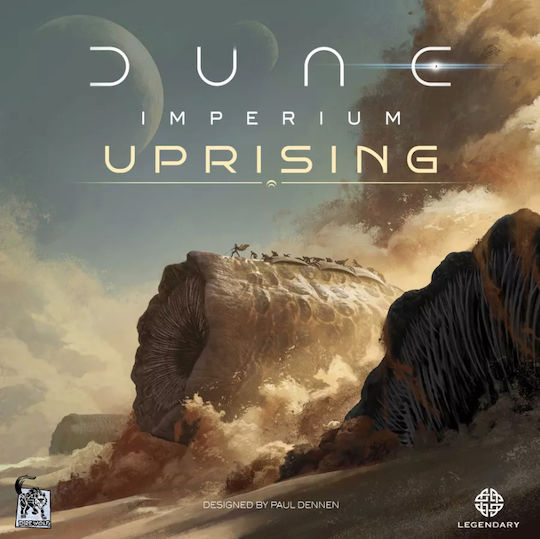
Dune: Imperium – Uprising Review
The Sandworm Has Teeth — and a Deckbuilder Under Its Scales
Hook / First Impression
The original Dune: Imperium (2020) blindsided the hobby. Paul Dennen took two systems that rarely mix cleanly — worker placement and deck building — fused them together with a layer of faction politics lifted straight from Frank Herbert's universe, and produced one of the finest medium-weight games of its generation. Three years later, Dune: Imperium – Uprising arrived not as a modest expansion but as a full standalone sequel that does what all great sequels should: it keeps everything that worked, dismantles everything that didn't, and adds just enough new material to feel genuinely new rather than just more of the same.
The result is one of the best board games published in 2023 — and, in our view, a marginal but meaningful improvement on the original it replaced.
Overview
Dune: Imperium – Uprising is a competitive worker placement and deck-building game designed by Paul Dennen and published by Dire Wolf. Players lead noble houses — Atreides, Harkonnen, Corrino, or Ix — competing for control of Arrakis and, ultimately, the spice. Uprising can be played as a fully standalone experience or combined with the original Dune: Imperium for expanded content.
| At a glance | |
|---|---|
| Designer | Paul Dennen |
| Publisher | Dire Wolf |
| Year | 2023 |
| Players | 1–6 |
| Play time | 60–120 minutes |
| Age | 14+ |
| Weight | Medium-heavy (BGG ~3.0/5) |
| Victory condition | First to 10 Victory Points |
Components & The Setting
The Setting: Each player commands a Great House of the Imperium, dispatching agents to the courts, deserts, and underworld of the Dune universe to gather spice, build armies, curry favour with factions — the Bene Gesserit, the Fremen, the Spacing Guild, and the Emperor — and fight for control of Arrakis's most precious resource. Unlike many licensed games where the IP is a thin coat of paint over an abstract system, Uprising earns its license. Every mechanic connects meaningfully to the source material: spice must flow from the desert but attracts sandworm attacks; Fremen allies grant desert movement and combat advantages; the Bene Gesserit manipulate the board state subtly rather than through brute force. Players who love the books will find the theme deeply woven into every decision. Players new to Dune will find the setting compelling enough to want to explore it further.
Component quality is exceptional for the price tier. The main board is large, sturdy, and beautifully illustrated — rich ochres and deep blues that immediately evoke the novels without slavishly copying the film aesthetic. The four faction boards are thick player mats with clear iconography. Cards are linen-finished and worth sleeving; the Imperium Row and Intrigue decks will see heavy handling over many sessions. The combat dial for the Conflict system is a satisfying physical object. Miniatures — including the iconic Sandworm — are well-sculpted though unpainted; they read clearly from across the table and add real presence to the Arrakeen board. Resource cubes are chunky and easy to handle. The Spice Harvest tokens are a notch above utilitarian. Overall, this is a high-production game that punches above its price point.
How to Play
The goal is to reach 10 Victory Points before any opponent. VPs come from winning Conflicts, advancing on faction influence tracks, completing certain cards, and holding key board positions. The game ends immediately when any player hits 10 VPs at the end of a round.
Each round, players take turns in a two-phase structure. During the Agent Phase, a player plays a card from their hand face-up. Every card in Dune: Imperium carries two values: an Agent icon (which lets you send an Agent to a matching board space) and a Reveal icon (which contributes resources and combat strength during the Reveal phase). You choose which half of the card to use on each turn. This elegant dual-use design — a single card simultaneously shaping your deck-building economy and your board presence — is the game's central genius.
Board spaces produce resources: Spice (the primary currency), Water, Solari (money), Troops (combat strength), and Influence on faction tracks. Once you've played all your Agent cards, you enter the Reveal Phase: flip your remaining hand cards and sum their combat strength. Players then choose how many troops to commit to the round's Conflict — a zero-sum battle where the rewards tier from first to third place, including VPs for the winner.
Between rounds, players use Solari and Spice to acquire new cards from the central Imperium Row, building their deck toward a late-game engine. Intrigue Cards — hidden one-time effects drawn by visiting the Sietch Tabr or Research Station spaces — add a layer of information asymmetry and surprise. And threading through everything: the Sandworm track, new to Uprising, which escalates the danger of spice harvesting as the rounds progress.
Gameplay Feel
Pacing & Tension: Uprising moves with a satisfying sense of inevitability. Early rounds are about positioning — claiming the right board spaces, hitting the influence tracks that match your faction's opening cards, and harvesting spice without triggering the Sandworm. Mid-game is where the tension peaks: the Imperium Row has begun to thin of its most powerful cards, Conflict rewards are escalating, and every Agent placement carries real cost because those same spaces are increasingly blocked by opponents. The endgame can be explosive — a well-timed Intrigue combo or a dominant Conflict victory can swing the game from 7 VPs to 10 in a single round, which keeps every player leaning forward until the very end.
Player Interaction is meaningful without being punishing. Board space blocking is real and often decisive — sending an Agent to a spice harvesting location your opponent needed is one of the game's most satisfying micro-plays. Combat creates direct confrontation but rewards smart troop management over brute force. The faction influence tracks create a quiet arms race: being first on the Bene Gesserit track, for example, unlocks a unique bonus that changes your whole strategic calculus. Nothing in Uprising feels personal; everything feels like legitimate political and military maneuvering. Table tension stays productive.
Luck vs. Strategy Balance: Uprising sits near the strategy end of the spectrum for its weight class. The primary randomness is the Imperium Row card selection — which cards appear and in what order shapes the metagame of each session. But experienced players adapt their strategy to what's available rather than being victims of it. Intrigue Cards introduce some variance but are consistently interesting rather than swingy. The Combat system involves no dice; outcomes are a direct result of troop commitment decisions and Intrigue plays. In our logged sessions, the player who read the board most accurately in the first three rounds won roughly 70% of the time.
Rule Overhead: Uprising is a medium-heavy game that takes about 30–40 minutes to teach completely. The dual-use card system clicks quickly once demonstrated — one played session is worth more than an hour of rulebook reading. The complexity comes not from complicated rules but from the sheer number of decisions that interact with each other: which card to Agent vs. Reveal, which board spaces to contest, when to fight vs. concede a Conflict, how to time spice harvesting against the Sandworm track. The overhead is earned, not gratuitous.
Mechanics Deep-Dive
The Dual-Use Card System
The central insight of Dune: Imperium — and Uprising — is that every card serves two masters. When played as an Agent, it sends your worker to a board space and triggers that space's effect; when revealed during the Reveal Phase, it contributes to your combat strength and produces additional resources. This means card acquisition isn't just about raw power — it's about identifying cards whose Agent icon type matches the board spaces your strategy requires and whose Reveal value supports the combat intensity you need.
Uprising's new card pool introduces stronger faction synergies and more cards with activated Fremen Bond effects, which rewards building tighter, more focused decks than the generalist "grab the best available card" approach that dominated early games of the original.
The Sandworm Uprising System
This is Uprising's signature addition and one of its best designs. Each time a player harvests spice from the deep desert, a Sandworm token advances on the Uprising track. Once the track fills, a Sandworm attack is triggered — players who have troops in the desert lose them, and the worm resets the track. This creates a ticking clock dynamic around spice harvesting: harvesting early and often is economically powerful but accelerates a threat that punishes careless positioning. Late in the game, when troops are precious and spice is abundant, the calculus of whether to risk harvesting becomes one of the session's most engaging recurring decisions.
Faction Influence Tracks & the CHOAM Economy
The four faction influence tracks — Bene Gesserit, Fremen, Spacing Guild, and Emperor — each unlock passive bonuses at certain thresholds and award VPs at Alliance level (the top slot). Controlling an Alliance locks that VP for you until an opponent surpasses your influence, creating a genuine arms race. The CHOAM economy, which revolves around purchasing and selling Shares for Solari, adds a market layer where the right timing on CHOAM buys and sells can generate explosive mid-game wealth — or leave a player cash-poor when they need troops most.
Combat & Conflicts
Each round resolves one Conflict card drawn from the deck, offering tiered rewards for first, second, and sometimes third place. Players secretly decide how many troops to deploy using a dial, then reveal simultaneously. The twist: Intrigue Cards played during combat can flip outcomes, and troops left at home are available next round while committed troops return slowly through recruitment. The result is a tense resource-management problem dressed up as a battle — the player who fights every Conflict at maximum force will exhaust themselves long before the endgame. Knowing when to concede is a core skill that separates good players from great ones.
The Signet Ring
Each player's Leader comes with a Signet Ring — a unique activated ability that can be triggered once per round by spending the appropriate resource. These are deliberately understated on early reads but powerful in extended play: the Atreides ring draws extra cards, the Harkonnen ring draws Intrigue cards and deploys troops, and the Ix ring generates Solari or enables surprise board plays. The rings reward familiarity with your leader's identity and give each faction a distinct rhythm without requiring different rulebooks.
Player Count Analysis
Solo — Excellent. Uprising includes a fully developed solo mode against an AI opponent called the Mentat. The Mentat takes board spaces, triggers Conflicts, and advances on influence tracks autonomously, creating genuine pressure without requiring a human opponent. It isn't the deepest solo experience in the hobby, but it's more than adequate — and it's genuinely useful for learning the card economy before your first multiplayer session.
2 Players — Very good, with caveats. Two-player Uprising is tight and tense, with every board space blocked feeling immediate and pointed. The faction influence race becomes a direct head-to-head contest. The main downside is that the political dimension — reading multiple opponents, timing your Conflict commitment against unknowns — is simplified when you only need to model one rival. Still a strong experience, but some of the game's best dynamics (three-way Conflict splits, CHOAM share timing against two opponents) are absent.
3 Players — The strategic sweet spot. Three players is where Uprising's political layer fully activates. Conflict outcomes become genuinely unpredictable — the three-way split is far more interesting than the two-way. Board space blocking becomes a meaningful decision without being suffocating. Games at this count consistently produce the tightest, most satisfying experiences in our logged sessions. If you have the option, three is the preferred count.
4 Players — The social sweet spot. Four players introduces the richest political environment: four factions with different Signet Ring powers and starting card affinities create real asymmetry. Conflicts are chaotic in the best way. The main cost is playtime — four-player games regularly run 100–120 minutes, and the downtime between turns increases enough to matter with slower players. At a brisk table, it's the fullest version of the game.
5–6 Players — Functional but slower. Uprising's native 1–6 support is one of its headline improvements over the original. The larger player counts work — the board is big enough, there are enough board spaces — but the downtime between turns becomes significant, and Conflict reads grow increasingly complex. Best for groups that specifically want to accommodate a larger gathering; at five or six, expect games to approach two hours comfortably. Have the solo mode rules ready as a fallback for players who finish their turns quickly.
Replayability
Uprising's replayability is extremely high for its weight class, driven by four distinct sources of variation. First, the Imperium Row is drawn from a shuffled deck — no two sessions present the same card acquisition opportunities, and a session where powerful Fremen Bond cards appear early plays entirely differently from one dominated by CHOAM and Spacing Guild cards. Second, faction asymmetry ensures each player's opening strategy differs depending on their Leader and Signet Ring. Third, the Conflict deck introduces variable escalation — the same round-three position can feel very different depending on whether the Conflict that turn offers VPs or only troops and spice. Fourth, combining Uprising's card pool with the original Dune: Imperium box multiplies the variable deck dramatically.
In our sessions, we consistently found new strategic lines emerging after 10 or more plays — the game rewards mastery without making early plays feel stale. The combination rules with the original box add a second shelf-life for dedicated groups.
Learning Curve
Ease of teaching: Uprising takes 30–40 minutes to teach fully, which is substantial. The good news is that the core loop — play a card as Agent or hold it for Reveal, then fight a Conflict — is graspable in five minutes. The complexity lives in the interactions: when to buy cards vs. spend resources on troops, how to manage the CHOAM economy, what the Fremen Bond icons do. A first game with an experienced teacher runs about 90 minutes and leaves new players confident in the basic decisions even if not yet fluent in the strategy.
Rulebook quality: Dire Wolf's rulebook is well-structured and clearly illustrated. It walks through setup and the turn structure logically, with good examples for the dual-use card system. The most common stumble in first games is the Combat resolution — when to play Intrigue vs. hold it — but one demonstration resolves it permanently. The Quick Reference card included in the box is genuinely useful during the first two sessions.
First-game experience: Positive for players who are comfortable with medium-weight games; potentially overwhelming for casual gamers. Uprising is not a gateway game — the cognitive load in the first session is real, and new players will make suboptimal decisions that compound into difficult positions by mid-game. This is a game for the interested hobbyist, not the reluctant participant at a family gathering. For those players, though, the first game is almost always enough to hook them for a second.
Who It's For
Hobby gamers who love medium-heavy euros: Uprising is close to a must-own. It delivers the forward-planning satisfaction of a worker placement game and the card engine dopamine of a deckbuilder in one tightly integrated package. At roughly 90 minutes for a four-player session with experienced players, it fits comfortably into a regular game night without the all-evening commitment of heavier titles.
Fans of the Dune franchise: The license is handled with real care. Book readers will find familiar faction dynamics, thematic resonance in every mechanic, and satisfying moments of convergence between what the game does and what the novels describe. The 2021 Denis Villeneuve film introduced a new generation to the IP, and Uprising's aesthetic sits closer to the film's visual language — a choice that helps onboard players who know the setting but haven't read the books.
Groups who play Dominion or Concordia: If your group loves deck-building or the build-and-optimize arc of Concordia, Uprising's card economy will feel immediately familiar and rewarding. It adds the worker placement tension those games lack.
Casual or family groups: Not the right fit. The rules overhead is real, the game rewards multiple sessions of familiarity, and the 14+ age rating is accurate. For groups newer to the hobby, Catan or Cascadia are more appropriate starting points.
Comparisons: Uprising occupies a unique design space, but its closest genre siblings are Architects of the West Kingdom (worker placement purity), Star Realms (deckbuilder speed), and Scythe (thematic faction asymmetry). None of them do what Uprising does; none of them should replace it on your shelf if Uprising is already there.
Pros & Cons
What Uprising does brilliantly:
- The dual-use card system — every card serving both an Agent function and a Reveal function — is one of the most elegant design solutions in modern board gaming.
- Theme integration is exceptional; every mechanic feels like it emerged from the Dune universe rather than being bolted onto a generic engine.
- The Sandworm track creates escalating tension without adding rules complexity — a masterclass in simple systems with emergent depth.
- Faction asymmetry through Signet Rings gives each player a distinct rhythm and strategic identity from turn one.
- Solo and 2–6 player support is genuinely functional at all counts, not just nominally listed.
- High replayability driven by card pool variance, faction diversity, and Conflict deck ordering — no two sessions feel identical.
- Fremen Bond system rewards focused deck construction over generic card power, creating more satisfying late-game engines.
Where Uprising has friction:
- The 30–40 minute teach time puts it firmly outside casual-game territory — not a pick-up game for mixed-experience groups.
- Downtime at 5–6 players is noticeable; AP-prone groups will stretch sessions well past two hours.
- The CHOAM share economy can feel opaque in early sessions — its power isn't obvious until you've been beaten by a well-timed CHOAM cycle.
- First-game position matters more than in games with explicit catch-up mechanics; a poor opening round of card buying can be hard to recover from against experienced opponents.
- The visual density of the main board intimidates new players before they understand how few spaces actually matter each round.
Expansions & Ecosystem
As of mid-2026, Uprising's expansion ecosystem is maturing alongside that of the original Dune: Imperium, and several additions are worth knowing.
Dune: Imperium – Bloodlines ★★★★☆
The first dedicated expansion for Uprising adds new Leader options, a deeper Intrigue card pool, expanded Fremen Bond combinations, and the Bloodlines mechanic — a legacy-adjacent system where decisions in one session carry thematic (though not permanent) consequences into the next. It slots cleanly into Uprising without meaningfully increasing the teach time, making it an easy buy for groups who have mastered the base game. Recommended after 10–15 sessions with the base box.
Dune: Imperium (Original) — Combination Rules ★★★★★
If you own the original Dune: Imperium (2020), Uprising includes official combination rules that let you merge both card pools. This dramatically expands the Imperium Row variance and creates a more diverse card acquisition environment across dozens of sessions. The combination doesn't add meaningful new rules — it simply gives you a larger, more varied deck. For long-term players, this is one of the best "expansions" available because most groups already own the original.
Quick Buyer's Guide
| Add-On | Best For | Complexity | Rating | Priority |
|---|---|---|---|---|
| Bloodlines | Veteran groups wanting variety | Low add | ★★★★☆ | 🥇 First buy after 10–15 sessions |
| Original + Combination Rules | Long-term card pool variety | None | ★★★★★ | 🥈 If you own the original already |
Value for Money
Uprising retails for approximately $60–$75 USD (€55–65 in Europe). For a medium-heavy game with solo and 1–6 player support, exceptional component quality, and a card pool that remains interesting across 30+ sessions without expansion, this represents strong value. The per-session cost for a regular gaming group drops below two dollars within the first month of play.
- Regular gaming group (4–6 sessions/month): Excellent value. The card variance and faction asymmetry ensure repeat plays remain fresh. The Bloodlines expansion extends this further at a modest cost.
- Occasional gamers (1–2 sessions/month): Still worth it, but allow time for the mechanics to click — the game rewards familiarity, and occasional players may not reach the point where the deeper strategy emerges. Consider whether you'll commit to 5–6 sessions before the investment pays off.
- Solo players: The solo mode is solid but not the game's primary identity. At $65 there are more dedicated solo experiences available. That said, if you want to use solo as a learning mode before multiplayer, it delivers exactly that.
- Budget shoppers: Watch for the original Dune: Imperium at a discount — it's slightly simpler and often $20–25 cheaper used. Uprising is the better game, but the original is the better value if price is the primary constraint.
Accessibility
Color blindness: Uprising uses color to distinguish player factions (blue, red, green, yellow at 4 players), but player pieces are also differentiated by faction symbol, which substantially mitigates the issue. Resource tokens use both color and shape. The board space iconography relies on color for faction-track differentiation, which could be challenging for deuteranopes — the Bene Gesserit and Spacing Guild tracks in particular use colors that may be difficult to distinguish in poor light. A printed reference card with labels replaces color-coding effectively.
Language dependence: Moderate. Cards have text abilities that require reading; card-text translation editions exist for major European languages. For mixed-language groups, the card text barrier is real and a translated card set or printed reference list is recommended.
Cognitive accessibility: Uprising is genuinely demanding. Tracking opponent influence, your deck composition, the Sandworm timer, troop reserves, and CHOAM share timing simultaneously is a meaningful cognitive load. Players with attention or working-memory challenges may find the multivariable decision space tiring. The game's turn structure is regular and easy to follow; the complexity is in the strategic depth, not the procedure.
Physical accessibility: Components are large, clearly printed, and easy to handle. Cards are standard size. The combat dial requires twisting, which may present a minor challenge for players with limited grip strength — a small number token substitutes easily. The board is large (fits a standard gaming table comfortably at four players) but remains accessible from all sides at the recommended 3–4 player counts.
Age range: The 14+ rating is appropriate. The game's complexity demands abstract strategic thinking and forward planning that younger players typically develop in their mid-teens.
Verdict
Dune: Imperium – Uprising is the rare sequel that genuinely improves on an already excellent original. The Sandworm Uprising system adds escalating tension without mechanical bloat. The Fremen Bond mechanic rewards deck focus over opportunistic card shopping. Six-player support makes the box more versatile. And throughout, the Dune license is worn with confidence — this is a game that knows exactly what it wants to be, and it delivers it with exceptional polish and depth.
It is not a casual game. The teach time, the cognitive load, and the reward structure all assume players who are willing to invest two or three sessions before the full strategic picture emerges. But for groups who make that investment, Uprising joins a small list of modern games that continue to offer new strategic lines and surprising sessions well past their twentieth play.
Buy it if: you enjoy medium-heavy worker-placement or deck-building games, you have a regular group willing to learn a ruleset properly, and you want a game that scales seamlessly from solo to six players without compromise.
Skip it if: you need a gateway game for mixed-experience groups, or the 30-minute teach time is a dealbreaker for your regular sessions.
Buy both boxes if: you already own the original Dune: Imperium — the combination rules transform both boxes into a single, endlessly variable system that easily earns its shelf space for years.
Score Breakdown
Love board game night? Explore our tools, score calculators, and strategy guides — everything you need to play better and have more fun.
Browse All Articles →