Hotel Review
The Classic 3D Resort Builder That Captured a Generation
Hook / First Impression
Before anyone had heard of worker placement or engine building, there was Hotel — Milton Bradley's 1987 resort-building classic that let you snap together colourful plastic skyscrapers on a sun-drenched island board. At a time when board games meant Monopoly or Scrabble, Hotel was genuinely spectacular: physical 3D buildings that grew floor by floor, a vibrant tropical theme, and the simple thrill of watching an opponent's token land on your penthouse and hand over half their cash.
Decades later, with thousands of modern games on the market, Hotel occupies an unusual position: it is too luck-heavy and mechanically thin to satisfy a modern hobby gamer, yet it delivers something many sophisticated games cannot — immediate visual delight, zero learning friction, and the kind of nostalgic table energy that turns a casual evening into a lasting memory.
Overview
Hotel is a competitive property-development game in which players buy plots on a resort island, construct hotels piece by piece, and collect rent from opponents who land on their properties. The winner is the last player standing — or the wealthiest when time runs out. Originally published by Milton Bradley in 1987, it has been republished under the name Hotel Tycoon in some European markets and has seen several revised editions over the years.
| At a glance | |
|---|---|
| Publisher | Milton Bradley / Hasbro |
| Year | 1987 (current edition varies by region) |
| Players | 2–6 |
| Play time | 60–120 minutes |
| Age | 8+ |
| Weight | Light (BGG ~1.5/5) |
| Victory condition | Last player solvent, or wealthiest at game end |
Components & The Setting
The Setting: Players are resort developers on a tropical island, competing to build the most lavish hotel empire and bankrupt their rivals. The theme is tightly integrated with the physical components — you are literally building hotels, floor by floor, on plots you own. When a rival lands on your property, they are checking in as a paying guest. The cause-and-effect is intuitive enough that children grasp it immediately without needing the rulebook to spell it out. It is a rare case where the theme genuinely teaches the rules.
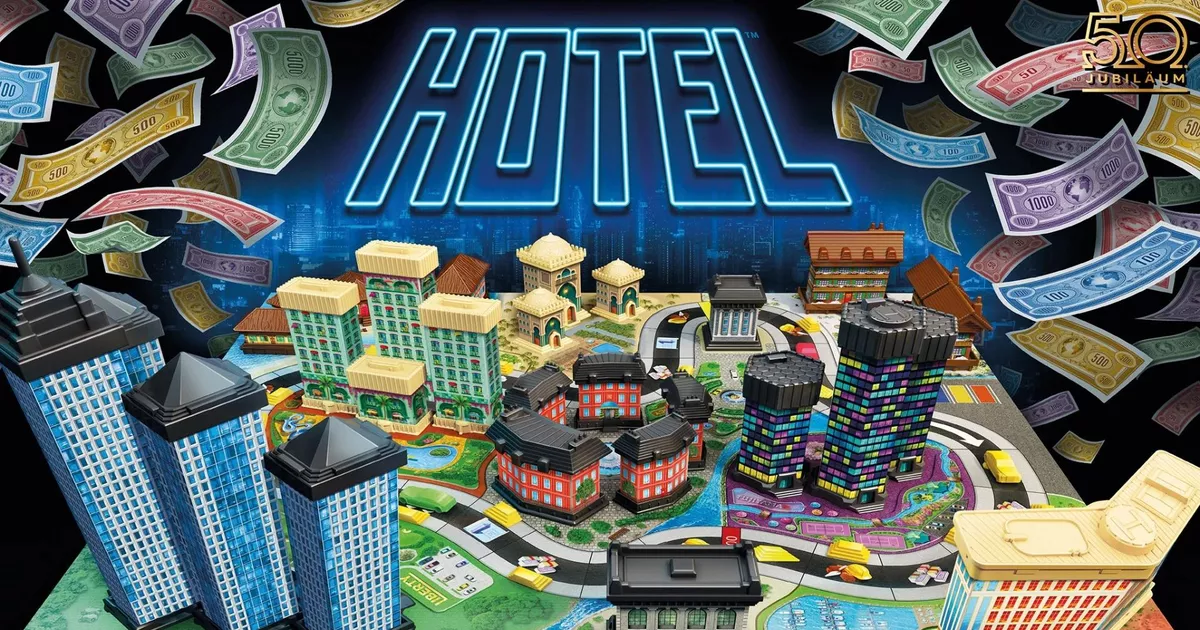
The star of the show is the component set. Hotel's 3D plastic buildings are the reason anyone remembers the game. Each hotel is a distinct, colourful structure: the Airport Hotel soars with its sleek tower, the Skyscraper dominates the skyline with its multi-floor assembly, the Hôtel du Lac sits elegantly by the waterfront, and the Beach Hotel sprawls in cheerful pastels. Assembling them at the start of a session — snapping floors onto base plates, sliding rooftop decorations into place — is a tactile pleasure that modern games rarely match. Children in particular find the construction phase as engaging as the game itself.
Beyond the buildings, components are functional but unremarkable. The board is bright and clearly laid out; the money is standard play-money paper; the player pawns are simple coloured tokens; and the cards, while durable enough, are a far cry from the production values of modern games. What you are paying for is the architecture, not the accessories. If any of the hotel pieces are lost or broken — a common fate for a 40-year-old game found at a charity shop — replacement parts are frustratingly difficult to source, which is the main practical caveat for second-hand buyers.
How to Play
The goal: Bankrupt all other players, or be the richest player when the game ends. Each player begins with a fixed amount of starting cash and takes turns rolling dice, moving around the island board, and interacting with whatever space they land on.
Turn structure:
- Roll and move — roll two dice and move your pawn the corresponding number of spaces around the board.
- Buy a plot — if you land on an unowned hotel plot, you may purchase it at the listed price. Each plot corresponds to one of the six hotels on the island.
- Build your hotel — on any subsequent turn when you own a plot, you may spend money to add floors and features to the hotel on your land. Hotels must be built progressively; you cannot place the top floor before the lower floors are in place. The more complete your hotel, the higher the nightly rate guests must pay.
- Pay rent — if your pawn lands on a hotel owned by another player, you pay rent according to that hotel's current size and any applicable card modifiers. A fully built luxury hotel can charge several times what a half-built structure earns — creating a strong incentive to complete your buildings quickly.
- Draw a card — certain spaces trigger event cards: windfalls, extra charges, free nights, and similar events that inject randomness into the economic flow.
A player who cannot pay rent is eliminated. The last player with money wins.
Gameplay Feel
Pacing & Tension: The early game has a pleasant, low-stakes rhythm as players claim plots and begin construction. The mid-game sharpens considerably once two or three hotels are operational — the board becomes a minefield of rent payments, and every dice roll carries genuine weight. Sessions tend to end fairly decisively: once the first player falls behind in hotel development, the rent spiral is difficult to escape. This creates a clear narrative arc that suits casual groups well, though it can also mean one player effectively loses long before the game officially ends.
Luck vs. Strategy Balance: Hotel is firmly in luck-dominant territory. The dice control where you land; the cards introduce additional variance; and the starting plots available to you depend entirely on which spaces come up early. Experienced players can make marginally better decisions around construction timing and cash management, but no amount of skill can reliably overcome a string of bad rolls that lands you on opponents' full hotels in rapid succession. This is a feature, not a bug, for the target audience — a grandparent and a ten-year-old have a genuinely competitive game here — but it means Hotel has essentially no ceiling for strategic depth.
Rule Overhead: Minimal. Hotel can be taught in five minutes to players of any age. The icons and colour-coding on the board are self-explanatory, construction is intuitive, and rent charts are printed directly on each hotel plot. There is almost no rulebook consultation once the game is underway. This ease of entry is one of Hotel's most enduring strengths and the primary reason it works so well at multi-generational gatherings.
Mechanics Deep-Dive
The Construction Economy
Hotel's most distinctive mechanic is its phased hotel construction. Unlike Monopoly, where a house appears instantly, Hotel requires you to physically build your property over multiple turns — placing ground floor, then mid-section, then upper floors, then rooftop features. Each phase costs money and each phase raises the rent multiplier. This creates a constant economic decision: spend now to build faster and charge more, or hold cash as insurance against landing on someone else's completed tower.
The construction system also generates the game's best moments. Watching an opponent's pawn creep toward your almost-complete hotel while you are one turn and one floor short of maximum rent is genuinely suspenseful — a small drama that the abstract nature of most modern games rarely produces.
The Six Hotels
Each of the six hotels has a different plot cost, construction cost, and maximum rent value, creating a loose risk-reward spectrum. The cheaper hotels are quicker to build and begin earning sooner; the prestigious tower hotels are expensive to develop but command catastrophic rents when complete. In theory this creates strategic variety; in practice most of the strategic decision is made for you by which plots come up for sale on your early turns. Nevertheless, the asymmetry gives each player's corner of the board a distinct visual identity — the island feels lived-in and varied rather than a uniform grid.
Event Cards
The event card deck adds an extra layer of randomness: tourist windfalls, inspector fines, free upgrades, and special guest bonuses all pass through the deck. Cards occasionally produce dramatic reversals — a lucky windfall can rescue a struggling player; a fine can dent a comfortable leader. However, the card effects are generally too small to meaningfully change the trajectory of a game already in progress. They function better as narrative flavour than as a genuine catch-up mechanism.
Player Count Analysis
Solo — Not supported. Hotel is entirely a competitive multiplayer experience with no solo variant. The game's economy requires at least two active players paying each other rent to function.
2 Players — Functional but thin. Two-player Hotel works mechanically, but the social energy that makes the game memorable is largely absent. Without multiple targets for rent payment and the table tension of watching several pawns navigate a crowded board, sessions feel low-stakes and short. Fine as a quick two-player filler; not recommended as the primary way to experience the game.
3 Players — Decent. Three players produce tighter games with meaningful competition for the best plots. Runaway leaders emerge more quickly with fewer players to absorb and redistribute wealth. Sessions are faster, which suits groups who want a casual 45-minute experience without committing to a full evening.
4 Players — The sweet spot. Four players hits the ideal balance. The board fills up at a satisfying pace, rent payments flow regularly, and the economic swings feel consequential without dragging the game out. The multi-generational dynamic — an adult who grasps probability sitting alongside children who are genuinely surprised by each dice roll — is where Hotel shines brightest. Budget 60–90 minutes.
5–6 Players — Lively but long. Five and six players produce the most chaotic and socially enjoyable sessions: the board is crowded, rent payments are frequent, and elimination events happen fast enough that no one waits long between meaningful turns. The tradeoff is playtime — a six-player game can run 90–120 minutes — and the increased variance means skill matters even less at higher player counts. Best for a party atmosphere where the experience matters more than the result.
Replayability
Hotel's replayability is modest by modern standards. The board is fixed, the six hotels never change, and the strategic space is shallow enough that experienced players exhaust their options within a handful of sessions. There is no scenario mode, no variable setup, and no expansion content that alters the core experience.
What does vary is the social context. Hotel with a group of children who have never seen the game before is a genuinely different experience from Hotel with adults who played it in the 1990s. The game's replayability lives in its audience, not its mechanics. For a family with growing children it will see table time for years — not because the game deepens, but because the players do. For a group of dedicated hobby gamers looking for mechanical variety, Hotel will feel exhausted after three or four sessions.
There are no official expansions. The game is a closed system, and that is fine given its target audience — the family gaming market it was designed for does not expect ongoing content support in the way modern hobby gamers do.
Learning Curve
Ease of teaching: Hotel may be the easiest game to teach in this review series. Rules explanation takes three to five minutes including setup. Children as young as six can participate meaningfully with minor adult guidance on rent calculations; by age eight most children play independently without assistance. There are no hidden systems, no exceptions to memorise, and no iconography that requires interpretation.
Rulebook quality: The original rulebooks vary by edition, but all are brief and clear. The most recent editions benefit from simplified layouts and colour-coded rent charts. Edge cases are rare — the game is simple enough that genuine rules disputes almost never arise.
First-game experience: Uniformly positive for the target audience. Children love the construction phase. Adults find themselves drawn in by nostalgia or by the simple pleasure of watching a physical structure grow on the board. The first game rarely produces confusion — it more commonly produces the immediate question of "can we play again?" The game delivers its most memorable moments — the shock of a massive rent bill, the near miss of a pawn stopping one space short of your hotel — within the first twenty minutes, which is an unusually short time-to-engagement for any board game.
Who It's For
Families with children (ages 6–12): This is Hotel's absolute strongest context. The game is visually spectacular for young children, immediately comprehensible, and generates genuine excitement around dice rolls and rent payments. Multi-generational groups — grandparents through primary-school children — will find it uniquely accessible in a way that most modern gateway games are not.
Nostalgia seekers: If you played Hotel in the 1980s or 1990s and want to share that experience with your own family, the game largely holds up as a vehicle for that memory. Expect to find it slightly thinner than you remember — childhood memories amplify games significantly — but the core charm is intact.
Casual adults looking for an evening filler: Hotel works well for groups who want something light, social, and physically engaging without any learning investment. It pairs well with drinks and conversation; the game runs in the background of a social gathering in a way that heavier games cannot.
Hobby gamers: Hotel will not satisfy anyone who regularly plays games above a light complexity rating. The luck dependence is total, the strategic ceiling is low, and sessions can feel predetermined once the dice have been unkind a few times. Hobby gamers who want a roll-and-move title should look at Camel Up for a more elegant modern take on luck-based family gaming, or Ticket to Ride for a gateway game that offers genuine strategic decision-making alongside its accessibility.
Pros & Cons
What Hotel does well:
- The 3D hotel components are genuinely spectacular — no other game at this price point delivers the same tactile, visual payoff of physically assembling a growing skyline on the board.
- Rules can be taught in five minutes to players of any age, including children as young as six. Zero barrier to entry.
- The construction-then-rent loop creates an intuitive cause-and-effect that feels satisfying even on the first play.
- Scales comfortably from 2 to 6 players without component strain or meaningful rule changes.
- Excellent multi-generational game — grandparents and grandchildren compete on genuinely equal terms.
- Produces memorable, story-worthy moments — the near miss, the catastrophic rent bill — within the first half hour of every session.
Where Hotel struggles:
- Strategy depth is minimal. Experienced players cannot reliably outperform beginners because dice variance dominates all decisions.
- The runaway leader problem is structural: once a player completes a high-value hotel first, compound income makes catching up extremely difficult.
- Player elimination can leave one person watching for 30+ minutes while the game grinds to its conclusion — frustrating for any group with mixed attention spans.
- No replayability beyond the social context; the game's mechanics are fully understood within two sessions.
- Replacement parts are almost impossible to find; a second-hand copy with missing hotel pieces is effectively unplayable and cannot be completed.
- No catch-up mechanism — a player who falls behind through bad luck has no meaningful way to recover.
Expansions & Ecosystem
Hotel has no official expansions. It is a self-contained product designed for the family mass-market, where ongoing content support is not an expectation. What does exist is a modest ecosystem of regional variants and re-editions:
- Hotel Tycoon — the European reissue (primarily France and Germany) which changed the hotel names and artwork but kept the core rules identical. Sought after by collectors for its distinct visual design.
- Various regional editions — several countries received localised versions in the 1990s and 2000s with minor rule tweaks and different hotel designs. These are collector items rather than meaningful gameplay variations.
- Digital adaptations — unofficial and official digital versions have appeared on PC and mobile over the years, though none have achieved lasting relevance. The physical experience of assembling 3D buildings is irreplaceable in digital form.
Value for Money
New copies of Hotel — when available — retail for approximately €30–45 depending on region and edition. For that price you receive a visually impressive game with immediate family appeal and essentially no learning investment required. If your household has children between the ages of 6 and 12, the per-session cost will drop very quickly.
The stronger value proposition, however, is the second-hand market. Hotel appears regularly at charity shops, car boot sales, and online auction sites for €5–15 — and a complete second-hand copy is as good as new, since the plastic components do not degrade. At that price it is genuinely one of the best-value family game purchases available, provided you verify completeness before buying.
- Families with young children: Excellent value. The game will be played repeatedly without any additional investment.
- Nostalgia purchase: Worth it at second-hand prices; think carefully at full retail, since the game will not reveal mechanical depth beyond what you remember.
- Casual adult groups: Good value as a party filler. Expect it to come out a few times a year rather than every session.
- Hobby gamers: Poor value unless purchased for family use. The money is better spent on a gateway title like Ticket to Ride or Cascadia that will satisfy both your group and casual guests.
Accessibility
Color blindness: Hotel uses distinct shapes for each hotel rather than relying on colour alone to differentiate properties, which is a genuine accessibility win compared to many games of its era. Player pawns and money are colour-coded, but the primary gameplay loop does not depend on precise colour discrimination. Most common forms of colour blindness do not significantly impair play.
Language dependence: Very low. Rent values are printed as numbers; card text is brief and uses simple vocabulary; the rulebook is the only significant language barrier. Hotel is suitable for mixed-language groups and non-native speakers.
Cognitive accessibility: Excellent. The turn structure is three steps: roll, move, act. New players require no orientation after their first turn. The rent charts are visible on the board and require only basic arithmetic — addition and subtraction within typical money ranges. Players with attention difficulties benefit from the game's fast turn pace; no turn should take more than a minute.
Physical accessibility: The 3D plastic components require some manual dexterity to assemble, particularly the smallest floor pieces. Players with limited hand mobility may find construction fiddly, though the act of placing floors can be assisted by other players without affecting game balance. The board is large and clearly printed; text is minimal and large enough to read comfortably from across the table.
Age range: The 8+ rating is conservative for assembly-assisted play; confident seven-year-olds participate fully. For younger children (4–6), the game works as a simplified rent-and-collect experience with adult handling of money math.
Verdict
Hotel is not a sophisticated game. It does not reward deep strategy, it has no catch-up mechanism, and its mechanical depth is fully exhausted within a handful of sessions. By the standards of modern hobby gaming, it is a relic — a roll-and-move title from 1987 that has not fundamentally evolved since its original release.
And yet Hotel has something that most sophisticated games do not: the ability to make a five-year-old and a seventy-year-old equally excited by a dice roll. The 3D buildings remain visually arresting in an era of flat cardboard tokens. The construction mechanic creates genuine suspense without demanding any rules knowledge. And the game's simplicity, which is its greatest weakness for the hobby-gaming audience, is its greatest strength for everyone else.
Buy it if: you have children under 12, you want a multi-generational game with zero teaching overhead, or you are chasing a specific nostalgia that no modern title can replicate.
Skip it if: you are looking for strategic depth, a meaningful catch-up system, or a game that will grow with an experienced gaming group.
Consider instead: Camel Up for luck-based family fun with more elegant mechanics; Ticket to Ride for a gateway game with genuine strategic decisions; Catan for a social, tradeable experience that scales from casual to competitive.
Score Breakdown
Love board game night? Explore our tools, score calculators, and strategy guides — everything you need to play better and have more fun.
Browse All Articles →