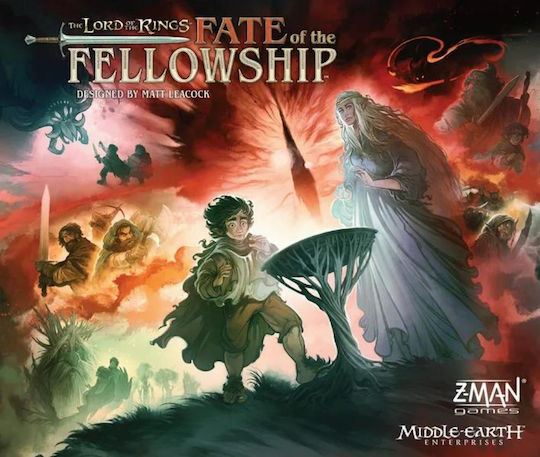
LotR: Fate of the Fellowship Review
The Greatest Lord of the Rings Board Game Ever Made?
Hook / First Impression
Matt Leacock invented cooperative board gaming as we know it. Pandemic, released in 2008, established the archetype that dozens of games have since imitated: shared resources, cascading crises, and a countdown that forces the team to prioritize ruthlessly. Seventeen years later, Leacock has returned to that same engine and applied it to the most beloved fantasy world in literature — and the result is arguably both his finest design and the greatest Lord of the Rings board game ever published.
The Lord of the Rings: Fate of the Fellowship (Z-Man Games, 2025) is not a reskin. It reimagines the Pandemic system from the ground up with Middle-earth's specific narrative logic — a fellowship of distinct heroes, a doomed ring-bearer inching toward Mount Doom, nine Nazgûl hunting him across the map, and an ever-present Eye of Sauron tightening its grip as time runs out. The result plays unlike any other cooperative game on the market, and unlike any other licensed LotR game that has come before it.
Overview
Fate of the Fellowship is a fully cooperative game designed by Matt Leacock and published by Z-Man Games / Asmodee. Players share control of 13 possible characters — each player manages two — and work together to protect Frodo as he travels from the Shire to the fires of Mount Doom. The Frodo/Sam player must collect five Ring symbols to destroy the One Ring before the team runs out of Hope or is overwhelmed by Shadow forces. Meanwhile, the Nazgûl stalk the board, Sauron's Eye hunts for weaknesses, and the haven cities of Middle-earth must be defended from encroaching Shadow troops.
| At a glance | |
|---|---|
| Designer | Matt Leacock |
| Publisher | Z-Man Games / Asmodee |
| Year | 2025 |
| Players | 1–5 |
| Play time | 90–120 minutes |
| Age | 14+ |
| Weight | Medium (BGG ~2.8/5) |
| Victory condition | Frodo collects 5 Ring symbols and destroys the One Ring at Mount Doom |
Components & The Setting
The Setting: Players are members of the Fellowship — Gandalf, Aragorn, Legolas, Gimli, Boromir, and others — providing aid, fighting shadow troops, and clearing the path while Frodo and Sam make their desperate journey toward Mordor. The theme is not cosmetic here. Every system in the game reflects the source material: the Nazgûl move with intelligence and persistence, the Eye of Sauron periodically searches locations and punishes exposure, the havens of Rivendell, Lothlórien, and Minas Tirith serve as the anchors the team must defend, and Frodo's progress is agonising and nonlinear, exactly as Tolkien wrote it.
The centrepiece of the box is the constructible 11-inch Barad-dûr Dice Tower — a physical model of Sauron's fortress that doubles as a functional dice tower for rolling battle and search dice. It is a remarkable inclusion, the kind of table-presence piece that makes a game feel like an event rather than just a session. The 9 Nazgûl miniatures are equally impressive: detailed, individually distinct sculpts that make placing them on the board feel genuinely ominous.
The full component list is generous: 72 Player Cards, 50 Shadow Cards, 24 Objective Cards, 13 Character Cards and Figures, 3 Battle Dice, 7 Search Dice, 48 Shadow Troops alongside Gondor, Elven, Rohirrim, and Dwarven troop types, plus an Eye of Sauron token, Hope Marker, Threat Rate Marker, and Symbol Tokens. The artwork throughout draws on original illustrations of the iconic characters rather than film photography, giving the game a timeless quality.
How to Play
The goal: The Frodo/Sam player must collect 5 Ring Symbols — found on certain Player Cards and at specific locations — and then reach Mount Doom to destroy the One Ring. The team loses if the Hope Track empties, if any haven is overwhelmed by Shadow Troops, or if the Threat Rate reaches maximum and triggers an immediate Sauron victory.
On their turn, each player takes 4 actions with their primary character and 1 action with their secondary character. Actions include moving between locations, battling Shadow Troops (using the Barad-dûr dice tower for dice rolls), searching for Ring Symbols, playing cards for special effects, and activating character-specific abilities. Characters are genuinely asymmetric — Aragorn heals and rallies allied troops; Legolas contributes from range; Gandalf manipulates the card flow in ways no other character can replicate.
After each player's turn, a Shadow Card is drawn. Shadow Cards spawn new troop units, move the Nazgûl, advance the Threat Rate, and trigger special events. The deck is the game's heartbeat — a relentless pressure system that escalates over time. If the Shadow deck runs out before the team wins, the One Ring is lost.
The Eye of Sauron activates periodically, forcing a Search — players roll dice against exposed characters or locations; failures advance the Threat Rate or scatter Ring Symbols. Managing Sauron's attention is as important as managing the troops on the board. Standing too long in the wrong location is rarely punished immediately, but the cumulative cost accrues fast.
Gameplay Feel
Pacing & Tension: Fate of the Fellowship builds dread in a way that few cooperative games manage. The early game feels manageable — the team is spread across the map, troops are contained, and Frodo makes visible progress. The mid-game is where the system starts to bite: Nazgûl converge, Shadow Card events chain together, and the havens suddenly feel fragile. By the late game, every player is making desperate triage decisions, and the table is leaning forward in collective anxiety. Players frequently report that a two-hour session feels like four hours — a compliment to the game's psychological immersion.
Player Interaction: Communication is constant and meaningful. Because each player controls two asymmetric characters, every turn involves discussion about positioning, priority, and which crisis to address first. The game generates genuine moments of heroic sacrifice — a player committing their only healer to a hopeless defence so Frodo can advance one more step — that feel earned rather than mechanical.
Luck vs. Strategy Balance: The dice introduce variance in combat and search outcomes, but the game provides enough mitigation that skill dominates over a session. Character abilities can reroll or redirect dice; certain cards suppress the Eye's attention; clever positioning reduces the number of rolls required. Bad luck can compound in a single round, but a well-prepared team rarely loses to randomness alone.
Rule Overhead: The rulebook is dense but logically structured. Players familiar with Pandemic will find the core loop intuitive; the added systems — the Nazgûl movement logic, the Eye's search mechanics, the character duality — require careful reading but come together into a coherent whole after the first session. First-game setup takes approximately 20–25 minutes for new players; experienced groups assemble in under ten.
Mechanics Deep-Dive
The Dual Character System
Each player controlling two characters is Leacock's most significant mechanical departure from the Pandemic template — and his best. It doubles the action space available each round and forces constant prioritisation: which character goes first? Which crisis is primary? Which ability is being held in reserve? A player running Gandalf and Éowyn is essentially managing two entirely different skill sets simultaneously, and the tension of choosing which to invest in on a given turn is consistently interesting.
The 24 different Objective Cards mean each game begins with a different configuration of goals and constraints. Some objectives require specific characters to be at specific locations; others impose new lose conditions or restrict certain actions. This variability, combined with the 14 Event Cards drawn during play, ensures that no two sessions follow the same arc.
Frodo's Journey as a Shared Burden
Assigning one player the role of Frodo/Sam pair is a brilliant thematic choice that creates natural dramatic structure. The Frodo/Sam player feels the weight of the Ring most directly — they must collect Ring Symbols, manage Sam's morale, and resist the Nazgûl's most targeted pressure — while the rest of the team acts as support. The design mirrors the books: the Fellowship cannot carry the Ring for Frodo, only clear the path ahead.
The Strategy Layer
- Threat Rate is the real clock: More than any single Nazgûl or Shadow Troop stack, the Threat Rate advancing to maximum ends the game fastest. Prioritise anything that slows its acceleration, even at the cost of immediate board control.
- Haven defence is non-negotiable: Losing a haven doesn't just cost the game — it cascades. The reinforcement troops you can no longer call on ripple through subsequent turns. Defend early, not desperately.
- Don't chase the Nazgûl: The nine Nazgûl cannot be eliminated permanently. Spending actions purely to delay one, when Frodo isn't in its path, is almost always worse than advancing objectives and letting the team intercept reactively.
- Player Cards are the team's oxygen: Hand management is the invisible strategy layer. Holding the right character ability for the right moment — rather than using it immediately on a suboptimal target — consistently outperforms reactive play.
- Communicate the secondary character: The secondary character's single action per turn is frequently undervalued by new players. That one action, optimised every round, adds up to the equivalent of an entire extra turn over the course of a game.
Player Count Analysis
Solo — Excellent. A dedicated Solo Token allows a single player to manage the equivalent of a standard hand with streamlined rules. The game loses the collaborative deliberation that makes multiplayer sessions memorable, but the puzzle is fully engaging on its own terms. An ideal solo cooperative experience for Tolkien fans.
2 Players — Very good. Each player controls two characters, which means the full six active characters are in play. The reduced deliberation time keeps the pace snappy, and the cooperative pressure is felt acutely by both players. The game scales effectively at this count, and the shared burden creates natural chemistry between partners.
3 Players — The tactical sweet spot. Three players means one controls the Frodo/Sam pair and the others each manage two support characters. Decisions are fast, responsibilities are clear, and the game runs at its tightest mechanical pace. Highly recommended for experienced groups.
4 Players — The narrative sweet spot. Four players generates the richest table experience. More voices in the deliberation, more dramatic handoffs, more opportunity for the heroic sacrifice moments that define great cooperative sessions. The game's 90-minute runtime is ideal at this count.
5 Players — Works, with longer runtime. Five players is fully supported and thematically satisfying — you genuinely feel like the Fellowship. Be prepared for 120+ minutes and some analysis paralysis during crisis turns. Best for groups that prioritise the narrative experience over tight mechanical efficiency.
Replayability
Fate of the Fellowship has exceptional replayability by cooperative game standards. The combination of 24 Objective Cards, 14 Event Cards, and 13 selectable characters generates a genuinely different opening configuration each session. The character pairing alone — deciding which two heroes each player controls — produces meaningful strategic variation across dozens of plays, as different pairings complement each other in non-obvious ways.
The Nazgûl and Eye of Sauron systems introduce controlled randomness that prevents any single optimal strategy from dominating. Teams that solved one session's crisis pattern will find the next session's threat priorities scrambled. This is Leacock's most intentional replayability design: the type of pressure changes, not just its intensity.
For groups that exhaust the base game — which will take a considerable number of sessions — the Pandemic ecosystem suggests expansion support is likely. The base box alone, however, represents tremendous value for the variety it already provides.
Learning Curve
Ease of teaching: Fate of the Fellowship is not a gateway game. The core Pandemic loop is accessible, but the additional systems — character duality, Nazgûl movement logic, the Eye's search mechanics, haven defence, and Frodo's Ring Symbol collection — create a teaching overhead that requires patience from both teacher and new players. Plan for a 25–30 minute rules explanation and accept that the first session will involve occasional rulebook consultation.
Rulebook quality: The rulebook is thorough and logically organised, with clear diagrams for setup and examples for the more complex interactions. The Nazgûl movement rules — which have a nuanced priority order — are the single area most likely to generate a misplay in the first session. A quick reference card (included) addresses this adequately.
First-game experience: The first game is almost always a loss, and almost always a memorable one. New players typically underestimate the Threat Rate acceleration and the cascading effect of a compromised haven. That first loss, however, teaches more about the game's priorities than any rules explanation can — and the immediate instinct to analyse what went wrong and try again is Leacock's cooperative design philosophy working exactly as intended.
Who It's For
Tolkien fans: This is the Lord of the Rings board game that the licence has always deserved. It is not a trivia game, not a roll-and-move retread, not a skirmish wargame with a LotR skin. It is a mechanical expression of the story's core anxiety: the weight of the Ring, the persistence of the enemy, the fragility of hope. Tolkien fans who have never played a modern cooperative game should absolutely try this one.
Pandemic veterans: If you have played Pandemic to exhaustion and want a version that adds genuine depth without abandoning the cooperative DNA, this is the upgrade. The dual-character system and narrative pressure create a meaningfully richer experience than any official Pandemic expansion has achieved.
Cooperative game hobbyists: Among modern cooperative games, Fate of the Fellowship competes directly with Spirit Island and Arkham Horror: The Card Game for the top tier. Its shorter runtime and more accessible rules overhead give it an advantage for groups that want depth without a permanent campaign commitment.
Casual players and families: This is not the entry point. The rules complexity and 14+ age rating are accurate. Families with younger teenagers who are Lord of the Rings fans may find it worthwhile, but expect a steeper on-ramp than most gateway titles. Cascadia or Ticket to Ride remain the better introduction for mixed-experience groups.
Pros & Cons
What Fate of the Fellowship does brilliantly:
- The most thematically coherent Lord of the Rings board game ever made — every system reflects the story's logic rather than just its aesthetics.
- Matt Leacock's most mechanically rich cooperative design: the dual-character system, 24 Objectives, and Nazgûl threat model combine to produce genuinely distinct sessions.
- The Barad-dûr Dice Tower is one of the best physical centrepieces in modern board gaming — it makes rolling dice feel like an event.
- Cooperative tension that holds throughout the full runtime — the game does not resolve into a solved puzzle once the team finds a pattern.
- Excellent solo and small-group modes; scales meaningfully from 1–5 players.
- Exceptional replayability for a cooperative game — 13 characters, 24 objectives, and 14 events prevent repetition for many sessions.
Where it falls short:
- The game board is cramped relative to the geography it represents — tiny figures and dense iconography in contested regions can be hard to parse mid-game.
- The first game is almost certainly a loss; new players need to be prepared for that, or the experience can feel frustrating rather than instructive.
- Rules overhead is genuine — this is not a drop-in-and-play cooperative game, and teaching it to four new players simultaneously is a significant time investment.
- No expansion content at launch; the base game is rich, but players who exhaust it quickly will be waiting.
- The Nazgûl movement rules have enough nuance to generate table disagreements — particularly in late-game high-pressure moments when the priority order matters most.
Expansions & Ecosystem
At the time of writing, no official expansions have been released for Fate of the Fellowship. Given Z-Man's track record with the Pandemic line — which received numerous scenario packs, standalone entries, and expansion modules — it is reasonable to expect supplementary content to follow. Leacock's design diary suggests additional character packs and scenario expansions are under consideration.
The base game includes enough variability — 13 characters, 24 Objectives, 14 Events — to sustain dozens of sessions without expansion content. Groups that exhaust it will find the wait for expansions a genuine absence; groups playing regularly will not reach that point quickly.
Value for Money
Fate of the Fellowship retails for approximately $70–$80 USD (€65–75 in Europe), placing it at the upper end of mid-tier hobby games. The price is justified by the production quality — the Barad-dûr Dice Tower and nine Nazgûl miniatures alone represent exceptional physical value — and by the game's replayability, which is high enough to bring the per-session cost below a dollar within a few months of regular play.
- Tolkien fans: Unambiguously worth it. There is no better way to spend an evening with the Fellowship around a table.
- Pandemic veterans looking for the next step: Worth it. This is the most ambitious thing Leacock has built, and it rewards the investment of learning its systems.
- Casual groups: Consider carefully. The rules overhead means your group needs genuine buy-in — purchasing for a group that drifts back to lighter games after one session is a poor value proposition.
- Solo players: Very good value. The solo mode is robust, and the cost per session for a solo cooperative game of this quality is genuinely low.
Second-hand copies will emerge as the game matures in the market, but at this stage of its release cycle, the price reflects strong demand. Full retail is the realistic purchase point for most buyers.
Accessibility
Color blindness: The game uses distinct iconography alongside colour coding for most elements, reducing reliance on colour alone. The Nazgûl miniatures are identical in form and differ only by numbering — a potential issue for players who rely on colour differentiation. The Shadow Troops are distinguished by unit type rather than colour.
Language dependence: Moderate. Card text carries meaningful rules content and requires reading during play. Players with reading difficulties will benefit from a support player; the game is not easily adapted for fully text-free play.
Cognitive accessibility: The game requires sustained multi-system tracking — board state, hand management, Nazgûl positions, Threat Rate, and Frodo's progress simultaneously. This is cognitively demanding by cooperative game standards. Players who find Pandemic's crisis-management engaging will cope well; those who find it overwhelming should look elsewhere.
Physical accessibility: The components are handled comfortably by most players. The Barad-dûr Dice Tower requires some assembly (its constructible nature means pieces slot together by hand) and involves repeatedly dropping dice through a tower structure — players with limited hand dexterity may find a flat dice tray a useful substitute. Character figures are standard miniature size; fiddly for players with severe dexterity limitations.
Age range: The 14+ rating is accurate and thoughtfully placed. The game's themes — persistent existential threat, the corruption of the Ring, the fading of hope — are emotionally appropriate for teenagers. The rules complexity is the primary barrier, not content.
Verdict
The Lord of the Rings: Fate of the Fellowship is a landmark cooperative game. Matt Leacock took his most celebrated design and rebuilt it around a story that the Pandemic system was, in retrospect, always suited for — a small group of heroes, an impossible task, a darkness that cannot be defeated by force, only endured long enough for one small act of courage to matter. The result is a game that feels like it earns its licence rather than exploiting it.
Its flaws are real: the board is too small, the rules require genuine investment, and the first loss will sting new players who were not warned. But these are the flaws of ambition, not laziness. No other Lord of the Rings board game has made the journey to Mount Doom feel like this.
Buy it if: you are a Tolkien fan, a Pandemic veteran looking for a worthy evolution of the system, or a cooperative game enthusiast who wants a richly replayable mid-weight challenge.
Skip it if: your group is new to modern board games, dislikes cooperative designs on principle, or requires a ruleset that can be taught in under ten minutes.
Score Breakdown
Love board game night? Explore our tools, score calculators, and strategy guides — everything you need to play better and have more fun.
Browse All Articles →