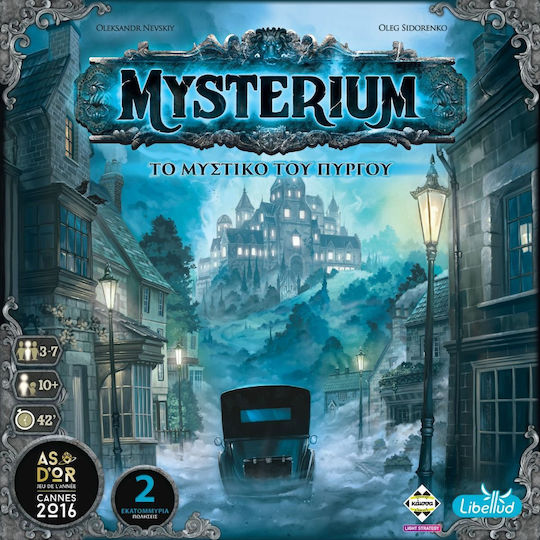
Mysterium Review
Where Clue Meets Dixit in a Haunted Manor
Hook / First Impression
Imagine Clue reimagined as a surrealist séance — where one player is a murdered ghost who can only communicate through fever-dream artwork, and everyone else is a psychic detective frantically interpreting the visions. That's Mysterium in a sentence. Designed by Oleksandr Nevskiy and Oleg Sidorenko, this Ukrainian gem became a genre-defining hit after its 2015 international release, winning multiple awards and selling millions of copies to families, casual players, and hobbyists alike.
What makes Mysterium special isn't its ruleset — it's genuinely simple — but the human drama that erupts at the table when six people stare at an abstract painting of a lighthouse being swallowed by roses and argue about whether it represents a candlestick or a revolver. Those moments of collaborative confusion and sudden revelation are unlike almost anything else in the hobby.
Overview
Mysterium is a cooperative deduction game designed by Oleksandr Nevskiy and Oleg Sidorenko, originally published by Portal Games in 2015 and later republished internationally by Libellud. One player takes the role of a silent ghost haunting Warwick Manor; all other players are psychic investigators attempting to solve the ghost's murder by identifying the correct suspect, location, and weapon assigned to each of them. The ghost communicates exclusively through illustrated vision cards — no words, no gestures, no eye contact.
| At a glance | |
|---|---|
| Designer | Oleksandr Nevskiy & Oleg Sidorenko |
| Publisher | Libellud / Portal Games |
| Year | 2015 (international edition) |
| Players | 2–7 |
| Play time | 45–75 minutes |
| Age | 10+ |
| Weight | Light-medium (BGG ~1.9/5) |
| Victory condition | All psychics correctly identify their suspect/location/weapon; then collectively identify the true murderer |
Components & The Setting
The Setting: Players are psychic mediums summoned to Warwick Manor to help a restless ghost expose its murderer. The ghost player sits behind a wooden screen — dramatically called the Ghost Screen — and manipulates the investigation from behind a veil. The theme is deeply integrated in a way that few games achieve: the restriction on communication (ghost can only speak in visions), the ticking clock of seven in-game hours, the shared séance around a central board — all of it feels like theatre as much as a game. This is one of the most immersive thematic packages in the hobby at this weight.
Component quality is exceptional for a mid-price game. The 84 large dream/vision cards are the star — lavishly illustrated with surrealist imagery that is simultaneously beautiful and deliberately uninterpretable. Each card could be a contemporary art print. The psychic boards, suspect/location/weapon illustration cards, and clairvoyancy tokens are thick cardboard with clear, charming artwork. The wooden Ghost Screen, crow tokens, and sand timer are satisfying physical objects. The game includes cloth bags for drawing tokens, which is a small luxury touch.
The central game board depicts the manor in a warm, stylised art-nouveau style. Everything fits neatly back into the box with a well-designed insert. Overall production quality punches above its price point — this is a game that looks gorgeous on the table before a single card is drawn.
How to Play
Setup: The ghost player secretly assigns each psychic a unique combination of suspect, location, and weapon from the illustrated card decks. The difficulty setting determines how many suspects, locations, and weapons are in play — easy uses fewer options, hard uses all of them. Each psychic places their token at the start of their personal progress track on the main board.
The investigation phase: The game runs over seven rounds, each representing one hour before dawn (when the ghost's window of communication closes). Each round, the ghost draws vision cards from their deck and deals them face-down to each psychic. The ghost may give up to any number of cards from their hand to each psychic, discarding down and drawing back up after each distribution. The ghost cannot speak, gesture, or react — they sit silently behind the screen while psychics deliberate.
Psychics discuss openly and freely — the ghost hears everything, which creates delicious moments where the ghost realises their vision has been spectacularly misinterpreted but can do nothing about it. Each psychic places their clairvoyancy marker on their best guess for their current category (suspect first, then location, then weapon). If correct, they advance to the next category. Incorrect guesses mean the ghost tries again next round with new cards.
Clairvoyancy tokens: Every psychic except the active guesser can also bet tokens on whether they think the active player will guess right or wrong. Correct predictions earn crow tokens, which determine your vote strength in the final round — a smart side-system that keeps non-active players engaged every turn.
The final round: If all psychics have solved all three categories by the end of hour 7, the game enters its climax. The ghost reveals three possible "final murder scenarios" — one of which is the true solution. Each psychic secretly votes for their chosen scenario. However, only psychics with enough crow tokens from the clairvoyancy system actually see all three vision cards; lower-scoring psychics see fewer. The majority vote wins — and if the group identifies the correct murderer, the ghost is freed and everyone wins together.
Gameplay Feel
Pacing & Tension: Mysterium has a uniquely unhurried pace that still generates real pressure. The early rounds feel exploratory — psychics debate freely, ghost players plan their next visions, and the manor's mystery gradually assembles itself. Tension crests in the final two hours as players who haven't solved all three categories start to panic, and the group realises they may not make it by dawn. The final voting sequence — especially when the table is split on the true murderer — is reliably one of the most tense moments in hobby gaming at this weight.
Player Interaction: Almost uniquely in co-op gaming, Mysterium's interaction exists on two planes simultaneously. The psychics talk openly and collaboratively while the ghost silently observes. This creates a wonderful voyeur effect where the ghost experiences the discussion as both audience and author — they know whether the group is hot or cold, but can only answer with the next hand of dream cards. The open discussion among psychics is consistently the most entertaining part of the game: creative misreadings, confident wrong answers, and sudden "oh, the clock!" realisations all happen naturally.
Luck vs. Strategy Balance: The ghost player's experience is almost pure strategy — hand management, reading the psychics' thought patterns, and planning a multi-card narrative across rounds. The psychic experience is more intuitive and personal, closer to free association than logical deduction. There is variance: a ghost who draws no useful cards for a particular player is stuck. But the ghost sees their full hand of eight cards before dealing, which gives substantial control. The game rewards ghost players who understand how their specific psychics think, not just what symbols appear on the cards.
Rule Overhead: Mysterium teaches in approximately 10–12 minutes. The psychic side has almost no rules to internalize beyond "guess your category and vote on others' guesses." The ghost side is similarly constrained: distribute cards, say nothing. The one subtlety is the clairvoyancy token system, which takes a round to feel natural but never creates confusion after that. New players are fully functional from turn one.
Mechanics Deep-Dive
The Dream Card System
The heart of Mysterium is its communication constraint. The ghost holds a hand of eight vision cards and must choose which ones — alone or in combination — point most unambiguously toward a specific illustrated suspect, location, or weapon. This is genuinely difficult design work: the vision cards are abstract enough to support almost any association, but the target cards (suspects, locations, weapons) are concrete enough that there is usually a defensible path between them. The ghost is playing a creative puzzle game; the psychics are playing an interpretive one.
Multi-card combinations are the ghost's most powerful tool. Sending a single dream card pointing at a colour, texture, or mood is often too ambiguous. Two cards that share a detail — a recurring bird, a specific shade of purple, a sense of movement — narrow the interpretation space dramatically. The best ghost players think in systems of association, not individual symbols.
The Clairvoyancy Side System
The betting mechanic — where non-active psychics predict whether the active player will guess correctly — serves a subtle but important design purpose. Without it, Mysterium would have a classic co-op problem: experienced players dominate discussion and new players feel like spectators. The clairvoyancy system gives every player skin in every guess, and converts the "waiting your turn" gap into an active prediction exercise. It also creates the satisfying final-round mechanic where better-informed players get more complete information for the final vote.
Difficulty Scaling
Mysterium's difficulty dial is one of its most underrated features. At difficulty 1, only three suspects, three locations, and three weapons are in play — making each guess a 1-in-3 choice. At difficulty 4, the full deck of seven options per category is active. This creates a genuine skill ceiling for experienced ghost players who want a real challenge, while keeping the game fully accessible for newcomers at lower difficulties. Most groups naturally settle at difficulty 2–3 after a few sessions.
- Difficulty 1–2: Casual groups, first plays, children. Generous interpretation margin; mistakes are recoverable.
- Difficulty 3: The sweet spot for most regular groups. Each guess requires genuine deliberation; the time pressure feels real.
- Difficulty 4: Punishing. Recommended only for experienced groups with a skilled ghost player. The card pool is large enough that vision cards that miss badly can strand a psychic for multiple rounds.
Player Count Analysis
2 Players — Functional, but stripped-down. One ghost, one psychic. The game works mechanically and can be surprisingly tense as a pure two-player puzzle. What it loses is the group deliberation — the comedy of collective misinterpretation, the drama of the table splitting on a guess — which is Mysterium's greatest social pleasure. Worth playing at two if no other option exists, but this is not the design target.
3–4 Players — Solid. With two or three psychics, the game has enough voices to generate interesting deliberation without becoming chaotic. The ghost can give each psychic dedicated attention. The clairvoyancy system feels a little thin at three, as there are fewer bets being placed per round, but the core experience is fully intact. A strong choice when a larger group isn't available.
5–6 Players — The sweet spot. This is where Mysterium reaches its full potential. Four or five psychics generate exactly the right level of creative cross-talk — enough differing interpretations to create genuine disagreement, but manageable enough that the ghost can track who is thinking what. The final vote with five or six invested players is one of the most exciting moments the game produces. This is the count the box was designed for.
7 Players — Possible, but stretched. The maximum player count is achievable and the ghost can support six psychics, but cognitive load on the ghost player is significant. Managing six separate mystery assignments, drawing and planning cards for all of them simultaneously, risks slowing rounds to a crawl and generating decision fatigue. Best reserved for experienced ghost players. For a group of seven, consider rotating the ghost role across two sessions instead.
Replayability
Mysterium has exceptional replayability for a game of its weight, driven by three structural sources of variability. First, the combination of suspects, locations, and weapons is procedurally assembled each game — a ghost who plays frequently will encounter most assignment combinations eventually, but the deck size ensures the path from dream card to target is always freshly constructed. Second, the ghost's hand is always drawn randomly — no two games present the same creative challenge. Third, and most importantly, the game changes fundamentally depending on who is in which role.
A group of five plays a meaningfully different game when different members take the ghost role. Ghost players develop personal visual languages — one player habitually uses colour palette, another uses scale, a third uses emotional tone — and psychics who know these patterns become increasingly attuned to them over time. This meta-layer of learning your group's communication style gives the game a depth that accumulates across sessions rather than depleting.
The Mysterium Park standalone and the Hidden Signs and Secrets & Lies expansions add new dream cards, suspects, locations, and weapons. Even without expansions, the base game supports 30–40 fully engaging sessions before any sense of saturation sets in for most groups — an unusually high baseline.
Learning Curve
Ease of teaching: Mysterium is one of the easiest games in the hobby to teach. The psychic rules are three sentences: guess your category based on the dream cards the ghost gives you, bet on other players' guesses, help identify the true murderer in the final round. The ghost rules add: you may not speak or gesture; give vision cards from your hand; draw back up to eight each round. A functional first game follows within minutes.
Rulebook quality: The Libellud rulebook is clear and well-illustrated, with a step-by-step example of a full round that eliminates almost every potential point of confusion. The most common first-game stumble is understanding the clairvoyancy token system — specifically that you bet on whether the active player guesses correctly, not on what they'll guess — but a single explained example resolves this completely.
First-game experience: Near-universally delightful, even for people who "don't play board games." The game's core interaction — interpreting surrealist artwork — requires zero prior gaming knowledge and taps into a universal human capacity for creative association. Non-gamers frequently outperform experienced hobbyists in their first session because they approach the dream cards without the bias of trying to decode a "game system." The first game reliably produces the comment: "Can we play again?"
Who It's For
Casual players and non-gamers: Mysterium is the best gateway co-op game for groups who enjoy talking, interpreting, and collaborative storytelling. It requires no strategic depth, produces no downtime, and generates memorable social moments from the very first session. If you have ever played Dixit and wanted more structure around the artwork, this is the obvious next step.
Families: Outstanding for families from age 10 upward, and workable with attentive 8-year-olds who enjoy art and storytelling. Children are often excellent psychics — they pattern-match on imagery without overthinking. Adults with artistic or design backgrounds frequently excel as ghost players. The fully cooperative structure means no one is eliminated or left behind, which suits mixed-skill family groups well.
Hobbyist gamers: Mysterium earns its place in serious gaming collections as the go-to "bring-down game" — something you can play with any group, at any skill level, without condescension, and still find genuinely entertaining. It's not a challenge for an experienced gamer, but it is reliably fun, and fun at scale (up to 7 players) in a way most hobby games aren't. Ghost players who enjoy creative puzzles often find it as engaging as heavier fare.
Comparisons: Dixit is the closest relative — both use dreamlike artwork for communication — but Dixit is competitive and lighter on structure. Wavelength scratches the same creative-communication itch with less setup. Codenames Pictures offers a faster, more abstract visual communication experience. For groups who specifically want mystery/deduction, Chronicles of Crime delivers a more procedural investigation experience with a smartphone integration.
Pros & Cons
What Mysterium does well:
- The most atmospherically immersive experience at this weight — theme and mechanics are seamlessly integrated, not bolted on.
- Dream card artwork is a genuine artistic achievement: beautiful, ambiguous, and endlessly interpretable.
- Fully cooperative structure with no player elimination, catch-up issues, or runaway-leader problems.
- Scales from 2 to 7 players and works well across a wide range — rare for a social deduction game.
- Teaches in under 12 minutes; non-gamers are fully engaged from the first vision card.
- The clairvoyancy side system keeps every player active on every turn without adding meaningful complexity.
- Exceptional replayability relative to its weight — the game is different every session because people are different.
Where Mysterium struggles:
- The ghost role is markedly more demanding and interesting than the psychic role — groups must actively rotate it to prevent one player from "owning" the ghost seat.
- Experienced ghost players who know their psychics very well can trivialise the game at lower difficulties; difficulty 4 may feel arbitrary-hard rather than satisfying-hard at that point.
- The no-communication constraint is easily violated by inexperienced or excitable ghost players — subtle reactions ruin the mystery without anyone noticing.
- The base deck of 84 vision cards, while excellent, will eventually feel exhausted for groups that play weekly. Expansions are almost mandatory for regular groups.
- The final vote can feel anticlimactic when one option is clearly dominant — the tension depends heavily on the group being genuinely uncertain.
- No solo mode; the co-op premise requires at least two players and genuinely shines only at four or more.
Expansions & Ecosystem
Mysterium's expansion ecosystem is lean but well-chosen. Every release adds new dream cards and investigation components rather than new rules — a deliberate design philosophy that keeps the game accessible for new players while extending the creative space for veterans.
1. Hidden Signs — More cards, new suspects, essential refresh ★★★★★
The first and most useful expansion. It adds 42 new dream cards — nearly doubling the vision card pool — along with new suspect, location, and weapon cards. No new rules whatsoever. For groups that play Mysterium regularly, Hidden Signs is simply more Mysterium and is essential within the first 20–30 sessions. The new artwork maintains the quality of the base game.
2. Secrets & Lies — An optional twist on the core structure ★★★☆☆
Adds a new story card category (replacing or supplementing weapons) and introduces a modest rule variant where the ghost can give psychics a card that hints at which category their vision belongs to, not just the specific element. Also includes more dream cards. The rule addition is well-designed but optional, and most groups play the new cards while ignoring the story category system.
3. Mysterium Park — Standalone spin-off: same soul, carnival setting ★★★★☆
A fully standalone reimplementation set in a 1950s fairground rather than a Gothic manor. Streamlined rules (no clairvoyancy token system, simplified final round) make it faster and more accessible than the original — a session runs approximately 30–40 minutes. The carnival artwork has a warmer, more playful visual style. It includes fewer dream cards than the base Mysterium, but is compatible with the base game's cards.
| Expansion | Best For | Rule Changes | Rating | Priority |
|---|---|---|---|---|
| Hidden Signs | Any regular group | None | ★★★★★ | 🥇 #1 — essential card refresh |
| Mysterium Park | Casual, families, faster games | Simplified | ★★★★☆ | 🥈 #2 — great standalone companion |
| Secrets & Lies | Veterans wanting variety | Minor optional | ★★★☆☆ | 🥉 #3 — extra cards + optional twist |
Value for Money
Mysterium retails for approximately $45–$55 USD (€40–50 in Europe), putting it at the same price point as Catan and Ticket to Ride. For that price you get premium artwork, high-quality components, and a game that reliably delivers one of the most memorable group experiences in the hobby. A standard group playing 15–20 base game sessions before adding expansions gets remarkable per-session value.
The expansion calculus is straightforward:
- Casual group (5–10 sessions per year): The base game alone easily sustains this. Buy Hidden Signs only when you start recognizing dream cards and predicting the ghost's associations before the psychic deliberation starts — a reliable indicator of saturation.
- Regular group (weekly play): Budget for Hidden Signs within the first 2–3 months. The base deck saturates faster than expected for frequent players.
- Family or mixed group: The base game plus Mysterium Park covers every occasion — one deep experience for invested players, one lighter standalone for larger or more casual gatherings.
Second-hand copies are widely available and the components are durable enough to survive previous owners. A used base game at $20–25 is an exceptional entry point, though inspect the dream cards carefully — warped or marked cards compromise the ghost player's ability to distribute them without signaling which are "good" cards.
Accessibility
Color blindness: Mysterium is notably accessible for color vision deficiencies. Player colors are used only to identify token ownership, and all categories (suspects, locations, weapons) are distinguished by imagery rather than color. The dream card artwork is rich in non-color visual information — texture, shape, composition, emotional tone — ensuring that color-blind players can fully participate as both ghost and psychic without adapters or workarounds. This is one of the more accessible games in the hobby on this dimension.
Language dependence: Essentially zero during play. Cards use only imagery; no reading is required after setup. The rulebook is the only language-dependent component. Fully suitable for mixed-language groups, which makes Mysterium an outstanding choice for international gatherings or families with different native languages.
Cognitive accessibility: The interpretive nature of the game is a strength here. There are no complex rules to track, no mathematical calculations, no hidden information beyond the ghost's screen. Players who struggle with complex rule overhead find Mysterium one of the most comfortable games available at its quality tier. The open discussion format also naturally accommodates players who process information more slowly — discussion continues until the group reaches consensus, not until a timer runs out (though a sand timer is provided for pacing).
Physical accessibility: Cards are large and easy to handle. The ghost screen requires sitting behind it, which may be awkward for players with certain mobility limitations — the screen can be propped against a box without degrading the experience. The main board is large and clearly readable from across the table. No dexterity-intensive components.
Age range: The 10+ rating is accurate for independent play. Children aged 7–9 can participate with light guidance. The dark, ghostly theme is spooky rather than disturbing — comparable to a mild children's ghost story rather than horror. The cooperative nature means younger players never feel singled out or eliminated.
Verdict
Mysterium is one of those rare games that achieves genuine crossover appeal without compromising in any direction. It is simultaneously simple enough for a first-time player's first session, visually rich enough to delight design-minded adults, and socially dynamic enough to remain entertaining for dedicated hobbyists who play it monthly for years. The fully cooperative structure, the stunning artwork, the interpretive communication constraint — these are not features bolted onto a game, they are a coherent and masterful design that could only work in exactly this form.
Its weaknesses are real but minor: the ghost role imbalance needs active management, the base card pool saturates for frequent players, and the final vote occasionally deflates rather than climaxes. None of these are reasons to skip it.
Buy it if: you want a beautiful, accessible, atmosphere-drenched co-op that works for any group from casual to experienced and generates genuinely memorable moments every time it hits the table.
Skip it if: your group specifically wants competitive play, pure logical deduction with no ambiguity, or a solo experience.
Upgrade it immediately if: your group plays more than once a month — Hidden Signs is an essential companion and should be treated as part of the base purchase.
Score Breakdown
Love board game night? Explore our tools, score calculators, and strategy guides — everything you need to play better and have more fun.
Browse All Articles →