Monopoly Review
The World's Most Misunderstood Board Game
Hook / First Impression
No board game on Earth has sold more copies than Monopoly, and no board game on Earth is more frequently played wrong. Charles Darrow's 1935 classic — itself adapted from Elizabeth Magie's 1903 The Landlord's Game — has moved over 275 million units across 47 languages and more than 100 countries. It sits in roughly one in three American households. Ask anyone to name a board game, and most will say Monopoly before they say anything else.
And yet the hobby board game community treats it as a punchline. Threads with titles like "Monopoly is a bad game and here's why" rack up thousands of upvotes. Designers cite it as the canonical example of what not to do. Families who played it as children associate board gaming with hours of grinding tedium and an argument about the Free Parking house rule.
The honest answer is: both camps are partly right. Monopoly is a deeply flawed game by modern design standards — and it's also more strategically rich than most people who hate it have ever actually experienced. This review covers both truths.
Overview
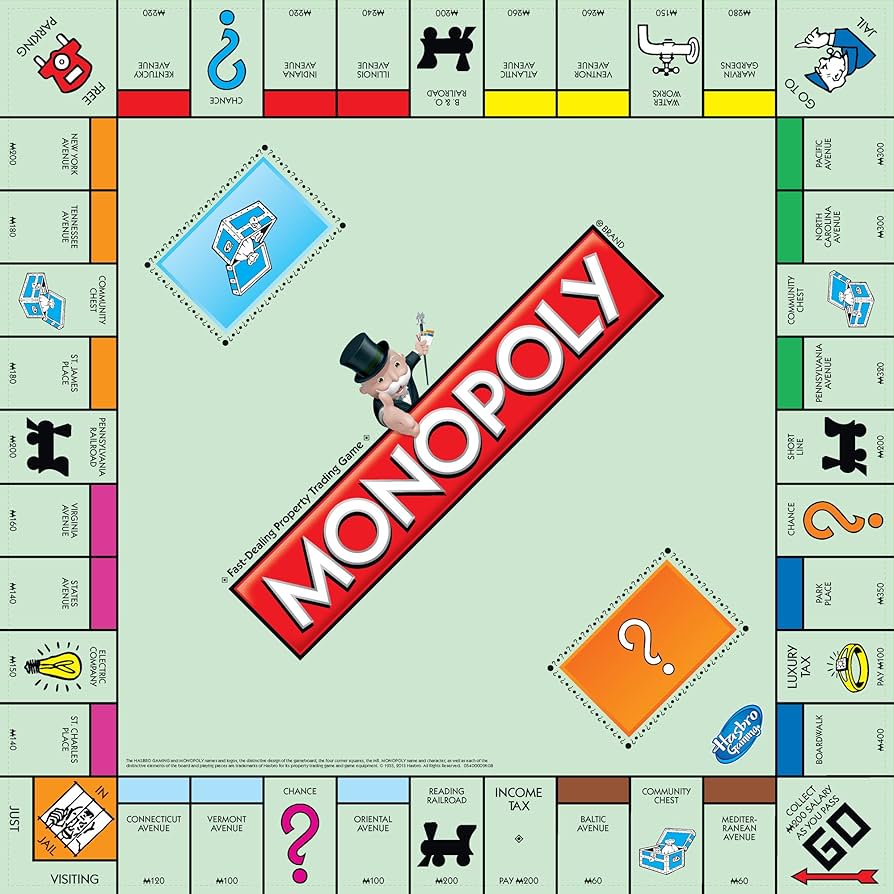
Monopoly is a competitive economic negotiation game originally designed by Charles Darrow (building on Elizabeth Magie's The Landlord's Game) and published by Parker Brothers in 1935, now under Hasbro. Players move around a fixed board, purchasing properties, constructing houses and hotels, and collecting rent from opponents with the aim of driving everyone else into bankruptcy.
| At a glance | |
|---|---|
| Designer | Charles Darrow (based on Elizabeth Magie's design) |
| Publisher | Hasbro / Parker Brothers |
| Year | 1935 (current standard edition: ongoing) |
| Players | 2–8 |
| Play time | 60–180+ minutes (heavily dependent on player count and house rules) |
| Age | 8+ |
| Weight | Light-medium (BGG ~1.7/5) |
| Victory condition | Last player solvent — all others bankrupt |
Components & The Setting
The Setting: You are a real estate tycoon racing to monopolise the property market of Atlantic City, New Jersey. The theme is unusually well-integrated for a 1930s game: buying properties, developing them with houses and hotels, charging rent, and going to jail all map directly onto recognisable real-world concepts. Children grasp the fantasy immediately — owning Boardwalk and Park Place feels genuinely powerful, even before you understand why. The theme is also Monopoly's most culturally durable asset; regional editions have replaced Atlantic City properties with local streets in dozens of cities worldwide, and the game's identity transfers intact every time.
Components in the standard edition are functional but firmly in the "toy" tier. The board is a single large folding cardboard sheet with crisp, iconic art that has changed surprisingly little since 1935. Property cards are thin but handled infrequently enough that they rarely show wear. The paper money is the most vulnerable component — it wrinkles, tears, and stacks poorly. Many groups upgrade to plastic money holders or a dedicated Monopoly banking tray. The plastic houses and hotels are satisfying to handle; the metal tokens — the battleship, top hat, iron, dog, car, and wheelbarrow — are tactile classics with genuine nostalgic weight, even if the set has been periodically revised.
The Chance and Community Chest card decks are thin and will shuffle roughly over time. The dice are standard and entirely unremarkable. Nothing about the components will impress a modern board gamer, but nothing actively interferes with play. The box is large, the insert is poor, and component organisation is a perennial complaint — a zip-lock bag set solves this permanently.
How to Play
The goal is to be the last player standing with money. Every other player must be driven to bankruptcy — owing more than they can pay and holding no assets to liquidate. This player-elimination victory condition is the game's most significant design limitation, and we'll address it directly in the Gameplay Feel section.
Each turn the active player rolls two dice and moves their token clockwise around the 40-square board. Landing on an unowned property gives them the option to buy it at face value. If they decline, the property goes to auction — a rule most groups skip, and a rule whose absence explains why most games of Monopoly last twice as long as they should. Landing on an owned property triggers a rent payment to the owner based on how many properties in that colour group they hold and how many houses or hotels are built there.
The critical resource in Monopoly is the colour monopoly: owning all properties in a colour group. Once you hold a complete group, you may build houses (up to 4) and then a hotel, which multiplies rent dramatically — sometimes by a factor of 10 or more. The asymmetry between monopoly rent and single-property rent is enormous, which means the entire mid-game pivots on trading to assemble complete colour groups.
Chance and Community Chest cards add random events ranging from small cash bonuses and penalties to movement to specific squares. Jail is a central mechanic: landing in Jail (via Go to Jail, rolling three doubles, or drawing a card) stops your movement, costs you turns unless you pay £50 or use a Get Out of Jail Free card, and — crucially in the late game — actually becomes a desirable position that keeps you safe from opponents' developed properties.
Gameplay Feel
Pacing & Tension: Monopoly's early game has a genuinely exciting energy. Players are racing around the board, snapping up properties, sizing up who controls which colour groups, and eyeing trades. There are real decisions: which properties are worth overpaying for, whether to build on the cheaper colours early or hold cash for the high-value ones, when to make a deal and when to let an opponent overpay at auction. This phase, roughly the first 30–40 minutes, is legitimately fun and deserves more credit than it gets.
The mid-game, once players begin completing colour groups and building houses, is where Monopoly delivers its most dramatic moments. A well-timed trade that hands you a monopoly, followed by a hotel build, followed by an opponent landing on it — this is the game's peak experience, and it can be electrifying. It is also where the session length begins to spiral. As players lose cash and start mortgaging properties, the gap between the leader and the field grows, and the game's final act begins: a slow, grinding march toward someone's inevitable bankruptcy.
Player Interaction is Monopoly's most underrated quality. Trading is entirely freeform — any combination of properties, cash, and Get Out of Jail Free cards can be negotiated between any two willing players. There is no enforced fairness mechanism; trades happen exactly when both parties agree they serve their interests. This produces genuine negotiation dynamics: reading opponents, timing leverage, making deals that feel mutually beneficial while advancing your own position. At a table of engaged, trading-willing players, Monopoly's deal-making phase is as socially rich as any game in the hobby.
Luck vs. Strategy Balance: Monopoly has more luck than most board gamers acknowledge, and more strategy than most Monopoly critics admit. The dice determine which properties you can buy, which hotels you land on, and which Chance cards you draw — none of these are negotiable. Over a single game, a player with unlucky dice has a real disadvantage. Over a series of games, skilled negotiators and accurate property valuers win more consistently. The game's strategic ceiling is genuinely higher than its reputation suggests; the problem is that luck compounds so visibly through the dice-and-board format that variance feels more prominent than it is in, say, a card game with equivalent randomness.
Rule Overhead: The core rules are very accessible — most children grasp the basic loop within one circuit of the board. The complexity comes not from rule depth but from the negotiation and valuation judgements that distinguish experienced players. Teaching Monopoly takes 10 minutes; getting good at it takes many sessions.
Mechanics Deep-Dive
Property Valuation: The Hidden Strategy Layer
Experienced Monopoly players know that not all colour groups are equal, and the conventional wisdom most families use — "Boardwalk and Park Place are the best" — is demonstrably wrong in many game states. The orange properties (St. James Place, Tennessee Avenue, New York Avenue) and the red group (Kentucky, Indiana, Illinois) are statistically the most frequently landed-on colour groups in the game due to proximity to Jail and the cards that redirect movement there. A player who builds hotels on the reds and oranges first often outperforms one who holds out for Boardwalk.
- The housing shortage is real: The game includes a fixed supply of 32 houses. When multiple players are building simultaneously, the bank can run out. This creates a genuine strategic constraint: building four houses and not upgrading to a hotel intentionally starves opponents of house supply — a powerful blocking move most casual players never consider.
- Cash flow vs. development speed: Houses pay back their cost in landed rent within a handful of visits; hotels pay back faster but require the cash outlay up front. The right build speed depends on how much cash you need to survive opponent rent payments during construction.
- Mortgaging is a last resort with a hidden cost: A mortgaged property earns no rent and costs 10% above mortgage value to unmortgage. Many players treat mortgaging as a neutral pause — experienced players treat it as a warning sign that their cash flow is structurally broken.
- Trade timing is a skill: The best trades happen before anyone has completed a colour group — demand is high and leverage is more evenly distributed. Once one player holds a monopoly and starts building, their trading leverage collapses as opponents refuse to help the leader.
The House Rules Problem
Monopoly is one of the most house-ruled games in existence, and most common house rules make the game worse. The two most damaging are:
Two house rules that are actually beneficial: a strict turn-time limit during negotiation (30–60 seconds prevents paralysis), and the variant where players collect double salary for landing directly on Go rather than passing it — though even this is non-standard. The base rules, played as written, produce a significantly tighter and faster game than most families have ever experienced.
Player Count Analysis
Solo — Not supported. Monopoly requires opponents to bankrupt. No solo mode exists and none could meaningfully replicate the negotiation core.
2 Players — Surprisingly workable. Two-player Monopoly is a direct bidding and territory war with no negotiation social layer. Trading still occurs, but with only one counterparty there is no diplomacy — every deal is a zero-sum calculation both players can see clearly. Games are faster and tighter. The absence of political dynamics removes most of the social colour, but it works as a pure economic duel. Better than most players expect.
3 Players — Good. Three players keeps games under 90 minutes with the rules played correctly. The negotiation dynamics are present — a coalition of two against one can emerge — but with three colour groups apiece there is enough variety to prevent any single player from being diplomatically frozen out. Elimination is still a problem, but with only three players the wait after elimination is shorter. A solid count.
4 Players — The sweet spot. Four players balances deal-making complexity, board competition, and game length most effectively. Trading options are diverse enough to produce genuine negotiation, and the property distribution creates meaningful competition for colour groups without turning the board into a traffic jam. Games run 60–120 minutes played correctly. This is the design target.
5–6 Players — Manageable with caveats. Five or six players brings richer social dynamics to the negotiation table — more parties means more potential coalitions, more auction competition, and more unpredictable game states. It also brings significantly longer game time (2–3+ hours), more pronounced player elimination suffering, and a more chaotic early game where the dice's role in property distribution is amplified. Fun for the right crowd; tiring for mixed groups with younger or less patient players.
7–8 Players — Avoid. At maximum player count, the board becomes absurdly competitive, properties are exhausted quickly, the negotiation phase becomes unmanageable, and the game frequently exceeds three hours. Bankruptcy comes fast for some players, leaving them watching from the sidelines for the majority of the session. Split into two four-player games instead.
Replayability
Monopoly's replayability is entirely dependent on who is at the table. The board, properties, and rules never change — there is no modular setup, no variable starting conditions, no asymmetric player powers. Every game begins from the same state. What varies is the sequence of dice rolls, which properties come up for purchase, and how the people around the table negotiate.
For groups who are genuinely engaged traders — who argue over deals, form and break alliances, and approach the game as a negotiation exercise — Monopoly sessions feel meaningfully different even after dozens of plays, because the human dynamics shift each time. For groups who play passively, refuse to trade, and wait for dice to deliver properties, the game produces the same experience every session: a slow, random march toward elimination that feels interchangeable with every other game.
The enormous edition catalogue — themed versions covering everything from Star Wars to Pokémon to individual cities worldwide — provides novelty but not mechanical replayability. Every edition plays identically to the standard game with reskinned property names. Collectors have reason to acquire them; players looking for varied gameplay do not.
Learning Curve
Ease of teaching: Monopoly is one of the most widely known games on Earth — the majority of players in any given session will have played it before. First-time players grasp the core loop (roll, move, buy or pay rent) within one full circuit of the board. The subtler mechanics — auction rules, mortgage strategy, housing shortage — require explicit teaching and are frequently glossed over or never mentioned, which contributes directly to the drawn-out games the game is infamous for.
Rulebook quality: The current Hasbro rulebook is clear for basic play and includes the auction rule in plain text, yet most players never read it beyond setup. The rulebook does not do enough to explain why certain rules exist, which makes it easy for groups to rationalise house rules that undermine the game's design. First-time players are strongly advised to read the complete rules once, paying particular attention to the auction and mortgage sections.
First-game experience: Highly variable. First-timers who play with engaged, trading-willing groups at 3–4 players with the auction rule in effect often have an excellent first session — fast, social, and exciting. First-timers who play at 6+ players, with Free Parking jackpot, and without auctions often have the grinding, hours-long experience that has defined Monopoly's cultural reputation. The game itself is less responsible for that experience than the rules variant in use.
Who It's For
Families with children aged 8–12: Monopoly's strongest demographic. Children at this age find the money-handling, property-buying, and hotel-building genuinely exciting, and the real-world economic concepts — rent, investment, bankruptcy — are introduced in an accessible context. Played with simplified house rules (remove auctions for very young players) and capped at 4 players, it runs in under 90 minutes and produces memorable sessions.
Casual players who want social deal-making: If your group loves haggling, reading opponents, and crafting improbable trades, Monopoly's negotiation mechanics deliver a specific kind of social fun that very few games replicate. The free-form trading system — with no restrictions on what can be offered — creates the widest deal-making space of almost any mainstream game.
Hobbyist board gamers: Honest answer: probably not. The player elimination, lack of mechanical variety, and session length compare poorly to modern designs that offer deeper strategy without the structural weaknesses. Chinatown captures the trading social layer in a tighter package; Brass: Birmingham delivers the economic engine fantasy with far more strategic depth. Hobbyists returning to Monopoly for nostalgia will likely find it more interesting than they remember — but not enough to displace games designed with modern sensibilities.
Comparisons: For pure deal-making, Chinatown or Bohnanza. For economic engines without elimination, Power Grid or Concordia. For a faster Monopoly-like experience with better design, Acquire. For a family gateway that scales better, Ticket to Ride or Catan.
Pros & Cons
What Monopoly does well:
- Freeform trading system produces genuine negotiation dynamics unmatched by most modern designs — any combination of properties and cash is fair game, creating a truly open deal-making space.
- Universally recognised theme and ruleset means most players arrive pre-familiar — near-zero onboarding friction in social situations.
- Children engage deeply with the economic fantasy — buying, owning, and collecting rent on real-world-analogue property is intrinsically motivating.
- Dramatically underrated strategic depth for experienced players: property valuation, housing shortage manipulation, and trade timing create a higher skill ceiling than the game's reputation suggests.
- Enormous edition variety makes it an accessible gift and conversation piece across virtually every interest category.
- Fast and tense when played with correct rules — auction rule and no Free Parking jackpot produce a 60–90-minute game that maintains momentum throughout.
Where Monopoly struggles:
- Player elimination is the game's cardinal design sin — bankrupt players sit out for potentially an hour or more, and a four-player game effectively becomes a two-player game for most of its runtime.
- Game length is highly variable and often excessive, particularly with common house rules that inflate the money supply and slow bankruptcies.
- No modular or variable setup means games are mechanically identical every session — replayability depends entirely on the people at the table, not the game system.
- Snowball dynamic: once the first player completes a colour group and builds houses, their economic advantage compounds. Players who fall behind often cannot catch up, making the endgame a formality rather than a contest.
- Most groups play with house rules that actively make the game worse — and the rulebook does little to explain the reasoning behind the actual rules.
- No player interaction in the absence of trading: when players refuse deals or have nothing to offer, turns reduce to roll-move-pay with no meaningful decisions.
Expansions & Ecosystem
Monopoly has no conventional expansion system. What it has instead is one of the most prolific edition catalogues in board game history — over 1,000 unique versions have been published, including city editions, franchise tie-ins, and collector's sets. All play identically to the standard game with cosmetically different properties, tokens, and artwork. From a gameplay perspective, they are interchangeable; from a collector or gift perspective, they are the brand's primary vehicle.
Notable Variants Worth Considering
Monopoly Deal (Card Game) — Faster, lighter, genuinely different ★★★★☆
A standalone card game using Monopoly's property theme but an entirely different ruleset. Players collect property sets, use action cards to steal properties or charge rent, and race to complete three colour sets. Games run 15–30 minutes. Carries none of the base game's structural flaws and delivers more active play per minute than its parent. A legitimate recommendation for groups who love Monopoly's theme but hate its pacing.
Monopoly: The Mega Edition — More Monopoly, for Monopoly enthusiasts ★★★☆☆
Adds a larger board with additional properties, a Speed Die that accelerates movement, skyscrapers (beyond hotels), and bus and subway mechanics. Games are longer and more chaotic than the standard edition, but the Speed Die specifically is a worthwhile addition that reduces the mid-game stall. Recommended only for groups who have exhausted the standard game and actively want more.
Monopoly: Longest Game Ever — A novelty, not a recommendation ★☆☆☆☆
A deliberate parody edition designed to last as long as possible. The board is three times larger, there are 66 properties to buy, and the only way to win is to own every single property. It exists as a joke product and should be understood as such. Do not buy it expecting a playable game.
| Variant | Best For | Play Time | Rating |
|---|---|---|---|
| Standard Edition | Families, casual groups | 60–120 min | ★★★☆☆ |
| Monopoly Deal | Quick sessions, Monopoly fans | 15–30 min | ★★★★☆ |
| Mega Edition | Hardcore Monopoly players | 90–180 min | ★★★☆☆ |
| Longest Game Ever | Novelty / gift | Hours | ★☆☆☆☆ |
Value for Money
The standard Monopoly edition retails for approximately $20–$30 USD (€18–28 in Europe), making it one of the most affordable board games available at any major retailer. For families with children aged 8–12, this represents outstanding value — a single box provides dozens of sessions, introduces economic concepts through play, and requires no expansions or accessories to deliver its full experience.
For adult board game enthusiasts, the calculus is different. At $25, Monopoly competes with Ticket to Ride, Catan, and dozens of modern designs that offer superior mechanical variety without the structural weaknesses. In that context, the per-session value is harder to justify unless Monopoly specifically addresses something no other game at that price does — namely, its specific brand of wide-open freeform deal-making.
Second-hand Monopoly copies are extraordinarily abundant and routinely priced at $5–10. Components hold up well over time (paper money aside), and used copies in good condition are a genuine bargain for anyone who doesn't already own a copy.
Accessibility
Color blindness: Monopoly's property groups are colour-coded, and distinguishing them is essential to play. The standard edition uses eight distinct property colours, several of which are difficult to distinguish under certain types of colour blindness (particularly the dark purple / dark blue pair, and the light blue / light purple distinction). Property names and board positions provide a secondary identification method that partially compensates, but at a glance, the colour coding is the primary affordance. Community-created colour-blind-friendly overlays exist as printable resources online.
Language dependence: Moderate. Property names, Chance and Community Chest cards, and deed cards all require reading comprehension. The game is not suitable for pre-literate players without adult support. For mixed-language groups, the iconography and numeric rent tables on property cards are useful but not sufficient — the card text events require translation. Localised editions exist in dozens of languages.
Cognitive accessibility: The core loop is simple and highly repetitive, making it accessible to a wide range of cognitive profiles. The complex decisions — trade valuation, property group strategy, mortgage timing — can be supported by a more experienced player without disrupting the game. Players who struggle with multi-step financial calculations benefit from a calculator or a designated "banker" helper role, which the game explicitly supports.
Physical accessibility: Components are large and easy to handle at a standard table. Paper money can be difficult to manage in large quantities with limited hand dexterity — a card holder or tray accessory addresses this. The board is large enough that all players can see it clearly from most standard table positions. Tokens are small enough to be fiddly for players with significant dexterity limitations; a small sticky tack applied to the base can help.
Age range: The 8+ rating is appropriate for independent play. Children aged 6–7 can participate with adult support, particularly if the trading and auction rules are simplified. The theme has no dark or violent content.
Verdict
Monopoly is not a bad game. It is a misplayed game — and the gap between those two things explains the vast majority of the hatred it attracts from the hobby board game community. Played correctly, at 3–4 players, with the auction rule, without the Free Parking jackpot, and with a table of genuinely engaged traders, Monopoly delivers a social deal-making experience that remains distinctive and entertaining in 2026. Its freeform negotiation system — where any combination of properties and cash can change hands at any time for any agreed price — is still relatively unusual in the mainstream game space.
That said, its structural flaws are real and cannot be fully papered over by correct rule enforcement. Player elimination is a genuine design failure. The snowball dynamic makes comebacks rare. Session length is unpredictable and often excessive. And for anyone building a modern board game collection, there are better options at every price point that achieve what Monopoly aims for with less friction.
Buy it if: you have children aged 8–12 who haven't played it yet, or you specifically want the widest-open deal-making negotiation game available at a mainstream price point.
Skip it if: you're looking for strategic depth, fair replayability, or a game that keeps all players engaged from start to finish.
Upgrade to: Chinatown for pure deal-making, Ticket to Ride for a family gateway without elimination, Brass: Birmingham for economic depth, or Monopoly Deal for Monopoly's theme in a 20-minute card game.
Score Breakdown
Love board game night? Explore our tools, score calculators, and strategy guides — everything you need to play better and have more fun.
Browse All Articles →