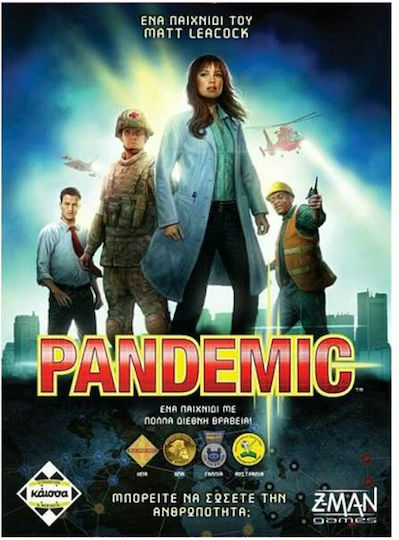
Pandemic Review
The Game That Taught the World to Play Together
Hook / First Impression
In 2008, Matt Leacock published a game where every player loses together or wins together — and nothing in between. Pandemic arrived at a moment when cooperative board games were a novelty, a curiosity, something a niche group of hobbyists played. Within a decade it had sold over four million copies, been translated into more than thirty languages, launched one of the most successful franchise lineups in modern tabletop history, and fundamentally changed what the average person expects a board game to be. You can draw a straight line from Pandemic to the cooperative gaming explosion of the 2010s. Without it, we almost certainly don't get Gloomhaven, Spirit Island, or Arkham Horror at the scale those games achieved.
What makes Pandemic special is not its complexity — by today's standards it sits squarely in the gateway category. What makes it special is the quality of the tension it generates. From the moment you deal the infection cards at setup, the board is already threatening to spiral out of control. Every turn is a negotiation between what you must do right now and what the game will punish you for ignoring later. That tightrope feeling, sustained over sixty minutes, is what cooperative gaming is for.
Overview
Pandemic is a fully cooperative game for 2–4 players in which the group works together to discover cures for four dangerous diseases threatening to overwhelm humanity. Players lose if: any disease spreads too far (eight or more outbreaks), if the disease cube supply of any colour runs out, or if the player card deck is exhausted. They win if they discover cures for all four diseases. Every game is a race against the board.
| At a glance | |
|---|---|
| Designer | Matt Leacock |
| Publisher | Z-Man Games |
| Year | 2008 (revised edition 2013) |
| Players | 2–4 |
| Play time | 45–75 minutes |
| Age | 8+ |
| Weight | Light-Medium (BGG ~2.4/5) |
| Victory condition | Discover cures for all four diseases before the board collapses |
Components & The Setting
The Setting: Players are specialist operatives at the Centers for Disease Control — epidemiologists, medics, scientists, researchers — working in concert to stop four simultaneous outbreaks across a network of 48 cities on a global map. The theme is tightly integrated with the mechanics. The Medic's ability to remove all disease cubes of a colour in a single action is thematically coherent: a skilled medical responder clears infections faster than a generalist. The Scientist's ability to discover a cure with fewer cards reflects specialised laboratory expertise. The map is not decorative — it is the engine of the game's threat model, and the connectivity between cities determines how quickly an outbreak cascades.
The 2013 revised edition improved on the original in every material respect. The world map board is clear, well-printed, and immediately readable — city names are legible, connection routes are obvious, and the four disease colours (blue, yellow, black, red) are distinguished by both colour and shape, aiding players with colour vision differences. The disease cubes are clean plastic markers, satisfying to place and remove. The player cards and infection cards are standard quality — nothing exceptional, but functional and durable.
The role cards are the component that matters most mechanically: five beautifully illustrated cards (seven roles in the revised edition) that define each player's unique ability. The role card you draw shapes every decision you make for the entire game, and the asymmetry between roles is Pandemic's deepest design element. The artwork across the game is clean and purposeful — the map feels like a real crisis dashboard, which is exactly the atmosphere Leacock was targeting.
How to Play
The goal is to discover cures for all four diseases. A cure is discovered when a player uses a Research Station action to discard five city cards of one colour from their hand. Once a cure is discovered, that disease's cubes still spread but are removed more easily. The game ends in victory the moment the fourth cure is found — you do not need to eradicate diseases, only cure them.
On your turn you take four actions chosen from a menu of options:
- Drive / Ferry — move to a connected city. The backbone of movement; used constantly.
- Direct Flight — discard a city card to fly directly to that city. Costly but powerful for reaching distant outbreak sites.
- Charter Flight — discard the card matching your current city to fly anywhere in the world. The most powerful movement action, used for urgent cross-continent responses.
- Shuttle Flight — move between any two Research Stations for free. Becomes increasingly powerful as your network of stations grows.
- Build Research Station — discard the card matching your current city to build a station there. Research Stations are required to discover cures and enable Shuttle Flights.
- Treat Disease — remove one disease cube from your current city. Remove three if the disease is cured. The Medic removes all cubes of one colour in a single action.
- Share Knowledge — give or take a city card from another player in the same city. The primary mechanism for concentrating five same-colour cards in one player's hand to discover a cure.
- Discover a Cure — at a Research Station, discard five same-colour city cards to cure that disease.
After your four actions, you draw two player cards. Some player cards are Epidemic cards, seeded into the deck at setup — when drawn, they trigger a three-step cascade: infect the bottom city of the infection discard pile to maximum (three cubes), intensify by shuffling the infection discard pile and placing it back on top of the infection deck, then infect the top city. Epidemics are the game's primary tension mechanic, and the intensify step means previously infected cities are in permanent danger of re-infection.
Finally, you infect cities: flip infection cards equal to the current infection rate (2–4, escalating over the game) and add one cube of the matching colour to each city. If a city would receive a fourth cube, it instead outbreaks — spreading one cube to every connected city. Chains of outbreaks across connected cities can spiral catastrophically in a single infection phase.
Gameplay Feel
Pacing & Tension: Pandemic's pacing is relentless. The opening turns feel manageable — you triage the initially seeded cities, begin concentrating cards for a cure, establish Research Stations in key positions. Then the first Epidemic drops and the board lurches. A city that was fine two turns ago now sits at two cubes; the infection discard pile shuffles back on top, meaning the cities you just treated are queued to re-infect. A second Epidemic compounds the pressure. By mid-game, the group is making crisis decisions every turn: do we treat the outbreak risk in Mumbai or spend the action pushing toward the red cure we are one card away from? The tension is not manufactured — it emerges organically from the interplay of the Epidemic and infection mechanics, and it rarely lets up until the game ends one way or the other.
Player Interaction is total and constant. Pandemic is one of the most genuinely cooperative games on the market — there is no hidden information between players, no secret objectives, no competitive scoring layer. Every decision is a group decision, or should be. The most experienced player at the table will naturally take a directing role, which is Pandemic's principal social friction point (more on this below). When the group is balanced in experience, the conversation around each turn is rich and engaging. When one player is significantly more experienced, that player may effectively play the game on behalf of everyone else — the "quarterback" problem that all cooperative games must navigate.
Luck vs. Strategy Balance: Pandemic is more luck-influenced than many hobby gamers acknowledge. The infection deck is semi-random (the intensify step provides predictability about which cities will be re-infected, but not when), and the order of Epidemic cards within player deck segments is random. A bad Epidemic draw at the wrong moment — hitting a city already at two cubes, triggering a chain outbreak — can end a game that was otherwise well-managed. This randomness is not a flaw; it is what keeps the game generating tension after dozens of plays. But players who expect consistent reward for good play will sometimes feel cheated by the cards.
Rule Overhead: Very low. The rulebook is among the clearest in modern board gaming. Most groups are fully independent after one teaching game, and many grasp the core rules within fifteen minutes. The role abilities are the only area requiring repeated reference in early sessions. Pandemic is genuinely accessible to non-gamers and makes an excellent first cooperative board game for families or mixed-experience groups.
Mechanics Deep-Dive
The Epidemic / Intensify Loop
Pandemic's central mechanical insight is the Epidemic card's intensify step. By shuffling the infection discard pile and placing it back on top of the infection deck, the game creates a memory-based threat model: you know which cities are in the "hot" zone (recently infected, now queued to re-infect), and you must prioritise treating them before the next Epidemic reshuffles the hot zone into permanent danger. Experienced players read the infection discard pile as actively as the board, treating it as a second layer of information about where outbreaks will next occur. This transforms a simple card-flip mechanic into a strategic planning tool — a subtle and brilliant design choice that most new players don't notice until their third or fourth game.
Role Asymmetry
The seven roles in the revised edition are Pandemic's deepest strategic layer. Each role grants a unique ability that changes how the group approaches the game fundamentally:
- Medic — removes all cubes of one colour in a single action; also removes cubes automatically when moving through a cured disease's cities. The most powerful role in most games, dramatically easing the treatment burden in mid-to-late game.
- Scientist — discovers cures with four cards instead of five. Accelerates the cure pipeline significantly; most valuable when the blue or yellow deck is hard to concentrate.
- Researcher — can give any city card (not just the matching city) to another player in the same city. The group's primary card-sharing role; essential for concentrating cure sets across multiple players.
- Operations Expert — builds Research Stations without discarding a city card; can also move from a Research Station to any city by discarding a city card. Solves the Research Station bottleneck that often constrains cure discovery.
- Dispatcher — can move other players' pawns as their own actions, and move any player to any city another player occupies. The game's logistics specialist; transforms movement efficiency for the whole group.
- Quarantine Specialist — prevents new infection cubes (and outbreaks) in their current city and all adjacent cities. A defensive powerhouse; parks this role in the most outbreak-prone region and neutralises entire threat corridors.
- Contingency Planner — can retrieve and re-use any discarded Event card. Provides a flexible, reusable toolbox of powerful one-time effects that other roles can only use once.
Role combinations determine strategy more than any other variable. A Medic-Scientist pairing can cure diseases faster than almost any other combination; a Quarantine Specialist-Operations Expert pairing can lock down a volatile region while building the Research Station network for cure discovery. Teaching players to think about their role combination as a team composition — not just individual abilities — is the key insight that separates competent Pandemic players from great ones.
The Difficulty System
Pandemic's difficulty is adjusted by the number of Epidemic cards seeded into the player deck: 4 (Introductory), 5 (Standard), or 6 (Heroic). More Epidemics mean the board escalates faster, the intensify loop fires more often, and the window for cure discovery narrows. The Heroic difficulty with six Epidemics is a genuinely hard game — not frustrating-hard, but the kind of tightly wound challenge that produces real triumph when beaten. The introductory mode with four Epidemics plays almost like a tutorial; experienced players will find it too forgiving to generate meaningful tension. Most groups settle at Standard (5 Epidemics) as their default, moving to Heroic once the roles and infection patterns feel fully understood.
Player Count Analysis
2 Players — Very Good. Two-player Pandemic gives each player two roles, adding strategic complexity and eliminating the quarterback problem entirely — both players are equally engaged with the decision space. Games run under an hour with experienced players. The slightly smaller role pool (two of seven roles) means less coverage of outbreak scenarios, but the game remains well-balanced at this count. Recommended for couples or partner gaming.
3 Players — Excellent. The sweet spot for most groups. Three roles provides excellent coverage of the crisis scenarios without anyone at the table feeling underutilised. Conversation is active, decisions are genuinely collective, and session length is consistent at 60 minutes. This is the player count that produces the best balance between collaborative decision-making and individual agency.
4 Players — Good, watch for quarterbacking. Four players at maximum capacity is the most chaotic and social version of Pandemic. With seven roles to choose from, the team composition possibilities are richest. However, four players means four turns between each player's actions — in fast-moving outbreak situations, the board state can change significantly before a player gets another turn, which sometimes produces a sense of helplessness. The quarterback problem is also most acute at four players. With an experienced, balanced group, four-player Pandemic produces the most dramatic table moments. With a mixed-experience group, it requires active facilitation to keep all players engaged.
Solo — Workable. Pandemic was not designed as a solo game, but works reasonably well by playing two roles simultaneously (or all four for a full challenge). The infection phases and Epidemic triggers play out the same regardless of how many roles are managed. Solo Pandemic is a solid option when no co-op partner is available, though dedicated solo designs like Friday or Pandemic: Iberia may serve solo players better.
Replayability
Pandemic's base replayability is moderate. The role combination, the seeded infection cities, and the Epidemic placement create a different opening board state each game, and the infection deck's behaviour is semi-random throughout. However, the base game has no scenario variation, no campaign structure, and no progression. After twenty to thirty games at Standard difficulty, most experienced groups feel they have mapped the strategic space and move to Heroic difficulty, expansions, or sequel games for fresh challenge.
The base game's replayability should be understood in context of its weight: it is a gateway co-op, not a deep euro. For its target audience — families, new gamers, occasional hobby groups — twenty to thirty sessions is a genuinely impressive run from a $40 game. For dedicated hobbyists who want a co-op game they can play weekly for a year, the base game alone will not sustain that cadence; the expansions or sequel titles become necessary.
Learning Curve
Ease of teaching: Pandemic is one of the best-designed games to teach in the hobby. The rulebook is short, clear, and logically sequenced. Most new players are ready to start their first game within fifteen minutes of explanation. The core turn structure — four actions, draw two cards, infect cities — is simple enough to internalise immediately. Role abilities add a small layer of complexity, but each role card is self-contained and readable at a glance.
Rulebook quality: Excellent. The 2013 revised edition rulebook in particular is clear, well-illustrated, and covers edge cases (outbreak chains, the interaction between the Medic and cured diseases) concisely. It is one of the few rulebooks in modern gaming that rewards reading cover to cover before the first session.
First-game experience: Pandemic is the rare game where the first-game experience is almost uniformly positive. New players feel genuinely threatened by the board, make real decisions that affect the outcome, and experience the tension of crisis management from their first turn. Even losing a first game — which happens regularly — tends to produce immediate requests to play again. The debrief after a loss ("if we had treated Cairo one turn earlier…") is often as engaging as the game itself.
Teaching tip: Before the first game, walk through the infection phase and demonstrate an outbreak chain using three or four highly connected cities on the map. New players who see an outbreak cascade before the game begins understand immediately why treating disease is not optional. This demonstration, which takes under two minutes, transforms the first game from a learning experience into a genuine crisis that the group is emotionally invested in surviving.
Who It's For
Families and new gamers: Pandemic is the best cooperative gateway game ever made. Its rules are simple, its decisions are immediately meaningful, and its tension is accessible without being punishing. It has converted more non-gamers into board game enthusiasts than almost any other title. If you want to introduce cooperative gaming to a household that grew up on Monopoly and Uno, Pandemic is the correct first step.
Groups who want to play against the game, not each other: Some groups simply prefer collaboration to competition. Pandemic is the originator and still the gold standard of the co-op genre for groups at this weight level. Its table dynamic — shared crisis, shared decision-making, shared outcome — is what makes game night feel genuinely social rather than adversarial.
Hobbyists building a co-op progression: Pandemic sits at the base of a clear progression ladder. After mastering it, the natural next steps are Pandemic: On the Brink (expanded roles and scenarios), Pandemic Legacy: Season 1 (campaign play), and eventually heavier co-ops like Gloomhaven: Jaws of the Lion or Spirit Island.
Who it is not for: Hardcore euro gamers who want deep strategic depth and minimal luck variance; competitive players who prefer beating each other rather than the board; groups prone to one dominant personality taking over group decisions (the quarterback problem); players who want a campaign experience — the base game is purely standalone.
Pros & Cons
What Pandemic does exceptionally well:
- The cleanest, most teachable cooperative ruleset in the hobby — new players are playing, not learning, within fifteen minutes.
- Tension that emerges organically from mechanics rather than artificial narrative — the board generates crisis, not the rulebook.
- The Epidemic / intensify loop is one of the most elegant semi-random threat mechanisms in board game design — it rewards memory and predictive thinking without requiring perfect information.
- Role asymmetry is meaningful enough to produce genuinely different strategies without adding complexity overhead — every role is readable on a card.
- A scalable difficulty system (4/5/6 Epidemics) that grows with the group's experience.
- Excellent production quality for the price point, especially in the 2013 revised edition.
- One of the best game night investments available: fast to teach, fast to play, universally liked across experience levels.
Where Pandemic struggles:
- The "quarterback" problem is real and can undermine the co-op experience for less assertive players in groups with a dominant personality.
- Luck variance is higher than the game's reputation suggests. A badly timed Epidemic chain can end a well-managed game without warning. Some groups find this frustrating rather than thrilling.
- Base game replayability is limited for dedicated hobby groups. Serious co-op players will exhaust the base game in 20–30 sessions and need expansions or successor titles to stay engaged.
- No solo mode designed for the game — solo play requires house rules or role-doubling.
- The base game has no scenario variety or campaign structure — every game uses the same map, same diseases, same win condition.
Expansions & Ecosystem
Pandemic's ecosystem is one of the most extensive in modern board gaming, ranging from modular expansions for the base game to full standalone sequels and a critically acclaimed Legacy series.
1. On the Brink — Roles, scenarios, and a bioterrorist mode ★★★★★
The essential expansion for base Pandemic. Adds five new roles (including the powerful Epidemiologist), three new scenarios (including a brutal Virulent Strain variant and a fully cooperative Mutation scenario), and an optional competitive bioterrorist mode where one player works against the group. On the Brink addresses almost every critique of the base game — it adds scenario variety, extends replayability significantly, and deepens role options. If you own the base game and want more Pandemic, this is the only expansion you need.
2. In the Lab — A laboratory mini-game for discovering cures ★★★☆☆
Replaces the standard cure discovery mechanism with a laboratory puzzle mini-game involving dice and lab equipment. More complex and more thematically immersive, but it significantly increases session length and adds rules overhead that the base game is specifically designed to avoid. Best for dedicated Pandemic groups who have fully exhausted the base game and On the Brink; not recommended as a first expansion.
3. State of Emergency — Three additional modules ★★★☆☆
Adds the Hinterlands Challenge (diseases spread from wildlife reservoirs), the Emergency Events module (new event cards with crisis twists), and the Superbug Challenge (a fifth, incurable disease). Modular and flexible, but feels like content that should have been in On the Brink. Worthwhile for groups who have finished the base game and On the Brink and want more scenario variety before committing to Legacy.
4. Pandemic Legacy: Season 1 — Standalone campaign game ★★★★★
One of the highest-rated board games ever made. Pandemic Legacy: Season 1 takes the base Pandemic engine and transforms it into a 12–24 session campaign where the board permanently changes, characters develop (and can be scarred or killed), and the story of a global pandemic unfolds across a year of in-game time. It is not an expansion — it is a separate game that destroys itself as you play it. The Legacy games address every limitation of the base Pandemic while retaining its accessibility and tension. If you and your group commit to a Legacy campaign, it will likely be the most memorable tabletop experience you have together.
Quick Buyer's Guide
| Product | Best For | Standalone? | Rating | Priority |
|---|---|---|---|---|
| On the Brink | All base game owners | No | ★★★★★ | 🥇 Buy first |
| Legacy: Season 1 | Committed groups of 2–4 | Yes | ★★★★★ | 🥈 Must-play eventually |
| In the Lab | Veteran groups wanting complexity | No | ★★★☆☆ | 🥉 Late addition |
| State of Emergency | Groups exhausting On the Brink | No | ★★★☆☆ | Optional |
Value for Money
Pandemic retails for approximately $35–$45 USD (€30–40 in Europe), making it one of the most affordable mid-complexity games in the hobby. For a game that teaches in fifteen minutes, plays in under an hour, and can sustain twenty to thirty sessions before exhausting its base content, the value-per-session ratio is excellent for families and occasional gamers.
- Families and new gamers: Outstanding value. Pandemic is the correct first co-op game for most households, and at this price point it competes favourably with any other gateway game on the market. If it introduces your household to cooperative gaming, its value is essentially incalculable — it opens an entire genre.
- Hobby gaming groups: Good value for the base game; excellent value when paired with On the Brink. The two together form a complete Pandemic experience at under $80 and will sustain 40–50+ sessions before feeling fully mapped.
- Legacy campaign groups: Pandemic Legacy Season 1 is a separate $50–60 purchase, but amortised across 12–24 sessions with 2–4 players, it represents some of the best per-session value in all of tabletop gaming. The base game is effectively a rules tutorial for the Legacy campaign — budget for both.
Accessibility
Color blindness: The revised 2013 edition was specifically designed to address colour blindness concerns. Each disease uses both a distinct colour and a distinct shape (cubes vs. cylinders vs. rings), and city connection routes on the board use shape differentiation alongside colour. This makes Pandemic one of the better-designed mainstream games for players with red-green or other colour vision deficiencies. Players should verify that the edition they purchase includes shape differentiation; the original 2008 edition is less well-designed in this regard.
Language dependence: Low. City names are printed on the board and cards, but gameplay does not require reading comprehension — the mechanics are icon-driven and the role abilities are short enough to memorise within a session. Non-English editions are widely available across multiple languages. Pandemic is playable with mixed-language groups more easily than most card-heavy games.
Cognitive accessibility: Very good. The turn structure is simple and repeating; the four-action limit keeps decision complexity bounded. Pandemic is one of the few strategy games that plays well with players across a wide range of cognitive ability, including older family members or children as young as eight with supervision. The cooperative nature means more experienced players can help newer or cognitively challenged players evaluate their options without taking over their turn.
Physical accessibility: The components are easy to handle — standard card size, chunky disease cubes, a flat board. No timed elements or dexterity requirements. Players with limited hand mobility can participate fully. The board can be positioned for wheelchair access without modification.
Age range: The 8+ rating is accurate and perhaps slightly conservative. Engaged 7-year-olds with board game experience can play competently; below that, the infection phase requires adult guidance. Pandemic is an excellent family game precisely because its threat model is intuitive: bad things spread, and you have to stop them.
Verdict
Pandemic is a landmark in board game design. Matt Leacock did not just make a great game — he proved that cooperative board gaming could be a mainstream experience, accessible to families and non-gamers while offering genuine strategic depth to dedicated hobbyists. Eighteen years after its release, it remains the first cooperative game most people should play, and the standard against which all co-op gateway designs are measured. The infection/intensify mechanic is still one of the most elegant semi-random threat systems ever devised. The role asymmetry still produces meaningfully different strategies per role combination. The 45–75 minute run time still fits real-world game nights.
Its limitations are real: the quarterback problem requires active management in mixed-experience groups, the base game's replayability has a ceiling, and luck can occasionally punish well-played games. None of these are reasons not to own Pandemic. They are reasons to understand what kind of game it is — a cooperative gateway, not a deep strategic system — and to evaluate it accordingly. Within its weight class, it is very close to perfect.
Buy it if: you want the best cooperative game for introducing co-op play to families, new gamers, or any group that has never played a board game where everyone wins or loses together. It will be the game that changes how they think about game night.
Skip it if: your group wants a full strategic challenge out of the box and plans to play it weekly for a year without expansions. The base game will not sustain that cadence alone — go straight to Pandemic Legacy: Season 1 or a heavier co-op design.
Upgrade it with: On the Brink for expanded roles and scenarios, then commit to Pandemic Legacy: Season 1 when your group is ready for a campaign. Season 1 is one of the finest tabletop experiences available — the base game is its on-ramp.
Score Breakdown
Ready to explore more board games? Browse our full library of honest, in-depth reviews — from gateway games to heavy euros.
Browse All Reviews →