Root Review
The Most Asymmetric Game Ever Made — and Why That's Its Greatest Strength
Hook / First Impression
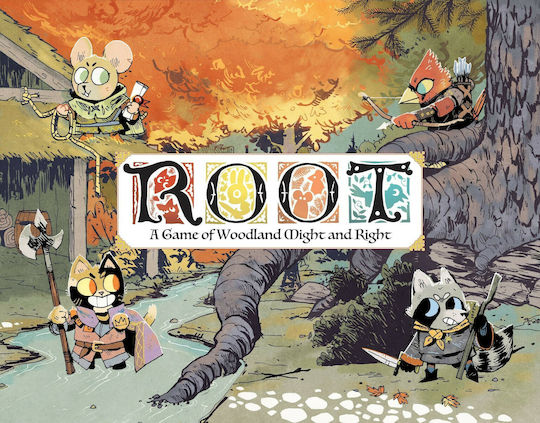
Most board games give every player the same rules. Root throws that assumption out of the window entirely. Across this sun-dappled, adorably illustrated woodland board, four factions fight for control — and not one of them plays anything like the others. The Marquise de Cat is running a conventional area-control empire. The Eyrie Dynasties are following an ever-growing royal decree that will eventually spiral into crisis. The Woodland Alliance are an insurgent underground movement spreading sympathy through guerrilla action. The Vagabond is a lone adventurer on quests, making alliances and betraying them as convenience dictates.
The same board. The same cards. Four completely different games happening simultaneously, bleeding into each other at every turn. It is one of the most original designs in modern board gaming — and also one of the most demanding.
Overview
Root is a competitive asymmetric war game designed by Cole Wehrle and published by Leder Games in 2018. Players lead competing factions vying for dominance over a great woodland, each racing to reach 30 Victory Points through radically different methods. It won the Golden Geek Award for Best Thematic Game and quickly became one of BoardGameGeek's top-rated games — a rare honour for a game released outside the traditional publisher establishment.
| At a glance | |
|---|---|
| Designer | Cole Wehrle |
| Publisher | Leder Games |
| Year | 2018 |
| Players | 2–4 (up to 6 with expansions) |
| Play time | 60–90 minutes |
| Age | 10+ (realistically 14+ for full experience) |
| Weight | Medium-heavy (BGG ~3.7/5) |
| Victory condition | First to 30 Victory Points (or Dominance Card control) |
Components & The Setting
The Setting: Root presents a rich political allegory dressed in the most disarming art imaginable. The woodland is inhabited by cats, birds, rabbits, foxes, and mice — all rendered in the warm, storybook illustration style of Kyle Ferrin. It looks like a children's book. It plays like a political science thesis. That contrast is entirely intentional: the cute exterior lowers the psychological barrier to engaging with what is fundamentally a game about empire, resistance, and insurgency. The theme is deeply integrated — every faction's mechanics are a direct expression of its political and military reality. The Marquise builds infrastructure because empires industrialise. The Alliance spreads sympathy because insurgents need popular support. The Vagabond makes and breaks alliances because lone actors survive by being useful, then expendable.
Component quality in the standard edition is excellent for an independent publisher. The rulebooks — plural, because each faction has its own faction board with a complete rules summary — are clearly laid out and remarkably readable. The neoprene-lined card stock feels premium. The wooden meeples, tokens, and warriors are chunky and satisfying. The double-sided map board (Autumn and Winter variants) is thick and vibrant. One practical note: the game comes with a bewildering number of small cardboard tokens (buildings, sympathy tokens, roosts, items) that benefit enormously from a sorting tray or small zip bags during storage.
How to Play
The goal for all factions is the same: reach 30 Victory Points. How you earn them depends entirely on which faction you're playing.
The shared board is a woodland map divided into clearings, each belonging to one of three suits (Fox, Rabbit, Mouse) and connected by paths. Clearings can hold warriors, buildings, and tokens from multiple factions simultaneously — territory in Root is contested and layered, not exclusively owned.
A shared card deck of 54 cards, also sorted by suit plus a Bird (wild) suit, drives most faction actions. Cards are spent to craft items, trigger special abilities, and — for the Eyrie — survive the game. This shared deck creates constant competition for the right cards, which is one of Root's most elegant tension mechanisms.
Here is how each base-game faction scores points:
- Marquise de Cat: Scores by building Sawmills, Workshops, and Recruiters in clearings. Each building scores 1 VP when placed. The Marquise wins by industrialising the woodland — a slow, steady accumulation strategy that requires field presence everywhere.
- Eyrie Dynasties: Scores by taking Roost buildings and resolving a Decree — a growing list of mandatory actions the birds must execute each turn or fall into Turmoil, losing points and resetting their leadership. The Eyrie is a high-risk, high-reward engine that can score explosively but collapses catastrophically if neglected.
- Woodland Alliance: Scores by spending sympathy tokens placed on the map. Each sympathy token placed earns 1–2 VP based on the clearing's connection to existing sympathy. The Alliance scores nothing from combat — it wins by spreading ideological support and undermining the other factions from the shadows.
- Vagabond: Scores by completing quests, aiding factions, and damaging hostile warriors in combat. Unlike the others, the Vagabond has no buildings and cannot control clearings — they win entirely through personal relationships and individual achievement.
Gameplay Feel
Pacing & Tension: Root's pacing is unusual compared to most board games. The early game is deceptively gentle — factions are expanding into their natural roles, the board is open, and direct conflict is limited. By the midgame, territories start overlapping, the Alliance's sympathy tokens are multiplying faster than anyone budgeted for, and the Eyrie's Decree has grown so demanding that one mismanaged hand sends them into Turmoil. The late game is a frantic sprint: one faction is approaching 30 VP, the Vagabond is three points away from a surprise win, and every action is scrutinised for whether it stops the leader or accidentally creates a new one. Sessions rarely stall and almost always end with a dramatic final few turns.
Player Interaction is constant and irreplaceable. Root is at its core a negotiation game wrapped in asymmetric strategy. Because every faction's strengths and weaknesses interlock with the others, no faction can win without reading the table and responding politically. The Marquise needs to keep the Alliance suppressed. The Eyrie needs open clearings to place roosts. The Alliance needs the Marquise and Eyrie to fight each other. The Vagabond needs alliances that everyone else will eventually want to dissolve. Every player is both threat and resource to every other player simultaneously.
Luck vs. Strategy Balance: Root is a skill-heavy game with a meaningful luck element in card draws. Because the shared deck is used by all factions, drawing into the wrong suits at the wrong time can stall a turn significantly. Combat also uses dice (two custom four-sided dice, one for attacker and one for defender), introducing variance to conflict. Neither of these luck elements dominates outcomes — experienced players adapt around bad draws and choose battles carefully — but they do prevent the game from becoming a pure calculation exercise, which at Root's complexity level is arguably a feature rather than a flaw.
Rule Overhead: Root is honestly a heavy game. Each faction has a completely unique turn structure — you cannot finish teaching one faction and assume the others work the same way. The first session with any new faction is effectively a tutorial. The payoff is that mastering a faction feels genuinely rewarding in a way that most symmetric games cannot match, but players need to accept that the first two or three games will involve regular rulebook lookups. Budget extra time for first sessions and strongly consider having one experienced player at the table to handle edge cases.
Mechanics Deep-Dive
Asymmetric Design Philosophy
Root's central design claim is that asymmetric factions do not just change the flavour of the game — they change the fundamental experience. Other asymmetric games (Root often draws comparisons to Blood Rage or Vast) adjust faction abilities within a shared framework. Root goes further: each faction has a completely different set of actions, a different scoring mechanism, a different relationship to the shared board, and a different win condition philosophy. Playing the Marquise teaches you nothing about playing the Alliance except how the board works.
This produces a design where faction matchup matters enormously. The Alliance is almost always the most dangerous opponent at an inexperienced table — new players underestimate how quickly sympathy spreads and how difficult it is to clear once established. The Eyrie is the faction most likely to self-destruct at the hands of a new player, since the Decree crisis arrives suddenly and punishes unfamiliarity harshly. The Vagabond is deceptively powerful in the hands of an experienced player who knows exactly which factions to aid and when to betray them.
The Shared Card Deck
Every faction uses the same 54-card deck, and competition for specific suits creates a natural layer of scarcity tension. The Alliance needs matching-suit cards to place sympathy tokens and call to arms. The Eyrie needs Bird (wild) cards to resolve ambitious Decrees. The Marquise spends cards for battle bonuses and crafting. When two factions are fighting over the Fox suit, the table feels it — not just strategically, but in the physical experience of watching the draw pile dwindle and calculating whether the discard will cycle before you need that card.
The Politics Layer
Root is fundamentally a political game. No faction can win if the whole table decides to stop it, and conversely, failing to stop the right faction at the right moment is the most common way games are lost. The meta-game — who is threatening enough to warrant attention, which alliance is worth honouring, when to betray a friend for strategic gain — runs parallel to the mechanical game at all times. Sessions are filled with table talk: "I won't attack your clearings if you keep the Marquise busy in the south." Whether those deals hold is between you and your conscience.
- Read the VP track constantly: Any faction within 6 VP of winning without a response is usually winning. Root's endgame accelerates — 30 feels far away until suddenly it isn't.
- The Alliance is always more dangerous than it looks: Sympathy tokens are cheap early and exponentially costly to remove late. Attack them before the network forms.
- The Eyrie needs breathing room: A crowded board stops roost placement and triggers Turmoil. If you want to slow the Eyrie without direct combat, colonise their target clearings first.
- The Vagabond wins by being useful: Aid the faction most likely to fight the leader. An allied Vagabond is an extension of your own hand size and crafting capacity.
- The Marquise wins by not being stopped: The cats have the most warriors and the most buildings. They lose when the whole table turns against them. Stay under the threat horizon until you can't.
Player Count Analysis
Solo — Supported via The Clockwork Expansion. The base game has no solo mode, but The Clockwork Expansion (first or second edition) replaces any human faction with an automated bot. Solo Root — running one faction against three bots — is a legitimate and satisfying puzzle experience. It is also an excellent way to learn the game before bringing it to a group.
2 Players — Functional but lean. Two-player Root is possible but strips away the political negotiation that makes the game extraordinary. With only one opponent, every decision reduces to direct optimisation: there is no one else to pressure the leader, no one to make deals with, no coalition to manage. The Vagabond faction is specifically not recommended for two-player games because its alliance mechanics require multiple partners to function. For two players, consider the Clockwork bots to fill the table, or look at dedicated two-player games like Patchwork or 7 Wonders Duel instead.
3 Players — Good, with the right factions. Three players works well if faction selection is handled carefully. The Vagabond at three players can become overpowered — with only two human factions to play off each other, the Vagabond's ability to aid and betray at will makes them a kingmaker rather than a competitor. Consider omitting the Vagabond entirely until the group is comfortable with the base factions. Three-player games are faster and more tactical, with less political noise — some groups prefer this cadence.
4 Players — The design target. Four players is where Root fully realises its potential. All four base factions are in play simultaneously, creating the interlocking threat web that makes the political layer sing. The board is appropriately contested without feeling cramped. Negotiations are multi-directional. Every session produces different configurations of alliances and betrayals. If you only ever play Root at one count, make it four.
5–6 Players — With expansions, excellent. The Riverfolk Expansion and Underworld Expansion each add new factions that scale the game to five or six players. More factions add political complexity and increase session length to 90–120 minutes, but they preserve Root's core dynamic and are among the best-designed faction additions in the hobby. The Marauder Expansion adds two further factions specifically designed for the three- and four-player game, providing better faction options at every count.
Replayability
Root's replayability is exceptional and comes from several independent sources. The most obvious is faction variety: with four base factions and up to ten in the full expansion ecosystem, every session with a different faction assignment is a fundamentally different game. A player who has mastered the Marquise will find the Alliance essentially new on first play, and vice versa. Most groups report still discovering faction nuances after 30+ sessions.
The double-sided map board provides meaningful geographic variation — the Autumn map's clearing layout favours different faction strategies than the Winter map's, and experienced players will seek out the map that suits their faction's needs. The Landmark tiles (from the Landmarks promotional pack and later included in expansions) add optional board variation that alters strategic priorities.
Perhaps most importantly, Root's replayability is driven by the people at the table rather than the components. The same faction matchup with different players — different threat assessments, different negotiation styles, different willingness to commit to betrayal — produces different outcomes. Root sessions have personalities, and those personalities are provided by humans, not cards.
Learning Curve
Ease of teaching: Root is difficult to teach well. The standard advice in the Root community is to start with the Marquise for first-time players — it is the most conventional faction and provides a good grounding in how the board, combat, and card systems work before the asymmetric complications are layered on. Attempting to teach all four factions simultaneously to four new players in a single session produces confusion and a slow, halting first hour.
The most effective teaching approach is the staggered introduction: have one experienced player at the table, have new players choose factions in order of complexity (Marquise first, then Eyrie, then Vagabond, then Alliance), and give each player a five-minute briefing on their specific faction rather than explaining all four in sequence. This adds time to setup but dramatically improves first-game quality.
Rulebook quality: Leder Games' rulebooks are above average for independent publishers. The core rulebook is concise and well-organised. Each faction's rules are contained on their individual faction boards — a format that eliminates constant rulebook lookup during play once you've internalised your own faction. The official Root website hosts the complete rules, errata, and extensive FAQ, which answers almost every edge case that arises in the first dozen sessions. The Root Reddit and Discord communities are extremely active and beginner-friendly.
First-game experience: Honest assessment: the first game of Root is almost always slower and messier than the session that first demonstrates why the game is great. Players are reading their faction boards constantly, combat feels slightly opaque, and the political layer has not yet emerged because everyone is still figuring out what they're doing. The second game — when players know their faction's win condition and have a feel for the board — is when Root clicks. If your group judges games entirely on first-session experience, manage expectations accordingly. If they commit to a second game, they will very likely want a third.
Who It's For
Experienced hobbyist groups: Root is an elite-tier recommendation for groups already comfortable with medium-to-heavy games. If your group plays Viticulture, Terraforming Mars, or Spirit Island and is ready for something more politically complex, Root is the natural next step. It rewards experience and discussion in a way that will keep a regular group occupied for years.
Strategy gamers who want asymmetry: If you have ever wanted to play a game where every player is genuinely playing by different rules, Root is the definitive example of what that can feel like at its best. No other mass-market game commits to faction asymmetry at this depth.
Families: Root is not a family game in the traditional sense. The 10+ age rating undersells the cognitive complexity. Most families will find the learning curve too steep relative to the payoff unless teenagers or adult family members are invested hobbyists. For family play, Cascadia or Ticket to Ride are better choices.
Casual groups: Not recommended. Root requires commitment — to learning your faction, to engaging with the political layer, to coming back for multiple sessions. Groups who play once a year and prefer simple, social experiences will not get the return on investment.
Comparisons: For pure asymmetric depth, Spirit Island (cooperative) and Vast: The Mysterious Manor are the closest companions. For political negotiation with slightly less complexity, Cosmic Encounter is an excellent stepping stone. For war games in a similar theme with more conventional mechanics, War of the Ring is a masterpiece of a different kind.
Pros & Cons
What Root does brilliantly:
- Radical faction asymmetry creates a different strategic experience with every faction assignment — essentially multiple distinct games in one box.
- The shared card deck creates constant indirect competition that keeps all players invested even on other players' turns.
- Theme and mechanics interlock perfectly — every faction's rules are an expression of its political and military reality, making them intuitive once understood.
- The political negotiation layer is emergent and genuine, driven entirely by player relationships rather than scripted events.
- Kyle Ferrin's artwork is disarming and beautiful — it makes the game approachable to people who would never pick up a traditional war game.
- Exceptional expansion support: each expansion adds well-designed new factions that meaningfully extend the faction diversity and strategic space.
- High replayability — groups consistently report that Root has the longest shelf life of any game in their collection at its weight tier.
Where Root struggles:
- The learning curve is genuinely steep — the first session is slow, messy, and requires an experienced guide to avoid confusion and frustration.
- Faction balance is sensitive to player count and experience level — at an inexperienced table, the Alliance and Vagabond can be accidentally dominant or accidentally irrelevant.
- The 10+ age rating is optimistic; the full political depth requires at least teenage cognition and patience.
- Setup time is long (20–30 minutes for a new group) due to the multi-faction rulebook complexity.
- Poor two-player experience without supplementary bots from an expansion.
- The charming art style actively misleads casual observers about the game's complexity — Root looks like a children's game and plays like a geopolitical simulation.
Expansions & Ecosystem
Root's expansion ecosystem is the deepest in modern hobby gaming for a game of its age. Every expansion adds new factions, and each faction introduces a completely new way of playing the game.
1. The Riverfolk Expansion — Two new factions, commerce and faith ★★★★☆
Adds the Riverfolk Company (a trading company that sells services to other factions, scoring by economic dominance) and the Lizard Cult (a religious movement that converts enemy warriors and scores by establishing holy sites). Both are complex, thematically rich, and significantly shift the political dynamics of any session they join. The Riverfolk Company in particular creates fascinating new negotiation opportunities — other players can literally pay to hire their warriors, creating a mercenary layer in the political game.
2. The Underworld Expansion — Underground maps and two new factions ★★★★★
Adds two new maps (the Underground Duchy's cavern network and the Lake Map) and two factions: the Underground Duchy (a subterranean empire that invades from below using a minister system) and the Corvid Conspiracy (a secretive criminal syndicate that spreads face-down plot tokens across the woodland, scoring when they are revealed). The new maps meaningfully alter strategic priorities. The factions are exceptionally well-designed and thematically memorable. The Corvid Conspiracy is one of the most uniquely asymmetric factions in any board game — their hidden information mechanics add a deception layer entirely absent from the base game.
3. The Marauder Expansion — Two new factions designed for smaller player counts ★★★★☆
Adds the Lord of the Hundreds (a warlord who plunders opponents and scores by controlling clearings with large warrior presence) and the Keepers in Iron (ancient guardians who score by excavating relics buried across the woodland). Both factions are specifically designed to perform well at three and four players, filling gaps in faction balance at those counts. The Keepers in Iron in particular provide a strong territorial-control option that the base game lacks at lower player counts.
4. The Clockwork Expansion (2nd Edition) — Automated bots for solo and bot-fill play ★★★★☆
Provides automated faction bots for all four base factions and all expansion factions, enabling solo play, two-player games, and filling empty seats at any player count. Each bot operates on a simple priority system that approximates the faction's strategic behaviour without requiring a human controller. The bots are not perfect strategic opponents, but they are competent enough to create meaningful pressure and maintain game balance. The second edition improves significantly on the original, with clearer priority tables and corrected edge cases.
Quick Buyer's Guide
| Expansion | Best For | Complexity | Rating | Priority |
|---|---|---|---|---|
| Underworld | Veteran players, map variety | High | ★★★★★ | 🥇 #1 — best overall addition |
| Clockwork (2nd Ed.) | Solo, 2-player, bot-fill | Low | ★★★★☆ | 🥈 #2 — enables solo and 2P |
| Marauder | 3–4 player regulars | Medium | ★★★★☆ | 🥉 #3 — best balance at small counts |
| Riverfolk | Commerce & faith themes | High | ★★★★☆ | Optional — adds two strong factions |
Value for Money
Root retails for approximately $60–$70 USD (€55–65 in Europe), placing it in the premium tier of hobby board games. For groups that commit to learning it, the value is extraordinary — the base game alone contains four distinct strategic experiences, and its replayability ceiling is among the highest in its weight class. A group that plays Root 20 times across two years has spent less per session than a single cinema visit.
The expansion ecosystem is similarly priced ($35–50 per expansion) and well worth the investment for dedicated groups. The complete Root collection — base game plus all four major expansions — delivers a strategic system sophisticated enough to occupy a serious gaming group for years.
- Dedicated hobby gaming groups: Exceptional value. Root is the kind of game that becomes the centrepiece of a collection rather than a title you rotate through.
- Groups willing to invest two or three sessions: Worth it. The payoff per session increases dramatically after the learning curve clears.
- Casual groups or one-time players: Not worth it. The base game cost is justified only if your group returns to it multiple times.
- Solo players: Buy the base game and Clockwork (2nd Edition) together — that combination provides an excellent solo experience.
Accessibility
Color blindness: Root performs reasonably well here by board game standards. Faction colours (orange for Marquise, blue for Eyrie, green for Alliance, grey/white for Vagabond) are distinct enough that most common forms of color blindness do not significantly impair play. Faction boards use iconography heavily, and the woodland clearings are identified by animal suit rather than colour. The token shapes also differ by faction, providing a secondary identifier. Leder Games has not released an official color-blind-friendly edition, but the existing design is more accessible than most area control games.
Language dependence: Moderate. Card text is present and sometimes decisive — understanding what a card does requires reading. However, the core game loop (birdsong, daylight, evening turn structure on faction boards) uses clear iconography, and the card text is short and consistent in vocabulary. Non-native English speakers report Root as learnable in translation with the help of an experienced player, and official translations exist in French, German, Spanish, and several other languages.
Cognitive accessibility: Root demands significant working memory — tracking your own faction's mechanics, reading three opponents' faction boards, maintaining a model of the political situation, and managing hand of cards simultaneously. This is not a game suitable for players with significant cognitive impairment or limited patience for complexity. The staggered faction learning approach (one faction at a time over multiple sessions) substantially reduces this burden.
Physical accessibility: The components are predominantly card and token-sized, with no particularly fine manipulation required. The wooden warriors are small (approximately 1.5cm) and may be fiddly for players with dexterity limitations. Sorting trays or component bags eliminate most of the handling issue during play. Nothing about Root's physical design is unusually demanding by hobby board game standards.
Age range: The 10+ rating reflects the game's thematic content (benign) more than its cognitive demands. Realistically, 14+ is the age at which most players can engage with the political layer meaningfully. Younger children can technically execute faction actions, but the multi-faction strategic awareness that makes Root rewarding requires a cognitive maturity that most players develop in their early teens.
Verdict
Root is not an accessible game, a quick game, or a forgiving game. It demands commitment, patience, and a group willing to invest several sessions before the design fully reveals itself. All of that is true, and none of it is a criticism. Root is one of the most original, most thematically coherent, and most strategically rich games the hobby has produced — a game where every faction feels genuinely different, where the political layer emerges organically from mechanical asymmetry, and where a well-played session produces stories that dedicated hobbyists will recount years later.
The charming woodland art is not a lie. It is a promise: beneath the foxes and mice and rabbits is a game that respects the player enough to make asymmetry mean something. Cats really do play like empires. Birds really do collapse under bureaucratic overreach. The Alliance really does win from the shadows. The Vagabond really is everyone's best friend until suddenly they aren't.
Buy it if: you have a dedicated group of four who are ready to commit to multiple sessions and want a game that rewards long-term mastery at the highest level of the hobby.
Skip it if: your group plays rarely, dislikes complex teaching, or expects a game to deliver its full experience in a single session.
Start with: watch the Watch It Played tutorial, assign factions before the session, and have one person play the Marquise to anchor the table. Your first game will be imperfect. Your second game will be the one that makes you cancel plans to play a third.
Score Breakdown
Love board game night? Explore our tools, score calculators, and strategy guides — everything you need to play better and have more fun.
Browse All Articles →