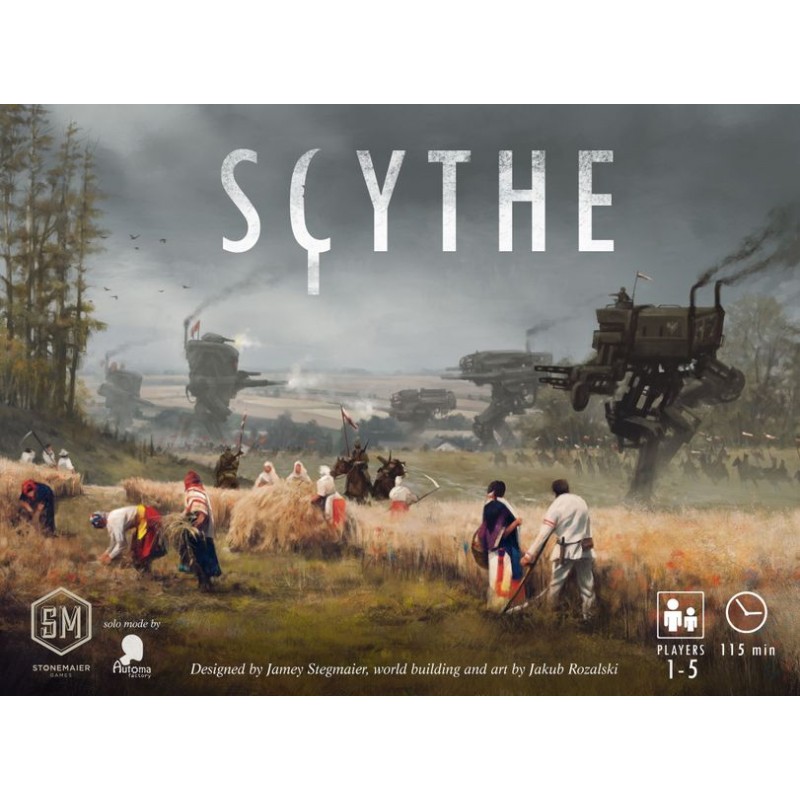
Scythe Review
Diesel Mechs, Asymmetric Factions, and an Engine That Never Stalls
Hook / First Impression
Few board games have arrived with the force of cultural disruption that Scythe did in 2016. Jamey Stegmaier's Kickstarter campaign — at the time one of the most successful in tabletop history — promised something the hobby had rarely seen: a heavy, asymmetric engine-builder wrapped in an alternate-history 1920s Eastern European setting, with towering diesel mechs painted over landscapes that looked like they were pulled from a gallery wall. The art of Jakub Różalski did something no rulebook could: it made Scythe feel important before anyone knew the rules.
The question was whether the game inside the box could match the world on its cover. Eight years and millions of copies later, the answer is largely yes — with some genuine asterisks.
Overview
Scythe is an asymmetric engine-building area-control game designed by Jamey Stegmaier and published by Stonemaier Games in 2016. Set in an alternate 1920s Eastern Europe dominated by the mysterious Factory at its centre, players lead unique factions — each with different starting resources, abilities, and mech upgrades — to earn coins, control territories, and complete objectives. The game ends the moment any player places their sixth Star (achievement token), triggering a final scoring round that rewards coins, territories, resources, and popularity.
| At a glance | |
|---|---|
| Designer | Jamey Stegmaier |
| Publisher | Stonemaier Games |
| Year | 2016 |
| Players | 1–5 (7 with Invaders from Afar) |
| Play time | 90–115 minutes |
| Age | 14+ |
| Weight | Medium-heavy (BGG ~3.4/5) |
| Victory condition | Most coins after the end-game scoring round |
Components & The Setting
The Setting: Each player leads one of five rival factions — the industrial Rusviet Union, the disciplined Crimean Khanate, the agricultural Nordic Kingdoms, the mercantile Polania Republic, or the mechanically gifted Saxony Empire — vying for dominance over the land surrounding the mysterious Factory. The theme is deeply woven into the mechanics: each faction feels genuinely different to pilot, the mechs physically occupy and control territories, and the Factory itself is a real, contested destination worth fighting for. Scythe is not a reskinnable abstract — it is a world, and you feel it at the table.
The production quality is extraordinary by any measure. The game comes with five highly detailed plastic mechs, one per faction, each moulded in a distinct silhouette. The main board is enormous and beautifully illustrated — the hexagonal territory tiles are richly detailed with forests, mountains, villages, and tundra, all in Różalski's signature oil-painting style. Player mats are player-specific thick cardboard with clever sliding-dial trackers for Popularity and Power; a rotary dial stores production counts without any tokens on the board. The resource tokens — wooden Food, Oil, Metal, and Coin pieces — are chunky and plentiful. Encounter cards, Objective cards, and the Factory cards all feature full-colour art consistent with the setting.
The insert is one of the best in the hobby: foam-lined compartments for every component type, faction trays for fast setup, and enough organisation that you can be play-ready within five minutes of opening the box. Stonemaier sets a quality standard here that many publishers still haven't matched. The only mild gripe: the smaller unit tokens (Workers and Characters) are somewhat fiddly to pick up from the board at distance. A minor complaint for an otherwise exceptional physical product.
How to Play
The goal is to earn the most coins when the game ends. Coins come from your treasury, controlled territories, and resources on the board — but how much each is worth scales with your Popularity track, which means being the most ruthless military player is not always the winning strategy.
On your turn you choose one of four sections on your Player Mat — each section contains a top action and a bottom action. You must take the top action and may take the bottom action. The cardinal rule: you cannot repeat the section you chose last turn. This simple constraint is the engine of the entire game. It forces you to think two or three moves ahead, stagger your economy, and resist the urge to do the same efficient thing every turn.
The four top actions are: Move (move units around the map), Bolster (increase Power or draw Combat Cards), Produce (generate resources on controlled territories), and Trade (buy resources or increase Popularity). Their paired bottom actions are: Deploy a mech (unlocking a faction-specific ability), Upgrade (improve your actions using a cost-reduction system), Build a structure (mine, mill, monument, or armory), and Enlist a recruit (grant permanent bonus triggers).
The game ends immediately when any player places their sixth Star. Stars are earned by completing Objectives, winning combat encounters, achieving maximum Popularity or Power, deploying all mechs, building all structures, or enlisting all recruits. Final scoring then rewards coins for territories and resources at a rate determined by your Popularity tier — a low-Popularity player gets far less per territory than a high-Popularity one.
Gameplay Feel
Pacing & Tension: Scythe's early game has a calm, almost meditative quality. Players spread across the map, build their engines, and rarely interact beyond occasionally occupying the same territory by accident. The tension is architectural — you're constructing something, watching it take shape, making decisions about which paths to unlock and which to defer. The mid-game accelerates as mechs hit the map, the Factory becomes contested, and Stars start appearing on the tracker. The final quarter can erupt with startling speed: a player nearing their sixth Star compresses everyone else's planning horizon to a single turn, and the last few moves of a Scythe game often feel like a controlled fall.
Player Interaction is lower than Scythe's visual identity implies. The mechs loom large on the board, but direct combat is expensive in Power and Cards and carries real risk. Most player interaction happens through territorial pressure: blocking expansion routes, racing to the Factory, and watching your opponents' Star counts. It's a game of cold war more than hot — the threat of your mechs is often more powerful than using them.
Luck vs. Strategy Balance: Scythe is nearly deterministic. There are no dice. The only randomness comes from the draw of Encounter cards (which offer three choices, so even bad draws have multiple outs), Combat Cards (which affect combat margins but not outcomes in well-managed fights), and Objective cards (which vary in difficulty). An experienced player will outperform a new one with overwhelming consistency. This is a feature for strategic gamers; it may frustrate players who prefer the variance equaliser that dice provide.
Rule Overhead: The rulebook is roughly 30 pages, but the game's actual turn structure is simple enough to summarise on an index card. The complexity lives in the faction abilities, mech deployments, and the interaction of bottom-action bonuses — not in remembering a long list of edge cases. Most teaching sessions run 20–25 minutes; players are independent within two full rounds. The biggest teaching stumble is consistently the end-game trigger: new players forget that the game ends immediately when someone places their sixth Star, not at the end of the round.
Mechanics Deep-Dive
The Player Mat Engine
The Player Mat is Scythe's core innovation. Each faction is paired with a Mat at the start of the game — and the pairing is not random in competitive play, because different mats have different bottom-action costs printed on them. A mat with cheap Enlist actions pairs differently with each faction than one with cheap Upgrades, creating meaningful variability before anyone takes a turn. The "cannot repeat last section" rule is deceptively powerful: it forces you to sequence your actions like a musician planning a chord progression, not a tactician taking the best move available each turn.
The bottom-action Upgrade system deserves special attention. Each upgrade moves a wooden cube from a top-action slot (making it cheaper to use) to a bottom-action slot (making it cheaper to activate). Over the course of a game, a fully upgraded faction runs its engine at a fraction of the early-game cost — the sensation of a tuned-up Scythe engine in the late game, where you're producing enormous quantities of resources and converting them into Stars every two or three turns, is one of the most satisfying feelings in modern board gaming.
Asymmetric Factions
Each of the five base factions plays meaningfully differently — not just different starting positions, but different styles of play enforced by their unique mech abilities and Character powers:
- Rusviet Union — the most controversial faction. Their unique ability allows repeating the same section on consecutive turns, breaking the game's core rule. In the hands of an experienced player this is extremely powerful; many competitive groups ban or house-rule this faction for new-player games.
- Nordic Kingdoms — the only faction whose workers can swim (cross rivers without mechs). This gives them enormous early-game reach and resource production, making them the most forgiving faction for new players who want to explore the map freely.
- Crimean Khanate — their mechs and Character can use Combat Cards as wild resources, giving them an economic flexibility no other faction has. They're the hardest faction to play well but reward mastery with an almost unkillable mid-game economy.
- Polania Republic — can choose from two Encounter cards instead of one, giving them the best probability of useful Encounter outcomes. Their play style rewards aggressive exploration of the map to maximise Encounter events.
- Saxony Empire — the only faction with no cap on the number of Stars they can earn from combat or Objectives. This makes them the game's natural aggressor: a Saxony player who commits to combat and Objectives can chain Stars faster than anyone else.
The Popularity Multiplier
Scythe's most elegant design decision is that your final scoring rate depends on your Popularity. At low Popularity (0–3), each controlled territory and resource set is worth 1 coin. At mid Popularity (4–12) it's 2 coins each. At high Popularity (13–18) it's 3 coins each. This single mechanic prevents purely military players from simply conquering the board and winning — a faction that smashes through opponents and ignores Popularity may control twelve territories while scoring less than a peaceful builder who holds six with maximum Popularity. The cold war dynamic is not accidental; it's deliberately baked into the economics.
Player Count Analysis
Solo — Excellent. Scythe's Automa system (the game's AI opponent) is a benchmark for solo design in hobby gaming. The Automa deck drives a mechanical opponent that expands across the map, earns Stars, and creates genuine spatial pressure — without requiring a human GM. The solo game captures roughly 85% of the Scythe experience, lacks only the political dimension of reading human opponents, and plays in under 60 minutes. One of the best solitaire experiences in a multiplayer-designed game.
2 Players — Good, with caveats. Two-player Scythe is more direct and tactical than the full experience — there's nowhere to hide from each other and the Factory is always a contested flashpoint. It works well and plays quickly (under 60 minutes), but the cold-war tension that makes Scythe unique is compressed. Both players feel the combat pressure more acutely because there's no third party to balance the table. Solid, but not the definitive Scythe experience.
3 Players — Very good. Three-player games are the inflection point where the political dimension begins to emerge. Players must decide whether to press an early advantage or risk provoking a coalition. The board is spacious enough that players rarely collide in the early game, making it a good count for first-time games where teaching is the priority.
4 Players — The sweet spot. Four players is where Scythe's design is most fully realised. The board fills at the right pace, territorial pressure is constant but not claustrophobic, and the Popularity dynamics play out with their intended richness. Games run comfortably under two hours with experienced players. This is the recommended count for anyone who has played before.
5 Players — Good, budget time. Five players fills the entire board and makes every hex feel meaningful. The game takes longer (120–150 minutes) and downtime between turns increases noticeably. The end-game trigger can feel sudden because there are five separate Star tracks advancing simultaneously. Excellent for groups who specifically want to use all five base factions, but the 4-player game is tighter.
Replayability
Scythe's replayability is exceptional and comes from several stacked layers. The randomised faction and player mat pairings mean that even playing the same faction feels different when your mat changes your action costs and bonus triggers. The Encounter card deck ensures no two exploration paths are identical. The Objective cards push players toward different strategic priorities each game. And most importantly, the table composition — which five factions are in play and how they interact spatially — creates emergent geopolitical situations that rarely repeat.
In practice, Scythe sustains a dedicated group for 30–40 sessions before the strategic space starts to feel thoroughly mapped. The expansions push this significantly further by adding new factions, a modular board system, and entirely new mechanisms. For most groups, the base game alone represents two to three years of periodic play before reaching any sense of exhaustion.
The game also rewards mastery accumulation in a way few heavy games do — each play teaches you something new about faction pairings, map control timing, and Star sequencing. Players who return to Scythe after a break often find that their understanding has deepened in the interim, making it the rare game that gets better with distance as well as repeated play.
Learning Curve
Ease of teaching: Scythe is genuinely teachable, but it benefits from an experienced teacher who has played enough to know which rules matter in the first turn and which can wait. The visual complexity of the board and faction sheets intimidates new players before the game starts — the teaching job is partly managing that anxiety and demonstrating that the turn structure is actually simple. A well-paced teach runs 20–25 minutes; a rulebook-read-aloud approach runs 45+ and loses the table.
Rulebook quality: Above average. Stonemaier's rulebook is clear, logically sequenced, and heavily illustrated with visual examples. The Learn-to-Play booklet (included separately from the full rules) is an excellent first-game guide that front-loads the essentials and defers edge cases to the reference booklet. For complex games, this two-document approach is best-in-class.
First-game experience: Almost universally positive, with one common pitfall. New players spend their first game building an engine they never fully accelerate because the game ends before their upgrades compound. This leads to a misleading first impression — "that went fast, I never felt powerful" — that resolves immediately in the second game once players understand the urgency of early Star progress. Teachers should explicitly prime new players: the game rewards you for ending it before opponents are ready, not for building the most beautiful engine.
Who It's For
Engine-builder enthusiasts: If you love watching a system accelerate — resources beget structures beget recruits beget faster resources — Scythe delivers this loop with more visual clarity and physical satisfaction than almost any other game in the category. The tactile pleasure of sliding resource tokens into a factory and deploying a mech is real and earned.
Strategy gamers who want asymmetry: Each faction requires a meaningfully different approach, and discovering the strategic identity of each one is half the game's long-term appeal. Players who enjoy Root's faction asymmetry will find Scythe less extreme but more economically satisfying to pilot.
Groups who want less combat than they expect: If your table enjoys area-control games like Dominant Species or Blood Rage for the combat, Scythe will disappoint. The mechs are props in a negotiation, not engines of destruction. If your table prefers the threat of conflict to its execution, Scythe is perfect.
Solo gamers: The Automa system is reason enough to own Scythe as a solo player. It's one of the most satisfying single-player experiences in heavy eurogames.
Comparisons: Players who want more combat should look at Blood Rage. Players who want deeper economic complexity should look at Brass: Birmingham. Players who want similar asymmetry with more direct conflict should look at Root. Players who want a step up from Terraforming Mars in thematic weight will find Scythe a natural progression.
Pros & Cons
What Scythe does exceptionally well:
- The alternate-history 1920s aesthetic is coherent, distinctive, and carries genuine emotional weight — Różalski's art elevates this above any other engine-builder on the market.
- The "cannot repeat last section" turn structure is the game's hidden genius: simple to explain, endlessly deep to master.
- Asymmetric factions create genuinely different strategic identities — not just different starting resources, but different styles of play.
- The Popularity multiplier elegantly prevents pure military dominance and keeps economic paths viable throughout.
- Component and insert quality is best-in-class for the price tier; setup is fast and satisfying.
- The Automa solo system is one of the best in the hobby.
- Near-zero randomness outside of card draws — skill compounds consistently across sessions.
Where Scythe struggles:
- The cold-war aesthetic deceives new players — the mechs look like a wargame, but direct combat is rare and often inefficient. Groups who want frequent battles will be frustrated.
- The runaway leader problem is real: once a player's engine is clearly superior, others have limited tools to slow them without derailing their own Star progress.
- The Rusviet faction is widely considered overpowered in base game play, especially when paired with the Innovative mat. Casual groups should consider restricting this pairing.
- The first game almost always ends before players feel their engine running at full speed, creating a misleading impression that evaporates in the second play.
- Analysis paralysis is a genuine risk with deliberate players — the depth of the faction mat optimisation can grind turns to extended think sessions.
- At five players the downtime between turns is noticeable; a non-engaged player can feel sidelined between their turns.
Expansions & Ecosystem
Scythe has a carefully curated expansion ecosystem — Stonemaier released fewer, larger additions rather than fragmenting the game into a constant drip of small-box purchases. Every expansion is designed to stack with the others.
1. Invaders from Afar — Two new factions and 6–7 player support ★★★★☆
The first expansion adds the Albion (a Highland faction that places permanent flags to mark territory) and Togawa Shogunate (a Japanese faction that places threatening traps to control territory through fear). Both factions are asymmetric enough to feel genuinely new, and the expansion extends the player count to seven — though games at six or seven push the session length to three-plus hours and the board becomes extremely congested.
2. The Wind Gambit — Airships, Resolution cards, and variable end-game rules ★★★★☆
Adds Airships — a new unit type that moves freely across the map and carries workers or resources — and two card decks: Airship Abilities (modular per-game rules for what airships do) and Resolution Cards (variable end-game scoring triggers that replace the standard six-Star trigger). The Resolution Cards are the standout feature, fundamentally changing how the game ends in each session and preventing the "rush to sixth Star" meta from becoming predictable. Some Resolution Cards are more balanced than others, and the community has curated a recommended shortlist.
3. The Rise of Fenris — An eight-episode campaign with permanent changes ★★★★★
The campaign expansion, and arguably the most ambitious thing Stonemaier has published. Eight linked episodes tell the story of Fenris, each adding new modules, rules, and components — some of which are permanently stickered onto your components (the game helpfully provides two copies of everything that receives stickers, so your original components are preserved). The campaign introduces Mech Mods (customisable abilities), a new map board, new factions, and narrative events that change based on prior-game outcomes. It is designed for a specific group playing through it together over multiple sessions, and is not suitable as a stand-alone or for rotating player groups.
Quick Buyer's Guide
| Expansion | Best For | Complexity Added | Rating | Priority |
|---|---|---|---|---|
| Rise of Fenris | Dedicated campaign groups | High | ★★★★★ | 🥇 #1 — best overall experience |
| The Wind Gambit | Experienced groups, meta variety | Medium | ★★★★☆ | 🥈 #2 — best for regular play groups |
| Invaders from Afar | More players, more faction variety | Low | ★★★★☆ | 🥉 #3 — best first expansion |
Value for Money
Scythe retails for approximately $80–$90 USD (€75–85 in Europe), placing it at the premium end of the hobby game market. At that price point, the question is whether the components, design, and replay value justify the premium over cheaper alternatives — and the answer is a clear yes. The production quality is exceptional, the rulebooks are thoughtfully designed, and the replay depth at five players over 30–40 base-game sessions delivers a per-session cost well under two dollars.
- Groups who play monthly: Outstanding value. Scythe's replay depth and component quality make it a shelf anchor for years. The expansions extend this investment at reasonable incremental cost.
- Casual groups who play rarely: Still worth it, but consider buying second-hand. Scythe holds its value well and used copies in excellent condition are readily available. The game survives heavy use with minimal component wear.
- Solo players: One of the best value propositions in solo gaming. The Automa system provides a genuine challenge across difficulty levels, and the solo game plays in under an hour.
- Players who want a wargame: The money is better spent elsewhere. Scythe's combat is incidental, not central — if that's the main appeal, look at Blood Rage or Kemet at a similar price point.
The Scythe: Collector's Edition and Legendary Edition bundles (available periodically from Stonemaier) package the base game with all expansions at a meaningful discount compared to buying separately and are worth timing a purchase around if you know you'll go deep into the ecosystem.
Accessibility
Color blindness: Scythe is one of the better heavy games for color accessibility. Each faction uses a distinct color for its player pieces, but the faction-specific mech sculpts are unique enough in silhouette that they can be identified by shape alone at distance. Resource tokens are distinct in shape as well as color. Some component text is small; strong ambient lighting helps significantly. Not perfect, but above average for the weight class.
Language dependence: Moderate. The Encounter cards, Objective cards, and Factory cards are text-heavy and require reading comprehension. The core mechanics are largely icon-based once learned, but new players need access to English text during play (or a translated edition — Scythe is published in over a dozen languages). The faction and player mat abilities are printed in English only in the standard edition.
Cognitive accessibility: Scythe is a heavy game by design and is not suitable for players with significant cognitive limitations unless paired with a very patient teacher willing to guide decisions. That said, the turn structure — choose a section, take two actions — is simpler than it appears. Players who struggle with complex rules can participate meaningfully by focusing on production and upgrades while more experienced players handle territorial and combat decisions; the game's economy rewards specialisation.
Physical accessibility: The player mats have small text and fiddly wooden cubes for the upgrade system. The resource tokens and mech models are large and easy to manipulate. Players with limited dexterity may find placing workers on territory hexes across the large board challenging without assistance. The game does not require rapid physical actions or timed elements.
Age range: The 14+ rating is accurate. The thematic content is mild — no violence beyond abstract mech combat — but the strategic complexity is genuinely adult. Exceptional 12–13 year-olds who enjoy strategy games can handle it with guidance; younger than that is unlikely without significant simplification.
Verdict
Scythe is a masterpiece of industrial design — the art, the components, the insert, the rulebooks, and the core mechanic all feel like they were built by a team obsessed with quality at every layer. The "cannot repeat last section" constraint is one of the most elegant turn-structure ideas in modern board gaming, and the asymmetric factions give it the kind of replay depth that keeps dedicated groups returning for years. The Popularity multiplier is quietly brilliant, preventing the game from collapsing into pure military dominance and keeping peaceful engines viable against aggressive plays.
Its weaknesses are real but manageable. The runaway leader problem exists and has no mechanical escape hatch. New players will almost always feel underpowered in their first game. And the Rusviet faction, in competitive play, edges close to broken. None of these are dealbreakers — they are the texture of an ambitious design that took meaningful risks.
Buy it if: you want a heavy engine-builder with extraordinary production quality, faction asymmetry, and a thematic world that feels genuinely alive at the table.
Skip it if: you want frequent, brutal mech-on-mech combat — this is a cold war game, not a hot one. The mechs are props in an economic drama.
Upgrade it with: The Wind Gambit first (for Resolution Cards that fix the end-game meta), then Rise of Fenris if your group can commit to a campaign.
Score Breakdown
Love board game night? Explore our tools, score calculators, and strategy guides — everything you need to play better and have more fun.
Browse All Articles →