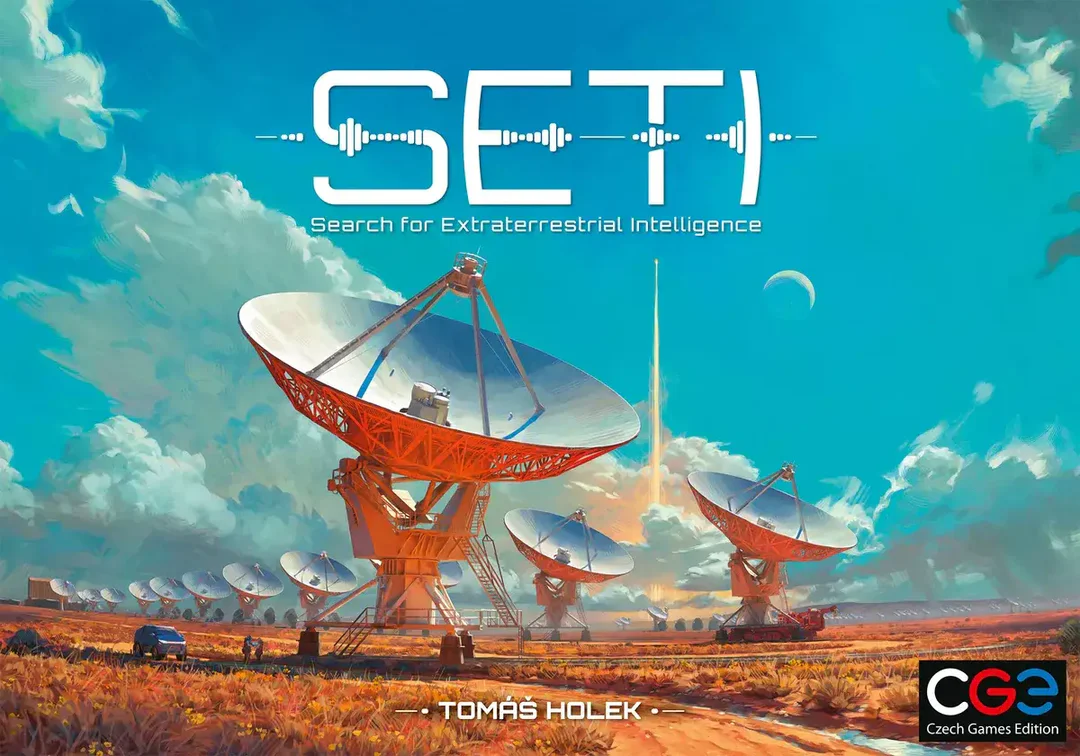
SETI Review
Scanning the Stars for the Hobby's Best Space Eurogame
Hook / First Impression
There is no shortage of games with a space theme, but there is a significant shortage of games that make space itself feel genuinely vast, uncertain, and worth exploring. SETI: Search for Extraterrestrial Intelligence, released by Mindclash Games in 2024, is the rare title that pulls it off. You are not colonising a planet or dogfighting enemy fleets. You are a research organisation pointing instruments at a mostly silent universe, following threads of data across radio frequencies and orbital mechanics, trying to build a scientific picture of something you cannot yet confirm exists.
It is a medium-heavy engine-builder with a dedicated solo mode, ambitious production, and a research structure that rewards the kind of careful, compounding decision-making that the best Eurogames live on. It arrived to significant acclaim on BoardGameGeek and has quietly become one of the most talked-about releases of its year. The question is whether the ambition translates to the table — and for the right group, the answer is a clear yes.
Overview
SETI: Search for Extraterrestrial Intelligence is a competitive engine-building game designed by Katalin Nimmerfroh and Lóránt Molnár, published by Mindclash Games in 2024. Players run rival research organisations each competing to make the most significant scientific discoveries — scanning sectors of space, launching probes, running experiments, and advancing research tracks to accumulate Victory Points before the game's final season ends.
| At a glance | |
|---|---|
| Designers | Katalin Nimmerfroh & Lóránt Molnár |
| Publisher | Mindclash Games |
| Year | 2024 |
| Players | 1–4 |
| Play time | 60–120 minutes |
| Age | 14+ |
| Weight | Medium-heavy (BGG ~3.4/5) |
| Victory condition | Most Victory Points after 4 seasons |
Components & The Setting
The Setting: Each player runs an independent scientific organisation dedicated to the search for extraterrestrial intelligence. The theme is not decorative — it is structurally load-bearing. You are scanning specific sectors of a modular star map, deploying telescope arrays to increase detection sensitivity, launching probes toward anomalous signals, and running experiments whose outcomes shift the game's central Signal Track. Every action maps to a real-world analogue of how such a search actually works: you gather data, refine instruments, follow leads, and make inferences from incomplete information. SETI is one of the most thematically integrated games in recent memory. It would be nearly impossible to reskin into a different genre without rebuilding the mechanics from scratch.
Component quality is where Mindclash sets itself apart. SETI's production is exceptional: the sector tiles are thick, double-layered cardboard with a satisfying heft; the probe miniatures are detailed and immediately evocative; the research track boards are clear and well-organised. Cards use a dense but readable layout, and the iconography — while requiring a learning period — is internally consistent once you understand the system. The central game board features a striking star map with a deep-blue aesthetic that genuinely looks like a scientific instrument panel rather than a board game.
The insert is functional but not lavish — components are organised adequately for setup without the premium feel of the components themselves. Sleeving cards is recommended for groups who play frequently, as the card stock is quality but not indestructible. Overall, for a game at its price tier, the production justifies the cost, and opening the box for the first time is a genuinely impressive experience.
How to Play
The goal is to accumulate the most Victory Points across four seasons (rounds). VPs come from multiple sources: discoveries made on the sector map, milestones reached on personal research tracks, experiment cards completed, probe launches, and end-game scoring objectives unique to each player's organisation.
Each season, players take turns selecting actions from a shared action board. The core action types are: Scan (reveal and investigate sectors on the star map), Research (advance up one of several specialised research tracks), Launch (deploy a probe toward a sector of interest), Experiment (activate cards in your personal tableau for chain effects), and Boost (acquire new cards or upgrade existing instruments).
The game's central tension is the Signal Track — a shared track that builds as players gather data. Certain events and cards push the signal stronger or weaker. When it crosses key thresholds, all players gain or lose resources, new sector sectors activate, or bonus scoring conditions trigger. No player controls the signal alone, but everyone is trying to position themselves to benefit most from its swings.
Cards form the backbone of the engine. Each card you acquire either adds a persistent ability to your tableau (activated during the Experiment action) or provides an immediate effect. Constructing a hand that chains cleanly — where each action unlocks the next — is the core puzzle of the game and the source of its most satisfying moments.
Gameplay Feel
Pacing & Tension: SETI opens with a deliberate, almost contemplative pace. The first season is largely about acquiring cards, staking early positions on the research tracks, and getting familiar with your organisation's unique strengths. It can feel slow if you are expecting immediate payoff. Seasons two and three accelerate sharply as engines ignite — suddenly you are chaining four or five actions off a single Experiment turn, flipping sectors, and watching your VP total climb faster than expected. By season four, the game reaches a focused, almost breathless tempo as everyone races to complete their final scoring objectives. The arc from quiet to explosive is deliberate and deeply satisfying.
Player Interaction is moderate and indirect. There is no trading, no direct combat, and no stealing. Interaction happens through three channels: competing for limited sectors on the star map (only one player can claim a discovery), racing for milestones on shared tracks (first to a threshold claims the bonus), and the Signal Track (which everyone pushes in different directions). This is not a confrontational game, but it is not solitaire either — reading what your opponents are building and blocking their most valuable sector before they get there is a genuine skill that separates experienced players from new ones.
Luck vs. Strategy Balance: SETI runs very light on randomness. Sector tile draws and card acquisitions introduce variance, but the game provides enough agency that skilled players consistently outperform newer ones. There is no dice. The closest equivalent to "bad luck" is drawing into a card pool that does not synergise with your current engine — but even then, cards are drafted from a visible market and players can adapt. This is about as skill-forward as medium-weight eurogames get.
Rule Overhead: The rules are dense on first read. The rulebook is thorough but long, and the iconography requires a reference sheet for the first two sessions. Plan for a 20–30 minute teach with experienced gamers and 45–60 minutes with newer players. The payoff is worth it — once the system clicks, it is elegant and consistent — but SETI is not a game you can set up cold with non-gamers.
Mechanics Deep-Dive
The Engine-Building Core
SETI's engine is built in two layers: the Research Tracks provide persistent bonuses that scale as you advance (more data from scans, cheaper probe launches, more powerful experiments), while the Card Tableau provides the chain reactions that convert those bonuses into actions. The interaction between the two is where the game lives. An engine that maxes a research track but has no cards to exploit it is inefficient; an engine built entirely on card chains without track support runs out of fuel quickly. The winning line is almost always a tight integration of both.
Research tracks cover five domains: Radio Astronomy, Optical Observation, Probe Technology, Data Analysis, and Xenobiology. Each provides a distinct advantage and feeds into a different end-game scoring condition. Specialising deeply in one track is viable; spreading across three or four is viable at higher player counts where contested milestones demand hedging. Going shallow across all five is a trap new players often fall into.
The Sector Map
The central board's modular star map is one of SETI's most interesting structural decisions. Sectors are revealed gradually — scanning a sector first reveals surface data (low VP, some resources), while deeper investigation yields discoveries (high VP, special bonuses). Players must decide whether to go wide, scanning many sectors lightly for consistent resource flow, or deep, investing heavily in a few sectors for high-value discoveries. Going deep requires committing probe actions that take several turns to pay off; going wide leaves you resource-rich but discovery-poor when scoring arrives.
The Signal Track
The Signal Track is SETI's most thematically resonant mechanism. It represents the collective weight of evidence for extraterrestrial signals — and it is controlled by no single player. Certain research milestones push it up; certain experiments push it down; certain sector discoveries flip it dramatically. When it crosses a threshold, a global event fires for everyone. Players who have positioned to benefit from an upswing (through specific cards and track bonuses) earn outsized rewards; players caught unprepared absorb the penalty.
In practice, tracking the signal and engineering threshold crossings at beneficial moments is an advanced skill that becomes increasingly important at higher player counts. It is also one of the game's most satisfying accomplishments when you pull it off.
Key Strategic Principles
- Identify your win condition by end of season one: Each organisation card gives you a unique end-game bonus. Build toward it from the first turn — waiting until season three to specialise is too late.
- Prioritise the card market: The cards available each season are the most important variable in the game. Watching what your opponents take — and what they leave — tells you more about their engine than any other signal.
- Probe early: Probes take multiple turns to reach their sectors and yield their scoring. Players who delay launching probes consistently leave VP on the table in the final season.
- Research Track milestones are first-come bonuses: The player who hits a milestone threshold first claims the premium reward; subsequent players claim lesser bonuses. In a competitive game, milestone racing is a primary source of tension.
- Manage action efficiency: SETI has a fixed number of actions per game. Every action that does not advance your engine or score directly is a loss. Boosting for a card that does not integrate with your current tableau is often worse than passing and taking a different action entirely.
Player Count Analysis
Solo — Excellent. The solo mode is one of SETI's strongest features. You play against an Automa opponent that occupies sectors and claims milestones through a card-driven system that is surprisingly unpredictable. The solo game captures roughly 90% of the full game's puzzle without the social overhead, and it is genuinely challenging at the medium and hard settings. Solo is a first-class mode, not an afterthought.
2 Players — Very good. At two players, the game is tighter and more confrontational than it might appear on paper — with only one competitor, sector blocking and milestone racing become deliberate and calculated. The board feels spacious but not sparse, and the Signal Track interaction is cleaner to read. Games run 60–75 minutes. An excellent count for players who want a focused, cerebral duel.
3 Players — The sweet spot. Three players brings enough sector competition and milestone pressure to make positioning genuinely difficult without creating the downtime concerns of a full table. Engines feel meaningfully differentiated, and Signal Track management becomes a real meta-game. Games run 75–90 minutes. This is the count most experienced players recommend.
4 Players — Great with the right group. At four players, the sector map fills quickly, milestone races are fierce, and the Signal Track swings more dramatically and unpredictably. The game is excellent at this count for groups who are all comfortable with the rules — but teach time climbs, and a player who analyses too deeply on each turn can extend the game to two hours or beyond. With an experienced and engaged group, four players is spectacular. With mixed experience levels, three is safer.
Replayability
SETI's replayability is among the strongest in its weight class. Three distinct variables shift every game: the organisation card you start with (each provides a unique ability and end-game condition), the sector map configuration (modular tiles create meaningfully different spatial puzzles), and the card market (the available research and technology cards vary every session). The combination means that no two games develop the same engine or reward the same strategy.
The organisation cards deserve particular mention. They do not simply modify your scoring — they redirect your entire strategy. Playing the Radio Astronomy specialist feels fundamentally different from playing the Probe Technology specialist, which feels different again from the Data Analysis path. With four distinct organisations in the base game and additional cards available through promotional and expansion content, the game supports dozens of plays before any sense of strategic déjà vu sets in.
Players who enjoy optimisation puzzles will find particularly deep replay value: each new combination of organisation, sector map, and card market poses a fresh question about what the optimal engine looks like in this specific configuration. The answer is rarely the same twice.
Learning Curve
Ease of teaching: Honest assessment — SETI is not easy to teach. The rulebook runs long, the iconography requires a reference sheet for the first two sessions, and the interaction between research tracks, card chains, and the Signal Track is difficult to convey without actually playing. An experienced teacher will need 25–35 minutes to cover the core rules, and important edge cases typically emerge mid-first-game. Players who prefer to learn through play rather than through upfront instruction will find SETI more comfortable; players who want to fully understand the rules before the first turn will feel pressure.
Rulebook quality: The rulebook is comprehensive and technically accurate, but structured as a reference document rather than a teaching guide. A better approach is to use the tutorial cards included in the box, which introduce mechanics incrementally over the first season — this significantly reduces first-game friction and is strongly recommended for new groups.
First-game experience: Expect a slower, exploratory first session where neither you nor your opponents are optimising efficiently. This is normal and intentional — the designers included a learning scenario for this reason. The second game, with everyone understanding what a complete engine should look like, is where SETI reveals its true quality. Reserve judgement until then.
Who It's For
Experienced gamers and eurogame enthusiasts: SETI is squarely targeted at this group and delivers at the highest level. If your shelf includes Ark Nova, Terraforming Mars, Wingspan, or Viticulture, SETI fits naturally and likely surpasses some of them in strategic depth. Players who enjoy the specific pleasure of watching an engine click into place and chain actions across a full turn will find this deeply satisfying.
Solo gamers: The solo mode is exceptional — one of the best in the medium-heavy category. If you regularly play games solo, SETI is a near-essential addition. The Automa system provides genuine challenge without requiring a second player to manage it mid-session.
Space theme enthusiasts: Few games take a real-world scientific premise this seriously and implement it this faithfully. If the actual science of SETI appeals to you — radio telescope arrays, Drake equations, Fermi paradoxes — the game will feel like a gift. The theme is not cosmetic.
Casual or gateway players: Not recommended as a first or second board game. The rules complexity and the depth of the strategic decision space will overwhelm groups who are still learning what eurogames are. Start with Catan, Ticket to Ride, or Cascadia and work up.
Comparisons: SETI sits between Ark Nova (similar card-engine depth, slightly more accessible) and Terraforming Mars (similar theme weight, less elegant action structure). For players who want less randomness than Terraforming Mars and a more integrated theme than Ark Nova, SETI is the answer. For pure engine-building with spatial puzzle elements, it has few direct competitors at its weight.
Pros & Cons
What SETI does well:
- Theme and mechanics are deeply integrated — every action maps authentically to real scientific practice, making the game feel substantive rather than superficially reskinned.
- Engine-building depth rivals the best games in the genre, with multiple viable strategic paths and genuine emergent complexity from the interaction of research tracks and card chains.
- Exceptional solo mode that provides a full-quality experience without compromise or excessive rules overhead.
- Very low randomness for its weight class — outcomes are determined almost entirely by player decisions, making wins and losses feel earned rather than arbitrary.
- Outstanding production quality, particularly the sector tiles and probe miniatures, that elevates the table presence and enhances immersion.
- High replayability through varied organisation cards, modular sector maps, and card market variance.
Where SETI struggles:
- Steep learning curve — rulebook is dense, iconography requires a reference sheet, and the first game is rarely representative of the experience the game actually delivers.
- Player interaction is mostly indirect; groups who want confrontation, negotiation, or direct player combat will find it subdued for a competitive game.
- Analysis paralysis risk at four players — the decision space is wide enough that deliberate players can significantly extend playtime, particularly in seasons three and four when engines are fully operational.
- Price point is premium — Mindclash titles command higher-than-average retail prices, and while the production justifies it, the entry cost is a meaningful barrier for some buyers.
- Not accessible to casual players — unsuitable as a gateway game and demanding enough that mixed-experience-level tables can result in very uneven games.
Expansions & Ecosystem
SETI launched as a Kickstarter project in 2023 with a significant selection of promotional and expansion content delivered to backers. The retail ecosystem is still developing as of 2026, but notable additions include:
Additional Organisation Cards
Several promotional organisation cards were distributed through the Kickstarter campaign and convention events. These expand the strategic variety significantly without adding rules overhead — each card drops into the base game seamlessly. Tracking these down second-hand is worthwhile for groups who have exhausted the base game's organisations.
Scenario Cards
The base game includes a small selection of scenario modifiers that adjust starting conditions, signal track behaviour, or sector configuration. These add replay value without requiring a separate expansion purchase and are recommended for groups on their fourth play and beyond.
Value for Money
SETI retails for approximately $65–$80 USD (€60–75 in Europe), placing it at the premium end of the hobby game market. For that price you receive a game with outstanding production quality, deep and genuinely replayable mechanics, a first-class solo mode, and a theme handled with more care and intelligence than almost any other game in its genre. For the right buyer, the value proposition is unambiguous.
- Committed eurogame hobbyist: Buy it without hesitation. The production and depth are worth every cent, and this is a game that will be on your shelf and on your table for years.
- Primarily solo player: SETI ranks among the best solo games at any weight. If solo play is part of your regular practice, this is one of the strongest investments you can make at the medium-heavy tier.
- Casual gamer who plays infrequently: The high price combined with the steep learning curve makes this a difficult recommendation. The per-session value only becomes favourable after many plays, which requires the investment of time to learn it properly.
- Gift for a gamer: Excellent choice if the recipient plays games like Terraforming Mars or Ark Nova and has not yet discovered SETI. The production quality ensures it lands impressively even before the box is opened.
Second-hand copies are increasingly available and often in excellent condition — Kickstarter backers who found the game too complex sometimes sell their copies after one or two plays. A used copy at 20–30% below retail is an excellent opportunity to acquire one of the hobby's most impressive recent releases.
Accessibility
Color blindness: SETI performs reasonably well here. Research tracks and sector tiles use colour with supporting iconography as a secondary differentiator, meaning colour-blind players can typically distinguish game states through icons alone. Player colour distinction uses standard board game palettes, and a reference card with all icons printed in black-and-white is included — a thoughtful inclusion that helps colour-blind players navigate independently.
Language dependence: Moderate. Cards contain meaningful text — effect descriptions are not purely iconographic — and a reasonable reading level is necessary to play. Card text is in English in the base retail edition; localised editions in several European languages were produced for the Kickstarter campaign. Players without strong English may find the card text a barrier.
Cognitive accessibility: SETI makes high cognitive demands: the decision space is wide, the interactions are deep, and the ability to hold a multi-turn plan in mind is necessary to play well. It is not suitable for players with significant cognitive limitations or attentional challenges. The fixed turn structure and lack of real-time pressure (all players take turns sequentially) does at least mean cognitive load is concentrated at your own turn rather than distributed across the entire session.
Physical accessibility: Components are handled comfortably by most players. Cards are standard size, tiles are large and easy to manipulate, and the probe miniatures — while charming — are small enough to be fiddly for players with limited dexterity. Card holders and a slightly raised play surface (to allow grip underneath tiles) help significantly for players with dexterity limitations.
Age range: The 14+ rating is accurate. The game's complexity makes it unsuitable for younger children except with significant adult guidance. Analytically mature teenagers who already play eurogames may engage with it comfortably from age 13.
Verdict
SETI: Search for Extraterrestrial Intelligence is the best eurogame released in 2024 and one of the finest medium-heavy games of the decade. It does something genuinely rare: it takes a real-world scientific premise and builds mechanics that are not merely evocative of it but structurally faithful to it. The engine-building is deep, the replayability is exceptional, the solo mode is first-class, and the production quality is among the best in the hobby. It does all of this while remaining accessible enough to teach in an evening — not easily, but with patience — and rewarding enough to play dozens of times without exhausting its strategic space.
Its weaknesses are real: the learning curve is steep, the interaction is indirect for players who prefer confrontation, and the price point is premium. But for the audience it is aimed at — experienced eurogame players, solo enthusiasts, and anyone who has ever looked up at the night sky and wondered — it delivers at the highest level.
Buy it if: you play games like Ark Nova, Terraforming Mars, or Viticulture and want something with more thematic depth and less randomness.
Skip it if: you are new to the hobby, prefer social negotiation games, or play infrequently enough that the learning investment won't pay off.
Play it solo if: you have never tried a solo eurogame before — SETI's solo mode is an outstanding entry point for discovering how good single-player board gaming can be.
Score Breakdown
Love board game night? Explore our tools, score calculators, and strategy guides — everything you need to play better and have more fun.
Browse All Articles →