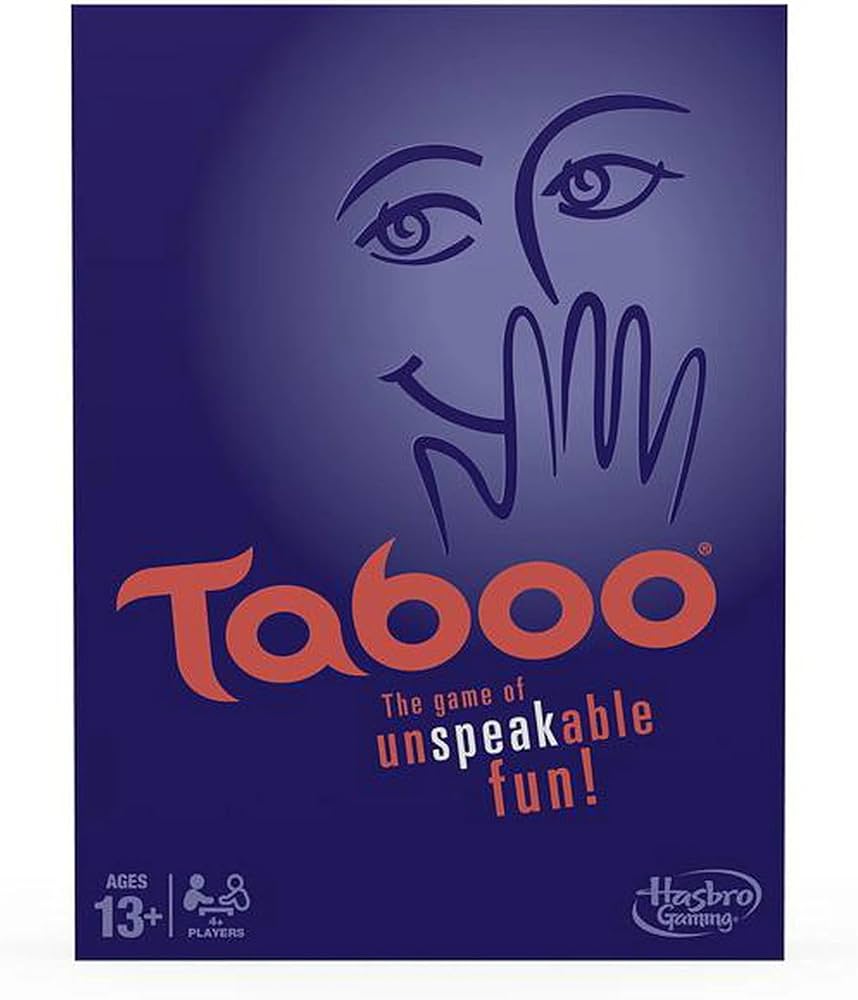
Taboo Review
Say Anything — Except the One Word That Would Actually Help
Hook / First Impression
There is a very specific type of agony that Taboo produces and no other game replicates: you know the word. You know it so completely, so obviously, that the clue you want to give is embarrassingly self-evident — and then you glance down at the card and every single word in that clue is listed as forbidden. So you pivot. You scramble. You say something so abstract that your teammate stares at you with the expression of a person watching a relative speak in tongues. Time runs out. The buzzer sounds. The other team scores a point for your failure.
And somehow, ten seconds later, you are already laughing about it.
That experience — the maddening, delightful collision of verbal constraint and social pressure — is what Taboo has been delivering since 1989. It is not a complex game. It does not want to be. It is a precision instrument for extracting noise, laughter, and mild hysteria from any group of four or more people who share a language, and after nearly four decades it remains one of the best party games ever designed.
Overview
Taboo is a party word game designed by Brian Hersch, published by Hasbro (originally Milton Bradley) in 1989. Teams compete to get their clue-giver's teammates to say a target word — but the five most obvious words for each clue are printed on the card and strictly off-limits. An opposing player watches with a buzzer, ready to penalise any slip.
| At a glance | |
|---|---|
| Designer | Brian Hersch |
| Publisher | Hasbro (Milton Bradley) |
| Year | 1989 |
| Players | 4–10 (teams of 2+) |
| Play time | 20–40 minutes |
| Age | 13+ |
| Weight | Very light (BGG ~1.1/5) |
| Victory condition | Most guessed words after agreed number of rounds |
Components & The Setting
The Setting: Taboo has no theme, no world, no fiction. Players are themselves — a group of people in a room who know things and are suddenly unable to say any of the words that would help them communicate. The game's entire premise is social and performative. You are not a character. You are just you, failing publicly, and that is entirely the point.
The physical package is straightforward: a deck of cards (500 in the standard edition), a sand timer (60 seconds), a squeaky buzzer for the opposing team's watchdog, and a card tray to hold and display the active card. Component quality is functional rather than premium — the cards are thick enough for regular use, the buzzer is deliberately obnoxious (a feature, not a bug), and the timer is standard.
Later editions have updated the card content for contemporary vocabulary and added variant modes. The core gameplay is identical across editions, so any copy will serve you well. Card freshness matters more than edition — if your deck has been played to death, a new edition is the single most impactful upgrade available.
How to Play
The goal is for your team to score more points than the opposing team by correctly guessing the target word on each card. Points are lost for using forbidden words or passing on a card without guessing it.
Play proceeds in rounds. On each turn:
- A clue-giver from the active team takes the card holder and draws the top card.
- One player from the opposing team acts as watchdog, holding the buzzer and reading along silently.
- The 60-second timer starts. The clue-giver gives verbal clues to their teammates, trying to get them to say the target word printed at the top of the card.
- The five taboo words printed below the target are forbidden — no part of them, no obvious derivations. The watchdog buzzes if any are used.
- Correctly guessed cards score +1. Buzzed cards score −1. Passed cards score 0.
- The clue-giver works through as many cards as possible before the timer expires.
Teams alternate turns. The game ends after an agreed number of rounds (usually 3 per team), and the team with the most points wins.
Gameplay Feel
Pacing & Tension: Taboo's 60-second timer is one of the most effective pressure mechanisms in all of board gaming. In the abstract, a minute is a long time. The moment the sand starts falling, it is not. Clue-givers who planned a careful, methodical approach discover that their carefully chosen words are taboo, pivot to a backup that is also taboo, and then produce something like "it's the thing — you know — when you do the thing with your hands at a concert but you're not playing" and somehow it works. The compression of language under time pressure is where Taboo lives.
Player Interaction: High, sustained, and exclusively positive in tone. Teams are competing but the real drama is within the active clue-giver and their teammates — the moment of agonised eye contact, the increasingly abstract circumlocution, the teammate who shouts sixteen wrong answers before landing on the right one. The opposing team's watchdog role keeps them engaged even when their turn is over, and the buzzer gives them a small, satisfying piece of authority over the active team's fate.
Luck vs. Strategy Balance: The card draw is random, which means some cards are easy and some are nearly impossible regardless of skill. A clue-giver who pulls "SAXOPHONE" without being able to say "instrument," "jazz," "music," "brass," or "blow" is facing a meaningfully harder task than one who pulls "CAT" with cat-adjacent taboos. Skilled clue-givers mitigate this through lateral thinking — angle of approach, analogy, rhyme, partial spelling, sound-alikes — but luck in the draw is real. Over a full game it balances out.
Rule Overhead: Near-zero. The concept is teachable in one sentence: "Say the word at the top without using any of the five words below it." Every edge case — can you spell? can you use rhymes? — is a house-rule decision that most tables make once and never revisit. New players are fully functional within thirty seconds of being taught.
Mechanics Deep-Dive
The Constraint Engine
Taboo's brilliance lies in a mechanism that designers call constrained clue-giving: it forces you off your most natural communication path and into creative territory you would never have found otherwise. The five taboo words are never arbitrary — they are the five words you would most instinctively reach for, identified in advance by the card designers. Removing them does not just make the game harder; it makes it funnier, more revealing, and more dependent on the relationship between clue-giver and guesser.
Pairs and teams that know each other well develop shorthand that can seem almost psychic to observers. A clue-giver who knows their teammate loves a specific TV show, band, or shared experience can build clues from that shared reference library entirely invisible to strangers. This is the game's hidden depth: it is not just a word game, it is a social archaeology exercise that rewards intimate knowledge of your teammates.
The Watchdog Mechanism
Assigning an opposing player as referee rather than a neutral third party is a subtle but important design decision. It keeps all players engaged at all times — there is no dead time in Taboo, even for the non-guessing team. The watchdog role also generates its own micro-drama: the moment the watchdog slams the buzzer creates an immediate, visceral interruption that almost always produces a reaction from the clue-giver, and that reaction is usually the funniest moment of the card.
Advanced Clue Strategies
Experienced clue-givers develop a repertoire of approaches for hard cards:
- Rhyme framing: "Rhymes with ___" bypasses taboos entirely and works brilliantly for one-syllable targets. "Rhymes with 'gate'" for LATE is faster than any conventional clue.
- Category elimination: "Type of sport, not football, not basketball, you use a racket but it's not tennis" narrows to a small set quickly without touching taboo words.
- Famous association: Specific proper nouns — a celebrity, a film, a brand — are almost never taboo and provide extremely precise anchors. "The car company from Stuttgart" for PORSCHE is often cleaner than any generic clue.
- Opposite + qualifier: "The opposite of fast, but not the speed, I mean being late to things as a personality trait" combines antonym with narrowing clause efficiently.
- Partial spelling: Only valid if your table allows it, but effective on words where sound doesn't help — "starts with P-H" opens phonetic territory without naming the word.
Player Count Analysis
Solo or 2 Players — Not supported. Taboo requires opposing teams and a watchdog role. Two players can improvise a cooperative speed-guessing variant, but this is not the game and it loses essentially all of what makes Taboo worth playing.
4 Players (2v2) — Functional, but intimate. Two-on-two games work and can be intense — every point matters and there is nowhere to hide. The downside is that with only one guesser per turn, the chaos and cross-talk energy that makes the game feel like a party is absent. Better for competitive play than social play. The watchdog role also feels more adversarial with small teams, which can occasionally shade into friction rather than fun.
6 Players (3v3) — The sweet spot. Three clue-givers guessing simultaneously creates the overlapping shouts and group momentum that makes Taboo electric. The watchdog is still engaged, the active team has genuine energy, and games move quickly enough that everyone gets multiple turns. Six players is our recommended count for the most consistently fun experience.
8–10 Players — Party mode. Larger groups produce louder, messier, more chaotic games. The multi-guesser pile-on when five people are shouting different wrong answers simultaneously is a specific kind of comedy that only happens at high player counts. The tradeoff is that individual turns become less frequent and quieter players can fade into the background. With an engaged, vocal group, eight is excellent. With a mixed-energy group, stick to six.
Odd numbers — Split unevenly. Taboo plays fine with teams of unequal size (e.g., 3v2) since each team gets the same number of clue-giver turns. Larger teams have more guessers per turn, which is a mild advantage — compensate by giving the smaller team an extra card per round if needed.
Replayability
Taboo's replayability is primarily limited by card exhaustion rather than mechanical fatigue. The core experience — constrained clue-giving under time pressure — does not wear out, because the skill ceiling is genuine and the social dynamic changes every time you change teams or players. What does wear out, eventually, is the card deck.
The standard edition ships with 500 double-sided cards (1,000 unique word challenges). For a game played once a week, that deck lasts roughly two to three years of play before cards begin to recur in memorable ways. When that happens, a new edition or an expansion deck refreshes the game completely. The mechanical experience remains compelling indefinitely; only the content ages.
Variant rules — playing with only category clues, playing with one-word clues only, playing silent-gesture mode — extend the experience further for groups who want variety without buying new cards. These variants change the clue-giving challenge significantly while leaving the core scoring and timer structure intact.
Learning Curve
Ease of teaching: Taboo may be the single fastest game to explain in the hobby. One sentence covers the core rule. One demonstration card covers the edge cases. A new player is fully functional before their first turn, and any uncertainty resolves itself through play within thirty seconds. It is the ideal game for mixed groups where some players are experienced tabletop gamers and some have never played a board game in their adult life.
Rulebook quality: The rulebook is brief and clear. The main ambiguity — what counts as a taboo word derivative — is addressed but not exhaustively resolved, which is why pre-game house-rule alignment is recommended. Everything else is stated plainly and requires no interpretation.
First-game experience: Universally positive. There are no components to misread, no setup errors possible, and the first awkward buzzed card — someone instinctively saying the taboo word, then realising mid-syllable, then getting buzzed anyway — reliably produces the first shared laugh of the session. The game explains its own appeal within its first sixty seconds of play.
Who It's For
Mixed groups and non-gamers: Taboo's highest-value use case is exactly this. It requires no prior game knowledge, produces immediately legible comedy, and operates on social and linguistic skills that everyone already possesses. It is one of a handful of games that works for a group composed entirely of people who "don't play board games."
Language learners: A quietly excellent tool for advanced language learners who need to practice circumlocution and lateral vocabulary access under time pressure. The constraint mechanic forces exactly the kind of language flexibility that advanced fluency requires. We have seen it used effectively in language exchange programs and as a classroom warm-up.
Team-building contexts: The watchdog role, the team dynamic, and the revealed assumptions about shared knowledge make Taboo surprisingly effective in professional contexts — not as a productivity tool, but as a genuine ice-breaker that surfaces how differently people think about the same concepts.
Hobbyist gamers: Use it as a reliable session opener with mixed groups rather than as the main event with a group of committed hobbyists. Experienced gamers will find the mechanical depth shallow compared to Codenames or Just One, but no other game in the genre produces Taboo's specific brand of real-time chaos and physical comedy (the buzzer, the panicked expressions, the frantic hand gestures that are immediately called out as illegal).
Comparisons: Codenames offers more strategy — one clue must cover multiple cards, creating genuine deduction puzzles — but sacrifices the real-time pressure and physical performance that make Taboo feel alive. Just One (Spiel des Jahres 2019) is cooperative and more elegant, but calmer and less chaotic. Password and Catchphrase are spiritual predecessors with less mechanical polish. Taboo sits in a unique position as the loudest, fastest, most physically expressive word game in the hobby.
Pros & Cons
What Taboo does brilliantly:
- Zero barrier to entry — explained in one sentence, playable by anyone who speaks the language.
- The constraint mechanic forces creative language use that produces genuinely unexpected and funny moments no other game replicates.
- The 60-second timer creates real, visceral pressure without any external stakes — purely mechanical tension that feels genuine every time.
- The buzzer is physical comedy hardware. The sound alone produces a Pavlovian response that rewards the watchdog role and keeps non-active players fully engaged.
- Works at any table size from 4 to 10, with the experience improving as player count rises up to about 8.
- Reveals something true about how people think and what they share — pairs and close friends consistently outperform strangers, making the game a genuine social discovery tool.
- Replayable for years before card exhaustion becomes a real issue; new editions and expansion packs are widely available.
Where Taboo struggles:
- Cannot be played with fewer than 4 players — it structurally requires opposing teams and a watchdog.
- Card draw variance is real — some cards are trivially easy, some are nearly impossible, and the distribution within a single turn is entirely random. A clue-giver can get a run of brutal cards through no fault of their own.
- The derivative rule ambiguity creates recurring arguments that the rulebook does not fully resolve. House-rule alignment is essential but often forgotten.
- Fully language-dependent — there is no version of Taboo playable across language barriers, which limits its use in multilingual groups.
- The card deck ages. A copy played twice weekly for two years will begin recycling familiar cards, requiring a new edition to restore freshness.
- Uneven energy groups suffer — the game requires vocal, willing participation from clue-givers and guessers. A quiet or reluctant player in a small team can deflate the entire dynamic for their teammates.
Expansions & Ecosystem
Taboo's ecosystem is built around card refreshment rather than mechanical expansion. No edition changes the rules substantially; they update the word lists to reflect contemporary language, culture, and difficulty calibration.
Taboo: The Game (2022 Edition) — Updated word list, refined taboo selections ★★★★☆
The most recent standard edition with fully updated cards covering contemporary vocabulary, current pop culture, and recalibrated difficulty. If your existing copy is more than five years old, this is the only upgrade worth buying — the gameplay is identical, but fresh cards restore full replayability.
Taboo: Junior — Family-friendly word list, ages 8+ ★★★☆☆
Replaces adult vocabulary and cultural references with age-appropriate content. Works well for family play with mixed adult-child groups, though the challenge ceiling drops noticeably. Adults will find it too easy; children will find it appropriately challenging. Best used when the youngest players at the table are in the 8–12 range and would be excluded by the standard deck.
Unofficial digital versions — App and browser implementations ★★★☆☆
Several well-made app implementations allow Taboo play without the physical game — useful for travel or spontaneous play. The mechanical experience is faithful, but the loss of the physical buzzer and the card-holder prop is more significant than it sounds. The buzzer is not decorative. App versions work in a pinch; they are not a replacement for the physical game.
Buyer's Guide
| Edition | Best For | Priority |
|---|---|---|
| Standard (2022) | Adults and teens, primary edition | 🥇 #1 — buy this |
| Junior | Family play with children 8–12 | Only if needed for age range |
| App version | Travel and spontaneous play | Backup only |
Value for Money
Taboo retails for approximately $25–$35 USD (€22–30 in Europe), putting it at the lower-mid range of the hobby. For a game that plays 4–10 people, requires no setup, and delivers a complete experience in under 40 minutes, the per-session cost across its useful lifespan is essentially negligible.
- Party hosts and social gamers: One of the highest-ROI party game purchases available. A single copy will serve any group for years without mechanical obsolescence.
- Gift buyers: An excellent choice for adults who do not consider themselves board gamers — accessible, immediately fun, and widely familiar enough that it requires no explanation of what board games are.
- Families: Strong pick for families with teenagers and adults. The Junior edition is available if younger children need to participate, but the standard game is appropriate from about age 13 upward.
- Hobbyist gamers: Worth owning at this price point for mixed-group sessions, even if you primarily play heavier games. It does something no other word game does as well, and it costs less than a restaurant meal.
Accessibility
Language dependence: Total. Taboo is entirely about verbal language production and comprehension in the language of the card deck. It cannot be played across language barriers, and non-native speakers face a meaningful disadvantage on culturally specific cards. The Junior edition mitigates this slightly through simpler vocabulary, but the game's core requirement is fluent verbal production under time pressure. For multilingual groups, Dixit or Concept are better-suited alternatives.
Color blindness: Not applicable — the game has no color-coded components. Card backs may vary by edition, but all gameplay information is in text.
Hearing impairment: The buzzer — both as a sound and as a physical press — can be adapted. Players with hearing impairment can participate fully in most roles; the watchdog role benefits from the physical buzzer press as a visible signal, which works regardless of hearing. Clue-giving in a fully deaf group would require a signed-language variant and is not officially supported.
Physical accessibility: Excellent. The game requires only verbal production and card-holding. A card stand or holder accommodates players who cannot hold the card tray. No dexterity, movement, or physical coordination is required beyond speaking.
Cognitive accessibility: Moderate. The constraint mechanic requires working memory (remembering which words are taboo while generating clues in real time under time pressure), which may be challenging for some players. The Junior edition's simpler vocabulary helps, but the dual-task demand — clue generation plus taboo suppression — is inherently cognitively loading. Players who need extra processing time will struggle with the 60-second timer regardless of vocabulary level.
Age range: The 13+ rating is accurate. Adults aged 70+ typically play well if comfortable with contemporary vocabulary. The game skews toward shared cultural reference, which can create mild generational gaps on pop-culture cards — mix teams by age to distribute this evenly.
Verdict
Taboo is 37 years old and it still has not been improved upon for what it does. The constrained clue-giving format under time pressure, the physical buzzer, the watchdog adversary — these elements combine into an experience that is immediately accessible, genuinely funny, and surprisingly revealing of how people think and communicate. It is not a game for people who want strategic depth or consistent skill expression. It is a game for people who want to be in a room full of laughter within four minutes of opening the box.
Its weaknesses are structural and minor: it needs four people minimum, it is entirely language-dependent, and the card deck eventually ages. None of these are problems if you understand what you are buying. The game costs less than most meals out, lasts for years, and works for virtually any group of adults who share a language.
Buy it if: you want a no-setup, high-energy party game that works for any group of four or more English speakers, produces consistent laughs, and gets better rather than worse as teams play together over time.
Skip it if: your group is smaller than four, plays across language barriers, or wants strategic depth and consistent skill expression in their party games.
Replace it when: the card deck has been played to the point where cards recur — that is the only meaningful reason to buy a new edition. Everything else about the game is as good as it was in 1989.
Score Breakdown
Love board game night? Explore our tools, score calculators, and strategy guides — everything you need to play better and have more fun.
Browse All Articles →