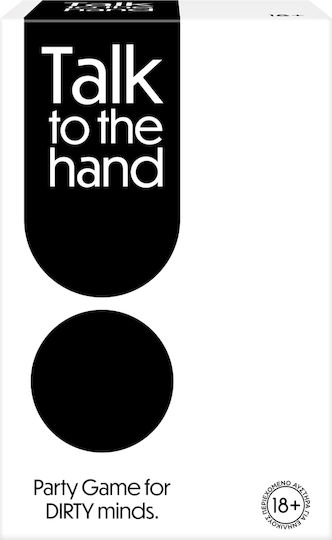
Talk to the Hand Review
The Bluffing Card Game That Turns Your Hand Into a Poker Face
Hook / First Impression
Talk to the Hand is the sort of game that can be explained in one sentence and produces arguments for the next hour. Deal cards, play them face-down to "hands" in the centre of the table, then try to collect sets — but you can lie about what you're playing, and other players can call you out. If they're right, you lose the cards. If they're wrong, they do. The concept is so immediately legible that most groups are bluffing competently within two minutes of their first turn.
The game sits in a lineage of bluffing card games that includes Coup, Liar's Dice, and Cheat — games built on the idea that the most interesting decisions happen when you can't fully trust what you're being told. Talk to the Hand strips that concept down to a tight card game with almost no setup and almost no downtime, and the result is one of the more reliably entertaining light games you can pull out after dinner.
Overview
Talk to the Hand is a bluffing and set-collection card game in which players secretly play cards to shared "hand" piles in the centre of the table, claiming what they've played — truthfully or not. Challenges, denials, and the slow accumulation of evidence make every round a layered exercise in reading people rather than reading cards.
| At a glance | |
|---|---|
| Publisher | Various (widely licensed) |
| Players | 3–6 |
| Play time | 20–35 minutes |
| Age | 10+ |
| Weight | Light (BGG ~1.5/5) |
| Victory condition | Collect the most complete sets without being caught bluffing |
Components & The Setting
The Setting: There is no narrative frame in Talk to the Hand. The theme — to the extent there is one — is purely social: you are playing a card game against people you probably know, and you are absolutely going to lie to their faces. The name itself functions as the theme: "talk to the hand" as in, your denial doesn't matter, I'm challenging you anyway. It is the rare game where the box art communicates the exact tone of the experience inside it.
Components are minimal and appropriately so. A deck of cards, a score tracker or paper, and the players' willingness to look each other in the eye while lying — that is the entire material requirement. The cards themselves are cleanly designed, easy to distinguish by type, and sturdy enough for a game that involves a lot of picking up, putting down, and flipping. There are no boards, no tokens, no setup beyond shuffling and dealing. For a social game that lives and dies by the interaction at the table rather than the components in the box, this is exactly the right decision.
How to Play
The goal is to collect the most complete sets of cards by the end of the game. Sets are assembled in shared "hand" piles at the centre of the table — but you never know for certain what other players have contributed to them, because every play is made face-down with only a verbal declaration to identify it.
On a player's turn:
- Play one or more cards face-down to a hand pile in the centre of the table, declaring what you are playing (e.g., "two red cards").
- Other players may challenge your declaration. If challenged, reveal the cards:
- If you were telling the truth, the challenger takes a penalty — typically losing cards or points.
- If you were lying, you take the penalty.
- If unchallenged, the cards remain face-down in the pile and your claim stands.
- When a hand pile is complete (the required set is assembled, truthfully or otherwise), the player who completed it claims the set for scoring.
The twist — and the engine that drives all the interesting decisions — is that a completed hand is claimed based on what was declared, not what is actually in the pile. Which means a bluffer who never gets caught can claim sets they never contributed to, and a cautious honest player can watch their truthful plays get attributed to someone else's deception.
Gameplay Feel
Pacing & Tension: Talk to the Hand runs fast between turns but slow within them. The actual mechanics — play cards, declare, challenge or not — take seconds. What extends each turn is the social moment: the pause before a challenge, the poker face being held, the player who says "really?" and stares at the declarer for just slightly too long. The game is almost entirely atmosphere. When it's working well, the table is loud, accusatory, and laughing. When it's working poorly — when nobody bluffs, or nobody challenges — it's mechanical and flat.
Player Interaction: Essentially total. Every turn affects everyone at the table, because every unchallenged bluff shifts the score dynamics, and every successful challenge is a public humiliation that the whole table reacts to. There is no solitaire corner of this game where you can quietly build your engine while others fight. Everything is visible, reactive, and social.
Luck vs. Strategy Balance: The cards you're dealt introduce genuine luck — a hand full of cards that don't match what's needed in the current piles forces more bluffing than you might want. But the decision of whether to bluff, what to claim, and when to challenge is pure read-the-room strategy. The best players are not those with the best cards; they're the ones who've figured out which player at the table challenges on instinct rather than evidence, and how to exploit that.
Rule Overhead: Very low. A new player can be playing correctly within one full round of observation. The only concepts that require a moment to internalize are what constitutes a valid challenge and how set completion is scored. Both become second nature within five minutes.
Mechanics Deep-Dive
The Information Asymmetry Problem
What makes Talk to the Hand mechanically distinct from simpler bluffing games is that the information is layered, not binary. It's not just "are they lying or not?" — it's "are they lying, and if so, what are they actually holding, and what does that mean for which set gets completed next, and how does that affect my own score?" The face-down pile is a shared ambiguity that everyone is contributing to and interpreting simultaneously.
A player who has been perfectly honest for four turns has built social capital. Their fifth declaration is trusted almost automatically. A player who got caught bluffing twice is challenged preemptively, even when playing honestly. The game builds a reputation economy in real time, and managing your reputation — deliberately establishing honesty to make a future bluff land harder — is the deepest strategic layer the game offers.
The Challenge Economy
Challenges in Talk to the Hand carry a cost. A failed challenge is a penalty; too many failed challenges and you've spent resources proving other players are honest. This creates a natural throttle on challenge frequency — players don't call every declaration, they save challenges for moments when the odds feel right or the stakes are high.
- High-value challenges: When a player declares the exact card needed to complete a high-scoring set. If they're lying, the payoff of the challenge is maximum; if they're honest, you've at least established that they had the card.
- Reputation challenges: When a player has a consistent bluffing history and you need to publicly reset the table's trust in them, even at some personal cost.
- Set-completion challenges: Blocking a set completion by challenging the final declaration — the highest-stakes moment in any given round.
Player Count Analysis
3 Players — Works, but thin. Three players is functional but exposes the game's group-dependency most clearly. With only three players, patterns become obvious quickly — you know which of two players played into a given pile, and the bluffing dynamic loses some of its ambiguity. Challenges feel like personal accusations rather than probability assessments, which can make the social dynamic uncomfortable rather than playful. Playable; not ideal.
4 Players — The minimum sweet spot. Four players is where the game's ambiguity properly activates. Multiple players contributing to each pile means challenges require genuine inference rather than process of elimination. The social energy is competitive without being claustrophobic. For groups that can only field four, this is an entirely satisfying experience.
5 Players — Excellent. Five players is where Talk to the Hand is most alive. The ambiguity in pile composition is high, reputations at the table are more varied, and the challenge decisions become genuinely complex probability exercises. Sessions stay under thirty-five minutes with five engaged players. The strongly recommended count.
6 Players — Fast and chaotic. Six players accelerates the game and increases chaos in the best way. Tracking who has played what becomes difficult, bluffs land more easily, and the social theatre of the table is at its loudest. The game can feel slightly unwieldy with six less-experienced players, but for a group that's played together before, six-player Talk to the Hand is an excellent party experience.
Replayability
Talk to the Hand's replay value comes almost entirely from the players, not the cards. Each session is a fresh read on the specific people at the table that evening — their tells, their bluffing habits, how tired they are, whether they challenged successfully last game and have grown overconfident. A game played with the same group ten times has ten distinct dynamics, because people change, patterns shift, and everyone is reading everyone else's reading of everyone else.
This makes the replayability essentially infinite with a good group and potentially exhausted quickly with a static one. If the people around the table never adjust their strategies — the person who always bluffs is always called, the person who never bluffs is always believed — the game flattens into predictability. But for groups that engage with the metagame, it remains fresh indefinitely.
The cards themselves have limited built-in variety. There are no modular sets, no variable power cards, no expansions that change the strategic landscape. What you see in the box is what the game is. That is enough — the variety lives in the people — but players looking for mechanical novelty across sessions will not find it here.
Learning Curve
Ease of teaching: Exceptional. The rules are genuinely learnable in under two minutes: "play cards face-down, say what they are, challenge or don't, penalty for the wrong party." The scoring for set collection takes a single visual demonstration to grasp. Most new players are making real bluffing decisions — not just reflex calls — by their second turn.
Rulebook quality: Clear and brief, as a game of this weight demands. Nothing in the rules is ambiguous once read, and the worked examples cover the most common edge cases (what happens on a tie, how challenges work when multiple players want to call simultaneously). The rulebook earns its size.
First-game experience: Reliably entertaining, with one caveat. Players who have no reference for social deduction or bluffing games may spend their first game playing honestly while watching others bluff freely — and losing as a result. The lesson is learned by game two. It's worth flagging to new players before the first game that lying is not just permitted, it's the point.
Who It's For
Social groups and party players: Talk to the Hand was built for exactly this context. A group that enjoys reading each other, teasing each other, and loudly accusing each other of cheating will find it endlessly entertaining. The game rewards social intelligence more than strategic depth, which makes it accessible to non-gamers who happen to be socially perceptive.
Bluffing game enthusiasts: If you love Coup, Liar's Dice, or Skull, Talk to the Hand is a natural addition. It occupies a slightly different niche — more card-game structure, less pure deduction — but the underlying pleasure is identical. Worth owning both.
Casual and non-gamer groups: This is one of the more accessible social deduction games available precisely because it does not require any prior game literacy. The concept of bluffing is universal; the concept of challenging a bluff is intuitive. Non-gamers engage immediately.
Heavy gamers: Talk to the Hand functions well as a filler between heavier games or as a session-opener for a mixed group. Its strategic ceiling is genuinely low, but its social ceiling is high — and for a thirty-minute social warm-up before something meatier, it does exactly what it needs to do.
Not for: Groups where social harmony is fragile, where direct accusation creates real discomfort, or where competitive instincts make bluff-calling feel personal rather than playful. The game requires a table that can laugh about being caught lying. If yours can't, play something else.
Comparisons: Coup is tighter, faster, and more ruthless — the natural next step for players who want deeper bluffing strategy in a shorter run time. Cockroach Poker is purely about reading tells with no set-collection element. Skull reduces the concept to its absolute minimum. Talk to the Hand occupies the middle of this spectrum — more structure than Skull, more accessibility than Coup — and is often the right entry point into bluffing games for a group that hasn't played them before.
Pros & Cons
What Talk to the Hand does well:
- Teaches bluffing mechanics — one of the most socially engaging mechanisms in the hobby — in the most accessible possible form.
- Zero setup, thirty-minute play time, rules in under two minutes: the ideal filler profile.
- Social intelligence outperforms card-game expertise, making it genuinely inclusive for non-gamers.
- Every session plays differently based on who's at the table and what reputations have developed — natural session-to-session variety.
- Works equally well as a standalone game or as a gateway into deeper social deduction titles.
- Excellent at 5–6 players, where most card games start to drag.
Where Talk to the Hand struggles:
- Entirely group-dependent: a table that won't engage with the bluffing produces a flat, mechanical experience that no rule change can rescue.
- Strategic ceiling is low. Experienced players who want a metagame deeper than reputation management will outgrow it quickly.
- No expansions or mechanical variety — what's in the box is the complete game.
- Three players is a noticeably weaker experience; the game really needs four or more.
- Can become repetitive with the same group of players who have fully mapped each other's tells — the metagame stagnates once everyone knows everything about everyone.
Expansions & Ecosystem
Talk to the Hand has no official expansions or standalone variants. The game is a self-contained experience, and given that its replay value derives from the players rather than the components, the absence of expansions is less of a limitation here than it would be for a mechanically richer game. The box you buy is the full game, and that is enough for most groups.
For players who love the bluffing core and want more mechanical structure, the natural progression is:
- Codenames — team-based word deduction with more structure and a longer run time. Different mechanism, same social intelligence premium.
- Coup — faster, sharper, more ruthless bluffing game with player elimination and a shorter arc. The closest relative in the hobby.
- Skull — the most minimal bluffing game imaginable: pure psychological poker with no cards, only discs. For groups who want the feeling without any game scaffolding at all.
Value for Money
Talk to the Hand retails at a low price point — typically $12–$18 USD depending on edition — which makes it one of the more accessible social game purchases available. For a game that can fill thirty minutes between heavier titles, accommodate six players without drag, and produce genuine laugh-out-loud moments across many sessions, the value proposition is strong.
The caveat is that its value is entirely a function of group fit. The right group will play this dozens of times and quote it at each other between sessions. The wrong group will play it once, find it awkward, and put it on a shelf. Given that social dynamics are hard to predict in advance, Talk to the Hand is best bought after you've tried it — or on the recommendation of someone who knows your group well.
- Gift for a social group: Excellent if you know they can bluff each other comfortably. Not a safe blind gift for groups with fragile social dynamics.
- Adding to an existing collection: The right call if you own heavier games and need a reliably fast, social filler that non-gamers can join without a learning curve.
- First game purchase: A reasonable entry point if the group already plays social deduction games or party games with a competitive edge.
Accessibility
Color differentiation: Card types are distinguished by both color and iconography, making the game fully playable for players with color vision deficiencies without modification.
Language dependence: Minimal. The cards use icons and numbers rather than text. The declarations made during play are verbal and informal — there is no required script, and players describe their plays in whatever language the table shares. Fully playable across language groups with a brief oral explanation of the rules.
Cognitive accessibility: Strong. The decisions in Talk to the Hand are socially complex but mechanically simple. Players who find abstract strategy difficult can engage fully through social intuition — reading faces, trusting instincts, and challenging when something feels wrong. No calculation or memory of complex rule interactions is required. The game meets players where they are.
Physical accessibility: Standard card handling is the only physical requirement. Players with dexterity limitations can participate fully with minor accommodation (such as placing cards face-down rather than sliding them). No fine motor precision is required beyond basic card management.
Social accessibility: This is the one real accessibility limitation of Talk to the Hand. The game is fundamentally about social pressure — lying to people you know, being called out publicly, and managing how you're perceived around the table. Players who experience high social anxiety, who find lying distressing, or who are uncomfortable with direct interpersonal accusation will not enjoy the game and should not be pushed into it. It requires a table where everyone is genuinely comfortable with playful deception.
Verdict
Talk to the Hand is one of the cleanest bluffing games available at its price point — a game that nails its narrow brief almost completely. It teaches deception and challenge mechanics with almost no rules overhead, plays in under thirty minutes, scales beautifully to six players, and produces reliably entertaining social moments that keep groups coming back to it. It knows exactly what it is and what it isn't, and that self-awareness is a design virtue.
What it isn't, however, is a game for every table. Its ceiling is low for players who want strategic depth, its floor is group-dependent in ways that most card games are not, and the base card set offers no mechanical variety across sessions. For the right group — social, comfortable with bluffing, interested in reading each other rather than reading rule books — it is an excellent twenty-five-minute investment. For a mixed or uncertain group, try before you buy.
Buy it if: your game nights include four to six people who enjoy social deduction, bluffing games, or simply the pleasure of lying convincingly to people they know. It earns its place on a shelf dominated by heavier games as the reliable social filler that non-gamer guests can jump into immediately.
Skip it if: you play exclusively with two or three people, or your group finds direct accusation uncomfortable. The game cannot overcome either of those constraints.
Score Breakdown
Love board game night? Explore our tools, score calculators, and strategy guides — everything you need to play better and have more fun.
Browse All Articles →