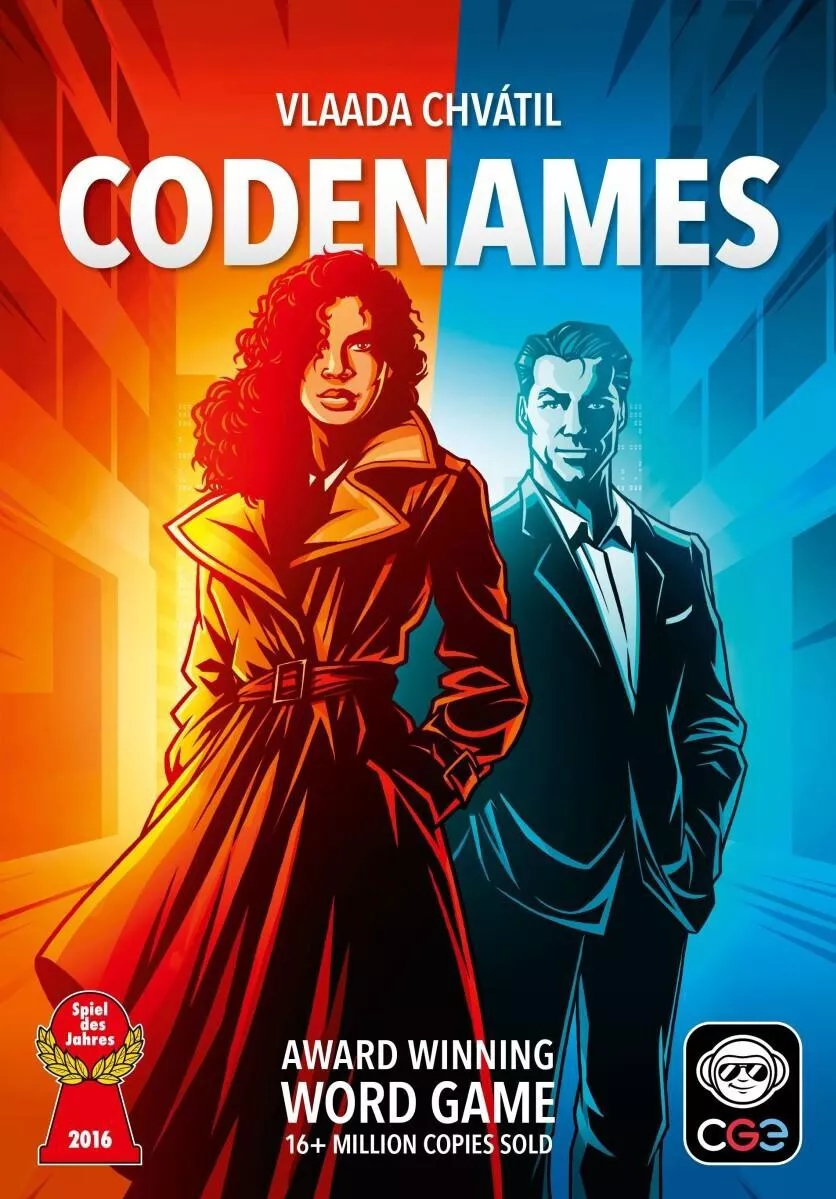
Codenames Review
One Word. Many Agents. Zero Room for Error.
Hook / First Impression
In 2015, Vlaada Chvátil — the designer behind Galaxy Trucker, Mage Knight, and a catalogue of some of the most complex games in the hobby — published a 25-card word game that you can explain in ninety seconds. It won the Spiel des Jahres. It sold millions of copies across dozens of language editions. A decade later it still appears on nearly every "best party games" list ever written, and for a game this simple, that longevity is worth examining carefully.
Codenames earns its reputation not through complexity but through an elegant tension: you have a grid of 25 words, some belong to your team, and you must connect as many as possible with a single one-word clue. That constraint — one word, linking multiple targets, avoiding the assassin — turns language itself into a puzzle. The moments of collective understanding when a team shouts the right word, then the right word again, then the right word a third time on a single clue are the moments that built this game's reputation. They are genuinely unlike anything else in gaming.
Overview
Codenames is a word-association party game designed by Vlaada Chvátil, published by Czech Games Edition in 2015. Two teams compete to identify their agents — represented by codename words on a 5×5 grid — using single-word clues given by their Spymaster. First team to correctly identify all their agents wins. Contact the assassin and you lose instantly.
| At a glance | |
|---|---|
| Designer | Vlaada Chvátil |
| Publisher | Czech Games Edition |
| Year | 2015 |
| Players | 2–8+ (best 4–8) |
| Play time | 15–20 minutes |
| Age | 14+ |
| Weight | Light-medium (BGG ~1.3/5) |
| Victory condition | First team to identify all their agents |
Components & The Setting
The Setting: Players are intelligence operatives — two rival spy networks competing to contact all their field agents before the other side does. The Spymaster knows which words on the grid are their agents, which belong to the enemy, which are bystanders, and which is the assassin that ends the game immediately. Field operatives hear one clue and must guess correctly without being able to see the Spymaster's map. The spy theme is thin but elegantly appropriate — it frames secrecy, misdirection, and coded communication as the mechanical core without ever getting in the way of play.
Component quality is clean and functional. The 200 double-sided codename cards give a vocabulary of 400 words; the 40 key cards determine which words belong to which team in each game; 8 agent cards per team and one assassin card complete the set. The card stock is adequate for repeated handling, and the compact box fits easily on any shelf or in a bag. The standee screen for the Spymaster — who alone can see the key card — is a small but well-designed touch that creates a visible moment of ceremony at the start of each round. Nothing in the box is premium, but nothing needs to be. This is a word game; the components exist to support the language, not to impress on their own.
How to Play
Divide into two teams. Each team selects one player as their Spymaster; the others are Field Operatives. Lay out 25 codename cards in a 5×5 grid. Both Spymasters take the same key card, which reveals which words belong to Red agents, which to Blue, which are innocent bystanders, and which is the single Assassin. The team shown on the key card goes first and has one extra agent to contact.
On each turn, the active Spymaster gives exactly one word and one number. The word is a clue; the number indicates how many codename cards on the grid it connects to. Field operatives then discuss and guess, touching one card at a time. The Spymaster reveals whether each guess was their agent (leave it face-up in team colour), the opposing team's agent (bad news — that card goes to the enemy), an innocent bystander (turn ends), or the Assassin (instant game loss). The team may keep guessing as long as they are correct, but they stop after using one more guess than the number given.
Gameplay Feel
Pacing & Tension: Codenames runs at a consistently high energy level. The Spymaster's thinking time creates a quiet moment of visible concentration that the table respects instinctively — everyone knows that person is doing something hard — followed by a clue that unlocks a burst of debate, laughter, or anguished groaning. The pacing is nearly perfect for a group game: tight turns, immediate feedback, and a score display (the remaining agent cards) that makes the race feel tangible at every moment.
Player Interaction is team-internal rather than adversarial. Field operatives debate openly; Spymasters watch in enforced silence. This asymmetry creates a specific comedy: Spymasters visibly suffering as their team confidently heads toward the wrong card. The cross-table rivalry is low-conflict by design — you win by being smarter, not by attacking the other side directly.
Luck vs. Strategy Balance: Meaningfully skill-weighted, more so than most party games. The starting word grid is random, but the Spymaster's ability to find connections, anticipate misreadings, and manage the assassin's proximity is a genuine and learnable skill. Experienced Spymasters consistently give better clues than beginners — this is one of the rare party games where the best player at the table has a real impact on outcomes, without making the game feel competitive in an unpleasant way.
Rule Overhead: Minimal. The rules have two gotchas worth knowing — the Spymaster cannot give a clue that is a form of any word currently visible on the grid, and cannot use proper nouns (in standard play) — but both feel natural once understood. A new player is fully functional by the end of round one without having read anything in advance.
Mechanics Deep-Dive
The One-Clue Constraint
The game's entire mechanical identity rests on the Spymaster's constraint: one word, which must be a genuine association, and a number. This is harder than it sounds. The grid will contain your agents but also enemy agents, bystanders, and one assassin — all of which share the semantic space that your clue must navigate. A clue that elegantly connects three of your agents is worthless if it also resonates with the assassin. Managing this semantic minefield under time pressure, in silence while your team debates loudly, is the game's deepest skill.
The field operatives' side is equally rich. Reading the Spymaster's mental model — not just what the clue means literally, but what this particular Spymaster considers an association — is its own puzzle. Regular partners develop shorthand; strangers must calibrate on the fly. Both forms of play are interesting, which is why Codenames works equally well as a one-off party game and as a regular fixture at a weekly game night.
Asymmetric Knowledge
Codenames is built on a clean information asymmetry: Spymasters see everything; operatives see nothing except the clues. This structure lets one player experience a puzzle game of encoding while others experience a puzzle game of decoding — simultaneously, at the same table, with shared stakes. It is the same mechanism that makes Mysterium compelling but deployed with far less setup overhead and at a much faster pace.
The structural implication is that the Spymaster role determines the quality of a session far more than any other factor. A great Spymaster with confident, well-calibrated clues produces a completely different game than a hesitant Spymaster who plays too safe or gives clues only they would understand. For regular groups, rotating the Spymaster role and comparing styles is half the fun.
Spymaster Strategy: What Good Looks Like
- Map the assassin first. Before looking for connections, identify which of your target words shares the most semantic space with the assassin. Those words need clues that point away from it — even if that means leaving them isolated for a later turn.
- Give "2" clues confidently. A reliable two-card clue given without hesitation is almost always better than an ambitious three-card clue your team might misread. Codenames rewards consistency; the team that makes fewer wrong guesses usually wins.
- Use your team's shared context. Inside references, shared experiences, and known interests are legitimate clue material. A clue that only your team recognises is not cheating — it is an advantage. Play to your audience.
- Leave emergency exits. Keep at least one "safe" single-word clue in reserve for any bystander-heavy area of the board. If your team goes off-script and is about to touch the assassin, a fast single-word clue on the next turn that covers only innocent territory can reset momentum.
Player Count Analysis
2 Players — Supported but different. The two-player variant has each player serving as their own Spymaster for one team and operative for the other, alternating turns. It works mechanically but loses the core social dynamic entirely — there is no team to debate with, no collective misreading to laugh at, no partner to calibrate against. It functions as a solo puzzle more than a party game. Dedicated two-player word game fans are better served by Codenames: Duet, the cooperative two-player standalone variant specifically designed for this count.
3 Players — Awkward. One team gets two operatives while the other gets one, creating an imbalance that the game does not fully compensate for. Playable, but clearly a concession to odd group sizes rather than an intended configuration. Not recommended as a first choice.
4 Players — The minimum sweet spot. Two Spymasters, two operatives per team. This is the leanest version of the intended experience — enough operatives to generate discussion without diluting the decision-making. Cleans up fast, runs under 15 minutes, and plays very competitively. Excellent for groups where players know each other well.
5–6 Players — The recommended sweet spot. Three or four operatives per team makes the guessing debates richer, funnier, and more revealing of how differently people think. Spymasters must work harder to calibrate for multiple mental models simultaneously — which raises both the skill ceiling and the entertainment ceiling. This is the count the game was designed for.
7–8+ Players — Party mode, and it still works. Codenames scales remarkably well to large groups. Four or five operatives per team creates a genuinely chaotic debate dynamic, and the game stays under 20 minutes regardless of player count because the Spymaster's thinking time is the binding constraint, not the number of guessers. A rare game that genuinely works at both small and large counts.
Replayability
Codenames is among the most replayable games in the hobby, full stop. The 400-word vocabulary and the random key card produce a combinatorially vast space of possible grids — no two games are the same, and the same 25 words arranged differently produce completely different clue opportunities and dangers. Unlike games where replayability relies on variable setups or scenario books, Codenames' replayability is inherent to its core design.
More importantly, the game's entertainment derives from the people playing it, not from the mechanical novelty of the grid. A session with a new Spymaster, a new group, or simply a different mix of familiar partners feels genuinely different from the last one because the associations people draw, the clues they give, and the debates they have are irreducibly personal. You are not replaying a game — you are having a new conversation using the game as a structure.
The practical ceiling is group familiarity. When a regular group has played many sessions together, they develop such strong shared association maps that games can feel almost telepathic — Spymasters can give clues that would confuse strangers while connecting immediately for their team. This is a feature, not a problem, but it can make adding new players to a seasoned group feel uneven. Rotating teams helps.
Learning Curve
Ease of teaching: The operative role requires about 60 seconds to explain and is intuitive from the first turn. The Spymaster role takes longer to teach — not because the rules are complex but because giving a good clue requires understanding both what you are allowed to say and why certain clues are risky. Most new Spymasters play their first game conservatively (one-card clues, safe associations) and develop range over several sessions. The game is kind to beginners in the operative role; it is demanding of beginners in the Spymaster role, which is honest about where its depth lives.
Rulebook quality: The rulebook is clear, well-organised, and includes multiple worked examples for edge cases (is this clue legal? is this a bystander or an enemy agent?). The rule that generates the most first-game confusion — the Spymaster cannot give a clue that is a visible word on the grid in any form — is explained with sufficient examples that it rarely creates disputes at the table.
First-game experience: Universally accessible for adult groups. The 14+ age rating is appropriate — not because the content is adult but because the language abstraction and semantic reasoning the game demands are genuinely challenging for younger players. For family play with children under 12, Codenames: Pictures replaces the word grid with illustrated cards and removes the language barrier almost entirely.
Who It's For
Language lovers and word game fans: Codenames is the definitive modern word game. If crosswords, wordplay, or lateral thinking puzzles appeal to you, this is the best social expression of that interest available in a box. Nothing in the party game space touches its combination of linguistic depth and social immediacy.
Mixed-experience groups: One of the best games for groups that range from non-gamers to dedicated hobbyists. The rules are simple enough that anyone can play; the skill ceiling is high enough that experienced players are genuinely engaged rather than performing patience. The Spymaster role naturally absorbs the group's strongest lateral thinker without making others feel outclassed.
Regular game night groups: An excellent fixture. It plays in under 20 minutes, requires no setup investment, and rewards accumulated familiarity between teammates. Groups that play it regularly develop a genuinely different quality of communication at the table — shared shorthand, running jokes, and a catalogued history of each other's associative blind spots.
Comparisons: Dixit covers similar "one clue, multiple targets" territory but with images rather than words and a scoring system that rewards calibrated ambiguity rather than precision. Wavelength is a two-team game about calibrating a shared mental spectrum — slightly heavier on concept but narrower in its appeal. Just One (Spiel des Jahres 2019) is a cooperative variant on the word-association format with a clever duplicate-elimination mechanic — more accessible, less competitive, and excellent for groups that find Codenames too adversarial. For competitive word-game purists, Codenames remains the standard.
Pros & Cons
What Codenames does exceptionally well:
- The one-clue-many-targets constraint is one of the most elegant mechanical ideas in modern board gaming — simple to understand, genuinely deep to execute.
- Scales from 4 to 8+ players without mechanical adjustment and without losing quality — a genuinely rare property in party games.
- Plays in 15–20 minutes regardless of player count, which makes it easy to fit into any evening and easy to play again immediately after a good session.
- Rewards consistent groups without punishing newcomers — the best Spymaster at the table carries their team, while operatives at any experience level contribute meaningfully through discussion.
- No elimination, no downtime — everyone is engaged every turn, whether giving a clue, debating guesses, or silently suffering through their team's wrong choices.
- Generates genuinely memorable moments — the three-word clue that lands perfectly, the obvious trap everyone sees coming but cannot escape, the assassin contact that ends a perfect game in one bad guess.
Where Codenames has limits:
- Language-dependent at its core — non-native speakers play at a real disadvantage, and cross-language groups need the Pictures variant rather than the standard word edition.
- The Spymaster role is significantly harder than the operative role; a weak Spymaster can make their team feel helpless, and rotating the role too early in a session can produce frustratingly bad clues from players who haven't calibrated yet.
- Victory is sometimes determined by starting advantage — the team that goes first has one fewer agent to find but gets the first turn, and on a particularly lopsided grid (the assassin adjacent to many of one team's agents), the game can feel decided before the first clue is given.
- The word vocabulary, while large (400 words across both card sides), does recycle in extended play — long-running groups will occasionally encounter grids they have seen before, which reduces the novelty of clue construction. Expansion packs and fan-made word sets address this, but they require purchasing additional components.
Expansions & Ecosystem
Codenames has spawned one of the most productive standalone-variant ecosystems in modern gaming. Czech Games Edition has treated the core mechanic as a platform rather than a product, generating multiple distinct games built on the same one-clue-many-targets structure.
1. Codenames: Pictures — The visual variant ★★★★☆
Replaces the word grid with a 4×5 grid of surrealist illustrated cards. Removes language dependency entirely, making the game playable across languages and age groups. The clue-giving is subtly different — visual associations are more intuitive for some players and more elusive for others — and the lack of exact semantic boundaries means fewer contested edge cases. An excellent companion to the original rather than a replacement: different enough to feel fresh, familiar enough to require no relearning.
2. Codenames: Duet — The cooperative two-player standalone ★★★★★
A fully redesigned cooperative variant for exactly two players (or two teams). Both players simultaneously serve as Spymaster and operative for each other, using a double-sided key card that creates a shared puzzle rather than a competition. Adds a timer track, a travel map with optional scenario cards, and the Assassin count rises to three — making every clue dramatically more dangerous. Mechanically richer than the base game and the definitive two-player word game experience.
3. Codenames: Deep Undercover — The adult party edition ★★★☆☆
The NSFW variant, replacing the standard vocabulary with adult-oriented words and the spy theme with a nightclub setting. Mechanically identical to the original; the appeal is entirely in the vocabulary shift and the comedy that ensues when operatives discuss double-entendres in public. For the right group it is a reliable laugh generator; for a wrong group it is uncomfortable. Know your audience before introducing this one.
Thematic Licensed Variants
Czech Games has released Codenames: Marvel, Disney, Harry Potter, and several other licensed editions. All are mechanically identical to the original with thematically appropriate vocabulary. These are ideal as gift purchases for franchise fans who may not otherwise seek out the hobby, but add nothing for existing players beyond a vocabulary novelty.
Quick Buyer's Guide
| Edition | Best For | Priority |
|---|---|---|
| Codenames (base) | Everyone — the definitive edition | 🥇 Buy first |
| Codenames: Duet | Couples and two-player households | 🥇 Co-equal first buy for 2-player groups |
| Codenames: Pictures | Multilingual groups; younger players | 🥈 Excellent companion |
| Deep Undercover | Adult party groups with compatible humour | Optional |
| Licensed variants | Franchise fans; gift recipients | Gift only |
Value for Money
Codenames retails for approximately $22–$28 USD (€19–24 in Europe), placing it in the same price bracket as Exploding Kittens and Dixit — light party games in the $20–30 range. At that price, for a game this replayable, the value proposition is exceptional.
- Party game buyers: The best value purchase in this category. A single copy provides more replayable entertainment than almost any comparably priced game in the hobby.
- Gift buyers: An excellent gift for language lovers, word game fans, and anyone who hosts regular social gatherings. Accessible enough for non-gamers; respected enough for hobbyists. The licensed variants (Marvel, Harry Potter) make strong themed gifts if you know the recipient's interests.
- Hobbyist game library builders: A mandatory inclusion at this price point. Its placement as a filler or session opener/closer is essentially unmatched in the under-30-minute category for mixed groups.
- Strategy-focused buyers: The price is easy to justify even knowing the game is a light party experience. The depth lives in the Spymaster role, not in the rules complexity, and it is sufficient to satisfy players who want something to think about.
Accessibility
Language dependence: High for the standard word edition. Codenames is a game about vocabulary, and players with limited proficiency in the game's language are at a significant disadvantage. For multilingual groups, Codenames: Pictures eliminates this barrier entirely. The base game is available in dozens of native-language editions, which is the correct solution for non-English-language groups.
Color blindness: The game uses red and blue as the two team colours, with agent cards, bystander cards (beige), and a black assassin card. The colour coding is essential to gameplay — players who cannot distinguish red from other colours will need assistance identifying which revealed cards belong to which team. An accessibility-aware house rule is to mark team cards with a distinct symbol in addition to colour.
Cognitive accessibility: The operative role is accessible to most adult players. The Spymaster role demands verbal abstraction, semantic awareness, and the ability to manage multiple relationships simultaneously under time pressure — it is genuinely difficult for players with certain cognitive profiles and should not be assigned to players who find word games stressful or anxiety-inducing.
Physical accessibility: The game requires only the ability to touch or indicate cards, which is achievable with minimal dexterity. Players with limited mobility can participate fully as both Spymasters and operatives using verbal indication rather than physical touch. The Spymaster screen is the only component requiring physical manipulation beyond card indicating.
Age range: The 14+ rating is calibrated for vocabulary range and abstraction capacity. Experienced readers as young as 10–12 can participate meaningfully in the operative role; the Spymaster role is genuinely demanding for younger players. Codenames: Pictures extends the practical age range down to 8+ by removing language as a prerequisite.
Verdict
Codenames is one of the few genuinely essential board games — a game that belongs in every collection, works for nearly every group, and rewards play across hundreds of sessions without mechanical exhaustion. Its elegance is the kind that only reveals itself over time: the rules are simple enough to ignore on first encounter, but the design decisions underneath them are so precise that every element earns its place.
It is not a perfect game. The language barrier is real, the starting advantage can skew outcomes, and a weak Spymaster can make their team feel helpless. But these are minor frictions in a game that consistently delivers its best moments — the perfect three-word clue, the debate that exposes how differently two people think, the assassin contact that teaches everyone something about their own assumptions.
Buy it if: you want a fast, replayable, socially rich game that works from 4 to 8+ players and plays to the table's intelligence rather than its patience.
Consider Codenames: Duet instead if: you primarily play with one other person — the cooperative two-player variant was designed specifically for that context and is the better choice for couples and dedicated two-player households.
Consider Codenames: Pictures alongside it if: your group includes non-native English speakers, younger players, or people who find pure word association stressful — the visual variant solves all three issues without sacrificing the core experience.
Score Breakdown
Love board game night? Explore our tools, score calculators, and strategy guides — everything you need to play better and have more fun.
Browse All Articles →