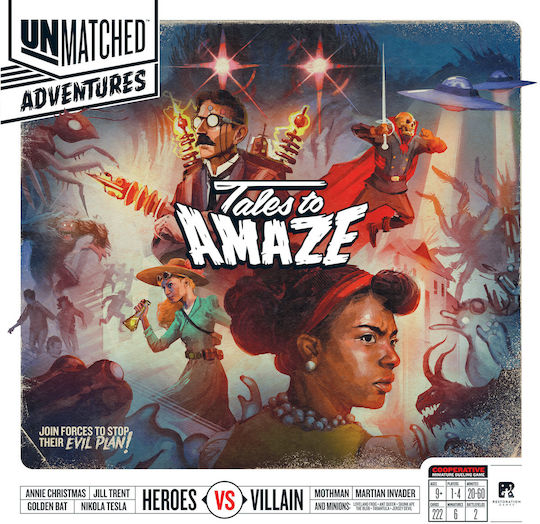
Unmatched Adventures Review
Pulp Heroes, Monster AI, and the Co-op Twist That Changes Everything
Hook / First Impression
The Unmatched series built its reputation on one core promise: take iconic characters from mythology, history, and pop culture, give each of them a uniquely designed deck of cards, and let players battle each other across tight, asymmetric duels. It worked brilliantly — Unmatched became one of the most acclaimed competitive card-combat games in the hobby. Then Restoration Games asked a harder question: what if the fighters stopped competing against each other and started fighting together?
Unmatched Adventures: Tales to Amaze is the answer. It takes the Unmatched engine — the card system, the hero decks, the movement and combat — and completely reorients it toward cooperative play. Up to four players control classic pulp-era heroes (Nikola Tesla, Annie Oakley, Houdini, Medusa) facing off against monstrous threats straight out of H.G. Wells and King Kong: Martian war machines, rampaging dinosaurs, the towering Kong himself. Instead of reading your opponent's hand, you're reading the monster's behaviour deck and racing the clock before catastrophe overwhelms the city.
Overview
Unmatched Adventures: Tales to Amaze is a cooperative card-combat game designed by Rob Daviau, Justin D. Jacobson, and Noah Cohen, published by Restoration Games in 2023. Players choose from a roster of asymmetric heroes and work together through scenario chapters to defeat a shared monster threat — each scenario telling a pulp-era adventure story with escalating danger.
| At a glance | |
|---|---|
| Designers | Rob Daviau, Justin D. Jacobson, Noah Cohen |
| Publisher | Restoration Games / Mondo Games |
| Year | 2023 |
| Players | 1–4 (fully cooperative) |
| Play time | 45–90 minutes |
| Age | 14+ |
| Weight | Medium (BGG ~2.5/5) |
| Victory condition | Complete all scenario objectives before the monster destroys the city or defeats the heroes |
Components & The Setting
The Setting: It is the golden age of pulp adventure — the early 20th century, when science, spectacle, and the supernatural collided on the pages of dime novels and movie serials. Players step into the roles of legendary figures reimagined as pulp heroes: Nikola Tesla commands electrical constructs, Annie Oakley blazes across the board with ranged precision, Houdini escapes every trap and teleports unpredictably, and Medusa turns her mythic gaze against the monsters threatening mankind. The theme is deeply integrated — every hero's playstyle reflects their legend, and every monster's behaviour deck tells a coherent story about how that threat actually behaves. The thematic coherence between card design and narrative is one of the game's genuine artistic achievements.
Component quality is excellent for the price tier. The hero decks are the star of the show: each card is beautifully illustrated in a consistent pulp comic style, and the cards are thick with a satisfying linen texture that holds up well over repeated shuffling. The double-sided board tiles — each scenario uses a specific configuration — are sturdy and vividly printed. The miniatures for heroes and monster are pre-assembled plastic, detailed enough to be impressive on the table without requiring painting.
The scenario and monster behaviour decks introduce a new layer of card quality: they are slightly thicker than standard cards to withstand the shuffling frequency that comes from being the game's primary randomisation mechanism. Tokens, health dials, and sidekick standees are all functional and clear. The box insert is thoughtfully designed — everything has a home, and setup from a packed box takes under five minutes once you know the game. The overall production signals a publisher that spent real time playing their own product.
How to Play
The goal varies by scenario — but it always boils down to completing a series of objectives before the city is overwhelmed. Each scenario is structured in chapters: the first chapter might task players with reaching a specific location and destroying a monster minion, the second might require activating a device while holding back an escalating horde, the third might stage a final confrontation against the main threat at full power. Failing any chapter's loss condition — heroes defeated, city damage reaching its limit, or the round track expiring — ends the game.
Each player's turn follows a clean two-phase structure. In the Action Phase, the hero moves up to their speed value and takes a card action — either playing an Attack card (dealing damage according to the card's value, modified by range and position) or a Scheme card (a special power unique to that hero). In the Monster Phase, the top card of the monster behaviour deck is revealed and resolved: the monster moves, attacks, triggers scenario effects, and advances the city-damage track according to its card instructions.
Combat uses the same elegant system as competitive Unmatched: the attacker names a value, the defender plays a Defence card from hand (or takes the hit undefended), and the difference in values is dealt as damage. What changes in Adventures is that players cannot directly target each other's attacks to "trade" — all damage goes on heroes or the monster, and the monster never runs out of hit points between chapters (it fully recovers). Managing hero health across a multi-chapter scenario is therefore one of the game's deepest strategic considerations.
Gameplay Feel
Pacing & Tension: Unmatched Adventures moves with surprising speed for a game with this much content. A three-player session across a full three-chapter scenario runs 60–75 minutes — fast enough that the table doesn't have time to drift between turns. The monster behaviour deck is the game's tension engine: each card reveal carries genuine stakes, because a bad draw can instantly change the board state. Players who expect predictable AI will be caught off guard; the behaviour deck delivers real surprises.
Player Interaction: Cooperation here is active, not passive. Because the monster behaviour deck reacts to board position — many cards specify "attack the nearest hero" or "move toward the highest-health target" — the team must actively manage positioning as a group. Sending one hero to lure the monster away while another completes an objective is not just a strategic option; it is often the only correct play. The game rewards players who communicate and punishes those who play their hero as a solo unit.
Luck vs. Strategy Balance: The monster behaviour deck introduces variance — a lucky draw can give the team a reprieve; a brutal one can cascade into a losing position. But the deck is not unmanageable: players know the monster's full behaviour deck at the start of the game, and tracking what has been drawn (and what is coming) is one of the most rewarding intermediate-level skills to develop. Variance feels fair, not arbitrary, because it is knowable.
Rule Overhead: The base rules are clear and concise — the Unmatched combat system is already a known quantity for many players, and Adventures adds only the monster behaviour and scenario systems on top. First-game teaching takes 15–20 minutes. The scenario books are well-written with clean diagrams. The main teaching stumble is the chapter-transition rules: what resets between chapters (hero hands and cards in play) versus what carries over (health, discards) can cause confusion mid-game. A reference card for each scenario is included and solves this completely.
Mechanics Deep-Dive
The Monster Behaviour System
The monster behaviour deck is the game's most innovative element and its primary source of replayability. Each monster has its own curated deck of behaviour cards specifying movement, attack patterns, and scenario consequences — and each card also carries a story text blurb that advances the pulp narrative. When Kong tears across the board because his behaviour card reads "pursue the nearest loud noise," it feels like a scene from the movie, not a random game effect.
What makes the system excellent is that it scales naturally with player count and hero selection. Fewer players mean fewer activations before the monster acts, creating a tighter time window. Different hero combinations produce different optimal positions relative to the monster. No two sessions unfold identically even within the same scenario, because behaviour card order changes everything.
Hero Asymmetry — The Depth Driver
Each hero is mechanically distinct in ways that go far beyond stat differences. Playing Houdini means thinking about escape routes and positional tricks that simply don't exist for other heroes. Playing Medusa means managing a petrification resource that changes how the monster behaves when adjacent to her. Playing Tesla means building a network of automaton constructs that effectively extend his reach across the board. The asymmetry is the game's highest-ceiling skill expression — mastering a single hero takes multiple sessions, and the decision of which hero to bring to a given scenario is itself strategic.
- Nikola Tesla: Constructs a network of Automaton sidekicks; excels at board control and consistent ranged pressure. Excellent for players who enjoy resource-building and positioning over burst damage.
- Annie Oakley: High-mobility ranged fighter with powerful conditional attack cards. The most intuitive hero for players new to the Unmatched system — her cards say what they do and the payoff is immediate.
- Houdini: Slippery escape artist who repositions freely and disrupts monster movement patterns. Requires the most spatial thinking; rewards players comfortable with lateral moves rather than direct confrontation.
- Medusa: The tank-and-debuff specialist. Her petrification mechanic slows the monster and enables the team to complete objectives without constant combat pressure. Surprisingly complex for a hero with a simple-looking card set.
Player Count Analysis
Solo — Surprisingly excellent. Unmatched Adventures includes a dedicated solo mode where one player controls two heroes simultaneously. The monster behaviour system works without modification for a single player, and the two-hero management challenge — tracking two hands, two sidekicks, two action windows — adds meaningful complexity without overwhelming. Genuinely one of the better solo card-combat experiences in the hobby at this weight.
2 Players — Very good. Two players each control one hero (or one player can run two heroes for a slightly harder challenge). The tighter hero count makes the monster feel more threatening, and the communication required to coordinate objectives is natural and unhurried. The game's time pressure feels appropriately calibrated at two. A strong date-night game for gaming couples.
3 Players — The sweet spot. Three heroes cover enough roles to handle the monster and objectives simultaneously, and turn-order management stays fast. The monster behaviour deck delivers enough variety to keep all three players engaged between activations. Communication is structured enough to feel like real teamwork without descending into committee decisions. Three is the design target and it shows.
4 Players — Works, but watch the pace. Four heroes can dramatically outpower the monster if the team coordinates well, and the base scenarios can feel less threatening with a full group. The box includes adjustments for difficulty scaling at four players that are strongly recommended — use them. Downtime between turns lengthens slightly. The game is still good at four, but three is stronger.
Replayability
Unmatched Adventures ships with three full scenarios (Martian Invasion, Kong Attacks, T-Rex Horde) and the replayability formula draws from three interlocking sources: hero selection, monster behaviour deck ordering, and scenario difficulty scaling.
The hero combination matrix alone provides significant variety. Four heroes produce six unique two-hero pairings and four three-hero groupings. Each pairing creates a different team identity and demands a different approach to the same scenario. Playing Martian Invasion with Annie Oakley and Houdini feels tactically unlike playing it with Tesla and Medusa — not slightly unlike, but genuinely different at the strategic level.
The monster behaviour deck shuffles fresh every game, which means scenario events unfold differently each time. On one run, Kong crashes toward the city early and the team scrambles to intercept; on the next run, Kong circles the outskirts and the team has more time to set up. The scenarios never feel identical across multiple plays.
The difficulty scaling system (adjusting starting city health and monster behaviour deck composition) effectively creates three difficulty tiers per scenario, extending the game's longevity for groups who have mastered the base challenge. Winning on the hardest tier with any hero combination is a genuine accomplishment that requires multiple sessions to achieve.
Learning Curve
Ease of teaching: The Unmatched combat system is compact and consistent. Teaching a completely new player the base rules takes 15–20 minutes; teaching an existing Unmatched player takes five. The cooperative layer adds the monster behaviour resolution step, which is intuitive once demonstrated. The scenario books walk through setup with clear diagrams. The game is teachable, but not as fast as Catan or Ticket to Ride — there is a meaningful rules-absorption phase before the first game runs smoothly.
Rulebook quality: The main rulebook is well-organized, with a functional quick-reference card for core combat. The scenario books are their own documents and vary slightly in layout quality — the Martian Invasion scenario book (the recommended starting point) is the clearest of the three. Edge-case rulings are available through the Restoration Games FAQ, which is actively maintained.
First-game experience: Strongly positive for groups who enjoy tactics; occasionally frustrating for groups expecting a simpler co-op experience. First-timers typically underuse their sidekicks, play too aggressively against the monster rather than focusing on objectives, and are surprised by the first brutal behaviour card draw. After one session these mistakes are gone permanently — the game teaches efficient play through failure in a way that feels instructive rather than punishing. The second game is almost always better than the first.
Who It's For
Competitive Unmatched fans: This is the clearest target audience. The card system translates beautifully, and the hero decks are designed with the same craft as the competitive line. The adjustment to cooperative play reveals new strategic dimensions in decks players thought they knew. If you love Unmatched but your group prefers co-op, this is the obvious answer.
Co-op gamers looking for something faster and leaner: Players who love Arkham Horror or Gloomhaven but sometimes want a complete session in under 90 minutes will find Adventures scratches the same itch at a fraction of the setup time and table space. It lacks the campaign narrative depth of those games, but the tactical quality is comparable.
Casual groups: Possible, but not the natural home. The hero asymmetry and scenario complexity put this above Pandemic or Forbidden Island on the accessibility scale. Groups who find Pandemic's rule-learning easy will manage Adventures fine; groups who find Pandemic overwhelming should start elsewhere.
Comparisons: For pure cooperative tension at this weight, Spirit Island offers more complexity and more scenarios. For a simpler cooperative experience, Pandemic is faster to teach. For competitive play using these heroes, the mainline Unmatched sets offer more matchup variety. Adventures sits in a specific and underserved niche: a cooperative card-combat game with genuine asymmetry and pulp aesthetic, playable in under 90 minutes. Nothing else does exactly what it does.
Pros & Cons
What Unmatched Adventures does well:
- Hero asymmetry is deep, meaningful, and genuinely fun to master — each hero plays like a different game.
- The monster behaviour deck creates real narrative tension and unpredictability without requiring a human opponent.
- Scenarios feel like pulp adventure stories, not abstract puzzles — theme and mechanics reinforce each other beautifully.
- Fast setup and play time (under 90 minutes for three players) make it genuinely sessionable on a weeknight.
- Excellent solo and two-player modes that feel designed, not bolted on.
- Production quality is exceptional — card art, miniatures, and scenario books all exceed expectations for the price.
Where Unmatched Adventures struggles:
- Only three scenarios in the base box — high-frequency groups will want expansions quickly.
- Monster behaviour deck clustering can create difficulty spikes that feel unjust rather than challenging, particularly in the first chapter of any scenario.
- Four-player mode needs difficulty scaling adjustments out of the box — the unmodified base experience can feel too easy for a full group.
- The chapter-transition rules (what resets, what carries over) require a reference card for the first several sessions and will be misplayed by groups that don't read carefully.
- No campaign system — scenarios are standalone; there is no narrative progression from one session to the next for groups that want persistent story.
- Requires prior Unmatched familiarity (or patience during teaching) to fully appreciate the hero design depth on the first session.
Expansions & Ecosystem
Unmatched Adventures launched with a small but growing expansion ecosystem. All expansions are compatible with the base game heroes and can be combined to increase scenario variety and hero options.
Additional Hero Packs — Expand your roster ★★★★☆
Restoration Games has released additional hero packs bringing new characters into the Adventures roster, including heroes from the competitive Unmatched line adapted for co-op play. Each hero pack includes a fully designed deck and sidekick, introducing new mechanical identities without requiring a full box purchase. The best entry point for groups who love the base heroes but want more combination options.
New Monster Scenario Boxes — New threats and stories ★★★★★
Scenario expansion boxes each introduce a new monster with its own behaviour deck, a new board configuration, and three fresh scenario chapters using the existing hero roster. These expansions directly address the base game's biggest weakness — limited scenario variety — and are the highest-priority purchase for any group that has completed all three base scenarios.
Quick Buyer's Guide
| Expansion Type | Best For | Priority |
|---|---|---|
| New Monster Scenarios | Groups who have cleared the base scenarios | 🥇 #1 — most impactful addition |
| Hero Packs | Groups wanting more team variety | 🥈 #2 — best combinatorial value |
Value for Money
Unmatched Adventures retails for approximately $50–$60 USD (€45–55 in Europe), placing it at the higher end of mid-tier games but below premium dungeon-crawlers. For that price, three complete scenarios, four asymmetric heroes, three monster threats, and components of genuine quality is a fair exchange. The question is frequency: a group that plays twice per month will exhaust the base scenario variety in three to four months and will want expansions. A group that plays once a month will get considerably more mileage from the base box before that point arrives.
- Existing Unmatched fans: Exceptional value. You are getting the system you already love in a new mode, with four hero decks designed to the same standard as the competitive line.
- Co-op gamers: Good value, with the caveat that the scenario count limits long-term play without expansion investment. If you are comfortable buying expansions, the long-term value proposition is strong.
- Casual gamers wanting a single co-op purchase: Consider whether three scenarios will satisfy your group. For groups that play rarely, the base box offers excellent value. For groups that play frequently, budget for at least one scenario expansion.
- Solo players: Outstanding value. Few games deliver this quality of solo experience at this price point — the solo mode is not an afterthought.
Accessibility
Color blindness: Hero identification relies primarily on miniature sculpt and card back color, with secondary iconography on tokens. The distinct miniature sculpts provide sufficient non-color differentiation for most common color vision deficiencies. The game is more accessible on this dimension than many tile-based games with color-coded territory.
Language dependence: Moderate to high. Card text is integral to gameplay — each card's effect is explained in text, not exclusively iconography, and the scenario books are fully text-based. Not suitable for players with limited reading ability in the game's language without a fluent translator at the table. A language-independent edition does not currently exist.
Cognitive accessibility: The game requires managing multiple simultaneous responsibilities: hero hand, sidekick position, objective status, and monster behaviour. This level of parallel tracking is manageable for most players but may be challenging for those with significant working memory limitations. The cooperative format is an asset here — more experienced players can naturally scaffold less experienced ones without disrupting gameplay.
Physical accessibility: Cards are standard size and reasonably easy to handle. The miniatures are on solid bases and don't require fine manipulation. The board tiles are large and clearly printed. Health dials require a small grip to adjust — players with significant dexterity limitations may prefer tracking health on paper instead. No dexterity-based mechanics exist.
Age range: The 14+ rating reflects reading complexity and tactical depth rather than dark themes. The pulp adventure content (monster attacks, hero combat) is action-oriented without being graphic. Confident readers aged 11–13 with prior board game experience will handle the game well; younger children will need significant adult guidance.
Verdict
Unmatched Adventures: Tales to Amaze does something genuinely rare — it takes an established competitive system and rebuilds it for cooperative play without losing the qualities that made the original great. The hero asymmetry is as good as it is in competitive Unmatched; the monster behaviour system adds a layer of tension and narrative surprise that competitive play can't replicate; and the production quality sets a benchmark for the price tier. The scenario limitation is real, and groups who play frequently will want expansions, but the base game earns its place on the shelf on the strength of the hero design alone.
Buy it if: you want a cooperative card-combat game with genuine tactical depth, great solo and two-player support, and a pulp adventure atmosphere unlike anything else on the market.
Skip it if: you want a simple co-op entry point, a campaign with persistent narrative progress, or more than three scenarios without additional purchases.
Upgrade it if: your group has mastered the base scenarios — new monster scenario boxes are the single most impactful expansion investment and directly address the only meaningful limitation of the base game.
Score Breakdown
Love board game night? Explore our tools, score calculators, and strategy guides — everything you need to play better and have more fun.
Browse All Articles →