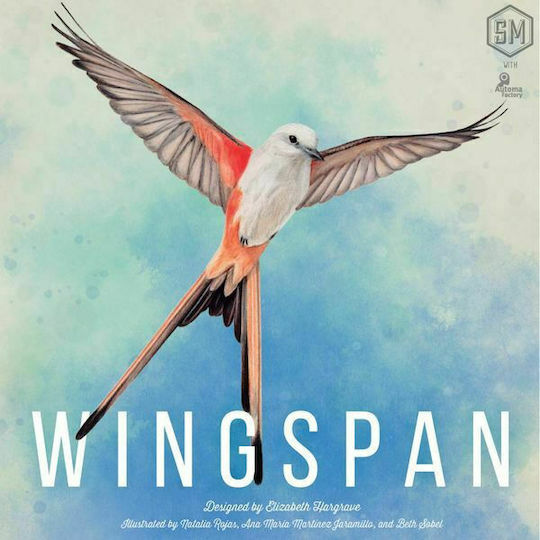
Wingspan Review
The Bird Game That Proved Eurogames Could Win Over Everyone
Hook / First Impression
In 2019, a first-time designer named Elizabeth Hargrave published a game about birds. It won the Kennerspiel des Jahres — Germany's award for complex hobbyist games — and sold over a million copies. It became the game that non-gamers bought for Christmas and then actually played. It became the gateway that converted casual players into engine-building enthusiasts. It became the proof that a serious board game could be beautiful, approachable, and mechanically deep without sacrificing any of those qualities for the others.
Wingspan, published by Stonemaier Games, remains one of the most important board games of the last decade not because it invented anything radical, but because it perfected something that had never been balanced quite so well: a tableau-building engine that scales seamlessly from casual afternoon to competitive hobbyist play, wrapped in some of the most gorgeous production values the hobby has seen.
Overview
Wingspan is a competitive tableau-building game for 1–5 players in which each player builds a wildlife preserve by attracting birds across three habitats: forest, grassland, and wetland. The goal is to score the most points across four rounds by placing birds, collecting eggs, hoarding food, and fulfilling end-of-round goal cards and bonus objective cards. The player with the most points after four rounds wins.
| At a glance | |
|---|---|
| Designer | Elizabeth Hargrave |
| Publisher | Stonemaier Games |
| Year | 2019 |
| Players | 1–5 |
| Play time | 40–70 minutes |
| Age | 10+ |
| Weight | Medium-light (BGG ~2.4/5) |
| Victory condition | Most points after four rounds |
Components & The Setting
The Setting: Players are ornithologists and wildlife enthusiasts competing to attract the most impressive collection of birds to their nature reserves. This is not an abstract theme applied to a mechanical framework — the birds on every card are real North American species (the base game; expansions cover Europe, Oceania, and Asia). Each card names the species, shows its real-world habitat, diet, nest type, and egg capacity. The artwork, illustrated by Natalia Rojas and Ana Maria Martinez Jaramillo, is widely considered the finest in modern board gaming: photorealistic watercolour birds against habitat backgrounds, each one distinct and identifiable. Playing Wingspan feels like flipping through a Field Guide that happens to be a strategy game.
Component quality is exceptional across the board. The 170 bird cards in the base game are thick, linen-finished, and beautifully printed. The custom wooden dice — moulded in food-type shapes (worm, berry, seed, fish, rodent) — are a tactile delight. The birdfeeder dice tower, a cardboard structure shaped like a bird feeder, is a functional centrepiece that doubles as the food distribution mechanism. Stonemaier Games has a reputation for exceptional component production, and Wingspan justified that reputation to a new audience.
The player mats are double-sided (for different game modes) and clearly laid out, with three habitat rows and spaces for up to five birds in each. Eggs are represented by small pastel resin eggs — one of the most beloved components in the hobby for purely aesthetic reasons. The neoprene game mat (included in the deluxe edition) and the bird tray with custom moulded insert are further evidence of a publisher that treats production as a design discipline, not an afterthought.
How to Play
The goal is to score the most points after four rounds. Points come from: birds played to your mat (their printed point values), eggs on birds, food cached on birds, cards tucked under birds, end-of-round goals (scored at the end of each of the four rounds), and your personal bonus card objective (revealed at game start, scored at the end).
On your turn you take exactly one of four actions:
- Play a bird — Pay the bird's food cost and egg cost (eggs from other birds in the target habitat), then place the bird card in the matching habitat row on your mat. The bird's "when played" power triggers immediately if it has one.
- Gain food — Roll the dice remaining in the birdfeeder tray and take one food matching a die result. Birds in your forest row have powers that trigger when you take this action, often giving bonus food, extra dice rolls, or card draws.
- Lay eggs — Place eggs on birds in your grassland row (up to each bird's printed egg capacity). Birds in your grassland row trigger bonuses when you lay eggs. Eggs are both a cost for playing future birds and a scoring resource.
- Draw bird cards — Take cards from the central tray (three face-up cards plus a face-down option) or draw from the deck. Birds in your wetland row trigger bonuses when you draw cards. Your hand size is limited to five; managing your hand is a meaningful constraint.
Each habitat row is a linear chain: the leftmost position is always available; each additional position requires laying one egg before it opens. This means your first forest bird is free to place (food cost aside); your fifth requires four eggs as a prerequisite investment. The habitat chain is the structural spine of Wingspan's engine — building a row means committing resources now for compounding returns later.
The game runs for exactly four rounds. Each round has a decreasing number of actions (8, 7, 6, 5), so the game tightens as it progresses. An end-of-round goal tile (drawn randomly at setup) is scored at the end of each round — players compare their count of a specific bird feature (nest type, habitat, egg count, cards tucked) and rank accordingly, with the top finishers claiming victory point tokens.
Gameplay Feel
Pacing & Tension: Wingspan's pacing is smooth and satisfying in a way that many heavier games never achieve. Early rounds feel deliberate — you are placing foundation birds in key habitats, establishing which rows will power your engine. By rounds three and four, a well-built preserve triggers cascading bonuses from your habitat chains: a single "gain food" action produces three extra food, a free card draw, and a bonus egg before you even look at the dice result. This cascade feeling — the payoff for early patience — is Wingspan's most reliably enjoyable moment.
Tension comes primarily from the shared bird tray and the end-of-round goals. The tray refreshes with new cards each time a player drafts from it, but good cards disappear fast in competitive play. Knowing that an opponent is building a wetland engine and that the powerful wetland bird you want is sitting in the tray creates genuine urgency. End-of-round goal races — particularly when two players are within one bird of each other on nest types — produce table-level drama that the otherwise gentle game rarely generates elsewhere.
Player Interaction: Low to moderate. Wingspan is largely a parallel construction game — your preserve does not directly affect others except through the shared card tray and the end-of-round goal competition. There is no combat, no blocking, no direct conflict. The game's indirect competition (draft pressure, goal races) is enough for most players, but groups who want confrontation or negotiation will find Wingspan too polite. This is a feature, not a bug, for many of its fans: the game is competitive without being aggressive, and this makes it uniquely suitable for mixed-age or mixed-preference groups.
Luck vs. Strategy Balance: Higher than in heavier euros, but expertly managed. The dice results are random, but the birdfeeder mechanic gives players meaningful agency: if the food type you need has not been rolled yet, you gain advantage from waiting — players who reroll the feeder (an option available when all dice show the same food) reset the pool for everyone. The bird card draw has randomness, but with 170 cards in the base game and expansions adding hundreds more, variance is an intended feature. Strong players win consistently because they build flexible engines and adapt to available cards rather than insisting on a fixed plan.
Rule Overhead: Minimal. The rulebook is 16 pages and teaches in under 20 minutes. Individual bird powers are text-only (no complex iconography to decode), and most powers are immediately intuitive. The most common first-game confusion is the egg cost for placing birds (eggs must come from other birds in the target row, not from a general supply) — once clarified, the rules are clear for the rest of the session. Wingspan is one of the easiest medium-weight games to teach cold.
Mechanics Deep-Dive
The Habitat Engine System
Each of Wingspan's three habitat rows is a distinct engine type. The forest produces food when you activate it — useful for paying bird costs and fuelling future plays. The grassland produces eggs when activated — the currency for opening new habitat slots and a direct scoring resource. The wetland draws cards when activated — replenishing your hand with new bird options. A player who builds heavily in all three rows creates a balanced but unfocused engine; a player who specialises — forest-heavy for early economy, wetland-heavy for card velocity — creates faster, more volatile strategies that require different management.
The habitat chain structure means that the first bird in a row provides its bonus immediately but costs nothing in eggs; the fifth bird in a row has been preceded by four eggs of investment and typically provides a substantially more powerful bonus (later-row bird powers are designed to compensate for the deeper investment). This layered investment structure is Wingspan's primary strategic lever: players who fill rows quickly unlock powerful late-row effects sooner, while players who spread across habitats collect moderate bonuses across multiple dimensions.
The Bird Power Taxonomy
Bird powers fall into three timing categories: when played (triggers once on placement), when activated (triggers each time you take the action for that habitat), and end-of-round / end-of-game (scored at specific moments). Understanding which timing category a bird falls into is the core skill of Wingspan's mid-level play.
- When-played powers — often involve tucking other birds under the card (scoring points for each tucked bird at game end) or caching food on the card. These are powerful but front-loaded; their value is locked in at placement.
- When-activated powers — the engine builders. A bird that gives you an extra egg every time you activate grassland is worth more than its printed point value if you activate grassland six or seven times across four rounds. Calculating the expected activations for a given bird is the single most important decision in Wingspan.
- End-of-round powers — trigger at the end of each round in which they are played. Powerful in early-round placements, worthless if placed in the final round. Experienced players recognise end-of-round birds and prioritise them in rounds one and two.
The Bonus Card System
Each player starts the game with two personal bonus cards, chooses one to keep, and discards the other. These bonus cards define a secondary scoring objective unique to that player — something like "score 3 points for each bird with a wingspan over 65 cm" or "score 1 point for each bird in the wetland habitat." Bonus cards create asymmetric player goals within the same base structure, adding strategic texture without adding rules complexity. A player with a nest-type bonus will draft birds differently from a player with a wingspan-measurement bonus, even with the same cards available.
The bonus card system is also the main mechanism Wingspan uses to create different skill ceilings between experience levels. Casual players ignore their bonus card until the final scoring. Experienced players build their preserve around their bonus objective from turn one, maximising its value while also satisfying the shared end-of-round goals. This layered optimisation — bonus card + round goals + habitat engine — is where Wingspan's depth fully reveals itself.
Player Count Analysis
Solo — Excellent. The solo Automa system (designed by Morten Monrad Pedersen, who pioneered the Automa concept) is one of the game's most praised features. The Automa does not build a preserve but instead competes for the end-of-round goals and drafts bird cards from the central tray using a dedicated Automa deck. It plays in under 45 minutes solo and provides a genuine challenge at multiple difficulty levels. For players who primarily game alone, Wingspan's solo mode is strong enough to be the primary reason to own the game.
2 Players — Very good. Two-player Wingspan is tight and fast (45–55 minutes). The card tray competition is direct — with only two players, the bird you want is either available when your turn comes or gone. End-of-round goals are a binary race: one player scores better, one scores worse. The low player count makes each decision feel consequential, and the session length makes multiple games in an evening practical.
3 Players — The sweet spot. Three players balances tray competition (enough pressure to matter, not so much that you always lose what you want) with reasonable session length (55–65 minutes). The end-of-round goals provide three-way races that produce satisfying mid-game drama. Most experienced Wingspan players cite three as their preferred count.
4–5 Players — Good, with caveats. Higher player counts increase the noise in the card tray (popular birds disappear faster) and extend session length (65–80 minutes at four, sometimes more at five). The end-of-round goals become more complex to track. Wingspan handles four and five gracefully — the system scales — but the parallel-construction nature of the game means that more players adds session length more than it adds interaction. For groups of five who want genuine multiplayer drama, a more interactive game will deliver more per person. For groups of five who want a shared aesthetic experience with competitive scoring, Wingspan at five is still very enjoyable.
Replayability
The base game's 170 bird cards generate significant variability — the combination of available bonus cards, randomly drawn bird tray refreshes, and the randomised end-of-round goal tile sequence ensures that no two sessions present the same strategic landscape. Experienced players identify which engine archetypes are available in a given game's card pool (tuck-engine, egg-engine, food-chaining wetland build) and choose accordingly. This read-and-adapt skill develops over 10–20 sessions and maintains engagement well into triple-digit play counts.
The four expansions multiply the card pool substantially. Each expansion adds 80–100 new bird cards alongside the new geographical setting, and they are all fully compatible and mix-and-match playable. Groups that buy all four expansions are playing with 500+ unique bird cards — a strategic space that is essentially inexhaustible for casual and mid-level players. The swift session length (under 70 minutes at most counts) also means that Wingspan's replay frequency is naturally higher than heavier games: a group that might play Ark Nova once a month will play Wingspan three or four times.
Learning Curve
Ease of teaching: Wingspan is among the easiest medium-weight games to teach. The four actions are self-explanatory, the scoring categories are visible from game start, and the only non-obvious rule (eggs as placement cost, sourced from your own birds) is typically understood in one demonstration. A first game with a competent teacher takes 15 minutes of setup and explanation and then proceeds naturally. Most players are making independent decisions by round two.
Rulebook quality: Excellent. The Wingspan rulebook is a model of clarity: colour-coded sections, worked examples, clear diagrams, and a separate quick-reference card included in the box. Stonemaier Games updated the rulebook after initial release to address common edge cases, and the current printing reflects several years of community feedback. Rulebook-related table disputes in Wingspan are rare — a meaningful achievement for a game of its complexity.
First-game experience: Almost universally positive. New players engage immediately with the bird art, the resin eggs, and the tactile dice tower. The rules are comprehensible quickly enough that the first game feels like a real game rather than a learning exercise. Players occasionally miss bonus card synergies or underestimate activation counting, but these are sophistications discovered in subsequent sessions rather than obstacles to first-game enjoyment. Wingspan has the best first-game-to-"I want to play again" conversion rate of any medium-weight game in the hobby.
Who It's For
Non-gamers and casual players: Wingspan was the game that proved this audience could engage with medium-weight engine-building. The theme is immediately accessible (birds, nature reserves), the artwork invites lingering, and the rules are simple enough that the game is genuinely enjoyable on a first play. If you are looking for a game that will work for someone who "doesn't play board games," Wingspan is the most reliable recommendation in this weight class.
Engine-builder enthusiasts: Wingspan satisfies the core desire of the genre — building a system that runs itself and produces cascading bonuses — at a lower weight and time commitment than Ark Nova or Terraforming Mars. For experienced players, it functions as a palette cleanser between heavier sessions, or as the game that travels well and teaches quickly to new people.
Mixed-experience groups: The gentle interaction model means that a first-time player and an experienced player can sit at the same table without the experience gap producing an unpleasant dynamic. Experienced players will win more often, but the scoring is close enough (and the bird art engaging enough) that newer players feel active and rewarded rather than outclassed.
Nature and birding enthusiasts: A surprisingly large portion of Wingspan's audience came from outside the board game hobby entirely — people who bought it because they love birds. The real species data on every card (wingspan measurement, diet, habitat, nest type, geographic range) engages this audience in ways that most games never access. Several bird clubs have adopted Wingspan as a social activity.
Who it is not for: Players who want direct conflict or negotiation; groups seeking a 2-hour strategic challenge; players who have already mastered Ark Nova and find Wingspan too light. For heavy euro players, Wingspan is a sidestep rather than a step forward. For conflict-oriented groups, something like Root or Scythe will produce more table politics. For those wanting a deeper nature-themed engine-builder, Ark Nova is the natural destination.
Pros & Cons
What Wingspan does exceptionally well:
- Best-in-class production quality: the bird art, resin eggs, and custom dice make the game a tactile and visual pleasure to play.
- Exceptional teach-to-depth ratio: four actions, 15-minute setup, but a strategic space that sustains dozens of sessions.
- The broadest accessibility of any medium-weight eurogame — works for non-gamers, casual players, and hobbyists simultaneously.
- Habitat engine system scales cleanly with experience: new players build randomly, veterans plan activation counts from turn one.
- Excellent solo Automa; one of the best solo implementations in the hobby for this weight class.
- Four expansions add hundreds of bird cards while remaining fully compatible and mix-and-match playable.
- Sessions run under 70 minutes at most counts, making it practical for regular midweek play.
Where Wingspan falls short:
- Player interaction is low. The game is competitive but not confrontational — groups who want direct conflict or negotiation will find it too polite.
- The strategic ceiling is lower than in heavier euros. Experienced players will find it well-mapped after 20–30 sessions without expansion variety.
- Luck plays a larger role than in heavier engine-builders. An unlucky run of card draws or dice results can frustrate players who prefer more deterministic games.
- The tray-drafting mechanism can feel passive at high player counts — good birds disappear before you can take them, and there is limited ability to respond.
- End-of-round goal scoring can feel opaque to new players who do not track their standing mid-round.
Expansions & Ecosystem
Wingspan's expansion ecosystem is the most cohesive in mid-weight eurogaming. Each expansion introduces a new geographic region and its native birds, with new powers and card effects that expand the strategic vocabulary of the base game without altering its rules structure. All expansions are fully compatible with each other and with the base game; mixing them is standard rather than exceptional.
1. European Expansion — 81 European bird cards + pink powers ★★★★★
The first and most influential expansion introduces pink "when activated by another player" powers — a new timing category that means your birds can trigger during opponents' turns, adding an interaction layer entirely absent from the base game. It also adds 81 European bird cards with new power types not seen in the base game. The pink powers alone substantially change the feel of the game: drafting a bird that benefits from opponents' actions, and then watching those benefits accumulate without spending your own actions, is a strategically distinct experience that experienced players consistently rank among the best additions to the game.
2. Oceania Expansion — 95 Australasian birds + revised player mats ★★★★☆
Oceania adds 95 Australian, New Zealand, and Pacific bird cards alongside new player mats with revised action spaces. The new mats introduce nectar as a sixth food type (a wild food that triggers end-of-round conversion bonuses) and adjust the habitat action layouts for greater variety. The new mats are compatible with base game and European cards, and many groups adopt them as the standard player mats even when not using Oceania birds specifically.
3. Asia Expansion — Asian birds + Duet and Flock solo/2-player modes ★★★★☆
Asia adds 75 Asian bird cards and introduces two new game modes: Duet (a cooperative 2-player variant using a shared landscape board) and Flock (an expanded solo mode for 1–5 players simultaneously, functioning as a more competitive automa). The new modes substantially change the social experience of the game at low player counts. The bird cards themselves include several with powerful new effect types.
4. South America Expansion — South American birds + conservation cards ★★★☆☆
The fourth expansion adds 75 South American bird cards and introduces conservation cards — a new card type that provides end-game bonuses tied to habitat composition and specific bird features. Conservation cards add a third scoring layer (beyond bonus cards and end-of-round goals) that experienced players appreciate but that can feel like complexity without payoff to players who are not specifically optimising around them.
Quick Buyer's Guide
| Expansion | Best For | Complexity Added | Rating | Priority |
|---|---|---|---|---|
| European Expansion | All groups; pink powers are essential | Low | ★★★★★ | 🥇 #1 — buy immediately |
| Oceania Expansion | Groups wanting revised mats and nectar | Low-medium | ★★★★☆ | 🥈 #2 — buy after European |
| Asia Expansion | Solo and 2-player groups specifically | Medium (new modes) | ★★★★☆ | 🥉 #3 — prioritise if playing at 1–2 |
| South America Expansion | Dedicated fans wanting more birds | Medium | ★★★☆☆ | #4 — last priority |
Value for Money
Wingspan retails for approximately $55–$65 USD (€45–55 in Europe) for the base game. For 170 unique bird cards, custom moulded resin eggs, a functional dice tower, and enough strategic depth to sustain dozens of sessions, this is strong value by any measure. The per-session cost for a group that plays it monthly drops to negligible within the first year.
- Mixed or casual groups: Exceptional value. Wingspan will be the game that converts reluctant players and anchors social evenings for years. The high first-play impression-to-cost ratio is unmatched in this weight class.
- Dedicated euro gaming groups: Very good value. Wingspan complements heavier games as a fast, accessible option. The expansion ecosystem means there is always more to explore without moving to a new game.
- Solo players: Excellent value. The Automa system is one of the best in the hobby; a solo session takes under an hour. If you primarily game alone, Wingspan is one of the highest-priority purchases available.
- Gift purchase: The best board game gift for non-gamers in the hobby. The box is gorgeous, the rules are approachable, and the theme appeals broadly. It is the rare game that looks like what a board game is supposed to look like to people outside the hobby.
Accessibility
Color blindness: Wingspan uses colour to distinguish habitat rows (forest/grassland/wetland) and some card categories. The habitat rows also use distinct habitat artwork and icon shapes, so players who navigate by shape rather than colour can play independently with familiarity. The food type dice use distinct shapes (worm, berry, seed, fish, rodent) that are distinguishable without colour perception. Overall accessibility for colour-blind players is better than most games of this complexity, though the player mat colour coding benefits from the additional icon reference during early sessions.
Language dependence: High. Bird powers are written in plain text (not icons), and there are 170 unique powers in the base game alone. The text is generally clear and unambiguous, but playing in a non-native language requires either a translated edition or tolerance for constant lookup. Stonemaier Games publishes Wingspan in over a dozen languages; translated editions are widely available.
Cognitive accessibility: Better than most games at this weight class. The four-action structure limits decision paralysis, and most bird powers are immediately intuitive ("gain 1 food" requires no interpretation). Players with mild cognitive challenges can participate meaningfully in Wingspan at a level that games with complex iconography or multi-step rules cannot achieve. The gentle interaction model also reduces social pressure during play.
Physical accessibility: Excellent. Cards are standard size, easy to handle, and large enough for clear reading. The resin eggs are small but not fragile or fiddly (no precise dexterity required). The dice tower is a convenience rather than a necessity — dice can be rolled freely. No timed elements. Players with limited mobility can play comfortably seated, and the component layout allows for extended arm reach to any part of the shared board.
Age range: The 10+ rating is accurate and potentially conservative. Mature 8–9 year-olds who enjoy card games can engage with the basic structure; the reading requirement for bird powers is the practical lower limit. Wingspan works well across generations at the same table — a quality that few medium-weight games share.
Verdict
Wingspan is not the deepest game you will own. It is not the most interactive, the most surprising after fifty plays, or the most demanding of strategic mastery. What it is — and what it does better than any other game in its class — is the right game for almost every table. Its rules are simple enough for a first-time player to grasp in twenty minutes. Its engine-building depth rewards experienced players for years. Its production values make it visually and tactilely beautiful. Its theme is warm, specific, and genuinely educational. And its session length is short enough to fit into an evening without planning.
The Kennerspiel des Jahres win in 2019 recognised something the hobby has rarely seen: a game that broke out of its genre without compromising it. Wingspan did not become accessible by becoming shallow. It found a rare design balance where depth and approachability live in the same box, and it held that balance long enough to change how a generation of new players thinks about what a board game can be.
Buy it if: you want a game that works for everyone at your table — casual, hobbyist, young, old, bird-enthusiast, or complete newcomer to board games. Wingspan is the closest thing the hobby has to a universal recommendation.
Skip it if: you want direct conflict, high player interaction, or a game that will still surprise you after a hundred plays at the same weight. For those needs, Scythe, Root, or Ark Nova serve better.
Upgrade it with: the European Expansion first — the pink powers add interaction that makes the core game meaningfully richer. Then Oceania for the revised player mats. Then Asia if you play primarily solo or at two players.
Score Breakdown
Enjoyed this review? Explore more honest board game reviews, score calculators, and strategy guides — everything you need for a better game night.
Browse All Reviews →