Sudoku Strategy Guide
Techniques, Tips, and Solving Methods for Every Difficulty
Why Sudoku Is One of the Greatest Puzzles Ever Designed
Sudoku has a deceptive elegance: nine rows, nine columns, nine 3×3 boxes. Fill every unit with the digits 1 through 9, each appearing exactly once. That's the entire ruleset. Yet the puzzle scales from a breezy five-minute warm-up to a multi-hour analytical challenge that pushes even experienced solvers to their limits — all within the same 9×9 grid.
What makes Sudoku remarkable is that it requires zero arithmetic. The digits are symbols, not numbers. You could substitute letters A through I and the puzzle would work identically. What the puzzle demands is pure deductive reasoning: the systematic elimination of possibilities until only one candidate remains. Every solve is a chain of logical conclusions, each one built on the last.
Most casual players learn one or two basic techniques and plateau there — able to finish Easy and Medium puzzles but stuck the moment they try Hard or Expert. The gap between those levels is not intelligence. It is vocabulary: knowing the names and mechanics of the techniques that crack tougher grids. This guide builds that vocabulary, from the most fundamental moves to the advanced patterns that open up the most resistant puzzles.

The Game Night Pro Sudoku offers four difficulty levels, each with a distinct clue count: Easy (36 clues), Medium (30), Hard (24), and Expert (20). The techniques in this guide are arranged roughly in the order you'll need them — Easy techniques first, with progressively more advanced methods toward the end.
The Fundamentals: How Solving Actually Works
Before strategy, understand the mechanics of deduction. Every empty cell in a Sudoku grid has a set of candidates — the digits that could legally sit there without violating the rules. A cell in row 4, column 7, box 6 cannot contain any digit already present in that row, that column, or that box. What remains is the candidate set for that cell.
Solving Sudoku is the process of reducing candidate sets until every cell has exactly one candidate left, at which point you place the digit. There are two broad categories of technique:
- Candidate elimination: You prove a digit cannot go in a particular cell, removing it from that cell's candidate set. Enough eliminations leave one digit standing.
- Placement by uniqueness: You prove a digit can only go in one specific cell within a unit (row, column, or box), so it must go there — even if that cell still has other candidates.
Every technique in Sudoku, from the simplest to the most advanced, is a variation on one of these two approaches. Keep that framing in mind as you learn each one.
Technique 1 — Naked Single
The naked single is the most fundamental solve in Sudoku: a cell where only one candidate remains after eliminating everything present in its row, column, and box. The digit is forced. You place it immediately.
On Easy puzzles, naked singles are abundant. You can often chain through twenty or thirty placements in a single pass — place a digit, which eliminates it from peer cells, which triggers more naked singles, and so on. This cascade is what makes Easy grids feel effortless once you're in the flow.
How to spot them: Scan each empty cell and count how many digits are already present in its row, column, and box combined. If eight are present, the ninth is your naked single. With practice, this becomes a rapid visual sweep — you're not counting consciously, you're recognising cells with just one remaining gap.
Technique 2 — Hidden Single
A hidden single occurs when a digit can only appear in one cell within a unit, even though that cell may have multiple candidates. The digit is "hidden" among the others — the cell doesn't look forced from a glance, but once you scan the unit, it becomes clear.
Example: In a 3×3 box, you're looking at where the digit 7 can go. Five cells in the box already have values. Of the four empty cells, three sit in rows that already contain a 7. The fourth cell is the only one in the box that can hold a 7. Place it — regardless of what other candidates that cell has.
Hidden singles are the single most important technique in Sudoku. The vast majority of Easy and Medium puzzle cells resolve through naked singles and hidden singles alone. If a puzzle resists after thorough naked single scanning, hidden singles are always the next step.
Where to look: Work box by box. For each box, mentally trace each digit 1–9 through the constraints. Cross off rows and columns that already contain the digit. Where does that leave candidates within the box? If a single cell remains, it's a hidden single. Then repeat for rows and columns — a digit confined to one cell in a row is equally valid.
Using the Notes Feature Strategically
Once naked and hidden singles are exhausted, you need to track candidates explicitly. This is where the Notes feature becomes essential — pencilling in all the possible digits for each empty cell so you can reason about groups of cells together rather than guessing.
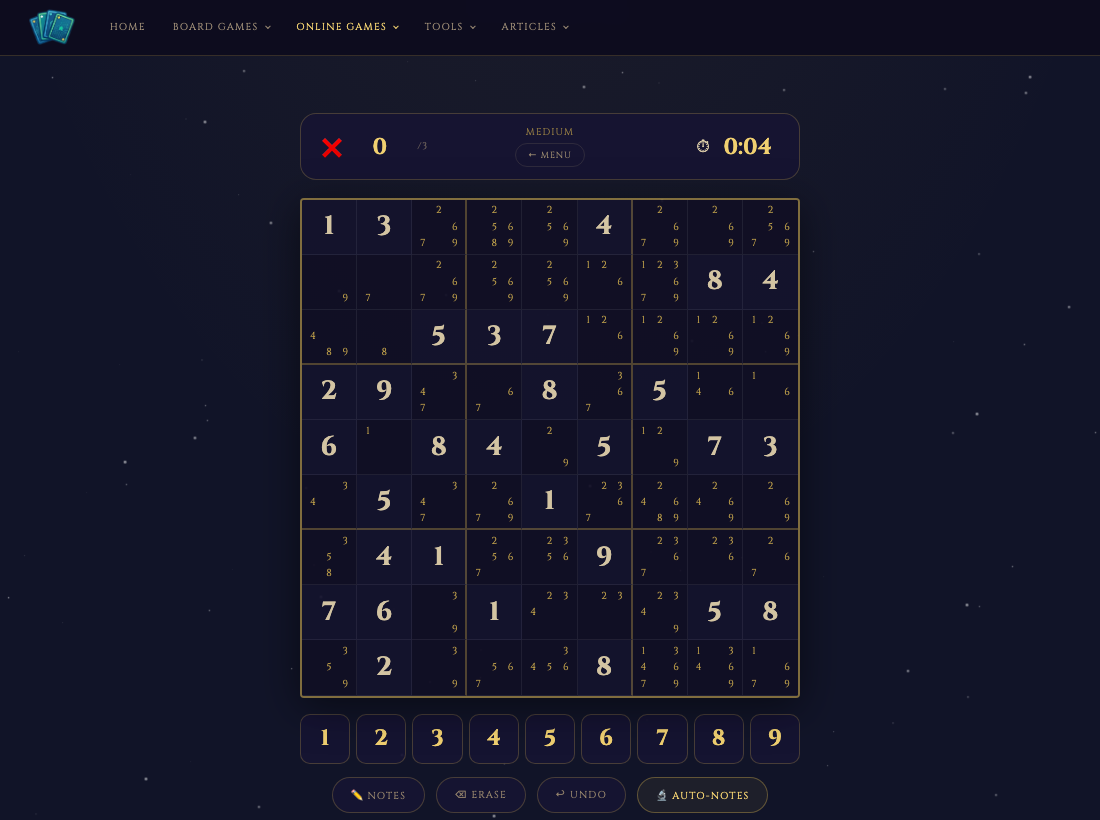
The Game Night Pro Sudoku includes Auto-Notes, which fills every empty cell with its full candidate set in one click. For Easy and Medium puzzles this isn't necessary — but for Hard and Expert, starting with Auto-Notes gives you an accurate picture of the grid's constraint landscape from the outset. Use it as a foundation, then apply techniques to eliminate candidates.

Above: a Medium puzzle with Auto-Notes applied. You can immediately see cells with only two or three candidates — those are your starting points for the next techniques. Cells dense with candidates indicate more constrained regions where advanced patterns may be hiding.
Technique 3 — Naked Pair
A naked pair is two cells within the same unit (row, column, or box) that share exactly the same two candidates — and only those two. Because both cells together must account for both digits, no other cell in the unit can contain either digit. You eliminate both candidates from every other cell in that unit.
Example: In a row, you find two cells that both contain only the candidates {3, 8}. You don't yet know which cell gets the 3 and which gets the 8 — but you know for certain that 3 and 8 will be placed in those two cells. Any other cell in that row that currently has 3 or 8 as a candidate can have them removed.
Naked pairs appear frequently in Medium and Hard puzzles. Once you start looking for them, you'll find them everywhere. The eliminations they trigger often unlock naked or hidden singles in the affected cells, cascading into a substantial solve streak.
Extension — Naked Triple: Three cells in a unit sharing candidates drawn from a pool of exactly three digits. The cells don't all need all three digits — one might have {1,2}, another {2,3}, another {1,3} — but together they cover exactly {1,2,3} and no more. Eliminate all three from the rest of the unit. Naked triples are rarer but powerful when they appear in resistant grids.
Technique 4 — Hidden Pair (and Triple)
A hidden pair is the complement of a naked pair. Instead of two cells with the same two candidates, you find two digits that appear as candidates in exactly two cells within a unit — and those two cells are the same two cells. Even if those cells have other candidates, those other candidates can be eliminated, because the two digits have nowhere else to go.
Example: In a column, the digits 4 and 9 each appear as candidates in only two cells — and they happen to be the same two cells, say rows 3 and 7. Those two cells will hold the 4 and 9 (in some order). Any other candidates in those two cells — say, 2, 6, and 7 — can be eliminated. The cells effectively become a naked pair after the elimination.
Hidden pairs require more careful scanning because the "hidden" aspect means you're looking for digits with constrained placement, not cells with constrained candidates. Most beginners miss them entirely. Finding a hidden pair on a Hard puzzle often breaks the grid open when nothing else seems to be working.
Technique 5 — Pointing Pairs and Box-Line Reduction
These two techniques exploit the interaction between boxes and lines (rows or columns). They are mid-tier strategies — more powerful than pairs alone, less complex than the advanced patterns below.
Pointing Pair: Within a 3×3 box, a particular digit's candidates all fall within the same row or column. Because the digit must go somewhere in that box, and all its candidates share a line, you can eliminate that digit from the rest of that line outside the box. The box "points" to a line and clears it.
Box-Line Reduction (Claiming): The reverse. Within a row or column, a digit's candidates all fall within the same 3×3 box. The line's constraint "claims" those candidates for that box, eliminating the digit from other cells within the box that aren't on that line.
These techniques become indispensable on Hard puzzles where single-unit logic has been fully exhausted but the grid still resists. They link units together, creating cross-unit eliminations that simpler techniques can't reach.
Technique 6 — X-Wing
The X-Wing is the first technique most players would call "advanced." It earns that label — but it's also the most elegantly visual of the advanced patterns, and once you see it, you'll recognise it immediately in future puzzles.
An X-Wing involves a single digit appearing as a candidate in exactly two cells in each of two different rows, and those four cells form a rectangle — meaning the two cells in each row occupy the same two columns.
The logic: In row A, the digit must go in column X or column Y. In row B, the digit must also go in column X or column Y — the same two columns. No matter how the digit is arranged across those two rows, it will occupy column X in one row and column Y in the other. Therefore, no other cell in column X or column Y can contain that digit. Eliminate it from both columns outside the X-Wing rectangle.
X-Wings are the gateway to Expert-level solving. Puzzles that resist every technique so far will often yield to a single X-Wing elimination that triggers a cascade of subsequent naked and hidden singles.
Using the Game's Tools to Learn Faster
The Game Night Pro Sudoku includes a toolkit specifically designed to help players improve, not just complete puzzles.

Mistake counter: The game tracks errors against a three-mistake limit. Rather than treating mistakes as setbacks, use them as information. An error tells you a logical chain you believed was sound was actually flawed. Retrace your reasoning. The undo button lets you step back without losing context — use it to identify exactly where the reasoning broke down, not just to erase the mistake.
Undo history: Every move is recorded. Undo isn't just an eraser — it's a time machine for your logic. On Hard and Expert puzzles, use undo liberally to explore whether a different placement at a decision point would have led somewhere more productive.
Hints: The hint system reveals one correct cell value when you're genuinely stuck. Use hints sparingly and deliberately — the goal isn't to see the answer, it's to unblock a reasoning chain. After accepting a hint, don't just move on. Ask yourself: why was that cell forced? Trace back the logic. Understanding the placement after the fact teaches you the technique that would have found it independently next time.
Auto-Notes for pattern hunting: On Expert puzzles, apply Auto-Notes at the start and then don't make any placements until you've identified at least one X-Wing or pointing pair. Force yourself to scan for patterns in the candidate grid before reaching for the low-hanging fruit. This habit-building transforms how you read a grid.
Difficulty Levels and Which Techniques They Require
Understanding what each difficulty level actually demands helps you choose where to focus your practice and sets realistic expectations for your first attempts at each tier.
Easy (36 clues): Solvable entirely with naked singles and hidden singles. The given clues are dense enough that scanning for forced placements resolves the grid without ever needing to track candidates formally. A clean Easy solve should take 5–10 minutes. If it's taking longer, you're missing naked singles — slow down and scan more systematically.
Medium (30 clues): Requires hidden singles and often one or two naked pairs. Notes become useful for the second half of the grid. Expect one or two moments where naked singles alone won't progress the puzzle and you'll need to look for pairs or hidden singles in columns and rows rather than just boxes. Target time: 10–20 minutes.
Hard (24 clues): Demands naked pairs, hidden pairs, and pointing pairs. Box-line reduction appears frequently. Auto-Notes is strongly recommended from the start. The puzzle will stall multiple times at stages where simple techniques are exhausted — that's normal. The stalls are where technique variety pays off. Target time: 20–45 minutes for a developing solver.
Expert (20 clues): Requires all of the above plus X-Wings and potentially Swordfish (the X-Wing extended to three rows and three columns). Expert grids are designed so that every standard technique has been applied before they yield. Budget 45–90 minutes and treat stalls as puzzles within the puzzle. Some Expert grids have a single critical elimination that unlocks everything — finding it is the challenge.
The Solver's Checklist
Apply these steps in sequence every time you feel stuck. Work through the list before assuming a puzzle requires a technique you haven't learned yet — most apparent dead ends resolve at step 3 or 4.
- Scan for naked singles: Any cell with only one candidate left. Place it and restart the scan — placements create new naked singles.
- Scan for hidden singles: For each digit, identify which cells in each row, column, and box can still hold it. Single-cell confinement means placement.
- Look for naked pairs and triples: Two or three cells in a unit sharing exactly two or three candidates. Eliminate those candidates from the rest of the unit.
- Look for hidden pairs and triples: Two or three digits confined to the same two or three cells within a unit. Eliminate other candidates from those cells.
- Apply pointing pairs and box-line reduction: Are a digit's candidates within a box confined to one row or column? Use it to eliminate from outside the box. Reverse: confined to one box within a row or column? Use it to eliminate from the rest of the box.
- Scan for X-Wings: A digit appearing in exactly two cells across two rows that share the same columns — or the same with rows and columns swapped. Eliminate from the shared columns (or rows).
- Use a hint strategically: If all of the above are exhausted, accept one hint, then identify the logic that forced that placement before continuing.
The Mistakes That Keep Players Stuck
These errors are responsible for the vast majority of stalled solves and incorrect placements across all difficulty levels.
- Scanning only boxes, not rows and columns: Hidden singles appear in all three unit types. Solvers who scan boxes habitually miss hidden singles in rows and columns — often the ones that break the grid open.
- Placing digits without eliminating from peers: When you place a digit, you must mentally (or physically, with notes) remove it as a candidate from every cell in the same row, column, and box. Forgetting one removal corrupts subsequent reasoning.
- Using notes inconsistently: Starting with notes, then abandoning them mid-solve when the grid feels "manageable," then returning to notes later — when the early notes are now stale. Keep notes updated continuously or don't use them at all.
- Assuming a guess is necessary: Expert Sudoku puzzles on this site are verified to have unique solutions reachable through logic. If you feel forced to guess, you've missed a technique application somewhere. Go back to step one of the checklist.
- Ignoring unit interactions: Pointing pairs and box-line reduction are frequently skipped by solvers who only think within single units. The cross-unit techniques unlock grids that resist everything else.
- Giving up during the "flatline": Every Hard and Expert puzzle has one or two moments where no obvious move presents itself. This is not the puzzle defeating you — it's the puzzle asking which technique you'll apply next. Solvers who push through the flatline with systematic scanning find the move. Solvers who stop don't.
Sudoku as a Group Activity
Sudoku is primarily a solo puzzle, but it works surprisingly well as a collaborative or competitive group exercise — especially for groups that mix experience levels.
Collaborative solving: One player controls the grid while others suggest moves. The rule: every suggestion must come with a reason. "Put 7 there" is not allowed. "Put 7 there because it's the only cell in that box that can hold a 7, since the top row and middle column already have 7s" is the format. This forces articulation of logic and catches errors before they propagate. Beginners learn techniques by hearing experienced players reason aloud. Experienced players often catch their own errors when forced to speak them.
Speed challenge: Two or more players open the same difficulty level simultaneously on separate devices. First to complete without hitting three mistakes wins. The competitive pressure changes how you read the grid — you start prioritising speed of scanning over thoroughness, which is a useful skill to develop independently of accuracy.
Teach-then-solve: An experienced player walks a beginner through a Medium puzzle, pausing before each significant technique to ask the beginner what they see. Teaching reinforces your own understanding faster than solo practice — explaining why a hidden single is forced reveals whether you actually understood it or were pattern-matching by feel.
Where to Play
Game Night Pro hosts a free browser-based Sudoku with all four difficulty levels, a full notes system, Auto-Notes, undo history, and a mistake counter. No account required. Playable on any device. Whether you're working through Easy puzzles to build speed or battling Expert grids to master X-Wings, the puzzle engine generates a fresh unique puzzle every game.
Ready to put these techniques to work? Start with a Medium puzzle and apply the checklist. When you hit the first flatline, resist the urge to guess — scan for hidden singles in rows and columns, then look for a naked pair. The breakthrough is usually one technique away.
Play Sudoku Now →