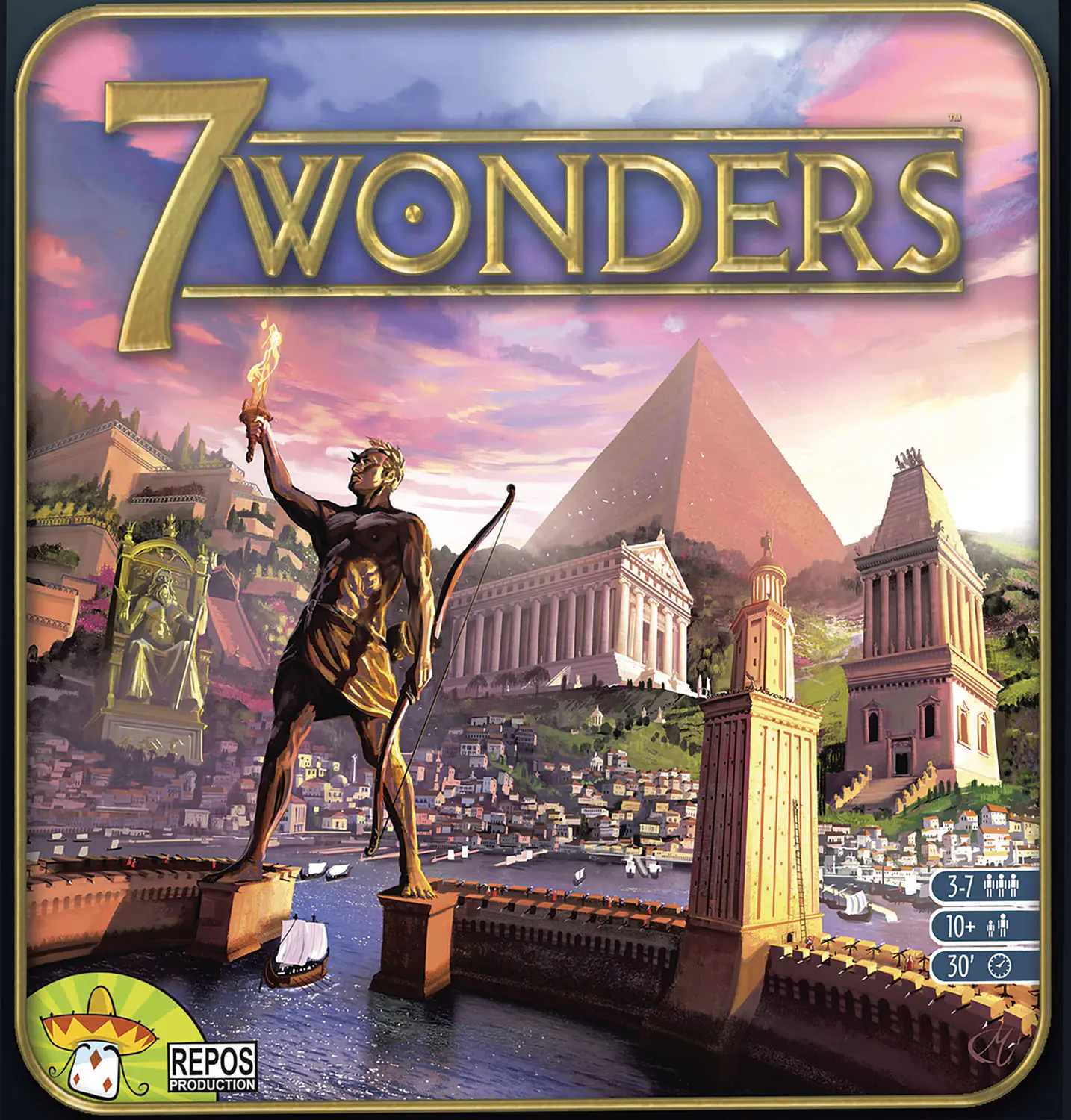
7 Wonders Review
Build a Civilisation. Draft Cards. Finish in 45 Minutes. With Seven People.
Hook / First Impression
There is a very specific problem in tabletop gaming that has never been satisfactorily solved: how do you run a great strategy game for a large group, at pace, without anyone sitting around waiting for other people to finish their turns? Antoine Bauza solved it in 2010 with 7 Wonders, and the solution is so elegant it borders on obvious in retrospect. Everyone takes their turn simultaneously. You pick one card, pass your hand left or right, pick again. Three ages, three full circuits of a drafting hand, and you have built a civilisation — complete with resource chains, military infrastructure, scientific apparatus, and civic monuments — in under 45 minutes with up to seven players.
That core insight — simultaneous drafting as the engine for a civilisation-building game — earned 7 Wonders the Spiel des Jahres in 2011, planted it permanently in the top tier of BoardGameGeek's all-time rankings, and made it one of the most-printed board games of the past fifteen years. In 2020, Repos Production released a revised second edition with updated artwork and cleaner card text. The game underneath is unchanged: it remains one of the most precise designs in the hobby, a game where every card you draft is a decision against the clock of a hand that shrinks by one each pass.
Overview
In 7 Wonders each player leads one of seven ancient civilisations — Alexandria, Babylon, Ephesus, Giza, Halikarnassos, Olympia, or Rhodes — each represented by a double-sided Wonder board with a unique special power. Over three Ages, players simultaneously draft cards representing the agricultural, commercial, military, scientific, and civic development of their city. The player with the most victory points at the end of Age III wins.
| At a glance | |
|---|---|
| Designer | Antoine Bauza |
| Publisher | Repos Production (Asmodee) |
| Year | 2010 (2nd Edition: 2020) |
| Players | 2–7 |
| Play time | 30–45 minutes |
| Age | 10+ |
| Weight | Medium-light (BGG ~2.3/5) |
| Victory condition | Most victory points after three Ages of card drafting |
Components & The Setting
The Setting: Players are the leaders of ancient city-states, each centred on one of history's great architectural achievements. Your Wonder board is both your identity and your strategic infrastructure — it tracks your resource production and offers two or three special Wonder stages that can be built by discarding cards from your hand. The theme is vivid without being oppressive: you feel like you are building something, not just optimising a point engine, even if the cards are ultimately abstracted from their historical referents.
The second edition components are a significant improvement over the original printing. The card artwork has been completely redesigned with a cleaner, more cohesive visual language. The Wonder boards are larger and more legible. The resource iconography, which was the most commonly criticised element of the first edition, has been simplified and clarified. The card backs now clearly distinguish Age I, II, and III decks by colour and design, making setup and shuffle errors almost impossible.
The 168 cards — split across three Age decks — are thin but adequately printed, suitable for sleeving if you plan high-rotation play. Seven Wonder boards, a score pad, a full complement of conflict tokens, and the coin supply round out the box. There are no unnecessary components; the second edition box is precisely sized for its contents. Production quality is comfortably above average for the price tier.
One note: the resource symbols on cards remain dense at first glance, and new players frequently misread the production values. The second edition player reference cards are significantly clearer than the original, but the first game with new players still benefits from a five-minute walkthrough of the resource icons before dealing cards.
How to Play
The goal is to accumulate the most victory points across five scoring categories: military shields, treasury coins, Wonder stages completed, civic buildings, and science symbols. Science is the most volatile category — collecting matching symbols scores exponentially, while completing full sets of all three science symbols earns massive flat bonuses — and it defines one of the game's primary strategic tension points.
Each Age consists of six drafting rounds. At the start of an Age, every player receives a hand of seven cards drawn from the shuffled Age deck (adjusted for player count). On each round, every player simultaneously chooses one card from their hand and places it face-down. All players reveal simultaneously, resolve their card effect, and pass the remaining hand to their left neighbour (in Age I and III) or right neighbour (in Age II). The last card in each hand is discarded without being played.
When you play a card, you have three options:
- Build it — pay any required resources (produced by your city's existing structures or purchased from neighbours for coins) and add it to your tableau. Cards are never stacked; they fan out in front of you, forming a visible civilisation you and your neighbours can read at any time.
- Discard it — take three coins from the bank. The universal fallback when nothing in your hand is useful.
- Build a Wonder stage — discard the card face-down under your Wonder board and pay the resource cost shown for the next Wonder stage. The card used is irrelevant; any card from your hand can be sacrificed to fund a Wonder stage.
At the end of each Age, military conflict is resolved. Every player compares their total shield count against each immediate neighbour. Win a conflict and earn victory points (value increases each Age); lose and take a defeat token worth -1 point. Draw produces no tokens in either direction.
Gameplay Feel
Pacing & Tension: 7 Wonders is one of the tightest games in the hobby in terms of time-per-decision ratio. Because all players draft simultaneously, there is no downtime. The tension arrives not from waiting but from watching: as the hand shrinks each round, you must decide whether to take what you need now or gamble that it will still be available after the next pass. The dread of seeing a card you needed disappear because the player who passed you the hand took it one round before you could is one of the game's most consistent emotional notes — and one of its most elegant design mechanisms. You are never bored; you are sometimes anguished.
Player Interaction operates on two levels. Conflict is direct and inescapable — military shields produce inevitable comparison with both neighbours at the end of each Age, and a civilisation that ignores shields will bleed defeat tokens from both sides. Commerce is semi-cooperative — you can sell resources to your neighbours for profit, generating coins for both parties, creating a fleeting economic partnership. Drafting is the invisible interaction: every card you take denies it to the player who sees your hand next. Experienced players draft "hate picks" — taking a card purely to prevent a neighbour from completing their science set — as a viable tactical layer. This indirect interaction is 7 Wonders at its most strategic, and it makes reading your neighbours' tableaux as important as building your own.
Luck vs. Strategy Balance: Card distribution is randomised but not arbitrarily so — each Age deck is precisely constructed, with specific quantities of each card type scaled to player count. The variance comes from which cards appear in your opening hand and which chains present themselves. Experienced players treat this as a hand-reading puzzle, not a lottery: by Age II, you have seen enough of the deck to understand which strategy is available to you, which neighbours are threatening your military position, and which science symbols are scarce. The game rewards adaptive thinking over rigid plan execution. Luck is present but manageable.
Rule Overhead: The rules fit on four pages of the rulebook and can be taught in fifteen minutes. The core loop — pick a card, pay its cost, pass your hand — is immediately intuitive. The learning complexity concentrates in the resource system (understanding which structures produce which resources and how inter-player trade works) and the science scoring (the quadratic formula for sets rewards players who grasp it early). Neither requires the rulebook after a first game. 7 Wonders is one of the most efficiently taught games at its strategic depth.
Mechanics Deep-Dive
The Five Victory Paths
7 Wonders' strategic richness comes from five genuinely distinct routes to victory, all viable, none dominant. Understanding each path is the difference between a confused first game and a purposeful second one.
- Military dominance — maximise shields to win both neighbour conflicts in all three Ages. A clean military sweep generates +18 points before a single building is scored. Military is the most reactive path: you only need to beat your two immediate neighbours, not the whole table, so a military build calibrated to your neighbours' visible shields is more efficient than an arms race against everyone.
- Science specialisation — collect as many identical science symbols as possible, or complete full sets of all three symbols. The exponential scoring (sets of identical symbols score n², so three identical symbols scores 9, not 3) makes science the highest ceiling of any single strategy — a committed science player who draws well can score 40–50 points from science alone. It is also the path most vulnerable to hate-drafting, since science cards are visibly distinct and opponents can deny them.
- Civic buildings — blue civic cards provide flat, unconditional victory points with no conditions. The safest path, the least volatile, and the least spectacular. Civic buildings require few resources and chain well between Ages, making them a reliable backbone for a hybrid strategy that mixes civic points with moderate investment in one other category.
- Commerce and treasury — yellow commercial cards generate coins, reduce trade costs, and in some cases score points based on the number of commercial structures in your city or your neighbours' cities. The commerce path is rarely a primary strategy but an enabling one — coins provide the flexibility to buy resources you are missing, and certain commercial cards score so reliably in specific Wonder configurations that they anchor complete builds.
- Wonder stages — each Wonder board offers two or three stages of increasing cost and reward. Wonder effects range from extra turns (Halikarnassos's power to play a card from the discard pile) to science wildcards (Babylon's free science symbol) to resource production boosts (Alexandria's flexible resource stage). Building all Wonder stages is rarely the primary scoring plan but almost always worth the investment — stage two and three effects routinely provide 10–15 points of direct value plus the strategic flexibility that their special powers add.
The Resource Economy
Every card in 7 Wonders costs resources. Resources are produced by your city's existing structures — brown raw material cards and grey manufactured goods cards. But here is the mechanism that elevates the resource economy beyond simple accounting: you can buy missing resources from either immediate neighbour at a cost of two coins per resource (reduced by commercial cards), with the coin going to the bank, not the neighbour. This creates a constant interdependence. A neighbour who has invested heavily in stone production is your cheapest stone supplier; a neighbour who produces what you need is simultaneously valuable (for purchasing) and threatening (their civilisation is developing efficiently). The resource economy is a social layer beneath the drafting layer, and it rewards players who are aware of the whole table, not just their own hand.
Wonder Board Asymmetry
Each of the seven Wonders offers a fundamentally different play style through its resource production and stage effects. This is not cosmetic asymmetry — the Wonder you hold shapes your strategy from turn one.
- Giza (Pyramids) — straightforward stone production and large flat point bonuses per stage. The most beginner-friendly Wonder; its value is unconditional and predictable.
- Babylon (Hanging Gardens) — stage two grants a free science symbol of your choice at end of game, which makes a science-focused Babylon player extremely difficult to stop. One of the most powerful Wonders for experienced players who know how to execute the science build.
- Alexandria (Lighthouse) — stage two produces one resource of any type, which grants enormous economic flexibility. Alexandria rewards opportunistic drafting rather than rigid planning.
- Halikarnassos (Mausoleum) — stage effects allow you to play a card from the discard pile for free, which turns every opponent's discard into a potential resource for you. Halikarnassos rewards patience and positional awareness in a way no other Wonder does.
- Olympia (Statue of Zeus) — one of the two sides offers free construction of one Age card per Age, which dramatically reduces resource dependency. A powerful Wonder for players who want to draft freely without resource constraints.
- Ephesus (Temple of Artemis) — generates significant coin bonuses, which fund trade purchases and score directly via treasury. The most commercially oriented Wonder, and a natural fit for a commerce-heavy hybrid build.
- Rhodes (Colossus) — produces shields and scores military points directly via its stages. Rhodes is the most overtly militaristic Wonder and performs reliably even against players who invest moderately in shields.
The Hate Draft
As players develop experience, one of the game's most contentious — and most interesting — strategic layers emerges: the hate draft. Because you see your neighbours' tableaux, you know exactly which card completes their science set, enables their military build, or fills their resource gap. At any point in the draft, you may choose to take that card not for yourself but to deny it to them. You gain three coins (by discarding) and they lose a crucial card. Done judiciously, hate-drafting shifts the balance of a close game. Done excessively, it destroys your own development and frequently gifts the victory to a third player you were ignoring. Calibrating when a hate pick is worth the sacrifice — and when it is spite rather than strategy — is a sophisticated skill that experienced players develop gradually.
Player Count Analysis
2 Players — Functional but not ideal. 7 Wonders at two players uses a "ghost player" called the Tableau des Merveilles — a dummy third player whose Wonder board is managed by both players in a specific way, used to ensure the hand-passing mechanism works. The implementation is serviceable and the game plays in 20–25 minutes, but many of the game's social dynamics — the table-wide military tension, the satisfaction of reading multiple neighbours — are absent. For dedicated two-player gaming, 7 Wonders Duel (reviewed below under Expansions) is a fundamentally superior product designed specifically for the format and should be considered the canonical two-player 7 Wonders experience.
3–4 Players — Good. The game functions well, the session stays under 45 minutes, and the military comparisons are tight enough to matter. Three players in particular creates intimate inter-player dynamics — every drafted card is seen by exactly two other players — that reward positional awareness. Four players adds a second pair of military neighbours for each player, which makes shield strategy marginally more complex and satisfying.
5–6 Players — Excellent. Five and six players is where 7 Wonders begins to separate itself from alternatives. Few strategy games of this depth remain under an hour at five or six players; 7 Wonders manages it because all turns are simultaneous. The increased player count expands the diversity of civilisation strategies visible at the table, makes military calculation more dependent on reading your immediate neighbours (since players further along the table can develop freely), and produces a richer variety of observable outcomes. This is arguably the game's natural habitat.
7 Players — Outstanding. Seven players is 7 Wonders at maximum load and, for the right group, its finest form. A complete seven-player game still runs in 45–50 minutes. The full set of Wonders creates maximum civilisation variety. Military becomes a chain — your shields must beat your immediate neighbours, who are themselves trying to beat their neighbours — which produces cascading dynamics across the table. There is no other strategy game of this calibre that handles seven players this cleanly. 7 Wonders earns its reputation at this count specifically.
Replayability
7 Wonders has exceptional replayability for its weight class, driven by several reinforcing sources of variability. The seven Wonder boards are double-sided (A and B versions, each with different stage effects), effectively giving fourteen starting positions rather than seven. The card pool for each Age is randomised and dealt in variable hands. The player count itself changes the game substantially — a four-player session and a seven-player session of 7 Wonders feel like different games in terms of strategy space and military dynamics.
The strategic depth accrues gradually across sessions. The first game is about understanding the resource system. The second is about recognising the five victory paths. The fifth is about reading your neighbours' strategies in real time. By the tenth game, experienced players are drafting with full awareness of the chain network, hate-picking against a science specialist, and calibrating military to two-thirds of their neighbour's shield count rather than maximising their own. The strategic ceiling is higher than the game's weight suggests.
In terms of raw session count, 7 Wonders sustains 30–50 base-game sessions before the strategic space begins to feel fully mapped — more for competitive players who explore the expansion material. For a 45-minute game at this price point, that is exceptional value per hour of distinct decision-making.
Learning Curve
Ease of teaching: 7 Wonders is one of the most teachable games at its strategic depth. The core loop — pick a card, pay its cost, pass your hand — is explained in two sentences. The complications are: what do cards cost, how do resources work, and how does inter-player trade function. These three concepts take ten minutes to explain with the physical cards as props. The resource iconography on the second edition cards is clear enough that most players can read their hand independently after the first round.
First-game experience: Almost universally positive. The speed of the game — even a learning game finishes in under an hour — means new players experience a complete arc from setup to score calculation, which provides immediate feedback on what worked and what did not. The most common first-game reaction is: "I picked the wrong cards and still had fun — let's go again." That willingness to immediately replay is one of 7 Wonders' greatest teaching assets.
Intermediate plateau: The step from understanding the rules to playing effectively takes three to five sessions. The most common intermediate mistake is ignoring military entirely — a player who drafts zero shields will reliably lose six to nine points to defeat tokens across three Ages, a deficit that requires exceptional play elsewhere to overcome. A close second is over-investing in raw resource production in Age I at the expense of Age II manufactured goods, which are required for most high-value Age III structures.
Teachable moments: After a first game, show new players the score breakdown and point to military results. The visual evidence of defeat tokens — "you lost this many points because your shields were lower than both neighbours" — immediately communicates the military system more effectively than any rulebook explanation can. The score pad is a teaching tool as much as a record-keeping device.
Who It's For
Large groups who want a real game: 7 Wonders is the single best answer to the question "what do we play with six or seven people that isn't a party game?" It provides genuine strategic depth, meaningful decisions, and a complete experience in under an hour. No other game in the hobby occupies this precise position as effectively.
Gateway gamers ready for the next step: Players who have mastered Ticket to Ride or Splendor and want more strategic depth without committing to a two-hour engine-builder will find 7 Wonders an ideal next game. The session length is familiar; the strategic depth is a significant upgrade.
Hobby gamers who want a fast filler: For experienced eurogamers, 7 Wonders serves as a fast, intelligent filler between heavier sessions. It offers enough decision weight to engage experienced players without the setup, teach time, or commitment of a full heavy game. It is a rare filler that rewards expertise.
Competitive groups: 7 Wonders at five to seven players with experienced players who understand hate-drafting, chain networks, and military calibration is a genuinely competitive game with a rich metagame. Tournament play exists for 7 Wonders specifically because the game rewards mastery consistently across sessions.
Who it is not for: Players who want a cooperative experience; players who are uncomfortable with simultaneous play and prefer clear turn order; players who want direct physical conflict or significant narrative. For deep solo or two-player strategic experiences, 7 Wonders Duel (discussed below) or Ark Nova are better recommendations. For players who want longer civilisation-building games with more granular control, Through the Ages or Terra Mystica are the natural next step up.
Pros & Cons
What 7 Wonders does exceptionally well:
- Simultaneous drafting eliminates downtime entirely — the game runs at full speed regardless of player count, making seven-player sessions faster than four-player games of lighter alternatives.
- Five distinct victory paths are all genuinely viable, preventing dominant strategies and ensuring varied session outcomes across many plays.
- Wonder board asymmetry creates meaningful starting identity — each Wonder shapes strategy from the first card, not just in flavour but in mechanical incentives.
- Session length is exceptional for the strategic depth: 30–45 minutes at any player count from three to seven.
- The hate-draft layer adds a sophisticated strategic dimension that only becomes visible after several sessions, providing an intermediate-player payoff that sustains long-term engagement.
- Chain builds create a satisfying long-term puzzle: the cards you place in Age I have mechanical consequences in Age III that reward forward planning.
- Teaches in fifteen minutes to any group; delivers a complete and satisfying experience to first-time players.
Where 7 Wonders struggles:
- Two-player base game requires the ghost Tableau mechanism, which is awkward and unsatisfying compared to the purpose-built 7 Wonders Duel. The two-player base game should rarely be played when Duel is available.
- Military scoring is opaque to new players and easily ignored — a significant structural source of defeat that many first-time players discover only at the score calculation stage.
- The science scoring formula (quadratic for identical symbols, flat bonus for full sets) requires explanation and reference for new players and can feel mathematically alienating without a concrete example.
- Score calculation at the end of the game involves simultaneous individual accounting that requires every player to correctly total five categories. With new players, the final ten minutes can be slower and less satisfying than the drafting itself.
- High player counts magnify analysis paralysis for slow decision-makers. A single deliberate player can noticeably brake the whole table at seven players.
- Lower strategic interaction compared to games with direct conflict — players who want to impact opponents directly beyond neighbour military comparisons and hate-drafting may find 7 Wonders too parallel.
Expansions & Ecosystem
7 Wonders has a rich expansion ecosystem developed over fifteen years, ranging from standalone companion games to modular add-ons that deepen specific mechanisms.
1. 7 Wonders Duel — Standalone 2-player version ★★★★★
Designed by Antoine Bauza and Bruno Cathala, Duel reimagines 7 Wonders as a tight, direct two-player confrontation. The drafting mechanism is completely redesigned — cards are laid out in a pyramid display, and players take turns picking face-up cards from the exposed edges, with the selection of one card potentially revealing others beneath it. Three victory conditions (military supremacy, science supremacy, or most points) add three parallel races to every session. Duel is widely considered one of the finest two-player board games ever designed, a peer to its parent game rather than a lesser version. If you own 7 Wonders and play primarily at two, Duel is an essential complement.
2. Leaders — Adds leader cards drafted before Age I ★★★★☆
Leaders adds a set of historical leader cards (Caesar, Aristotle, Hannibal, etc.) that are drafted before Age I begins. Each leader provides a permanent ability that shapes your strategy for the entire game. Leaders significantly deepen the strategic variety and replay value, and they add a pre-game drafting phase that rewards knowing the card pool. The added complexity is modest — one extra drafting phase and a set of leader effects — and integrates cleanly with the base game. Recommended after five to ten base-game sessions.
3. Cities — Adds political intrigue and shared debt mechanics ★★★☆☆
Cities introduces black political cards that introduce negative effects on neighbours (debt tokens, card theft) and a new shared debt mechanism. It adds meaningful direct conflict to a game that otherwise operates at arm's length, which some groups find exciting and others find disruptive. Cities is a divisive expansion that polarises experienced groups: those who want more interaction love it; those who prefer the parallel development feel of the base game resent the disruption. Try before you buy.
4. Armada — Adds a naval fleet board to each player ★★★☆☆
Armada provides each player with a small fleet board tracking four naval categories (trade, military, science, civil) that generate additional bonuses and end-game scoring. It adds a meaningful sub-system that rewards naval investment and produces a new scoring axis. Armada is mechanically clean and integrates smoothly, but it adds ten minutes to session length and a parallel sub-game that can dilute focus from the core drafting. Best for groups who have fully explored the base game and Leaders and are looking for additional strategic texture.
5. 7 Wonders Architects — Standalone family-weight version ★★★★☆
Architects is a standalone game that strips 7 Wonders down to its structural essence for a family audience. Cards are colour-coded by resource type; there is no coin cost — you simply match colours to chain builds; military is resolved between all players simultaneously with a simple shield-counting mechanism. Architects plays in 25–30 minutes and is accessible to players as young as eight. It is an excellent standalone for family groups and a superb introduction to the concept before progressing to the full game.
Quick Buyer's Guide
| Product | Best For | Complexity Added | Rating | Priority |
|---|---|---|---|---|
| 7 Wonders Duel | Two-player gaming | N/A (standalone) | ★★★★★ | 🥇 #1 — buy immediately for 2-player |
| Leaders | Groups wanting more strategic depth | Low | ★★★★☆ | 🥈 First expansion for base game |
| Architects | Family groups, new players | N/A (standalone) | ★★★★☆ | Great family gateway |
| Armada | Experienced groups wanting new axis | Medium | ★★★☆☆ | After 20+ base game sessions |
| Cities | Groups who want direct conflict | Medium | ★★★☆☆ | Try before you buy — divisive |
Value for Money
7 Wonders retails for approximately $50–$60 USD (€40–50 in Europe) in the second edition. For a game that runs 30–45 minutes, accommodates up to seven players simultaneously, and sustains 30–50+ sessions of increasing strategic depth, this is among the best value propositions in hobby gaming. The cost-per-session for a regular group drops below 50 cents within the first year of play.
- Large groups: Exceptional value. There is no competing game at this price point that handles six or seven players with equivalent strategic depth and equivalent session length. 7 Wonders earns its shelf space in almost every collection.
- Two-player households: Buy 7 Wonders Duel instead of (or alongside) the base game. The Duel is a superior product at two players, is similarly priced, and is one of the finest two-player games in the hobby.
- Casual family groups: Consider 7 Wonders Architects as a potentially better fit. Architects is cheaper, plays faster, and is more accessible to younger players and non-gamers without sacrificing the game's core appeal.
- The second edition: If buying new, the second edition is clearly superior to the first and is now the widely available version. If you own the first edition, the second is not worth upgrading to unless the original card text legibility has frustrated you — the gameplay is identical.
Accessibility
Color blindness: 7 Wonders uses colour as a primary visual identifier for card categories — brown (raw materials), grey (manufactured goods), blue (civic), green (science), red (military), yellow (commerce). The second edition adds distinct geometric border shapes per category alongside colour, which provides a secondary differentiation channel. Players with red-green colour blindness may still find the red/brown distinction difficult, but the second edition's redesigned borders significantly improve this over the first edition. A colour-blind player with a reference card identifying shapes should be able to play comfortably after a single session.
Language dependence: Low. The vast majority of cards have no text — their effects are communicated entirely through icons. A small number of Wonder stage effects include text descriptions, but these are permanent and can be explained once before the game starts. 7 Wonders is one of the most language-agnostic games in the hobby for its complexity level, and mixed-language editions at the table are feasible as long as all players understand the icon language.
Cognitive accessibility: Moderate. The resource system and trade mechanism require abstract reasoning, and the science scoring formula is mathematically non-trivial for players unaccustomed to pattern thinking. However, the simultaneous play structure means cognitively slower players can take their time without holding up the table significantly — other players are also deciding simultaneously. 7 Wonders is more accessible than its strategic depth suggests because the decision at any given moment is constrained to a maximum of seven cards in your hand, declining to six, five, four — a manageable and shrinking option space.
Physical accessibility: Cards are standard Tarot-size in the second edition — easy to hold and read. No physical dexterity is required beyond holding and passing a card hand. The game requires no reaching across a table; each player manages only their own tableau and Wonder board. Fully playable for players with physical mobility limitations.
Age range: The 10+ rating is accurate. Children of ten or eleven with existing card game experience can grasp the resource system within one game. The civilisation theme is entirely benign in content. Military mechanics — conflict tokens, defeat penalties — are abstract and non-graphic.
Verdict
7 Wonders earns its place among the all-time great board games with a design that remains unreplicated fifteen years after publication. Antoine Bauza solved the large-player-count strategy problem so cleanly that no designer since has improved on the solution: make every turn simultaneous, build five distinct victory paths that require watching your neighbours, and end in under an hour. The result is a game that works for casual groups and competitive players in the same box, at the same table, with the same rules, producing sessions that are engaging at game one and still strategically rich at game fifty.
Its weaknesses are narrow and known. Two players should play Duel. Groups who want direct conflict will find the indirect drafting and military comparisons too arm's-length. Score calculation remains slightly clunky. None of these are design failures — they are parameter choices that define the game's precise niche.
Buy it if: you regularly play with four or more people and want a strategy game that finishes before anyone gets bored. It will be in your game collection for years.
Skip it if: your gaming is exclusively two-player (buy Duel) or your group wants lengthy civilisation building with granular control (move up to Through the Ages or a dedicated 4X).
Upgrade it with: 7 Wonders Duel for two-player gaming — an immediate purchase. Leaders after ten sessions for the group that wants more strategic depth from the base game.
Score Breakdown
Love strategy games that finish in under an hour? Explore our full review library, score calculators, and strategy guides — everything you need for a better game night.
Browse All Reviews →