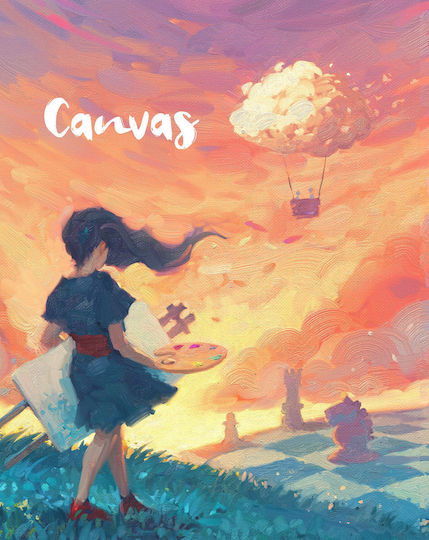
Canvas Review
The Card-Drafting Game That Makes You Feel Like an Artist
Hook / First Impression
Canvas does something no other board game does: it hands you a stack of transparent art cards and asks you to layer them into a painting. Not metaphorically — you physically slide translucent cards over a background canvas, watching imagery bleed through from underneath, composing something that looks genuinely like a piece of finished artwork. In a hobby packed with wooden cubes and cardboard chits, that tactile, visual moment is genuinely startling the first time you experience it.
Designed by Jeff Jensen and published by Road to Infamy Games in 2020 following a successful Kickstarter campaign, Canvas quickly earned a reputation as one of the most distinctive light games of the decade — a title that earns its shelf space on sheer elegance and production beauty before you even play a single round.
Overview
Canvas is a competitive card-drafting and set-collection game designed by Jeff Jensen and published by Road to Infamy Games (2020). Players draft transparent art cards from a shared river, layer three of them over a background canvas to create a unique painting, and score points by satisfying a set of randomly selected ribbon conditions — each of which rewards a different combination of icons visible through the stacked layers.
| At a glance | |
|---|---|
| Designer | Jeff Jensen |
| Publisher | Road to Infamy Games |
| Year | 2020 |
| Players | 1–5 |
| Play time | 30–45 minutes |
| Age | 14+ |
| Weight | Light-medium (BGG ~2/5) |
| Victory condition | Most points from ribbon scoring + inspiration tokens |
Components & The Setting
The Setting: Each player is an artist competing to paint the most celebrated canvas at an open-air exhibition. Unlike most competitive games, Canvas's theme is not a thin coat of paint over abstract mechanics — the theme IS the mechanic. Drafting is selecting artistic elements. Layering is composition. The five scoring ribbons are the exhibition judges awarding prizes for different aesthetic qualities. Everything in the game reinforces the feeling that you are creating something, not optimising a resource engine.
That said, Canvas is definitively a Eurogame at heart. The "painting" you create is scored by counting icon symbols visible through your stacked transparent cards — the thematic wrapper is gorgeous but the underlying system is pure set collection. Players who approach it expecting narrative depth will find clean puzzle mechanics instead. That is not a flaw; it is simply clarity about what the game is.
Component quality is exceptional. The transparent art cards are the star of the show — printed on genuinely clear acetate-style plastic with watercolour artwork by Luan Huynh, they are among the most beautiful components in modern board gaming. The background canvases are thick, illustrated boards that serve as the base layer for each painting. Scoring ribbons are double-sided thick cardboard tiles. The art card row uses a sliding coin mechanic: each card not immediately drafted accumulates an inspiration token, making it progressively cheaper to pick up without spending an action — a clean, elegant solution to the classic "leftover card" problem in drafting games.
How to Play
The goal is to score the most points by completing three paintings over the course of the game, each evaluated against five randomly drawn scoring ribbons displayed face-up at the start of the game.
On your turn you take one of two actions: Draft a card from the art card river (paying inspiration tokens equal to the card's position, plus taking the tokens that had accumulated on it), or Complete a painting by taking a background canvas from the supply and choosing three art cards from your hand to layer on top of it in any order.
The six icon types — Light, Shadow, Nature, Structure, Texture, and Emotion — appear once or twice on each transparent card and show through the layers when stacked. The key constraint: only the top visible instance of each icon is counted. Stack order matters enormously. A card buried at the bottom may have its icon blocked by an opaque region on a card above it, or it may show through a transparent gap — choosing which card goes where is the central puzzle of every painting.
Each ribbon has a specific scoring condition: one might award 3 points per set of three different icons; another might give points for having four or more of a single icon across your whole painting; a third might score pairs of a specific icon combination. Five ribbons are selected at random from a larger deck at the start of each game, ensuring that the specific combination of icon targets changes every session.
Players complete three paintings total. After all paintings are scored, bonus points go to players who accumulated the most inspiration tokens — creating a secondary incentive to skip picks on popular cards and let them accumulate value.
Gameplay Feel
Pacing & Tension: Canvas moves quickly. A three-painting game with experienced players runs under 35 minutes; a first game with teaching takes about 50. Turns are crisp — you draft or you complete — and there is no analysis paralysis trap because the rules naturally time-gate decisions. You cannot complete a painting until you have at least three cards in hand, and you cannot draft indefinitely without falling behind on finished paintings. The rhythm of accumulate, compose, score repeats three times and the game is over before it has a chance to overstay its welcome.
Player Interaction is the game's most honest limitation. Canvas is, in practice, a parallel solitaire puzzle. You share a drafting river with opponents, so a card you want can be taken — but there is no direct blocking, no targeted disruption, and no negotiation. Experienced players do pay attention to what rivals are collecting and occasionally draft defensively to deny a key card, but this is subtle and optional. Groups who love confrontational games will find Canvas serene to the point of placidity.
Luck vs. Strategy Balance: The random ribbon selection at the start of each game determines which icon combinations are worth pursuing, and the river of available cards introduces variance in what you can draft. Neither source of randomness is punishing — there are always multiple viable paths to a competitive score, and the inspiration token system ensures that cards you miss in one turn become cheaper options in the next. Skill expresses itself through efficient card evaluation, stack optimisation, and reading which ribbon conditions are achievable given your current hand.
Rule Overhead: Canvas has one of the lightest cognitive footprints of any game that claims strategic depth. The core rules fit on a single reference card. The primary teaching sticking point is the icon-visibility rule — explaining that layering order affects which icons show through requires a quick physical demonstration. Once that clicks, usually mid-first-painting, everything else falls into place. Canvas is teachable in under 10 minutes to complete non-gamers.
Mechanics Deep-Dive
The Transparent Card Engine
The transparent card layering system is Canvas's defining innovation and its clearest design achievement. Each card is divided into visual regions — some opaque, some transparent — and the icon symbols printed on them are positioned to interact with the layers above and below. Stack three cards and you get a composite image that is simultaneously an artwork and a scoring puzzle.
The strategic depth here is real but accessible. You are always solving a constraint-satisfaction problem: given the icons on the cards in your hand, and given the five ribbon conditions currently active, which three cards — in which order — generate the most points? The answer changes depending on which ribbons are scored, creating genuine replay variance in which cards are valuable.
The Ribbon Scoring System
The five scoring ribbons are the primary engine of replayability and strategic differentiation. Each ribbon is double-sided, so the active pool of possible ribbons is large. In any given game, you might be scoring:
- Symmetry — points for having equal counts of two paired icon types
- Variety — points for having at least one instance of every icon type across your painting
- Flourish — points for total counts of a specific icon, rewarding deep specialisation
- Contrast — points for deliberate imbalance, scoring a large gap between two icon types
- Cohesion — points for sets of icons that appear together in specific combinations
The power of this system is that different ribbon combinations actively favour different drafting strategies. A game with three ribbons that reward variety pushes every player toward breadth — collecting one of each icon. A game heavy on flourish ribbons rewards depth — stacking duplicates of one or two icons as high as possible. Reading the ribbon board at setup and committing to a strategy within the first two drafts separates consistent winners from reactive drifters.
The Inspiration Token Economy
Every card not immediately drafted accumulates one inspiration token per turn it sits in the river. When you draft that card, you take all its tokens as income — and you can spend tokens to draft further-right cards without taking a separate action. This sliding economy elegantly solves two classic drafting-game problems: desirable cards don't rot forever unclaimed, and players who draft "cheap" early cards are rewarded with currency to purchase expensive ones later. It is one of the cleanest drafting innovations in recent years, and the Reflections expansion builds on it.
Player Count Analysis
Solo — Excellent. Canvas includes a fully developed solo mode where you compete against a phantom artist who claims cards and scores via a simple algorithm. The solo mode is not an afterthought — it uses all the same mechanics, scales the ribbon targets appropriately, and provides a genuine challenge across multiple difficulty settings. Canvas is genuinely worth owning for solo play alone. The Reflections expansion takes this further with a dedicated solo campaign.
2 Players — Very good. Two-player Canvas is tighter and more tactical than larger counts. With only one opponent watching the same river, defensive drafting becomes meaningful — you can actively deny a key card if you spot your rival's strategy. The parallelism of the design means there is no downtime concern at two. The base game's solo mode works as an informal "beat your rival's score" variant for couples who want a slightly looser experience.
3 Players — The sweet spot. Three players keeps the game under 40 minutes, generates enough competition over the river to make drafting decisions feel consequential, and avoids the occasional crowding issue at higher counts. Most sessions at three feel satisfying and well-paced. This is the count most veteran Canvas players recommend.
4 Players — Works well. Four players extends the game slightly and makes the river more competitive. Inspiration tokens become more valuable because popular cards cycle faster. The parallel solitaire nature means downtime per player is still minimal. Recommended for groups who want to include everyone without splitting into smaller sessions.
5 Players — Functional but not ideal. Five players is supported but pushes the session toward 50–60 minutes and reduces each player's influence over the river — cards cycle in and out quickly enough that long-term planning becomes harder. The game works, but the experience becomes notably more chaotic and luck-dependent. If your group regularly sits five, the Reflections expansion includes a second copy of key components that alleviates some of the pressure.
Replayability
Canvas's replayability rests almost entirely on the variable ribbon system — and it holds up well. With a large pool of possible scoring ribbons, the combination of five active ribbons changes the strategic landscape meaningfully from session to session. A game that rewards symmetry plays very differently from one that rewards specialisation, and players who optimised for one setup cannot carry that strategy wholesale into the next.
The art card deck itself is sufficiently large that no two drafting rivers feel identical. Specific cards become more or less valuable depending on the ribbons in play, so even familiar cards present new decisions each game.
The one replayability ceiling is that the core loop — draft, layer, score — is short and light. After roughly 20–25 sessions, experienced players may find that the puzzle has become too familiar: they can evaluate a ribbon board at setup, identify the two or three obvious drafting strategies, and execute without being surprised by anything. This is earlier than most euro-weight games reach saturation, and it is when the expansions earn their place. But for groups who play monthly rather than weekly, Canvas has a long shelf life.
Learning Curve
Ease of teaching: Canvas may be the easiest game in this review series to teach. The turn structure is two choices: draft a card or complete a painting. The token economy requires one sentence of explanation. The only concept that requires demonstration rather than description is the layering system — "icons on lower cards can be hidden by opaque regions on cards above them." One physical demonstration with three cards is universally sufficient. Total teaching time: 8–10 minutes.
Rulebook quality: The Canvas rulebook is exceptionally produced — clear layout, abundant examples with actual component photography, and an icon glossary on the back page that serves as a permanent reference. The scoring ribbon cards include reminder text on each tile. First-time players rarely need to consult the rulebook mid-game. It is one of the best-written light-game rulebooks in recent memory.
First-game experience: Almost universally positive. New players immediately grasp the visual appeal of the components, the core tension of "which cards do I layer and in what order" resolves itself naturally in the first painting, and the game ends quickly enough that a suboptimal first run feels like a calibration round rather than a wasted evening. Canvas reliably generates "can we play again?" responses from first-time players in a way that heavier games rarely do.
Who It's For
Casual players and non-gamers: Canvas may be the single best "next step" game for someone who has enjoyed Azul or Ticket to Ride and is ready for something with slightly more decision-making. The theme is universally appealing, the session is short, and the beautiful components do half the selling work before the rules are even explained.
Solo gamers: Canvas belongs in every solo gamer's collection. It is one of the rare games where the solo mode feels designed rather than tacked on, and it plays in under 30 minutes — a genuine low-commitment option for evenings when you want a game but not a commitment.
Families: The 14+ age rating is conservative. Children aged 10–11 handle Canvas comfortably if they have prior experience with set-collection games. The non-violent theme and lack of player elimination make it family-friendly in practice.
Hobbyist gamers: Canvas occupies a specific role in a heavy gamer's collection: the palate cleanser. It is not trying to be Terraforming Mars and should not be evaluated against it. It fills the "30-minute filler with depth" slot better than almost anything else at its weight. Veterans who dismiss it as too light are typically bringing the wrong expectations.
Comparisons: Canvas sits closest to Sagrada (dice-placement puzzle with similar meditative quality), Cascadia (short, puzzle-like, accessible), and Azul (tile-collection where presentation is half the appeal). If your group enjoys any of those, Canvas is a natural companion. If you need direct conflict and player interaction, look at 7 Wonders or Sushi Go Party! instead.
Pros & Cons
What Canvas does well:
- The transparent card layering system is a genuine mechanical innovation — tactile, visual, and thematically coherent in a way that few games achieve.
- Component quality is exceptional, particularly the transparent art cards and their watercolour artwork. The game looks beautiful on the table.
- Variable ribbon scoring creates meaningful strategic differentiation from game to game without adding rules complexity.
- Teaches in under 10 minutes; accessible to complete non-gamers without compromising the puzzle depth for experienced players.
- Excellent solo mode that feels complete rather than bolted on.
- Sessions run 30–45 minutes, making Canvas one of the most practical games in a collection for weeknights or warm-up games.
- Genuinely works at every player count, including the rare solo mode that stands on its own merits.
Where Canvas struggles:
- Player interaction is minimal. Canvas is fundamentally a parallel solitaire puzzle; the shared draft is the only point of contact with opponents. Groups who want confrontation will be disappointed.
- Strategic ceiling is relatively low. After 20–25 plays the puzzle becomes familiar and the sense of discovery fades without expansion content.
- The 5-player experience introduces enough crowding and randomness that it is noticeably weaker than smaller counts.
- The art card river can occasionally leave a complete drought of icons you need, with no mechanical recourse beyond waiting and hoping. This is rare but frustrating when it happens.
- The premium component quality drives the price above what the rules complexity would otherwise justify — Canvas is not a $50 game in mechanical depth, even if it is in production quality.
Expansions & Ecosystem
Canvas has two official expansions that each address specific aspects of the base game without inflating its complexity beyond the light-medium tier.
1. Reflections — Solo & Two-Player Overhaul ★★★★★
Reflections (2022) is the definitive upgrade for solo and two-player Canvas. It introduces a dedicated solo campaign with a narrative thread across linked scenarios, a new two-player competitive mode with asymmetric starting conditions, and an additional deck of art cards that expands the drafting pool significantly. It also adds a "watercolour" variant where transparent cards can be placed under the background canvas rather than on top, creating a reversed layering puzzle with completely different icon dynamics.
For anyone who plays Canvas primarily solo or at two, Reflections is essentially a required purchase. It takes the base game's most underserved modes and makes them genuinely outstanding. The solo campaign in particular is one of the best-designed narrative solo experiences in a light game.
2. Highlights — New Ribbons & Art Cards ★★★☆☆
Highlights adds a third expansion deck of art cards and a new set of scoring ribbons, extending the pool without changing any core rules. It is the most straightforward expansion imaginable — more content, same game. For groups that have played Canvas extensively and feel the ribbon pool has become too familiar, Highlights refreshes the strategic landscape without demanding any new learning.
For groups that have played Canvas fewer than 30 times, the base game's ribbon variety is sufficient and Highlights feels like unnecessary surface area. It is the least exciting of the two expansions but the most accessible to add mid-session without explanation.
| Expansion | Best For | Complexity Added | Rating | Priority |
|---|---|---|---|---|
| Reflections | Solo players, couples | Low | ★★★★★ | 🥇 #1 — best overall addition |
| Highlights | Veteran groups seeking variety | None | ★★★☆☆ | 🥈 #2 — optional refresh |
Value for Money
Canvas retails for approximately $50–$60 USD (€45–55 in Europe), which places it at the premium end of light board games. That price reflects the production cost of the transparent art cards — a genuinely unusual manufacturing choice — more than the ruleset, and the components deliver on the promise. If you evaluate Canvas as "how much game do I get per euro," the answer is modest. If you evaluate it as "how much of a premium experience do I get per euro," the answer is excellent.
- New to the hobby: Worth it, especially if you respond to beautiful, tactile components. Canvas makes a stronger first impression than almost any other game at its price point.
- Regular game group: Very good value. At 30–45 minutes per session, Canvas accumulates table time quickly. A group that plays monthly will log 20+ sessions in its first year.
- Solo player: Excellent value. Few games this price include a solo mode that stands entirely on its own merits.
- Heavy gamer looking for a filler: Reasonable value in that context — you are buying a specific experience (tactile, visual, meditative) rather than strategic depth.
Second-hand copies are available but rare — Canvas retains its value on the used market precisely because it looks and feels expensive. If you find one under $35, take it.
Accessibility
Color blindness: Canvas relies on icon symbols rather than colour alone to distinguish the six element types, which is a thoughtful baseline design decision. Each icon has a distinct shape that is differentiable in greyscale. The art cards themselves use a broad palette that may be difficult to appreciate fully with some forms of colour blindness, but the scoring mechanics are fully accessible without colour distinction. One of the better-designed games in this regard.
Language dependence: Very low. Scoring ribbon tiles have brief text descriptions, but the icons are intuitive and a quick one-time read at setup covers everything. The game plays without language barriers after the initial rules explanation. Suitable for multilingual groups.
Cognitive accessibility: The simple two-action turn structure and short session length make Canvas one of the more cognitively accessible strategy games. The layering puzzle does require spatial reasoning — visualising which icons will show through from lower cards — which can be challenging. A house rule of "complete paintings face-up before scoring" allows players who struggle with spatial preview to verify their work before it is locked in.
Physical accessibility: The transparent cards are standard playing card size and handled comfortably by most players. The layering action requires holding three cards in alignment, which can challenge players with dexterity limitations. A simple workaround is to complete paintings on a flat surface with a slight edge stop rather than holding them. The inspiration tokens are small but not fiddly — a card tray or small bowl eliminates most handling issues.
Age range: The 14+ rating is conservative. In practice, Canvas works well from age 10 upward for players comfortable with set-collection games. The spatial reasoning required for icon layering is the primary age gate; children who enjoy spatial puzzles will handle it earlier.
Verdict
Canvas succeeds by committing fully to a single, unusual idea — transparent card layering — and building every mechanic around it with discipline. It does not try to be a deep strategic game and never pretends to be. What it offers instead is a short, beautiful, tactile puzzle that works for almost any group, plays in under 45 minutes, and generates aesthetic satisfaction in a way that few games in the hobby bother to attempt. The moment you hold three layered transparent cards up to the light and see the composite painting they form is worth the price of admission alone.
Buy it if: you want a short, visually stunning game that works for solo play, non-gamers, or as a warm-up before heavier games.
Skip it if: you need direct player confrontation, meaningful social dynamics, or a strategic ceiling that sustains 50+ plays.
Upgrade it if: you play Canvas primarily solo or at two — Reflections makes those experiences significantly better and belongs in the box from day one.
Score Breakdown
Love board game night? Explore our tools, score calculators, and strategy guides — everything you need to play better and have more fun.
Browse All Articles →