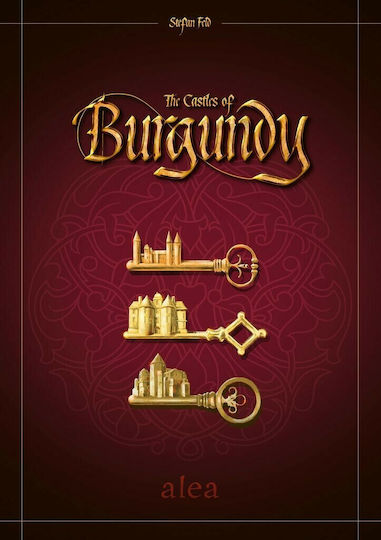
Castles of Burgundy Review
The Dice-Placement Masterpiece That Never Gets Old
Hook / First Impression
There are games that impress you the first time you play them, and games that reveal new depths on the fiftieth. Castles of Burgundy is firmly in the second category — a medium-weight eurogame that looks modest on the table, plays deceptively simply in the first few turns, and then quietly pulls you into one of the most satisfying optimization puzzles in the hobby. Designed by Stefan Feld and first published in 2011, it has spent over a decade near the top of BoardGameGeek's all-time rankings — a perch that is almost never accidental.
The premise: you are a 15th-century prince of Burgundy, building up your estate one hexagonal tile at a time, guided — and constrained — by two dice you roll each round. The magic is in how those dice, which should feel like pure luck, somehow become one of the most strategic tools in board gaming.
Overview
Castles of Burgundy is a dice-placement and tile-laying eurogame designed by Stefan Feld, originally published by alea / Ravensburger in 2011. A 25th Anniversary Edition with fully revamped artwork and components was released in 2023 by Ravensburger. Players take on the roles of French princes competing to build the most prosperous estate in the Burgundy region, earning Victory Points through efficient tile placement, trade routes, and timely set completion.
| At a glance | |
|---|---|
| Designer | Stefan Feld |
| Publisher | alea / Ravensburger |
| Year | 2011 (25th Anniversary Edition: 2023) |
| Players | 1–4 |
| Play time | 30–90 minutes |
| Age | 12+ |
| Weight | Medium (BGG ~3.0/5) |
| Victory condition | Most Victory Points after five phases |
Components & The Setting
The Setting: Each player assumes the role of a French aristocrat in 15th-century Burgundy, developing a personal estate from bare land into a network of castles, monasteries, mines, villages, and animal pastures. The theme is present and historically flavored without being immersive — Castles of Burgundy is fundamentally an abstract tile-laying puzzle wearing a pleasant medieval coat. Players who want deep narrative or campaign storytelling will not find it here; players who want a clean, well-integrated system with satisfying tactile decisions will be very happy.
Original edition components are the one genuine blemish on an otherwise excellent game. The artwork in the 2011 release is famously unattractive — muddy hex tiles with cramped iconography that experienced players learn to read fluently but that consistently confuses newcomers. Player boards are thin; the tiles feel serviceable rather than premium. The white dice are functional but unexciting. By modern eurogame standards, the original production is spartan to a fault — which explains why so many players sought out third-party upgrades for over a decade.
The 25th Anniversary Edition corrects almost every complaint. New artwork is crisp, thematic, and easy to parse at a glance. Tiles are thicker. The boards are larger and color-coded per player. Linen-finish cards replace bare cardboard. If you are buying Castles of Burgundy for the first time in 2025 or 2026, the Anniversary Edition is the unambiguous recommendation — same game, dramatically better presentation.
How to Play
The goal is to accumulate the most Victory Points by the end of five phases, each consisting of five rounds. VPs come from completing regions of your estate, trading goods, reaching milestones on the worker track, and end-game bonuses for animals and unused silver.
At the start of each round, every player rolls two personal dice. On your turn, you spend each die on one of three actions: take a tile from the central board (the die value determines which depot you draw from), place a tile onto your estate (the die value determines which region of your board is eligible), or sell goods from your estate (the die value determines which good type you sell). You may optionally spend workers (a limited currency) to adjust any die result by ±1 per worker, giving you flexibility when the dice don't cooperate.
Tiles are color-coded by terrain type: blue buildings each grant a unique immediate or ongoing bonus when placed; yellow mines generate silver income; green pastures score based on the number of unique animals you collect; grey knowledge tiles provide persistent advantages; beige castles let you take an extra action immediately; and dark yellow cities score based on completed districts. Completing a full region of your estate earns a VP bonus that scales with how early in the game you finish it — speed rewards the efficient.
Gameplay Feel
Pacing & Tension: Castles of Burgundy runs at a steady, contemplative pace — turns are short (30–60 seconds for experienced players), but the decisions within each turn are dense. You're never waiting for something dramatic to happen; the drama is quiet and internal — the satisfaction of placing the exact tile you needed, or the groan of a depot clearing out the piece you were counting on. By the end of phase three, most players feel the pleasant pressure of too many things to do and not enough turns to do them.
Player Interaction is low-to-moderate and indirect. You cannot directly attack another player's estate or block their actions. Competition happens through the central depot: tiles are a shared resource, and a key piece snatched by an opponent forces you to pivot. Watching which tiles your rivals take is as important as planning your own engine — knowing they're building toward animals tells you to compete for the same pastures before they clean out the depot.
Luck vs. Strategy Balance: This is where Castles of Burgundy earns its reputation. Dice introduce variance, but the worker adjustment mechanic, the breadth of each round's possible actions, and the sheer volume of decisions across 25 rounds mean that skilled players consistently outperform lucky ones over a full game. A bad run of dice costs a turn of efficiency; a good run of play recovers it. The game is not dice-light — randomness is structural — but it is deeply skill-rewarding in a way that few dice games achieve.
Rule Overhead: Moderate. Teaching Castles of Burgundy takes 20–25 minutes for a complete run-through, and the first game will reveal some rules confusion around tile-placement adjacency and building bonuses. A reference card (included in the Anniversary Edition, essential in the original) eliminates almost all mid-game lookups. By game two, the rules are invisible and the strategy is front and center.
Mechanics Deep-Dive
The Dice as a Resource
The dice in Castles of Burgundy are not random obstacles — they are the game's primary resource management puzzle. Rolling a 4 and a 6 doesn't mean "good roll" or "bad roll"; it means "here are the two tools you have this turn — what can you build with them?" The question isn't whether you got what you wanted; it's how well you can exploit what you got.
This framing is the key mental shift that separates frustrated players from happy ones. Experienced players plan estates that are flexible enough to use a range of die values productively in any given turn. A board that can only advance when you roll 2 or 5 is fragile; a board where a 3 lets you place a pasture, a 4 lets you grab a building, and a 6 lets you sell goods is robust. Building that robustness is the central strategic skill of the game.
The Scoring Engine
Castles of Burgundy rewards players who understand its VP multipliers. Completing a region early in the game earns substantially more points than completing it late. The difference between finishing a six-hex pasture in phase two versus phase five can be 15+ VP — a massive swing in a game where winning margins are often under 20 points.
- Region completion bonuses scale with time: Finish regions early and often. The VP bonus decays each phase, so an incomplete region at the end of the game is worth nothing beyond its tile bonuses.
- Animals reward diversity: Pasture regions score (number of animals in the region)² Victory Points. Maximising variety within a single region is more valuable than collecting many of the same animal across different regions.
- Buildings chain: Many blue building tiles trigger effects that compound — a market speeds up silver income, which buys more workers, which adjusts dice, which enables better tile placement. Identifying and completing a building chain early accelerates the rest of your game significantly.
- Castles as tempo: A beige castle tile grants an immediate extra action when placed. In a game where turns are the scarcest currency, a free action is often worth more than any tile bonus — use castles to bridge gaps when the dice are awkward.
- Knowledge tiles are invisible advantages: Grey knowledge tiles provide persistent passive effects that don't show up on the board but quietly warp the scoring math — a tile that grants +1 VP for every completed mine pays off every game; a tile that lets you adjust one die by 2 instead of 1 is a two-worker discount every turn.
The Depot System
The central board contains numbered depots (1–6, matching die faces) stocked with face-up tiles each round. To take a tile from depot 4, you must spend a die showing 4. This creates a fluid, competitive market — valuable tiles in high-probability depots (4, 5, 6) are contested; tiles in low-probability depots (1, 2) are safer but harder to claim. Knowing when to grab a tile immediately versus waiting a round (risking a rival takes it) is one of the game's most consistently engaging tension points.
Player Count Analysis
Solo — Excellent. The Anniversary Edition includes a polished solo mode with an automa deck that simulates an opponent drawing from the depot. The solo game captures the full optimization puzzle of the multiplayer experience — timed scoring pressure, contested tiles, strategic sequencing — without feeling like a stripped-down consolation prize. One of the best solo implementations of a eurogame in its weight class.
2 Players — Outstanding. Two players is arguably the finest Castles of Burgundy experience. Turns are fast, downtime is minimal, and the depot competition is intense — with only one rival taking tiles, every piece you covet is exactly the piece they also need. Tension is high and games run in 45–60 minutes. If you play primarily with one other person, this game should be near the top of your shortlist.
3 Players — Very Good. Three players adds a third competitor for the depot without meaningfully increasing downtime. The dynamics shift slightly — a tile that no one has taken by the third turn is almost certainly a trap, because two experienced players have already passed on it. Planning becomes marginally less predictable, which some groups find engaging and others find slightly frustrating. Still an excellent experience.
4 Players — Good, with caveats. Four-player Castles runs noticeably longer (90 minutes with experienced players; 120+ with learners), and downtime between turns becomes perceptible. The depot clears quickly, which can leave later players in a round with few desirable tiles. The game is still enjoyable at four, but the sharper experience is at two or three. If your group frequently plays at four, budget time accordingly and consider the Anniversary Edition's larger boards, which reduce some of the congestion.
Replayability
Castles of Burgundy has extraordinary replay value, driven by three interlocking sources of variety. First, each player board has a unique layout — the regions, their sizes, and their positions are fixed per board, but the boards themselves are all different, and the optimal strategy for board A looks nothing like the optimal strategy for board B. Playing all five boards (or the additional boards in the Anniversary Edition) keeps the strategic puzzle fresh across dozens of sessions.
Second, the tile pool randomizes each game. Which building effects appear, which animal tiles show up, and how the depots fill each round all vary. A knowledge tile that was irrelevant last game might be the cornerstone of your engine this game. No two sessions have the same decision landscape.
Third, and most importantly: the game rewards mastery in the way that only a small number of eurogames achieve. There is no ceiling where you feel you have "solved" Castles of Burgundy, because every session presents a slightly different combination of dice, tiles, boards, and opponent pressure. Players who have logged 50+ sessions report that new strategies and scoring lines are still emerging. The anniversary edition also introduced additional map boards and expanded tile sets, adding yet another layer of freshness for long-term fans.
Learning Curve
Ease of teaching: Moderate. The core loop — roll, spend dice on actions, place tiles — takes about 10 minutes to explain. The complexity lurks in the tile-specific effects: each of the six terrain types has its own scoring rule, and blue building tiles each do something different. Trying to explain all tile effects before the first game is counterproductive. The better approach is to teach the action structure, hand everyone a quick-reference card, and let tile effects explain themselves when they are drawn.
Rulebook quality: Mixed in the original edition — functional but dense, with several interactions that require FAQ clarification. The Anniversary Edition rulebook is substantially clearer, with better examples and explicit notes on common edge cases. Both editions benefit from the widely available community reference cards that condense tile rules onto a single page.
First-game experience: New players almost always end their first game feeling they made several mistakes they can now see clearly — which is a hallmark of a well-designed eurogame. The game is not punishing; it is instructive. Mistakes in tile placement are visible and educational, not devastating. Most players who enjoy medium-weight strategy games are eager to play a second game immediately after their first, specifically because they can already see a better path. That is the Castles of Burgundy learning curve in miniature: the rules click fast, mastery builds slowly, and every game teaches you something new.
Who It's For
Strategy gamers who want depth without marathon sessions: Castles of Burgundy is the go-to recommendation for players who want genuine strategic complexity in a 60–90 minute box. It sits perfectly in the gap between gateway games and heavy eurogames — accessible enough to teach in an evening, deep enough to reward dozens of sessions.
Couples and two-player households: The two-player experience is excellent, the session length is manageable, and the game scales beautifully at low player counts. It is one of the most-played two-player eurogames in the hobby for good reason.
Solo players: The solo mode is genuinely rewarding, not a tacked-on afterthought. If you enjoy optimization puzzles and want a game you can play alone without sacrificing depth, this belongs in your collection.
Comparisons: If Castles of Burgundy appeals to you but you want more thematic weight, Viticulture scratches a similar worker-placement itch with richer storytelling. If you want a lighter, more accessible tile-layer, Cascadia is excellent. For players who love the dice-as-resource concept but want something more chaotic and social, King of Tokyo scratches a completely different itch. Players who graduate from Castles looking for heavier optimization should look at Agricola or Tzolk'in.
Who it's not for: Players who dislike any dice involvement will find the randomness frustrating even with the worker adjustment system. Groups that primarily want social interaction and negotiation will find Castles too heads-down and solitary. It is a thinker's game that happens to play quickly — not a party game with mechanical depth underneath.
Pros & Cons
What Castles of Burgundy does exceptionally well:
- Transforms dice from a luck mechanic into a resource management puzzle — a rare design achievement that most dice games never manage.
- Outstanding at one and two players; one of the best two-player eurogames ever published.
- Extraordinary replayability driven by varied player boards, randomized tile pools, and deep mastery curve — still teaching new strategies after 50+ plays.
- Every turn is meaningful — even bad dice rolls present genuine decisions, never dead turns.
- Session length is honest and manageable: 60–90 minutes with experienced players, never overstaying its welcome.
- The 25th Anniversary Edition corrects the original's component shortcomings without changing a single rule.
- Excellent solo mode that captures the full strategic experience.
Where Castles of Burgundy struggles:
- Original edition components are aesthetically poor by modern standards — muddy artwork, cramped icons, thin tiles. Seek out the Anniversary Edition or budget for third-party upgrades.
- The tile-effect variety, while a strength for experienced players, creates a steep initial information load for newcomers — reference cards are mandatory, not optional.
- Player interaction is indirect and low; players who want conflict, trading, or negotiation will feel the game is played almost entirely in isolation, despite sitting at the same table.
- At four players, downtime accumulates and games stretch to 90–120 minutes — the sharp experience is at two or three.
- The adjacency placement rules catch new players frequently, especially in the first game; mistakes made in the first phase can be difficult to recover from.
Expansions & Ecosystem
The original Castles of Burgundy received five numbered expansion packs (sold individually as small blister packs), each adding new player boards, tile types, or rule modules. The content across all five expansions was substantial, but the individual format made purchasing and cataloguing them impractical for most players.
25th Anniversary Edition — The definitive version ★★★★★
Rather than continuing the blister-pack expansion model, the 2023 Anniversary Edition consolidated the base game with substantially upgraded components, multiple additional player boards (including asymmetric boards with unique starting conditions), and expanded tile sets. If you are buying Castles of Burgundy for the first time, this is the only version worth considering. It contains everything you need for years of play without needing to hunt down individual expansions.
Original Expansion Packs (1–5) — For existing original-edition owners ★★★☆☆
The five expansion packs for the original edition added new boards, a solo automa variant, and additional tile types including ships and new building effects. They are worth seeking out only if you already own the original edition and don't plan to upgrade. The content is good — the format is just cumbersome. Notable highlights: Expansion 5 introduced the solo automa, which was later refined and incorporated into the Anniversary Edition. Expansion 3 added new player boards that significantly change the strategic calculus and extend the game's replayability noticeably.
Value for Money
The original Castles of Burgundy edition retailed for approximately $35–45 USD — exceptionally good value for its depth, particularly given the widespread availability of second-hand copies in excellent condition. The 25th Anniversary Edition commands a higher price of approximately $70–90 USD, reflecting the substantial component upgrade and expanded content. Both represent strong value by hobby standards.
The per-session cost of Castles of Burgundy is among the lowest of any eurogame in its weight class. Groups that play regularly amortize the cost across 30, 50, or 100+ sessions — at that point the cost per play is measured in cents, not dollars. For players who know they enjoy medium-weight strategy games, this is one of the safest purchases in the hobby.
- New to the hobby or medium-weight eurogames: Start with the Anniversary Edition. The improved components meaningfully reduce teaching friction, the additional boards extend your first year of play significantly, and you avoid the frustration of the original's visual design.
- Already own the original edition: The Anniversary Edition is a meaningful upgrade, not a mandatory one. If the game is already a regular at your table and the components aren't bothering you, put the upgrade budget toward a different game.
- Budget-conscious buyers: A used original edition for $10–15 is one of the best-value purchases in the hobby. The gameplay is identical; you're accepting suboptimal components in exchange for outstanding strategic depth at a fraction of the retail price.
- Solo players: Either edition's solo mode is a genuine standalone experience. This is the rare case where a solo player is not getting a diminished version of the game.
Accessibility
Color blindness: A notable concern in the original edition, where terrain types are distinguished primarily by the color of the hexagonal tiles — green pastures, yellow mines, blue buildings, grey knowledge, beige castles, and dark yellow cities. Red-green color blindness in particular can make certain tile types difficult to distinguish under standard lighting. The Anniversary Edition improves this significantly with clearer iconography and better color contrast. Reference cards, which label terrain types explicitly, are a practical workaround for either edition.
Language dependence: Moderate. Building tiles carry unique text effects that must be read and understood during play. An English-language reference card covering all tile effects is the primary language tool needed — one per player is ideal. Fortunately, community-created reference cards in multiple languages are widely available online. The game itself runs smoothly once players have the reference card in hand.
Cognitive accessibility: Castles of Burgundy is a sustained decision-heavy game. Players must track their own board state, the depot contents, rival progress, and the evolving value of available tiles simultaneously. This is not a game that can be played passively — it demands focused attention across a full session. Players who find analysis-intensive games tiring may find the experience exhausting rather than enjoyable. The turn structure is well-defined and repetitive, which helps — once the action sequence is internalized, the cognitive load shifts entirely to strategy rather than rules recall.
Physical accessibility: The hexagonal tiles are small-to-medium in size — comfortable for most players, but potentially fiddly for those with limited dexterity. The Anniversary Edition's larger tiles are a modest improvement. Player boards lie flat and are easy to read from across the table. Dice are standard size. No cards need frequent shuffling mid-game. Overall: manageable for most players, with the small tile size being the primary potential friction point.
Age range: The 12+ rating is accurate. Younger players (8–11) who are comfortable with multi-step planning can participate with adult support, but the tile-effect variety and VP calculation are genuine cognitive demands. This is not a family-weight game in the Ticket to Ride sense — it is a strategy game with a sensible age recommendation.
Verdict
Castles of Burgundy is one of the most quietly brilliant board games ever designed. It takes a mechanism — rolling dice — that most designers use to inject luck, and converts it into the most interesting planning tool in its weight class. It is not flashy. It has no miniatures, no hidden traitor, no dramatic social deduction. What it has is a precision-engineered optimization puzzle that rewards thoughtful play over dozens of sessions without ever feeling solved.
The original edition's component quality is a real obstacle for new players in 2025 — but the 25th Anniversary Edition removes that excuse entirely. There has never been a better time to own this game.
Buy it if: you enjoy strategy games that reward planning and flexibility, you play primarily at one to three players, or you want a solo game that delivers the full strategic experience.
Skip it if: you want high social interaction, negotiation, or direct conflict — this game is heads-down planning, not table diplomacy.
Buy the Anniversary Edition if: you are purchasing for the first time — the upgraded components are worth the price premium for the vastly improved teaching experience and long-term playability.
Score Breakdown
Love board game night? Explore our tools, score calculators, and strategy guides — everything you need to play better and have more fun.
Browse All Articles →