Hues and Cues Review
The Game That Exposes How Differently We All See the Same Colour
Hook / First Impression
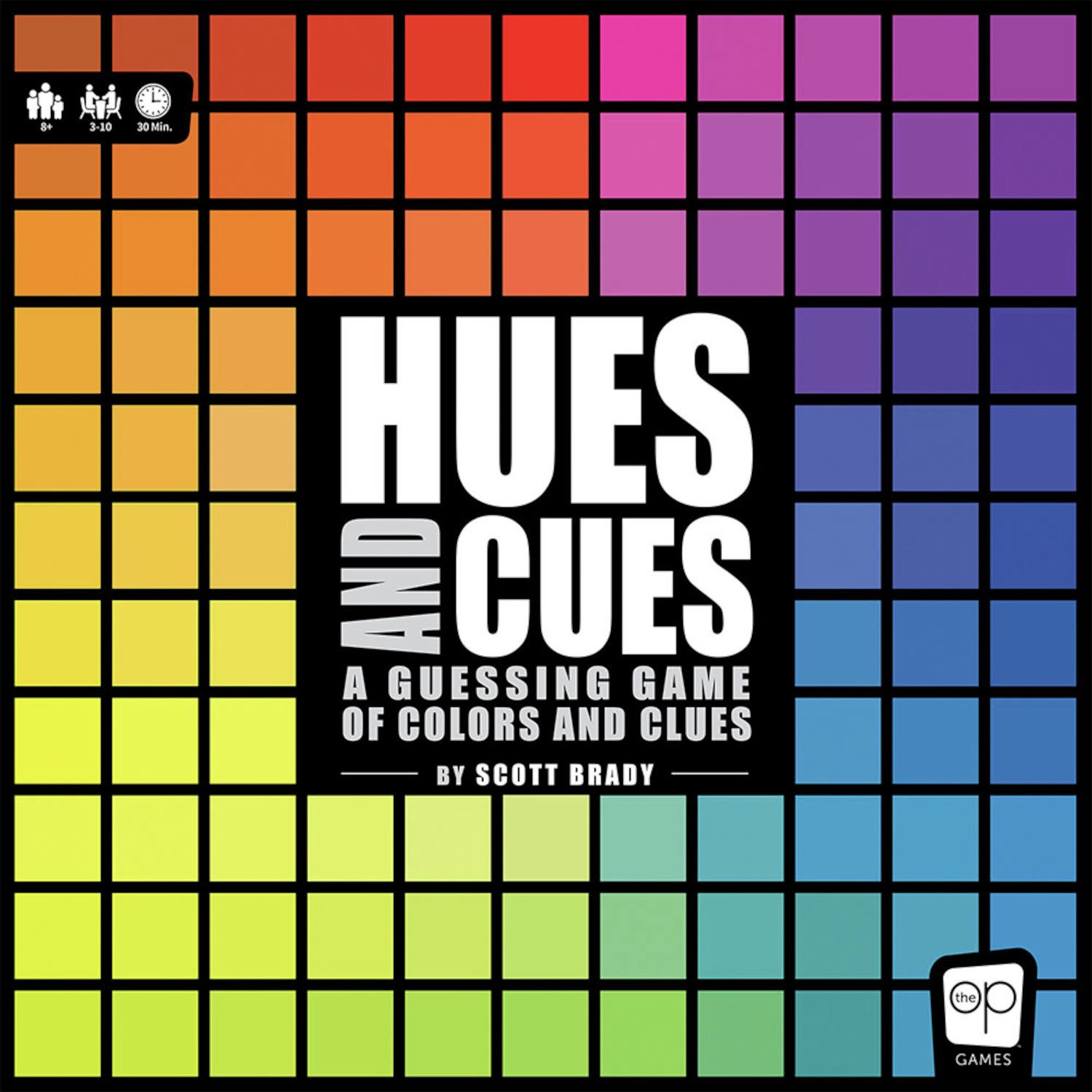
At first glance, Hues and Cues looks impossibly simple: a large board covered in a grid of 480 colour swatches, a deck of cards, and the premise that you say one or two words to point your teammates toward a specific shade. No categories, no letters, no numbers — just language and colour. Then someone says "grandma's kitchen" for a particular beige and half the table places their cones in completely different corners of the board, and you realise this game is doing something quietly fascinating.
Hues and Cues is a game about the gap between perception and communication. Everyone at the table is looking at the same 480 colours, but how you describe a specific shade — and how others interpret your description — is shaped by memory, culture, and the particular texture of individual experience. No other party game surfaces that gap as quickly or as entertainingly.
Overview
Hues and Cues is a colour-guessing party game designed by Scott Brady and published by The Op (USAopoly) in 2020. On their turn, the active clue-giver draws a card showing the coordinates of a specific colour swatch on the board, then gives one-word and two-word clues across two rounds while other players place coloured cones as close to the target as they can. Points are awarded based on proximity — the closer your cone, the more you score.
| At a glance | |
|---|---|
| Designer | Scott Brady |
| Publisher | The Op (USAopoly) |
| Year | 2020 |
| Players | 3–10 |
| Play time | 30–45 minutes |
| Age | 7+ |
| Weight | Very light (BGG ~1.1/5) |
| Victory condition | Most points after all players have been clue-giver twice |
Components & The Setting
The Setting: There is no narrative or theme — the entire game lives on the board itself, a large, meticulously designed grid of 480 distinct colour swatches arranged from warm to cool, light to dark. The board is the star, and it is genuinely beautiful. Players who enjoy colour design, painting, or visual art will find themselves studying it before the first card is even drawn. It doubles, inadvertently, as a piece of wall art.
Component quality is a clear strength. The game board is large (the standard edition measures roughly 20 × 20 inches) with a matte finish that prevents glare under typical table lighting. The colour printing is impressively consistent — a critical requirement for a game whose entire premise depends on distinct, accurate shades. The player cones are chunky, satisfying to place, and colour-coded clearly enough for most vision types. The card deck is thick and durable, and the game includes a scoring track, rulebook, and storage insert that actually works.
How to Play
The goal is to score the most points by placing your cone closest to the target colour swatch on the board. The active player is the clue-giver each round; everyone else is guessing.
On your turn as clue-giver:
- Draw a card and locate your secret target colour on the board using the grid coordinates printed on the card.
- Round 1 — one-word clue: Give a single word that describes or evokes the target colour. All other players immediately place one of their cones anywhere on the board.
- Round 2 — two-word clue: Give a two-word phrase as a second, more refined clue. All other players place a second cone, adjusting their guess.
- Reveal: Place the target marker on the actual colour. Score cones based on how close they are: 3 points for the innermost ring, 2 points for the next, 1 point for the outermost — and 0 for anything beyond. The clue-giver scores 2 points for every cone that lands in the scoring zone.
Play continues clockwise until each player has been clue-giver twice. Highest score wins.
Gameplay Feel
Pacing & Tension: Hues and Cues is a relaxed, convivial experience rather than a tense one. The moments of drama come not from competition or elimination but from revelation — the collective gasp when the target is revealed and half the table placed their cones in a completely different region, or the delighted laughter when five cones cluster within a square inch of each other because one word landed perfectly. It is a game of small, warm surprises rather than mounting stakes.
Player Interaction is indirect but continuous. Everyone is watching the board, watching each other's cones, and making inferences: if they moved their cone to that purple-blue corner after the second clue, they must see it differently than I do. The scoring means the clue-giver wants everyone to land close but not too close — you are actively trying to be precise without being perfectly decoded, which creates a light tension in clue crafting that most players find engaging without feeling competitive.
Luck vs. Strategy Balance: There is no luck in Hues and Cues. Every outcome is a product of vocabulary, cultural association, and spatial reasoning. Cards are drawn randomly, so some targets are objectively easier to describe (a vivid, primary red) and some are brutally hard (a muddy, brown-adjacent taupe that sits between four equally plausible descriptions). But within a given card, the result is entirely determined by how good your clue is and how well your table knows you. Skill dominates.
Rule Overhead: Effectively zero. The rules take five minutes to explain and cover two pages. There are no exceptions, no edge cases, and no special abilities. The only recurring question at new-player tables is what counts as a "word" (compound modifiers, proper nouns, and brand names are the three areas the rulebook addresses directly).
Mechanics Deep-Dive
The Colour Space as Puzzle
The 480-swatch grid is arranged along two axes — hue (warm to cool, left to right) and luminosity (light to dark, top to bottom). This structure means experienced players can use directional language efficiently: "deep ocean" pulls people toward dark, cool blues; "peach fuzz" lands in warm, light pinks. Clue-givers who internalise the board's layout consistently outperform those who treat it as an undifferentiated mass of swatches.
The scoring proximity system — concentric rings awarding 3, 2, and 1 point — creates a gradient of success rather than a binary hit-or-miss. This matters enormously for feel: in most party games, a close miss is as worthless as a wild miss. In Hues and Cues, being almost right has genuine value, which means players feel rewarded for reasonable interpretation even when they don't land precisely on target.
The Clue-Giver's Dilemma
Because clue-givers score based on how many cones land in the scoring zone, there is a built-in incentive to find clues that are precise enough to cluster guesses tightly but not so precise that everyone lands in a tiny area the game rewards the same regardless. In practice, the dilemma sharpens most when the target colour is genuinely ambiguous — is this green-yellow or yellow-green? — and the clue-giver knows that different players at the table have different internal mappings of the spectrum.
Player Count Analysis
Solo — Not supported. The game requires guessers to function. There is no solo variant and no practical way to create one from the base box.
3 Players — Functional, but thin. Three players works but produces sparse cone placement — only two guessers per round means each reveal is low-energy, and the scoring trajectory feels slow. The game's social pleasures scale with the number of viewpoints landing on the board simultaneously. Three is the minimum viable experience; push for four or more when you have the option.
4–6 Players — The sweet spot. Four to six players is where Hues and Cues is at its best. There are enough guessers to produce genuinely diverse cone placements — the moments where half the table lands in the warm oranges and the other half clusters in dusty roses — while keeping the reveal phase crisp and legible. Five players is our single recommended count for the sharpest balance of chaos and clarity.
7–10 Players — Party mode. At larger counts the board gets crowded with cones and the scoring overhead increases, but the game remains playable and the diversity of guesses creates louder table reactions. Managing cone placement logistics at ten players requires a patient moderator, but the payoff is correspondingly larger group energy at each reveal. Recommended only if someone at the table is comfortable running the scoring.
Replayability
Hues and Cues has deceptively strong replayability for a game this simple. The card deck contains 165 double-sided cards for 330 distinct colour targets — more than enough for dozens of sessions before repetition becomes noticeable. But more than the deck size, the game's replayability comes from its personnel dependency: the same colour card played with different people produces an entirely different game.
Playing with a group of artists, painters, or designers produces games thick with technical colour vocabulary — "cerulean," "sienna," "chartreuse" — that land with high precision. Playing with non-specialists produces broader, more evocative clues — "hospital," "autumn," "tax form" — that scatter cones across larger sections of the board and generate more collective laughter. Neither experience gets old quickly, and the two are meaningfully different.
Within a regular group, the game also develops a personal metagame: players learn each other's colour associations, anticipate each other's cluing tendencies, and use that knowledge to place cones more precisely over time. This accumulated familiarity is a genuine long-term replayability driver that most party games lack entirely.
Learning Curve
Ease of teaching: Extremely easy. The rules can be explained in under three minutes to any adult group and in five with children. There are no card abilities to memorise, no special actions, and no complex scoring edge cases. The two-sentence summary — you give colour clues, everyone places cones, closest to the target scores most — is genuinely sufficient as a teaching prompt. New players are fully functional before their first turn ends.
Rulebook quality: Clear and efficient. The rulebook addresses the most common edge cases (can you use a colour name as a clue? — yes; can you use a brand name? — yes; can you gesture at the board? — no) and is structured so that a single player can read it cold and teach the game immediately. No player has ever needed to re-read a rule mid-session.
First-game experience: Almost universally positive, with one consistent caveat: first-time clue-givers frequently underestimate how difficult precise colour communication is. The first round of any new-player session typically produces wide cone scatter and some bewildered reveals — I said "sky" and you went to teal? — which is funny rather than frustrating, and which immediately teaches the actual skill the game is asking for. By the second round of their first session, most players have recalibrated and the game clicks.
Who It's For
Mixed-experience groups and non-gamers: Hues and Cues is one of the cleanest gateway party games available. It asks for nothing beyond vocabulary and perception — no gaming literacy, no strategy knowledge, no genre familiarity. Non-gamers consistently enjoy it without needing to be sold on the hobby. It is the rare game that works equally well as the main event and as the first experience someone has with board gaming.
Creative professionals and visual thinkers: Artists, designers, photographers, and anyone who works with colour professionally will find a particularly satisfying layer of play in the gap between their specialised vocabulary and the general population's. Watching your careful technical clue produce bewilderingly off-target results is an instructive and entertaining lesson in communication.
Families: An excellent family pick from age 7 upward. Children often outperform adults at colour games because their associations are fresher and less filtered — a child saying "dinosaur egg" for a particular green-brown will sometimes land the entire family in the right zone while adult over-thinkers scatter. The game does not punish inexperience.
Comparisons: Dixit is the closest spiritual relative — both are about finding the calibrated clue that lands with enough players but not all of them. Dixit uses abstract imagery as the puzzle space; Hues and Cues uses the colour spectrum, which makes it more grounded and easier to teach. Codenames shares the one-word-covers-multiple-targets structure but adds competitive pressure and a failure state; Hues and Cues is kinder and more social. Wavelength is the most direct mechanical cousin — both games ask you to place a marker on a spectrum based on a clue — but Wavelength uses conceptual opposites rather than colour, which produces a different flavour of conversation.
Pros & Cons
What Hues and Cues does well:
- The premise is immediately legible to anyone — no gaming background required to understand what you are trying to do.
- The board is genuinely beautiful and functions as a conversation piece before the game even starts.
- Reveals produce reliable collective reactions — the mix of groans, laughs, and vindicated "I told you so" is consistent across almost every group.
- Skill-based throughout with no luck, meaning better calibrators and better communicators consistently do better over a full session.
- Scales gracefully from 3 to 10 players without rule modifications — the same game works at any count.
- Develops a satisfying long-term metagame with regular groups as players learn each other's colour associations.
- No player elimination, no hidden roles, no catch-up mechanics — the experience is reliably calm and non-confrontational.
Where Hues and Cues struggles:
- Some target cards fall in areas of the board with near-identical adjacent swatches, making clue-giving frustrating rather than challenging — the game has no skip or redraw mechanism.
- Requires a large table with good lighting — the viewing experience is meaningfully worse from the sides of the board versus the top, and harsh overhead lighting flattens swatch distinctions.
- Colour vision deficiencies affect the experience significantly — a player who cannot distinguish certain hue ranges is at a genuine disadvantage that no rule accommodation fully addresses.
- The scoring system, while clear, requires a moderator to track proximity rings accurately at larger player counts — it can slow the reveal phase if the table is crowded.
- The game has no expansions, no variant modes, and no official way to extend the card pool — when the 330 targets feel familiar, there is nowhere else to go.
Expansions & Ecosystem
Hues and Cues currently has no official expansions. The Op has not released additional card packs or variant boxes, and the game's ecosystem remains limited to the single base edition — available in standard size and, in some markets, a travel edition with a smaller board.
The lack of expansions is a practical limitation for dedicated groups: once the 330-card deck is exhausted, the only novelty comes from new players, not new content. There is no official solo mode, no team variant, and no competitive format beyond the base scoring system. House-rule communities have created unofficial variants — timed clue-giving, restricted vocabulary categories, photography-themed clue sessions — but none are published by the designer.
Value for Money
Hues and Cues retails for approximately $25–$35 USD (€22–30 in Europe). Given the component quality — a large, well-printed board, satisfying chunky cones, a generous card deck — the price is fair to good for a party game in this tier.
- Casual hosts and gift buyers: An excellent choice. The game looks premium on the table, teaches in minutes, and works for any gathering from family dinner to games night with strangers. The visual appeal makes it a confident gift for anyone who hosts regularly.
- Party game collectors: Worth owning. It fills a specific niche — the social, non-competitive, perception-focused party game — that few other titles occupy as cleanly. It will not replace your copy of Dixit but it earns shelf space alongside it.
- Strategy gamers: The price is low but the return may disappoint — there is no mechanical depth to explore, no strategic layer to develop, and no variant mode to sustain interest after the novelty fades. If party games are not already part of your rotation, this will not convert you.
- Budget-conscious buyers: The lack of expansions means you are making a one-time purchase with a fixed content ceiling. At this price, that is acceptable; at a higher price it would be a liability.
Accessibility
Colour blindness: This is Hues and Cues' most significant accessibility challenge, and it is an honest one given the game's premise. Players with red-green colour deficiency (the most common form) will struggle to distinguish adjacent swatches in affected areas of the board, particularly in the yellow-green-brown range and in low-saturation passages. The game does not include a colour-blind friendly variant or alternative labelling. Players with more severe deficiencies may find the core activity inaccessible. This should be disclosed before purchasing for a group with known colour vision impairment.
Language dependence: High for the clue-giver role — the entire game is built around verbal colour description, and a player with limited vocabulary in the table's shared language will struggle significantly. For guessers, the game is playable with minimal language comprehension once the cone placement mechanics are understood. Non-English editions are available in several markets.
Cognitive accessibility: Very good for a party game. The rules are minimal, the turn structure is always identical, and there is no hidden information, hand management, or multi-step decision-making to track. Players with attention or memory challenges can participate fully in the guesser role; the clue-giver role adds modest vocabulary pressure that may be challenging for some.
Physical accessibility: The cones are easy to pick up and place for most players. The board size requires reaching across a large surface, which may be awkward for players with limited range of motion — seating placement near the relevant board quadrant mitigates this. A card holder or physical reading aid supports players who struggle to hold a card steady while locating coordinates.
Age range: The 7+ rating is accurate. Younger children can participate as guessers with adult support. The game contains no dark themes or age-inappropriate content.
Verdict
Hues and Cues is one of the most elegantly conceived party games of the past decade. The premise is deceptively simple — point your friends at a colour using words — but the execution exposes something genuinely interesting about how differently people map language onto perception. Every reveal is a small window into how someone else's brain works, and that novelty does not wear off the way mechanical game novelty does.
Its weaknesses are real: colour-blind players face a structural disadvantage, a handful of card draws fall in near-indistinguishable board zones, and the absence of any expansion keeps the long-term content ceiling low. For regular groups who play it weekly, these issues will eventually surface. For groups who play it monthly or with rotating casts of guests, they are marginal concerns against a very strong core experience.
Buy it if: you host mixed groups, want a beautiful, easy-to-teach party game with no competitive friction, and appreciate games that generate genuine conversation about perception and association rather than just points.
Skip it if: you or a regular player at your table has significant colour vision deficiency, you prefer games with strategic depth, or your group plays often enough with the same people that a fixed card ceiling will become limiting within a few months.
Pair it with: Dixit for a complementary evening of perception-focused party games — one uses imagery, one uses colour, and together they cover the same underlying skill from two distinct angles.
Score Breakdown
Love board game night? Explore our tools, score calculators, and strategy guides — everything you need to play better and have more fun.
Browse All Articles →