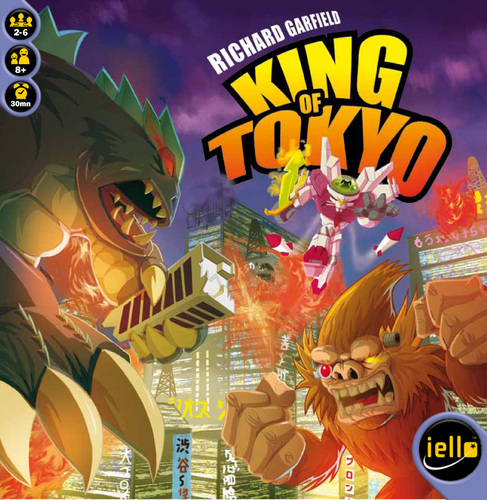
King of Tokyo Review
Roll Dice. Smash Monsters. Claim the City. Survive.
Hook / First Impression
There is a tension at the heart of dice games that most designers quietly surrender to: the more meaningful the dice rolls, the more the game rewards luck; the more you layer strategy on top, the slower and heavier the game gets. King of Tokyo refuses this trade-off. Richard Garfield — the designer who created Magic: The Gathering — found an elegant solution by making the central decision not about what you roll, but about where you stand. Do you stay in Tokyo and absorb punishment while banking victory points? Or do you leave, cede the throne, heal your wounds, and wait for the right moment to strike back? That single question, asked on every turn throughout the game, is why King of Tokyo has remained one of the most-played gateway games in the hobby for over a decade.
Published in 2011 by IELLO and revised in a second edition in 2016, King of Tokyo distils the essence of a Kaiju movie into a 30-minute dice-rolling brawl for two to six players. The presentation — giant monster standees, chunky custom dice, comic-book card art — signals immediately that this is not a game trying to be serious. It is trying to be fun. It succeeds comprehensively.
Overview
In King of Tokyo, each player controls a giant monster — Gigazaur, Meka Dragon, Alienoid, Cyber Bunny, The King, or Kraken — fighting to be the last creature standing or the first to reach 20 victory points. The city of Tokyo sits at the centre of the table: a coveted throne that generates points but makes its occupant a target for every other player simultaneously.
| At a glance | |
|---|---|
| Designer | Richard Garfield |
| Publisher | IELLO |
| Year | 2011 (2nd Edition: 2016) |
| Players | 2–6 |
| Play time | 30–45 minutes |
| Age | 8+ |
| Weight | Light (BGG ~1.5/5) |
| Victory condition | Reach 20 victory points, or be the last monster standing |
Components & The Setting
The Setting: Players are Kaiju — giant monsters of the Godzilla school — rampaging through and around Tokyo. The theme is completely and deliberately non-serious: the monster standees are cartoonish, the card artwork is pulpy and exaggerated, and the game's tone is cheerfully violent in the way a Saturday-morning cartoon is violent. The theme is deeply integrated into the experience in the sense that it perfectly matches the chaos of the game mechanics, but it is not a simulation — you never feel like you are managing a monster's biology or tactics. You feel like you are playing a monster movie where the monsters are also rolling dice.
The second edition components are a meaningful improvement over the original. The six custom dice — large, chunky, and satisfying to roll — are identical in both editions but cleaner in the second. The six monster dashboards track health (ten hearts) and victory points in two rotating dials, which is tactile and practical. The 66 power cards are the visual highlight: illustrated in a bold comic-book style with enough variety that the deck feels fresh across many sessions. The Tokyo board is simple — a single cardboard tile marking the city space — but it does its job without requiring more complexity.
Component quality is solidly above average for a game at this price point. The dice feel premium. The standees are large enough to command table presence. The dials are smooth and durable. The card stock is adequate but benefits from sleeving if played frequently. The box insert is functional but will not win awards. Overall: a well-produced game that delivers on its visual promises.
How to Play
The goal is to be the first monster to reach 20 victory points or the last monster standing after all others have been eliminated (reduced to zero health). Both victory conditions are live throughout the game, which creates a dual-track tension: you can race for points or destroy opponents, and the balance between these two approaches defines the game's strategic texture.
On your turn, you roll all six dice and may re-roll any subset up to two additional times — a classic Yahtzee-style mechanism. The six die faces are:
- 1, 2, 3 — rolling three or more of the same number scores victory points equal to that number, plus one additional point per extra matching die above three. Three 1s score 1 VP; four 2s score 3 VP; six 3s score 8 VP.
- Lightning bolt (⚡) — each lightning bolt earns one energy cube. Energy is spent to purchase power cards from the face-up market.
- Heart (❤️) — each heart heals one damage, but only if you are outside Tokyo. Healing while inside Tokyo is not permitted.
- Claw (👊) — each claw deals one damage. If you are outside Tokyo, claws damage all monsters inside. If you are inside Tokyo, claws damage all monsters outside simultaneously.
The Tokyo mechanic is the game's defining rule. At the start of the game, Tokyo is empty. The first player to roll at least one claw enters Tokyo and immediately scores 1 VP. While in Tokyo, you score 2 VP at the start of each subsequent turn — a passive income that accelerates your path to 20. But you cannot heal, and every other player's claw rolls are directed at you. When you take damage while inside Tokyo, you may choose to yield: leave Tokyo, take no more damage from that attack, and let the attacking monster take your place. The decision to stay or yield is the game's central tension, and it is genuinely agonising at the right health levels.
Gameplay Feel
Pacing & Tension: King of Tokyo plays at a brisk, energetic pace. Turns are short — roll, keep, roll again, buy a card, deal damage — and the game never stalls. The tension is concentrated in two moments: the Yahtzee-style re-roll decisions (do I commit to hearts and heal, or pivot to claws and attack?) and the yield decision (do I leave Tokyo now or gamble that I can survive one more round?). Both decisions are emotionally charged in the way that only dice games can manage: you are never in control, but you always feel responsible for the outcome. King of Tokyo is a game where players cheer and groan loudly throughout, which is exactly right for its design intent.
Player Interaction is high and direct. Unlike many euro games where interaction is primarily economic or positional, King of Tokyo's interaction is immediate and physical — you are rolling dice specifically to hurt other players, and the choice of who to target (and how much damage to accept) is made every single turn. The Tokyo mechanic ensures that one player is always the focal point of all aggression, which creates a rhythm of crowning a King, destroying the King, and crowning a new one. This creates dramatic narrative arcs within sessions: the monster who has been in Tokyo for four rounds and built a card engine is both the most threatening and the most satisfying to finally knock out.
Luck vs. Strategy Balance: King of Tokyo is a luck-heavy game, and it does not pretend otherwise. You will lose sessions because the dice refused to cooperate at a critical moment, and this is by design. The strategic layer — managing re-rolls, reading the card market, timing your Tokyo entries and exits — narrows the variance but does not eliminate it. The game's genius is that this variance feels exciting rather than frustrating, because the decisions are fast and the consequences are immediate. You are not spending an hour building a strategy that luck destroys in one die roll; you are spending 30 minutes in an improv comedy where dice are the punchlines.
Rule Overhead: King of Tokyo is one of the most teachable games in the hobby. The rules fit on a single reference card per player, and the core loop — roll dice, keep results, do what the symbols say — is intuitive to anyone who has played Yahtzee. The one rule that requires explanation is the Tokyo mechanic, which takes about ninety seconds to explain and is fully understood by every player at the table within two turns. First-game sessions, including setup and rule explanation, routinely finish in under 45 minutes.
Mechanics Deep-Dive
The Dual Victory Condition
The coexistence of two victory conditions — 20 points or last monster standing — is King of Tokyo's most underappreciated design decision. It prevents the game from collapsing into pure aggression or pure point racing. A player who focuses entirely on combat will eventually eliminate enough opponents to win by survival, but their own health will be depleted in the process, leaving them vulnerable to a counter-attack. A player who races for 20 points by camping Tokyo will generate so much VP that opponents are forced to attack them aggressively or concede the victory — which pulls the aggressor into Tokyo and makes them a target. The two conditions are in constant tension, and the best players are those who read which condition their current game state is pushing them toward and adjust accordingly.
The Re-Roll Decision
The Yahtzee mechanism — roll six dice, set aside keepers, re-roll the rest up to twice — seems simple but contains real decision depth in King of Tokyo. The key insight is that the six die faces are not equal in value across all game states. Hearts have zero value if you are in Tokyo. Lightning bolts have diminishing value if you already have more energy than any available card costs. Claws have variable value depending on who is in Tokyo and how close they are to elimination. The re-roll decision requires constant reassessment of the current board state, not just optimisation of a single-session preference. A player who always re-rolls for claws is playing a simpler game than King of Tokyo is offering.
The Power Card Engine
The 66 power cards are what elevate King of Tokyo from a pure dice roller into a game with meaningful session-to-session variety. The deck contains roughly equal distributions of aggressive cards (extra damage, stolen VP), defensive cards (extra health, damage immunity), and economic cards (extra energy, card discounts). The most powerful cards cost four to five energy cubes and provide effects strong enough to swing a game — permanent extra damage per attack, VP at the start of each turn, the ability to re-enter Tokyo immediately after yielding. Recognising which cards are available in the current market, planning your energy accumulation around them, and buying them before opponents can is a skill that separates experienced players from new ones.
Cards also create the game's most memorable moments. The card that gives you 2 VP every time you roll three of a number suddenly makes number-focused re-rolls dominant. The card that lets you deal 1 damage to all opponents at the start of your turn turns you into a passive attacker without spending a single claw face. The card that gives you two extra health resets your risk calculation for Tokyo occupation entirely. The card market introduces a semi-randomised drafting layer that gives King of Tokyo a different strategic texture every session.
The Tokyo Entry and Yield Decision
The yield decision deserves extended analysis because it is the game's most richly contextual choice. When you are in Tokyo at eight health and take three damage, leaving is objectively correct — five health is enough buffer to re-enter at a favourable moment. When you are in Tokyo at four health and take two damage, leaving at two health is probably correct even though it feels cowardly, because two health leaves you one bad attack from elimination. When you are at 18 victory points and in Tokyo, leaving for any reason is almost never correct — the two VP per turn from Tokyo is your fastest path to the win condition you are two points from reaching. The yield decision is a continuous cost-benefit calculation that no formula can resolve; it requires reading the current board, the remaining player count, and the card powers in play. It is the decision that King of Tokyo players replay mentally after losing sessions.
Player Count Analysis
2 Players — Functional but thin. At two players, the game reduces to a direct duel between two monsters. Each player takes turns entering and yielding Tokyo, alternating aggression and recovery. There is no ganging-up dynamic, no opportunity to let other players weaken the leader before you strike, and no chaos. The game works mechanically but loses most of its social texture. For a dedicated two-player experience, King of New York (discussed below) or a different game entirely is a better choice. King of Tokyo at two players is a reasonable option when nothing else is available; it is not the game's natural form.
3–4 Players — Good. The game functions well at three and four players. Four players produces clean Tokyo dynamics — one monster in the city, three outside — that create consistent target concentration. Three players is slightly more tense, as losing one player removes a significant portion of the game's aggression and can push the survivor into a heads-up game prematurely. Both counts produce satisfying 30-minute sessions and are the most common King of Tokyo configurations.
5–6 Players — Excellent. King of Tokyo at five or six players is the game at its most entertaining, provided everyone at the table is comfortable with elimination mechanics. The chaos increases substantially — more players means more cards entering the market, more varied attack patterns, and more unpredictable board states. The elimination dynamic also intensifies: a player eliminated early in a six-player game faces a potentially long wait, which is King of Tokyo's most significant structural weakness at high counts. Managing this requires either fast session pacing (King of Tokyo is never truly slow) or the expansion that addresses it directly.
Replayability
King of Tokyo has strong replayability for its weight class. The 66-card power deck means that the specific cards available in any given session vary substantially — a game where Alien Metabolism (free re-roll of all dice) appears early plays differently from one where Acid Attack (permanent +1 damage per claw) dominates the market. The six monsters are cosmetically distinct in the base game (they share the same health and VP starting values) but their standee variety contributes to session identity. The game's pace ensures that even with familiar card combinations, individual sessions feel distinct because dice variance and player targeting decisions generate unique trajectories every time.
The strategic ceiling is lower than heavier games — experienced players are not discovering new systems after game twenty the way a 7 Wonders player is still refining chain networks — but the entertainment ceiling remains constant. King of Tokyo at game fifty is as fun as game five, which is a different kind of replayability: not deepening strategy but reliably delivering the game's core experience. For a gateway game with a casual audience, this type of replayability is arguably more valuable.
Learning Curve
Ease of teaching: King of Tokyo may be the easiest game of its strategic weight to teach in the hobby. Deal the dice, explain the six faces, explain the Tokyo mechanic, explain the card market, start playing. The explanation takes five minutes to first die roll. Every rule is visible on the player reference cards, which are well-designed and sufficient for experienced players. The only repeated confusion in first games is clarifying that hearts do not heal damage when in Tokyo — this rule requires one verbal reminder and is never confused again after the first turn it becomes relevant.
First-game experience: Universally positive. The combination of custom dice, tactile health dials, and immediate consequences produces emotional engagement from the first roll. First-game players laugh, groan, and cheer within their opening turns. The game ends before it overstays its welcome, and the most common response from first-time players is an immediate request for a second game.
Growth ceiling: King of Tokyo has a modest strategic ceiling compared to its peers in the hobby. Mastery — understanding re-roll priority, card market timing, Tokyo entry and yield decisions — is reachable within five to ten sessions. After that point, the game's variance determines outcomes more than player skill does. This is not a design failure; it is what King of Tokyo was built to be. For groups who want a game that grows indefinitely with increasing skill, King of Tokyo is an excellent starting point rather than a long-term destination.
Who It's For
Casual groups and families: King of Tokyo is arguably the best all-ages gateway game for groups that want something with more personality than Uno and more interaction than Codenames. The theme appeals universally; the rules are almost self-explanatory; the session length guarantees everyone gets to play again before the evening ends. For families with children aged eight and up, it is a near-perfect table game.
New gamers stepping into the hobby: The card market introduces concepts — resource management, engine building, drafting from a shared pool — that appear in more complex games. King of Tokyo is a gentle introduction to these mechanics without requiring players to commit to a 90-minute teach. It is the kind of game that creates hobby gamers: people who play it, enjoy it, and start asking what else is out there.
Experienced gamers as a filler: For hobbyists with deep game libraries, King of Tokyo serves as a fast, joyful filler between heavier sessions. The game is too luck-dependent to satisfy a competitive gaming appetite long-term, but as a palette-cleanser between Ark Nova and Hegemony, it performs exactly as intended.
Who it is not for: Players who are frustrated by luck-driven outcomes and want consistent skill expression will find King of Tokyo insufficiently rewarding after the initial novelty. Players who dislike elimination mechanics — particularly those at larger player counts who might face extended waits after being knocked out — should consider the Power Up! expansion or a different game. For players who want a thematically rich monster experience with strategic depth, Monsterpocalypse or Root's asymmetric factions offer more.
Pros & Cons
What King of Tokyo does exceptionally well:
- The Tokyo mechanic — a single rule that makes occupying the centre of the board simultaneously rewarding and dangerous — is one of the most elegant mechanisms in gateway gaming.
- Rules teach in five minutes and are fully absorbed within two turns of play; no reference card required after the first session.
- Generates consistent emotional engagement — cheering, groaning, and trash talk — from the first die roll, regardless of player experience level.
- The power card market adds session-to-session variability and introduces players to resource management and shared-pool drafting concepts in a low-stakes context.
- Dual victory conditions (20 VP or last monster standing) prevent the game from collapsing into pure aggression or pure point racing, maintaining strategic tension throughout.
- Plays in 30 minutes at any player count from three to six; downtime between turns is minimal; the game never stalls.
- Component quality — large custom dice, satisfying health dials, bold card artwork — punches well above the game's price point.
Where King of Tokyo struggles:
- Elimination mechanics at five or six players can leave knocked-out players waiting for a significant portion of the session, which reduces table satisfaction for the eliminated player.
- Strategic ceiling is modest — experienced players are not discovering new strategic layers after ten sessions, and variance governs outcomes more than skill at higher play counts.
- Monster asymmetry does not exist in the base game — all six monsters have identical starting stats. The cosmetic variety is entertaining but not mechanically differentiated. Power Up! addresses this but is a separate purchase.
- Two-player game is mechanically functional but loses the social chaos that defines the experience at higher counts.
- The push-your-luck variance, while intentional and well-executed, will occasionally produce outcomes that feel arbitrary — a player who did nothing wrong eliminated by a run of unlucky dice in a single turn.
Expansions & Ecosystem
King of Tokyo has a well-developed expansion ecosystem that addresses most of the base game's structural limitations without replacing its core appeal.
1. Power Up! — Adds monster-specific Evolution cards ★★★★★
Power Up! is the essential King of Tokyo expansion and arguably should be considered part of the base game experience. It adds a deck of Evolution cards for each monster — unique abilities that are unlocked by rolling three hearts in a single turn. Each monster's Evolution deck contains ten cards providing passive and active powers that differentiate the six monsters meaningfully: Gigazaur's evolutions lean toward raw damage output; Cyber Bunny's toward speed and evasion; Meka Dragon's toward armour and endurance. Power Up! adds a seventh monster (Pandakai), meaningful monster asymmetry, and a comeback mechanism for damaged monsters that significantly reduces the frustration of elimination at high counts. It is a required purchase for groups who play King of Tokyo more than five times.
2. King of New York — Standalone sequel with more complexity ★★★★☆
King of New York is a standalone game rather than an expansion — it uses the same dice and card purchase mechanism but redesigns the city board with five distinct Manhattan borough spaces, each offering different rewards for occupation. Military units respond to your rampaging, buildings can be destroyed for bonuses, and a Superstar track rewards persistent combat. King of New York is more complex and more variable than the original, with a slightly longer play time and a higher rule overhead. It is the better game for groups who have exhausted the base game and want a system upgrade; it is the wrong first purchase for groups new to the system. The two games can also be combined for eight-player sessions using both city boards.
3. Halloween — Adds two monster-themed promo decks ★★★☆☆
The Halloween expansion adds two new monsters (Pumpkin Jack and Boogey Woogey) with their own Evolution decks (compatible with Power Up!) and a small set of Halloween-themed power cards. It is a cosmetic and content addition rather than a mechanical upgrade — if you enjoy the monsters and want more variety, it delivers; if you are looking for new systems, it does not provide them. Primarily of interest to dedicated King of Tokyo fans who want to expand their monster roster.
Quick Buyer's Guide
| Product | Best For | Complexity Added | Rating | Priority |
|---|---|---|---|---|
| Power Up! | All groups — adds monster asymmetry | Low | ★★★★★ | 🥇 Buy with the base game |
| King of New York | Groups who want a deeper system | Medium | ★★★★☆ | 🥈 After 10+ base game sessions |
| Halloween | Fans wanting more monsters | None | ★★★☆☆ | Optional content expansion |
Value for Money
King of Tokyo retails for approximately $40–$50 USD (€30–40 in Europe). For a 30-minute game that handles two to six players, teaches in five minutes, and generates consistent table engagement across many sessions, this is an excellent value proposition. The cost-per-session for a regular group drops into negligible territory within months of purchase.
- Casual and family groups: Outstanding value. King of Tokyo delivers a complete, entertaining experience for a broad age range at a price point well below its entertainment value. It is one of the most cost-efficient games in the hobby for the use case it is designed for.
- Hobbyist collections: Good value as a filler. The game punches above its price in component quality and punches below its price in strategic depth — which is exactly right for a filler role. If you need a fast game for mixed-experience groups, King of Tokyo is a reliable investment.
- Buy Power Up! at the same time: The combined cost of King of Tokyo and Power Up! (approximately $60–70 USD) is the definitive version of the game and worth the combined price over the base game alone. If budget is the constraint, start with the base game and add Power Up! within two sessions.
Accessibility
Color blindness: King of Tokyo uses colour primarily for card categorisation (green one-use cards vs. blue permanent cards) with no other colour-critical gameplay elements. The green/blue distinction is the only colour-dependent rule, and it can be communicated verbally or via the card text. Players with colour blindness should have no significant difficulty with the base game. The dice faces use distinct symbols rather than colours, which is accessible by design.
Language dependence: Moderate. The power card text is in English and contains rules effects that require reading, with no iconographic equivalent for most cards. Players who do not read English fluently will need a translator or card-by-card explanation during play. The core dice game — ignoring the card market — is completely language-independent, but the card market is central to the full experience. IELLO publishes King of Tokyo in multiple languages, so non-English editions are widely available.
Cognitive accessibility: High. King of Tokyo is one of the most cognitively accessible strategy games in the hobby. The decision space at any given moment is small: which dice to keep, whether to buy a card, whether to yield Tokyo. There are no hidden information puzzles, no complex resource chains, and no long-term planning requirements beyond "I want to buy that card next turn." It is well-suited for players with attention or memory constraints who want a game with meaningful decisions.
Physical accessibility: Good. The dice are large and easy to grip. The health and VP dials require fine motor control to adjust but are not precision instruments — small errors in dial positioning do not affect gameplay. Cards are standard size and easy to hold. The game requires no reaching across large boards. Players with significant dexterity limitations may benefit from a dice tray and assistance adjusting dials, but no component presents a fundamental accessibility barrier.
Age range: The 8+ rating is accurate. Children of eight with basic reading ability can play the base game fully. The monster theme is age-appropriate; combat is abstract and bloodless. King of Tokyo is a genuine family game at its age floor, not a game marketed to children that adults find unstimulating.
Verdict
King of Tokyo is one of the finest gateway games ever designed. Richard Garfield took a simple dice mechanism, added a single spatial rule — the Tokyo board creates a throne that is simultaneously the most rewarding and most dangerous place to stand — and built around it a game that generates genuine tension, loud table moments, and consistent fun in 30 minutes. It is not a deep game. It is not meant to be. It is a game that does exactly what it promises on the box: puts giant monsters in a city, hands players dice, and asks who wants to be King.
Its limitations are structural but honest. The elimination mechanic can frustrate at high player counts. The strategic ceiling is reached quickly. Monster asymmetry requires a separate purchase. None of these are surprising or concealed — they are the expected parameters of the weight class King of Tokyo chose to inhabit.
Buy it if: you want a gateway game that teaches itself, plays in 30 minutes at any table size, and produces genuine laughter and memorable moments every session. It belongs in almost every game collection.
Add Power Up! immediately — or at minimum, after your second session. Monster asymmetry transforms the game from good to great.
Skip it if: your group wants deep strategy with consistent skill expression, or if players are especially sensitive to elimination mechanics. For those cases, Carcassonne or Pandemic offer comparable approachability with more strategic depth.
Score Breakdown
Enjoyed the review? Explore our full library of board game reviews, strategy guides, and score calculators — everything you need for a better game night.
Browse All Reviews →