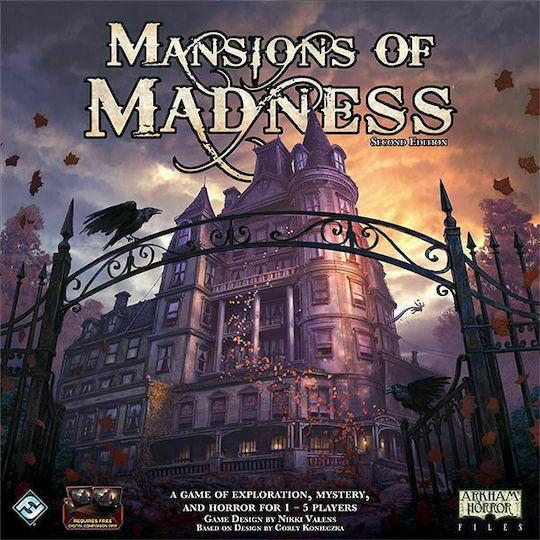
Mansions of Madness 2nd Edition Review
Lovecraftian Horror on Your Table — and Your Phone
Hook / First Impression
The first edition of Mansions of Madness had a brilliant idea wrapped in a frustrating problem: one player had to act as the "Keeper," running all monsters, traps, and story events while the rest explored. The Keeper needed to read a separate rulebook, manage secret information, and essentially run a role-playing encounter in real time — a burden that made setup take an hour and drained whoever drew the short straw. In 2016, Fantasy Flight Games solved that problem with a single, audacious move: they handed the Keeper's job to a free companion app.
Mansions of Madness 2nd Edition is a fully cooperative app-driven dungeon crawler set in H.P. Lovecraft's Cthulhu Mythos. The app handles all the bookkeeping — monster behaviour, room reveals, puzzle logic, story events, and atmospheric narration — while players explore tile-based rooms, fight eldritch horrors, solve physical puzzles, and try desperately not to go insane. The result is one of the most cinematic and accessible thematic board games available: genuinely terrifying, surprisingly easy to learn, and capable of producing stories that players retell for years.
Overview
Mansions of Madness 2nd Edition is an app-assisted cooperative adventure game for 1–5 players. Players take the roles of investigators — academics, detectives, private eyes, and drifters — exploring room by room through haunted mansions, hospital wards, and Arkham city streets. Each scenario runs 2–3 hours and tells a self-contained horror story with multiple possible endings. No one plays against the group; everyone is working together, and the app is the antagonist.
| At a glance | |
|---|---|
| Designer | Nikki Valens |
| Publisher | Fantasy Flight Games |
| Year | 2016 (2nd Edition) |
| Players | 1–5 |
| Play time | 120–180 minutes per scenario |
| Age | 14+ |
| Weight | Medium-Heavy (BGG ~3.0/5) |
| Victory condition | Complete the scenario objective before the Doom track fills or investigators are all incapacitated / driven insane |
Components & The Setting
The Setting: Players are investigators in Arkham, Massachusetts, circa the 1920s — the world of H.P. Lovecraft's horror fiction. The mansions and city streets they explore are places where the boundary between the mundane world and something ancient and incomprehensible has worn dangerously thin. Players do not merely fight monsters; they uncover clues, decode puzzles, read diary entries, and piece together what happened before they arrived. The horror is atmospheric and psychological as much as it is physical — investigators who witness too many impossible things begin to crack, suffering Trauma and Horror cards that impose mechanical penalties and increasingly desperate narrative flavour text.
Component quality is excellent. The modular map tiles are thick, double-sided, and highly detailed — kitchens with stained tables, libraries with cracked spines on the shelves, church crypts with moss-covered stonework. The tiles click together snugly and present a genuinely evocative table presence. The investigator miniatures are among Fantasy Flight's finest sculpts: each character has a unique, expressive pose that matches their backstory. Monster miniatures range from serviceable (the cultists and zombies) to spectacular (the Shoggoth, a writhing mass of iridescent flesh that commands the table).
The companion app is available on iOS, Android, PC, and Mac, and is free to download. All base-game scenarios are included at no additional cost. The app displays a map of explored rooms (with a top-down rendered version of the tile layout), handles all monster activation (displaying movement and attack behaviour for each creature on screen), runs puzzle minigames (sliding puzzles, symbol rotation, pipe connection), and delivers voiced atmospheric narration for room reveals and story events. The production quality of the app is high and has been consistently updated since 2016 — a significant commitment from Fantasy Flight that distinguishes Mansions of Madness from app-assisted games abandoned shortly after release.
How to Play
The goal varies by scenario — defeat a specific monster, prevent a ritual, find a missing person — but the structure is consistent: explore the mansion room by room, gather clues and items, and complete the objective before the Doom track advances to its maximum (which triggers a bad ending) or all investigators are eliminated. The app tracks the Doom track and advances it in response to specific events and round-end triggers; players can see it at all times but cannot directly control it, creating an invisible clock of dread.
Each investigator round proceeds in two phases:
- Investigator Phase — Each investigator takes two actions in any order. Actions include: Move (advance one space on the map, or two with a Sprint action); Explore (interact with a search token in the app, receiving an item, clue, or encounter); Attack (roll dice against a monster's defence value); Cast a Spell (use a magic item with a Horror test); Trade (exchange items with an adjacent investigator); or take a Focus action (place a concentration token to boost the next skill test). The simplicity of two-action turns makes the game accessible; the range of options within each action keeps it interesting.
- Mythos Phase — After all investigators have acted, the app activates each monster in sequence, displaying movement and attack instructions directly on screen. New events may trigger — a hidden cultist revealed, a new clue highlighted, a door locked. The Doom track may advance. This phase is entirely app-driven; players simply follow the instructions as they appear.
Skill tests are the game's resolution mechanic. When an investigator attempts something risky — picking a lock, evading a monster, resisting Horror — they roll a pool of custom dice equal to their relevant skill value. Each die shows either a blank, a success, or an elder sign (a bonus success). The app or the card specifies how many successes are required. Investigators can spend Focus tokens before rolling to convert blanks to partial results — a small but meaningful tactical layer atop the dice pool.
Sanity and Health function as the investigator's two resource pools. Damage tokens reduce Health; Horror tokens reduce Sanity. When Health reaches zero, the investigator is incapacitated. When Sanity reaches zero, they are driven insane and flip to their "insane" side — still in play but with a new, often contrary, secret objective and a rule forbidding them from sharing information with other players. This Insanity mechanic is one of Mansions' most elegant designs: it removes a player from the cooperative effort without eliminating them, and produces memorable moments of paranoid, untrustworthy behaviour at the table.
Gameplay Feel
Pacing & Tension: Mansions of Madness builds tension through information asymmetry. Players know the layout of rooms they have explored and the threats they have seen, but the app holds everything else: what lurks behind the next door, what the search token in the library will produce, whether the Doom track event at the end of this round will spawn one monster or three. This sustained uncertainty produces genuine dread that most board games cannot replicate. The pacing follows a horror-story arc: cautious early exploration, escalating encounters as the map fills in, and a desperate final act where every action feels consequential and insufficient.
Player Interaction is high and positive. Because the game is fully cooperative, every decision is a conversation. Should we split up to cover more ground, or stay together and handle threats as a group? Who has the right skills to handle this puzzle? Can we afford to spend an action helping the wounded investigator, or does the Doom track not allow it? These discussions are where Mansions of Madness produces its best moments — not the dice rolls, but the decisions that precede them.
Luck vs. Strategy Balance: More luck-dependent than most hobbyist board games. Dice rolls are not deterministic, and a string of failures on important skill tests can cascade into an unwinnable position through no strategic fault of the players. The game is also heavily scenario-dependent — some scenarios have elegant designs that build to a satisfying climax; others feel punishing or opaque on a first play, particularly if the group does not know what objective triggers they need to prioritise. This is a game that rewards experience and accepts variance as a feature of the horror genre, not a design flaw to be eliminated.
Rule Overhead: Surprisingly low for a game that looks this intimidating on the table. The app handles the complex rules, and the player-facing rules are primarily: move, explore, test, attack. First-game setup and teaching takes 20–30 minutes including app setup; experienced groups are playing within 15 minutes of opening the box. The complexity is in the scenario design, not the rulebook — a meaningful distinction that makes Mansions far more accessible than its physical presence suggests.
Mechanics Deep-Dive
The App as Game Master
The companion app is the game's most significant design element, and it succeeds where the 1st Edition's human Keeper failed. The app handles everything a dungeon master would: it holds the map layout in advance, manages monster AI (each creature type has a distinct behaviour tree — Cultists move toward investigators and attack; Byakhees fly over walls; Deep Ones prioritise the investigator with the lowest Sanity), triggers story events at appropriate moments, and reads room-reveal text aloud with ambient sound effects. Players never need to manage secret information or alternate between playing their character and running the world.
The AI behaviour varies meaningfully by monster type, creating distinct tactical challenges. A room full of Zombies is a different problem from a room with a single Star Spawn — the former is manageable by any investigator; the latter may require the whole group. The app also scales some scenarios to player count, adjusting the number of monsters and Doom track starting position, which helps prevent the common thematic dungeon-crawler problem of early-game triviality at low player counts.
Physical Puzzles
When investigators trigger certain app events, the app presents a timed puzzle that is resolved using physical game components: a set of round cardboard tokens that players must arrange on a physical puzzle board in the configuration displayed on screen. These puzzle types include slide puzzles, symbol rotation challenges, pipe-connection grids, and lock-combination sequences. The physical component makes the puzzle a table-level event — everyone leans in, pointing and arguing over the best move — rather than one player tapping a screen while others watch.
The puzzles are timed, which adds genuine stress. Getting them wrong does not immediately fail the scenario — it typically advances the Doom track or inflicts Horror on the interacting investigator — but repeated failures compound. Puzzle difficulty is set in the app and scales with difficulty level. They are one of Mansions' most polarising elements: players who enjoy tactile spatial challenges love them; players who find spatial puzzles stressful under time pressure find them an unwelcome intrusion into the narrative. Know your group before leading with this one.
Investigator Asymmetry
Each investigator has a unique stat block (Will, Strength, Agility, Observation, Lore, Influence) and a unique ability that triggers under specific conditions. The archaeologist might ignore penalties for entering monster-occupied rooms. The nun might recover Sanity for other investigators at the cost of an action. The detective might draw an extra item card when Exploring. These asymmetries are not as pronounced as in Root or Nemesis — every investigator can do everything, just better or worse at specific tasks — but they create natural role specialisation that shapes cooperative planning without forcing it.
- Investigators are genuinely differentiated — a high-Lore character handles spells; a high-Strength character fights; a high-Observation character searches faster. Compositions matter.
- Starting items vary — each investigator begins with a unique item that reflects their backstory and partially defines their early strategy.
- Sanity vs. Health balance — some investigators are glass-cannon scholars (high stats, low Health) while others are durable brawlers (high Health, poor spell ability). This creates different risk profiles across the group.
- Insanity variants — when an investigator goes insane, their insane-side secret objective is unique to their character, creating different table dynamics depending on who cracks.
The Doom Track
The Doom track is Mansions' most important invisible pressure system. It starts at a scenario-defined value and advances when specific app-triggered events fire — a Mythos event at the end of a round, a failed ritual check, a search that reveals something catastrophic. When it hits maximum, the scenario ends immediately with a specific bad outcome, often the awakening of a Great Old One. Players can see the current Doom value in the app at all times but have no direct mechanism to reduce it — only to avoid advancing it through efficient play.
The result is a tempo game embedded within the exploration. Every action that does not advance the objective is an action spent while the clock ticks. Spending a full round healing a wounded investigator may be the right call — but it costs a turn, and turns are the scarcest resource. This constant tension between short-term survival and long-term objective efficiency is Mansions' deepest strategic layer, and it plays out differently in every scenario.
Player Count Analysis
Solo (1 Investigator) — Good. Mansions of Madness works solo, though it is a different and harder experience than the multiplayer game. Solo players typically control two investigators to have a viable coverage of skills, which adds management overhead. The narrative experience is thinner without table discussion, but the horror atmosphere is arguably more intense alone. Recommended for players already familiar with the scenarios who want a personal challenge, rather than as a first-play mode.
2 Players — Very good. Two players controlling one investigator each is a tighter, more focused experience. Decision-making is faster, the cooperative discussion is cleaner, and the scenario pacing feels intentional. The investigator count means the group covers fewer skills, which increases the tension of skill-test failures. A strong player count for the game's narrative experience.
3–4 Players — Excellent. The sweet spot. Three or four players, each controlling one investigator, is where Mansions of Madness performs at its best. There is enough investigator diversity to cover most situations, the cooperative discussion produces good table energy, and the scenario pacing was clearly designed with this count in mind. Most scenarios feel balanced and satisfying at 3–4. This is the recommended player count for a first play.
5 Players — Good, budget time. Five players works but strains the experience. The investigator phase runs long with five individual turns, which introduces downtime and can leave quieter players waiting. The Doom track does not always scale to compensate for the additional firepower of a full five-investigator party. Best reserved for groups where the social experience of five around a table is the primary goal.
Replayability
Replayability is Mansions of Madness' most nuanced topic. Each scenario has multiple possible story outcomes, multiple possible map configurations (the app randomises room layouts and monster placements within a scenario's structure), and branching events that play out differently on each run. On paper, this provides substantial replay value. In practice, once you know a scenario's objective structure and critical trigger locations, subsequent plays feel significantly less surprising. Mansions of Madness is fundamentally a discovery game — much of its power comes from not knowing what is behind the next door — and that power fades with familiarity.
The base game includes five scenarios. The expansion ecosystem adds significantly more. A group that plays each base scenario twice will have 10–12 sessions of strong content before replay fatigue sets in. Expansions extend this substantially: Beyond the Threshold, Streets of Arkham, Suppressed Memories, and the Path of the Serpent campaign collectively add over a dozen additional scenarios. A fully expanded Mansions collection can sustain a dedicated group for 40–60 sessions of primarily fresh content.
Learning Curve
Ease of teaching: Mansions of Madness is unusually easy to teach for a game of its component weight. The app handles setup (tile placement, token distribution, and investigator starting locations are all directed on screen), which removes the most error-prone part of most dungeon-crawler setup procedures. The core rules — two actions per turn, skill tests are dice pools, monsters activate in the Mythos phase — fit on a single reference card and take 10 minutes to explain. New players are functional after a single practice round.
Rulebook quality: The physical rulebook is brief and clearly written, primarily because the app carries so much of the rule load. Edge cases (line of sight for ranged attacks, what happens when an investigator is incapacitated in a monster-occupied room) are handled in the app rather than in print, which keeps the physical rulebook thin but occasionally requires app consultation mid-game.
First-game experience: Almost universally positive. The combination of voiced narration, physical puzzle tactility, and genuine horror atmosphere produces immediate engagement even for players new to thematic board games. Non-gamers who would balk at Gloomhaven or Arkham Horror often find Mansions approachable because the table experience feels like collaborative storytelling rather than rules management. The first scenario ("Insmouth Escape" or "Cycle of Eternity" depending on the edition) is well-paced and introduces mechanics gradually without overwhelming new players.
Who It's For
Horror fans and storytellers: If your group loves horror movies, tabletop RPGs, or games where the narrative is the point, Mansions of Madness is an immediate recommendation. Nothing else in the board game hobby produces the feeling of playing through a Lovecraftian horror story with this combination of accessibility and atmosphere. The voiced narration, the branching events, and the Insanity mechanic create emergent stories that feel authored even when they are algorithmically generated.
Cooperative game veterans looking for more theme: If you love Pandemic but want something with stronger narrative and atmosphere, Mansions of Madness is the natural step up. It retains the "everyone works together" structure while adding exploration, character progression within a scenario, and genuine horror.
Groups intimidated by heavy dungeon crawlers: Players who find Gloomhaven or Descent overwhelming will often find Mansions of Madness accessible despite its similar footprint. The app removes the rules management burden that makes those games feel heavy, and the two-action turn structure is genuinely simple. The weight is in the atmosphere and decision-making, not the rules.
Who it is not for: Groups who dislike app-mediated board game experiences; players who want high strategic depth and deterministic play; groups with a member who is genuinely frightened by horror content (the ambiance is effective — dim the lights and you may frighten a sensitive player more than intended); groups who want a short game. Mansions of Madness is a 2–3 hour commitment per scenario and cannot be paused mid-session without saving through the app.
Pros & Cons
What Mansions of Madness does exceptionally well:
- The app-driven model eliminates the 1st Edition's Keeper problem and makes the game fully cooperative without requiring any player to manage opposing forces.
- Atmosphere is unmatched in the genre — voiced narration, ambient sound design, and the physical tile-laying combine to create a genuinely cinematic horror experience.
- The Insanity mechanic produces memorable, emergent moments of cooperative betrayal that players retell long after the session ends.
- Accessible to non-gamers despite its component weight — the app handles complexity, and the two-action turn is genuinely simple.
- Physical puzzles create table-level engagement at key story moments.
- Investigator asymmetry is satisfying without being overwhelming — every character can contribute, but each does so differently.
- The app has received consistent updates for nearly a decade, including free digital conversions of 1st Edition scenarios.
Where Mansions of Madness struggles:
- App dependency is a genuine long-term risk. If support ends, the game is unplayable without community alternatives.
- Replay value per scenario diminishes sharply after the second or third play — the discovery experience cannot be recaptured once you know the critical locations and trigger conditions.
- Luck variance is high. Bad dice runs on critical skill tests can doom a well-played session. Some groups find this frustrating rather than dramatic.
- Requires a device at the table. In some play environments (poor lighting, limited space, device charging issues) the app setup adds friction.
- Session length is fixed and long — 2–3 hours per scenario is not negotiable. Groups who cannot commit a full evening need a different game.
- Puzzle mechanics will not appeal to all players — timed spatial puzzles under horror atmosphere are fun for some and stressful for others in the wrong direction.
Expansions & Ecosystem
The Mansions of Madness 2nd Edition expansion ecosystem is extensive. Expansions fall into two categories: large box expansions (new scenarios, maps, investigators, and monsters) and figure and tile collections (component upgrades for 1st Edition content converted to 2nd Edition via the app).
1. Beyond the Threshold — New scenarios and investigators ★★★★☆
The first small box expansion adds two new scenarios, two new investigators, and new monster types. The scenarios are stronger than some base game entries — "Shattered Bonds" in particular is frequently cited as one of the best individual Mansions scenarios released. A straightforward first purchase after mastering the base game.
2. Streets of Arkham — Outdoor maps and street scenarios ★★★★☆
Takes the action out of the mansions and into Arkham itself — alleyways, docks, and city streets. The outdoor map tiles change the tactical dynamics significantly (more open movement, different threat patterns), and the three included scenarios are among the most narratively ambitious in the game's history. Recommended for groups that have completed the base game scenarios.
3. Suppressed Memories — Figure/tile collection for 1st Edition content ★★★☆☆
Contains miniatures and map tiles for the 1st Edition scenarios that Fantasy Flight converted to 2nd Edition rules via a free app update. Only relevant if you want physical components for those digital scenarios; the scenarios themselves are available through the app without purchasing this box. A low priority unless you are a completionist.
4. Path of the Serpent — Campaign expansion ★★★★★
The most ambitious Mansions expansion: a connected campaign of six scenarios set in South America, where investigator choices, injuries, and discoveries carry forward from session to session. The campaign adds a meta-progression layer entirely absent from the standalone model — investigators gain traits and permanent consequences between scenarios, and the final confrontation is shaped by how earlier missions played out. For groups who want the Gloomhaven model of narrative continuity, this is the definitive Mansions of Madness experience.
| Expansion | Best For | Complexity Added | Rating | Priority |
|---|---|---|---|---|
| Beyond the Threshold | All groups wanting more content | Low | ★★★★☆ | 🥇 #1 — buy after base game |
| Streets of Arkham | Experienced groups, outdoor variety | Low | ★★★★☆ | 🥈 #2 — strong scenarios |
| Path of the Serpent | Groups wanting a campaign | Medium | ★★★★★ | 🥉 #3 — essential for campaign play |
| Suppressed Memories | Completionists only | None | ★★★☆☆ | Low priority — optional components |
Value for Money
Mansions of Madness 2nd Edition retails for approximately $80–$100 USD. The base game includes five scenarios, eight investigators, 24 monster miniatures, and approximately 40 map tiles. At 2–3 hours per scenario, the base game provides 10–15 hours of play for groups that run each scenario twice before moving to expansions. This is a lower hour-per-dollar ratio than heavy strategy games like Ark Nova or Gloomhaven, but the quality of those hours — the atmosphere, the emergent narrative, the memorable moments — is higher than the raw numbers suggest.
- Horror and narrative enthusiasts: Excellent value. No other product in the board game space delivers this specific experience — Lovecraftian horror cooperative storytelling with this production quality — at any price. The base game alone will produce sessions your group discusses for months.
- Casual groups who play rarely: Consider the per-session investment. At five scenarios played once, the base game provides five evening sessions before the core content is exhausted. If your group plays monthly, that is five months of content before expansion investment is needed. For groups who play weekly, you will need expansions within two months.
- Used copies: Mansions of Madness holds its secondary market value reasonably well. Used copies in good condition are available at a moderate discount. When buying used, confirm all investigator sheets, reference cards, and tokens are present — small component loss can be significant in this game.
Accessibility
Color blindness: Mansions of Madness uses colour as a secondary identifier — most tokens are additionally differentiated by shape and icon. The investigator dashboards use colour coding for Health and Sanity tracks, but both are clearly labelled in text. Overall accessibility for colour-blind players is better than average for the genre.
Language dependence: Moderate to high. Item cards, Event cards, and Horror cards have significant text that affects gameplay. The app delivers room-reveal narration in the chosen language (multiple languages are supported). Playing with cards in an unfamiliar language is possible with a reference but impractical for new players. Official translations are available in German, French, Spanish, Italian, Polish, and several other languages.
Physical accessibility: The app delivers all voiced content, making it suitable for players with hearing impairment through subtitles (the app displays text for all narrated content). The puzzle mechanic requires handling small tokens under time pressure, which may be challenging for players with dexterity limitations — the app puzzle timer can be disabled in accessibility settings. Miniatures are standard size and easy to handle. The physical puzzle boards require fine motor placement of tokens, which is the most significant dexterity demand in the game.
Cognitive accessibility: The two-action turn structure is genuinely simple, and the app removes the need to manage monster behaviour or scenario logic. Players with mild cognitive challenges can participate meaningfully with a supportive group making joint decisions. The game is not suitable for players who are genuinely frightened by horror content — the atmosphere is effective and intended to be unsettling.
Age range: The 14+ rating reflects thematic content (body horror, psychological distress, Lovecraftian imagery) rather than rules complexity. The game's horror theme is not suitable for young children, but mature 12–13 year-olds with a tolerance for spooky content can handle the mechanics comfortably.
Verdict
Mansions of Madness 2nd Edition is the best horror board game ever made, and it is not particularly close. Nikki Valens and Fantasy Flight Games identified exactly why the 1st Edition failed — the Keeper burden — and replaced it with a solution so elegant that most players forget it is a compromise at all. The result is a game that delivers on every promise of the thematic dungeon-crawler genre: genuine atmosphere, meaningful investigator choice, emergent narrative, and cooperative moments that produce stories. The Insanity mechanic alone is worth the price of admission; the rest of the game is built around it with care and intent.
Its limitations are real. App dependency is a long-term concern that responsible buyers should acknowledge. Replay value per scenario is inherently limited by the discovery model. Luck variance is higher than strategy-focused groups prefer. But none of these limitations undercut the primary experience for their target audience, and the target audience for "atmospheric Lovecraftian horror cooperative storytelling" has very few alternatives of comparable quality.
Buy it if: your group loves horror, cooperative games, or tabletop RPGs — and has an evening to spare. It will produce one of the most memorable sessions you have ever had at a table.
Skip it if: you need a game playable in under two hours, you dislike app-dependent products, or your group wants deterministic, strategy-heavy gameplay.
Expand it with: Beyond the Threshold first for more scenarios, then Path of the Serpent if your group wants a connected campaign — it is the highest expression of what Mansions of Madness can be.
Score Breakdown
Love thematic and cooperative board games? Explore our reviews, strategy guides, and game night tools — everything you need to find your next great session.
Browse All Reviews →