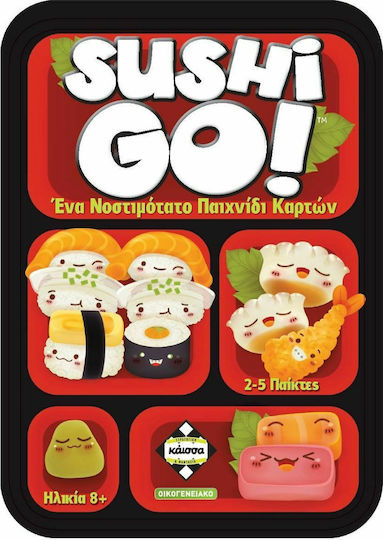
Sushi Go! Review
The Adorable Card-Drafting Classic That Hits the Table Every Time
Hook / First Impression
Sushi Go! arrives in a tin small enough to fit in a coat pocket. You open it, tip out 108 cards covered in absurdly cute cartoon sushi, and deal hands to everyone at the table. Two minutes later, you're mid-game. That's the pitch — and for the right group on the right evening, nothing else comes close.
Phil Walker-Harding's 2013 design has become one of the most played gateway games in the hobby, logging millions of copies worldwide, and its staying power is easy to explain: it teaches card drafting — the mechanism that underpins 7 Wonders, Dominion, and countless other acclaimed designs — in its absolute simplest form, with rules that fit on one card and a play time under twenty minutes. Sushi Go! is not trying to be a complex game. It is trying to be a perfect twenty-minute game, and it largely succeeds.
Overview
Sushi Go! is a card-drafting and set-collection game designed by Phil Walker-Harding and published by Gamewright in 2013. Players simultaneously select one card from their hand, reveal, then pass the remainder to the next player — racing to collect the highest-scoring combination of sushi dishes over three rounds.
| At a glance | |
|---|---|
| Designer | Phil Walker-Harding |
| Publisher | Gamewright |
| Year | 2013 |
| Players | 2–5 |
| Play time | 15–20 minutes |
| Age | 8+ |
| Weight | Very light (BGG ~1.2/5) |
| Victory condition | Most points after three rounds of drafting wins |
Components & The Setting
The Setting: You are a diner at a conveyor-belt sushi restaurant, plucking dishes from the passing belt. The theme is entirely decorative — there are no resource systems, no narrative decisions, no thematic consequences — but it is executed with such consistent, cheerful charm that it enhances rather than distracts. Every card features a cartoon face on its sushi, and the facial expressions are delightful enough that children and adults alike spend time looking at the art before they look at the points. It is, unambiguously, a lovely-looking game.
Components are modest but appropriate for the price. The 108 cards are standard card stock — not premium, not linen-finished, but perfectly serviceable for a game that will be shuffled often. The round scoring pads are a welcome inclusion; they last longer than you'd expect. The tin is the real star of the physical package: compact, durable, closes cleanly, and fits into any bag or drawer. It is one of the better travel-game containers in the hobby at this price point. No tokens, no boards, no setup beyond dealing — which is exactly right for a fifteen-minute game.
How to Play
The goal is to accumulate the most points across three rounds by drafting sushi cards that score through set collection, majorities, and bonus conditions.
Each round, players are dealt a hand of cards (size depends on player count). On each turn:
- Every player secretly selects one card from their hand and places it face-down.
- All players reveal simultaneously.
- Hands are passed to the next player (clockwise).
- Repeat until all cards have been drafted.
Between rounds, all played cards except Pudding are discarded. Points are tallied. Pudding cards persist through all three rounds and score (or penalise) at the game's end based on who has the most and least.
Each card type scores differently:
- Maki Rolls: The player with the most maki symbols scores 6 points; second-most scores 3. A majority game within a game.
- Nigiri & Wasabi: Nigiri cards score 1, 2, or 3 points on their own — but a Wasabi card played before a Nigiri triples that Nigiri's value. Wasabi without Nigiri scores nothing.
- Tempura: Score 5 points for each pair. Odd tempura scores nothing.
- Sashimi: Score 10 points for every set of three. Incomplete sets score nothing.
- Dumplings: Score 1, 3, 6, 10, 15 points for 1, 2, 3, 4, 5+ dumplings respectively — an accelerating curve.
- Pudding: At game end, the player with most puddings gains 6 points; the player with fewest loses 6.
- Chopsticks: A card that, once played, lets you draft two cards in a future turn by calling "Sushi Go!" — returning chopsticks to the passing hand.
Gameplay Feel
Pacing & Tension: Sushi Go! is fast in a way that few games match. The simultaneous reveal mechanic eliminates downtime almost entirely: everyone picks at the same time, reveals at the same time, and passes at the same time. A five-player game rarely takes more than twenty minutes. Turns require no waiting, no watching others deliberate, no idle time — the game moves at exactly the speed of its slowest decision-maker, which in practice means it hums along briskly even with new players.
Tension builds from scarcity: as each round progresses, the passing hands shrink. A sashimi you needed is suddenly gone because someone upstream took it. A maki-heavy hand you expected to receive was stripped by two players before it reached you. The simultaneous reveal adds a moment of drama every single turn — the "oh no" when a player who needed that card already claimed it is reliably engaging even after many plays.
Player Interaction: Higher than it appears from the rules. Drafting is inherently interactive — what you pass matters as much as what you keep. Experienced players will track what others are collecting, deliberately deny key cards, and use Chopsticks to snipe two high-value cards in a single turn. New players interact less consciously but still feel the effects of a good hand being stripped by the time it reaches them. The interaction is reactive and spatial rather than confrontational, which makes it comfortable for groups who dislike direct conflict.
Luck vs. Strategy Balance: Luck is meaningful and present. What cards appear in the initial hands is random, and a round where no Wasabi appears despite needing one is genuinely frustrating. However, skilled play has real impact: knowing when to pivot from Sashimi to Tempura because a complete set is no longer achievable, recognising when a Chopsticks pick will maximise your round score, or timing Pudding collection over multiple rounds — these are learnable skills that consistently separate experienced players from beginners. Sushi Go! is predominantly a light game, but it is not a random one.
Rule Overhead: Essentially none. The entire ruleset fits on one card included in the tin. Most groups are playing correctly within three minutes of explaining. The one reliably confusing element for new players is Wasabi timing — it must be played before the Nigiri it triples, not after — but this clicks quickly after one round of observation.
Mechanics Deep-Dive
The Scoring Variety
What makes Sushi Go! mechanically interesting for its weight is that each card type scores through a fundamentally different mechanism. Maki is a majority contest. Tempura and Sashimi are set-completion games with punishing failure conditions (incomplete sets score zero). Dumplings use an escalating curve that rewards commitment. Nigiri/Wasabi is a sequential combo. Pudding is a long-game investment. Chopsticks is a tempo acceleration tool. In a twenty-minute game played with 108 cards, that is a remarkable variety of strategic textures layered together without any one of them overwhelming the others.
The result is that no two strategies are identical, and no single strategy is dominant. A player who commits entirely to Maki may win the round majority but lose the game to someone who quietly accumulated six Dumplings. A Sashimi specialist who cannot complete their set of three is simply outscored. This variety prevents the game from becoming predictable even after many plays.
The Chopsticks Timing Puzzle
Chopsticks deserves specific attention because it is the card that separates experienced Sushi Go! players from beginners most clearly. Chopsticks placed early in a round sit in your played area, taking up a pick that could have been a scoring card, but offering a future turn where you can draft two cards simultaneously — and return Chopsticks to the passing hand, potentially giving an opponent that same tool.
- Early Chopsticks: Maximum value when the hand is large and you can predict a future turn where two high-value cards will appear together — for example, a Wasabi + high-value Nigiri in the same hand.
- Late Chopsticks: Usually a mistake. The hand is small, fewer options remain, and the value of two picks over one diminishes. Taking Chopsticks with two cards left in hand is almost always a wasted pick.
- Returning Chopsticks: When you use Chopsticks, you return them to the passing hand. Passing Chopsticks back upstream to a player who already has them is occasionally strategic — they cannot use double Chopsticks efficiently, and it clogs a pick.
Player Count Analysis
2 Players — Functional but stripped. Two-player Sushi Go! works, but loses much of its character. With only two players, you know exactly which cards your opponent is seeing (every card you don't have, they do), which makes denying trivially obvious and the game feel more like a direct calculation than a drafting puzzle. The random element of not knowing what the hand across the table looks like — one of the game's key pleasures — largely disappears. Playable in a pinch; not where the game shines.
3 Players — Solid, slightly predictable. Three players is a meaningful improvement. The passing direction creates some genuine uncertainty about what cards have been stripped before your hand arrives. Maki majority contests become genuinely contested. Sessions stay under fifteen minutes. A good option for a quick three-person filler.
4 Players — The sweet spot. Four players is where Sushi Go! fully comes alive. Hands are large enough to offer real choices early in each round, small enough to create scarcity by the final turns. The simultaneous reveal becomes genuinely exciting — four players unveiling cards together produces more frequent "oh no" moments. Maki competition is contested across enough players to be meaningful without being chaotic. Pudding tracking becomes a real long-game consideration. Most experienced players prefer this count.
5 Players — Fast, chaotic, joyful. Five players accelerates the game to an almost frantic pace and introduces the most unpredictability in which cards cycle around to you. Strategy becomes looser and more reactive. The game stays under twenty minutes with five. For groups who want something casual, loud, and quick before moving on to something heavier, five-player Sushi Go! delivers exactly that.
Replayability
Sushi Go!'s base game has a fixed card set, which means the variety between sessions comes from the random card distributions and from the different strategies players bring rather than from changing components. After ten to fifteen sessions the game starts to feel familiar — the card interactions are learned, the optimal Chopsticks windows are understood, and the scoring calculus becomes largely automatic.
This is not a criticism so much as an accurate description. Sushi Go! is designed to be a twenty-minute filler, played multiple times in a sitting, not a sixty-session exploration of ever-deepening strategy. Used in that role — three quick games before a main event, a warm-up while waiting for a late guest, a palate cleanser between heavier plays — the replayability is excellent precisely because each game is so short that you can play it four times before getting tired of it.
For players who want more variety, Sushi Go Party! (the expanded version) adds sixteen card types that can be combined modularly each session, extending the strategic variety significantly while keeping the same core mechanism. It is the natural upgrade for players who love the game and want more.
Learning Curve
Ease of teaching: Outstanding. The rules are genuinely teachable in ninety seconds: "pick one card, pass your hand, reveal together." The scoring nuances take one practice round to absorb — most new players understand Maki, Tempura, Dumplings and Nigiri within the first five picks. Sashimi's all-or-nothing payoff and Wasabi timing are the only points that reliably require a reminder mid-first-game.
Rulebook quality: Excellent and brief. The rulebook is a single folded card included in the tin, with clear icons and enough examples to cover every scoring scenario. It is one of the more elegantly compact rulebooks in the hobby — appropriate for a game of this size.
First-game experience: Reliably positive. The cute art reduces any social anxiety about "playing wrong." The short game length means a first game that goes poorly is over in fifteen minutes and immediately followed by a second. The most common first-game experience is finishing the game, having someone say "wait, that's it?" — and immediately dealing for another round.
Who It's For
New-to-hobby gamers: Sushi Go! is a near-perfect entry point because it introduces card drafting — a mechanism that recurs throughout the hobby — with zero mechanical overhead. Players who enjoy Sushi Go! are likely to enjoy 7 Wonders, Wingspan (which uses a similar pick-and-pass element), and many deckbuilders. It opens a door to a large category of games.
Families with children: The 8+ age rating is accurate, and children from around age seven can participate fully. The cute art is universally appealing. The game has no reading required, no complex text, no player elimination, and games rarely extend past twenty minutes — all of which make it one of the most practical family games at any price point.
Party and casual groups: Where Sushi Go! truly excels. It requires no prior board game experience, fills itself in fifteen minutes, and produces a naturally fun dynamic from the simultaneous reveal. It is the game to own when the group does not always include dedicated hobbyists, or when you need something that scales easily and goes quickly.
Hobbyist gamers: Sushi Go! serves a specific function for experienced players: it is a filler between heavier games, a warm-up, or a game to play when someone at the table is new. Its strategic ceiling is modest by hobbyist standards, but its execution of its stated goal is essentially flawless. It earns a place in any collection as the go-to accessible option.
Comparisons: 7 Wonders uses the same drafting mechanism with far greater strategic depth and complexity — the natural next step for players who love Sushi Go!. Ticket to Ride offers a longer, more involved family experience. Coup fills a similar fifteen-minute filler role with a different mechanism (deduction and bluffing). For pure drafting pleasure at lightweight scale, nothing touches Sushi Go! at its price.
Pros & Cons
What Sushi Go! does well:
- Teaches card drafting — a foundational hobby mechanism — in the simplest possible form, without sacrificing meaningful decision-making.
- Fifteen to twenty minutes play time is genuine; the game never outstays its welcome.
- Simultaneous reveal produces consistent moments of shared excitement and surprise every single turn.
- Art and theme are universally appealing, reducing the social barrier to introducing new players.
- Tin packaging is excellent — compact, durable, and genuinely portable in a way most travel games only claim to be.
- Works well at 3, 4, and 5 players with equally short sessions at all counts.
- Multiple rounds per sitting is the intended mode and adds up to a satisfying full evening of quick play.
Where Sushi Go! struggles:
- Two-player mode is notably weaker than 3–5; the drafting mystery that drives the game largely disappears.
- Strategic ceiling is low. Experienced players will feel they have exhausted the decision space after 15–20 sessions.
- The fixed card set in the base game offers no session-to-session variability beyond random distribution — Sushi Go Party! solves this but is a separate purchase.
- Luck variance is higher than in other games at the same weight. A round where key cards simply do not appear in your pool can feel beyond your control.
- No solo mode — entirely a social, multiplayer experience.
Expansions & Ecosystem
Sushi Go!'s ecosystem is lean and well-targeted. Rather than traditional expansions, Gamewright has released a larger standalone version and a few variants, none of which combine directly with the base tin.
1. Sushi Go Party! — The definitive version ★★★★★
Sushi Go Party! is a larger-box standalone that replaces the tin with a game board, score tracking, and sixteen different card types (eight of which appear in any given session, chosen from a menu before each game). Players can play with the same base Sushi Go! card set for familiarity, or mix and match new card types — including Super Sashimi, Uramaki, Spoon, and more — to completely change the strategic landscape each session. The expansion dramatically extends replayability, accommodates up to 8 players, and adds a menu of suggested card combinations for different group sizes and styles. For anyone who plays Sushi Go! regularly, Party! is the better long-term purchase.
2. Sushi Roll — Dice-based variant ★★★☆☆
Sushi Roll replaces cards with custom dice drafted from a spinning conveyor belt. The mechanism is clever and tactile, and the thematic presentation is charming, but the dice introduce more luck than the card version and the drafting feels less precise without the ability to see exactly what you are passing. A fun novelty for groups who love the theme but prefer physical interaction to card management; not a superior game for experienced Sushi Go! players.
| Game | Best For | Players | Rating | Priority |
|---|---|---|---|---|
| Sushi Go! (base tin) | New players, portability, quick intro | 2–5 | ★★★★☆ | 🥇 Start here |
| Sushi Go Party! | Regular groups wanting variety | 2–8 | ★★★★★ | 🥈 Upgrade once you love it |
| Sushi Roll | Families who love dice games | 2–5 | ★★★☆☆ | Optional fun variant |
Value for Money
Sushi Go! retails for approximately $15–$18 USD (€12–16 in Europe), making it one of the most affordable games in the hobby relative to the quality of experience it delivers. At that price point, the tin packaging alone is a differentiating feature — most games at this budget come in a tuck box. For a family game, party game, or travel game, there are very few alternatives that offer comparable play time per euro spent.
Per-session cost for a group that plays it regularly is negligible within the first month. The game handles being played repeatedly in a single evening without feeling repetitive, which means any group that tries it once tends to get multiple sessions out of the first sitting.
- First game purchase: Easy recommendation at full price. There is almost nothing in the hobby at this price point that delivers a cleaner, more accessible drafting experience.
- Gift for non-gamers: One of the best gift choices in the hobby — the art is disarming, the rules are non-threatening, and the price removes any concern about whether the recipient will enjoy it enough to justify the cost.
- Already own a large collection: Worth adding as the canonical fast filler. Even heavy gamers benefit from having a fifteen-minute game they can confidently hand to a newcomer and have them playing correctly within two minutes.
Accessibility
Color differentiation: Each card type uses a distinct color background — orange for Maki, yellow for Nigiri, pink for Tempura, and so on — combined with unique artwork for each card type. Color alone is sufficient to distinguish cards, but the unique art on each type means color-blind players can still distinguish all card categories by illustration rather than color. One of the more accessible designs in the filler category.
Language dependence: None at all. Every card uses only icons and numbers; there is no text to read during play. The rulebook is the only text-dependent component. Sushi Go! is fully playable across any language group without modification.
Cognitive accessibility: Very strong. The one-card-per-turn decision is a consistently simple action frame, and the game rewards — but does not require — sophisticated strategic thinking. Players who want to engage deeply can track opponents' collections, calculate Maki majorities, and time Chopsticks precisely. Players who want to play casually can simply pick the card they like and have a good time regardless. Both modes are valid. The short game length means players who find sustained concentration difficult are never asked to maintain focus for long.
Physical accessibility: Standard card handling is required. Cards are small but not unusually so. Players with dexterity limitations may find simultaneous reveal slightly awkward but can participate fully with minor accommodations (such as placing cards face-down on the table rather than holding them). No fine motor precision beyond basic card handling is required.
Age range: The 8+ rating is accurate for full independent play. Children aged 6–7 can participate with minimal guidance. The game has no dark themes, no player elimination, no reading required, and the cute art specifically appeals to children — making it one of the more genuinely all-ages designs in the hobby.
Verdict
Sushi Go! is not trying to be a complex game, a long game, or a deep strategic experience. It is trying to be the best possible fifteen-minute card game with a fun theme, an accessible mechanism, and a play experience that works equally well for an eight-year-old at their first game night and for a seasoned hobbyist warming up before heavier fare. By that standard, it succeeds almost completely.
The card drafting mechanism — pick one, pass the rest — is one of the cleverest mechanisms in the hobby, and Sushi Go! introduces it in the gentlest possible way without stripping out the meaningful decisions. Every pick involves real trade-offs. Every simultaneous reveal produces a moment of shared reaction. Every round ends with a scoring moment that is fast, clear, and satisfying. The game does everything it sets out to do.
Its limitations are equally honest: the strategic ceiling is low, two players is a weaker experience, and the base game's fixed card set has finite variety. None of these are design failures — they are conscious choices in service of making the best possible lightweight filler. For extended strategic exploration of the same mechanism, Sushi Go Party! resolves the variety issue and 7 Wonders raises the complexity ceiling substantially.
Buy it if: you want an accessible, portable, fifteen-minute filler that teaches card drafting elegantly and works for groups of all experience levels — especially families and casual players.
Skip it if: you exclusively play heavy, complex games and have no use for a lightweight filler. Even then, consider keeping a copy for guests.
Upgrade it if: you love the base game and find yourself wanting more variety per session — Sushi Go Party! is the definitive version of the same idea with dramatically more strategic range.
Score Breakdown
Love board game night? Explore our tools, score calculators, and strategy guides — everything you need to play better and have more fun.
Browse All Articles →