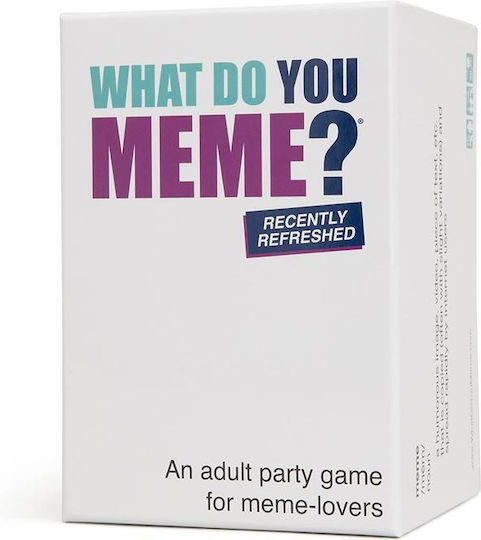
What Do You Meme? Review
The Party Game Built on Internet Culture — Does It Survive the First Scroll?
Hook / First Impression
In 2017, Elliot Tebele — the man behind the @fuckjerry Instagram account with tens of millions of followers — co-founded a company with Ben Kaplan and asked a simple question: what if the meme format that had taken over the internet became a physical card game? The result was What Do You Meme?, a party game in which players compete to caption oversized photo cards of iconic internet memes with the funniest line from their hand of caption cards. It crowdfunded, it shipped, and it sold millions of units at Target and Amazon, becoming one of the best-selling party games of the late 2010s.
The hook is immediate and obvious: the game translates a language that already lives on every phone screen into a format you can play on a table. If your group has spent any time sending memes to each other — and in 2026, what group has not — the premise lands in thirty seconds. The first round typically produces genuine laughter. The question this review answers is what happens after that first session, because first-round energy and sustained game quality are not the same thing.
Overview
In What Do You Meme? a rotating judge draws a large photo card from the deck — typically a well-known meme image — and places it where all players can see it. All other players scan their hand of caption cards and submit the one they believe the judge will find funniest, applied to that image. The judge reads submissions, reacts, and awards the photo card to the winner. Most points at the end wins. The entire structure is identical to Cards Against Humanity; the innovation is the visual prompt layer.
| At a glance | |
|---|---|
| Designers | Elliot Tebele, Ben Kaplan |
| Publisher | What Do You Meme LLC |
| Year | 2017 |
| Players | 3–20+ |
| Play time | 30–90 minutes |
| Age | 17+ (adult edition); family edition available |
| Weight | Party (BGG ~1.1/5) |
| Victory condition | Most photo cards collected (judge's choice each round) |
Components & The Setting
The Setting: Players are not characters in a story, managing resources, or solving a puzzle. They are comedians competing for a rotating audience of one. The "theme" is internet culture itself — the shared visual vocabulary of memes that functions as a social dialect for anyone who has spent significant time online. The game assumes this fluency; it does not explain the memes or provide context. If you do not recognise the Distracted Boyfriend, the Drake Approval template, or the Woman Yelling at Cat, several rounds will be functionally opaque. This is not a limitation the game apologises for — it is precisely its identity.
Component quality is where What Do You Meme? genuinely earns praise. The photo cards are large — roughly A5 in size — printed on thick, glossy card stock with sharp, full-colour image reproduction. They look and feel premium for a party game. The caption cards are standard-sized, cream-coloured, and easy to read. The box is sturdy. Compared to the deliberate minimalism of Cards Against Humanity, WDYM leans into visual production: the box art, the card design, and the oversized photo format all signal that this is a game taking its aesthetic seriously. Setup involves shuffling two decks and dealing seven caption cards per player. Teardown is returning everything to the box. Two minutes total.
The base game ships with 75 photo cards and 360 caption cards. The caption cards range from absurdist to mildly risqué, with content broadly equivalent to a PG-13 film — significantly less extreme than Cards Against Humanity, but still adult in register. The photo cards are the heart of the product and their selection is critical: a recognisable, widely understood meme image produces a strong round; a niche or dated image produces confusion and flat energy.
How to Play
The goal is to collect the most photo cards by winning the judge's vote in each round. There is no fixed end condition in the base rules — most groups play to a set target (e.g. five wins) or until the photo deck runs out.
- The judge (rotating clockwise each round) draws a photo card from the deck and places it face-up in the centre of the table where all players can see it clearly.
- All other players examine their seven caption cards and choose the one they believe the judge will find funniest when applied to that specific image. They submit it face-down.
- The judge collects and shuffles the submitted caption cards, then reads each one aloud while gesturing to the photo. Reading the caption in the "voice" of the meme — exaggerating the image's implied tone — is an informal convention that most groups adopt naturally and that significantly improves the entertainment value of each reading.
- The judge selects their favourite without explanation and awards the photo card to the winning player. The winner keeps it as a point. All players draw back up to seven caption cards.
- The judge role passes clockwise and a new photo card is drawn.
Gameplay Feel
Pacing & Tension: What Do You Meme? plays faster than Cards Against Humanity. Rounds are shorter because the visual prompt is instantaneous — players process an image faster than they parse a text prompt — and the reading phase, while still entertaining, is briefer. A session moves at the rhythm of the group's reactions: a particularly strong combination of meme and caption can pause a round entirely for group laughter; a weak photo card produces quick consensus and the round moves on. The pacing is generally livelier and more energetic than its text-only competitors, though the energy depends heavily on the quality and recognisability of the photo cards in rotation.
Luck vs. Strategy Balance: Like all games of this type, WDYM has a social skill layer beneath its apparent randomness. The real game is reading the judge: knowing which judge rewards surreal non-sequiturs versus which rewards caption cards that directly reference the meme's original context, and knowing when to deploy your strongest cards. Caption card hand management is real and makes a measurable difference in win rates over multiple sessions. That said, the luck component is significant — being dealt a hand with several captions that pair poorly with the current photo card is genuinely limiting, and no amount of skill compensates for a truly mismatched hand.
Rule Overhead: Essentially zero. If you have played Apples to Apples, Dixit, or Cards Against Humanity, you can play What Do You Meme? without reading the rules. The core mechanic is "pick the funniest caption for this picture" — learnable in the time it takes to deal the first hand. This makes WDYM an excellent choice for mixed-experience groups where not everyone is a regular gamer.
Mechanics Deep-Dive
The Two-Layer Caption Problem
What Do You Meme? asks players to operate on two layers simultaneously: the literal caption (what the words say) and the contextual caption (what those words mean when applied to this specific meme image, interpreted by this specific judge). A caption card reading "My dad after two beers" is mildly amusing in isolation. Submitted against a photo of a man confidently doing something ridiculous, it becomes funnier — but only if the judge reads the image as "confident man," not as "distressed man." The dual-layer nature means that identical caption cards can be hilarious or flat depending entirely on which photo card is in play and how the judge visually interprets it. This creates more variance than CAH's text-only format, which is both a strength (more surprising outcomes) and a weakness (more rounds where the "right" answer is unclear even in retrospect).
Photo Card Quality Variance
The 75 photo cards in the base game are not equal in quality, and the inequality is structural. Meme images age differently: some (the Drake template, Distracted Boyfriend, the "This Is Fine" dog) have demonstrated decade-long cultural staying power and will generate strong rounds indefinitely. Others were culturally specific to 2016–2018 and have faded from recognition — a photo card featuring a meme that a quarter of the table does not recognise produces a weaker round regardless of the captions played. This creates an uneven experience across the deck that older editions of the game feel more acutely. What Do You Meme? LLC has released updated "Fresh Memes" expansion packs explicitly to address this decay, which is a responsible design acknowledgement but also an honest admission that the base game has a built-in shelf life.
The Reading Performance Layer
Unlike Cards Against Humanity, where the judge reads text submissions in sequence, WDYM's judge reads captions while physically gesturing to, or speaking over, the displayed photo card. This creates a performance layer that rewards judges who are willing to commit theatrically — reading captions in the implied "voice" of the meme character, exaggerating the visual context, or playing the combinations for maximum effect. Groups with at least one naturally theatrical player find that this performance layer adds considerable entertainment beyond the card selection itself. Groups that read submissions flatly miss a significant portion of the game's potential energy. This is an underdocumented mechanic that significantly differentiates high-energy WDYM sessions from merely functional ones.
Player Count Analysis
3 Players — Technically functional, socially thin. Three is the stated minimum and it shows. Two submissions per round gives the judge almost no variance to work with; the game feels mechanical rather than social. Anonymity dissolves immediately in a three-player game. Only play at this count if no other option exists.
4–6 Players — Comfortable and well-paced. The sweet spot for focused play. With three to five submissions per round, the judge has genuine choices, anonymity holds for several rounds, and the table reacts collectively to each reading. Sessions run efficiently without stretching past their natural energy. This count works well for a dedicated game session where WDYM is the main event rather than background entertainment.
7–10 Players — The party mode sweet spot. Large enough that submissions become genuinely surprising, small enough to stay manageable. The reading phase at eight players is long enough to be theatrical without becoming exhausting. This is where What Do You Meme? performs at its highest energy level — a large enough group that unusual combinations feel discovered rather than predicted, but tight enough that every player is engaged throughout.
11+ Players — Ambient entertainment. At large player counts, the game becomes background social glue rather than a focused activity. Very long reading phases, players losing track of submissions, and the judge's attention divided across many options reduces the quality of any individual round. Still functional as party entertainment, but the game is no longer the centre of the room at this scale — it is furniture.
Replayability
What Do You Meme? has a more complicated replayability story than most party games because its content ages in two distinct ways. Caption cards age relatively slowly — a caption like "sending thoughts and prayers" or "thanks, I hate it" will remain usable for years. Photo cards age faster: meme images that felt fresh and immediately recognisable in 2018 can feel dated by 2024, not because they are unknown but because the cultural context that made them charged has dissipated. Playing a photo card everyone recognises as "old" changes the dynamic from discovery to nostalgia, which produces different — and generally weaker — comedy.
The practical replayability for a stable group is roughly six to ten sessions before noticeable repetition in the caption cards becomes an issue. Groups that play monthly can sustain the base game for approximately a year before the experience begins to feel repetitive. The expansion ecosystem is designed to address this directly, with "Fresh Memes" packs providing updated photo cards and new caption cards on a semi-regular release cycle. Without expansions, the game has moderate longevity; with them, it can be sustained for years as long as the group remains willing to invest in new content.
Learning Curve
Rules learning: Among the easiest games to teach ever made. Any player who understands "pick the funniest caption for this picture" can play immediately. There is no rules overhead to manage, no turns structure to explain, and no victory conditions requiring elaboration. Groups that have never played a party game can be up and running in the time it takes to deal the first hand.
First-game experience: Reliably entertaining in the right group. First-time players typically experience immediate recognition of the meme format, moderate surprise at the range of caption cards available, and genuine laughter at the best combinations. The game is engineered to produce an accessible first round — the photo cards selected for the base game are among the most broadly recognisable memes in internet history. New players who are regularly online are typically enthusiastic from the first draw. New players who are not familiar with meme culture may find the first few rounds confusing before settling into the caption-card logic.
Mastery: No mechanical mastery exists; the skill ceiling is social. Experienced players develop accurate models of different judges' comedic tastes and learn which caption cards have broad applicability versus niche effectiveness. This meta-game is real but shallow — it reaches a ceiling within four or five sessions after which further play refines rather than expands the skill set.
Who It's For
Groups with shared internet culture literacy: What Do You Meme? works best when everyone at the table has broadly equivalent meme fluency. Friend groups who regularly share memes, follow internet culture, or spend meaningful time online will find the photo cards immediately legible and the caption combinations landing reliably. The game is genuinely excellent for this audience.
Groups who want CAH's format without the extreme content: WDYM occupies a meaningfully less extreme content space than Cards Against Humanity. The caption cards are mildly adult rather than transgressive. It is an appropriate choice for groups who enjoy the judge-based format but find CAH's content either too extreme for their preferences or inappropriate for the specific gathering.
Casual game nights and mixed-experience groups: Zero rules overhead, visual prompts, and broadly familiar source material make WDYM one of the most accessible entry points into party gaming. Non-gamers can play immediately alongside experienced gamers without any meaningful disadvantage from rules comprehension.
Who it is not for: Groups with members who are significantly less online than others — the meme literacy gap creates a real and visible skill divide that is hard to bridge mid-session. Players who want any mechanical depth, strategic complexity, or rules-based competition. Groups looking for a game that ages gracefully — WDYM's photo card pool has a cultural shelf life that most games do not. For family-friendly visual party games that everyone can access regardless of internet culture exposure, Dixit is a far better choice. For groups who want social word-based gameplay with actual mechanical structure, Codenames is the stronger recommendation.
Pros & Cons
What What Do You Meme? does well:
- Instantly accessible to anyone with internet culture familiarity — the learning curve is effectively zero and the premise lands immediately.
- Visual format creates a reading performance layer absent from text-only party games, rewarding theatrical judges and producing more entertaining reveal moments.
- Content sits in a friendlier register than Cards Against Humanity — adult without being transgressive, making it suitable for a wider range of adult gatherings.
- High production quality: large-format, glossy photo cards look and feel premium for the price point.
- Expansions are genuinely useful rather than optional — "Fresh Memes" packs directly address the aging problem with updated content on a regular release schedule.
- Scales well from 4 to 10+ players, with the 7–10 range delivering particularly high-energy sessions.
Where What Do You Meme? falls short:
- Meme literacy dependency creates a visible and unaddressable skill gap in mixed-online-experience groups — those less familiar with internet culture will consistently underperform regardless of comedic ability.
- Photo card pool ages at a rate no other major party game faces — memes have cultural half-lives and the base game's photo cards will feel progressively dated without expansion investment.
- No mechanical depth whatsoever; experienced players hit the skill ceiling within a handful of sessions and subsequent play is refinement rather than discovery.
- Caption card pool is smaller than comparable games — 360 cards versus CAH's 500+ — and repetition becomes noticeable somewhat earlier.
- Judge subjectivity, identical to the CAH problem, rewards social personality and group status as much as actual comedic skill, creating a self-reinforcing dynamic in established groups.
- The game is entirely dependent on one judge's taste per round, with no mechanical check on arbitrary or deliberately obtuse judging.
Expansions & Ecosystem
What Do You Meme? has built a substantial expansion ecosystem that serves two distinct functions: adding volume (more caption cards to delay repetition) and adding freshness (new photo cards to replace dated base game content). Both types are available and both are more structurally necessary than expansion packs for most other party games.
Fresh Memes Expansion Packs ★★★★☆
The most important expansions in the ecosystem. Each Fresh Memes pack introduces new photo cards featuring memes from the period after the base game's publication — more culturally current, more immediately recognisable to active internet users, and free from the dating problem that affects older base game cards. If you are going to buy one type of expansion, this is it. The quality is high and the functional benefit (replacing aging photo cards) is concrete.
Themed Expansion Packs ★★★☆☆
WDYM has released packs themed around specific cultural niches — NSFW Edition, Family Edition, Game of Thrones Edition, 90s Edition, and many others. Themed packs work best when the theme matches the group's specific cultural touchstones. The NSFW Edition shifts the content register closer to Cards Against Humanity territory. The themed pop-culture editions work well for groups with shared fandoms. Buy these based on group fit rather than as general expansions.
Family Edition ★★★★☆
A genuinely redesigned version for players aged 12+ using age-appropriate meme images and caption cards. It is a functional product in its own right and an honest attempt to serve families who want the visual-caption format without adult content. The meme selection skews toward broader cultural references rather than internet-native images, which makes it more accessible to non-online family members while reducing some of the game's characteristic energy.
| Product | Best For | Rating | Priority |
|---|---|---|---|
| Fresh Memes Packs | All groups; addresses photo card aging | ★★★★☆ | 🥇 Buy first — most functional |
| Family Edition | Mixed-age or family groups | ★★★★☆ | Buy instead of base game for families |
| NSFW Edition | Groups who want CAH-level content | ★★★☆☆ | Context-dependent |
| Themed Pop-Culture Packs | Groups with matching fandom | ★★★☆☆ | Buy only if theme fits your group |
Value for Money
The base game retails for approximately $29–$35 USD (€25–30 in Europe) and delivers 75 photo cards and 360 caption cards at high production quality. For a party game, the raw component value is strong. Unlike Cards Against Humanity, there is no free digital alternative — the physical game is the product, and the photo card format does not meaningfully translate to a print-and-play substitute.
- Groups who play monthly or less: Excellent value. The base game alone sustains roughly six to ten quality sessions before meaningful repetition, and a single expansion extends that timeline significantly.
- Groups who want a long-term game: Good value with ongoing expansion investment. The Fresh Memes pack cadence makes sustained play viable, but the total cost of keeping the game fresh over several years is meaningfully higher than a static game like Codenames.
- Groups with significant meme literacy gaps: Reduced value — the core experience degrades in proportion to how much of the table cannot engage with the photo card content.
- Strategy or depth seekers: Poor value regardless of price — this game does not provide mechanical depth and is not trying to. Invest the same budget in Codenames or Carcassonne.
Accessibility
Visual dependency: What Do You Meme? is unique among major party games in that it requires players to see and recognise photo cards clearly. The large-format cards help — they are significantly bigger than standard playing cards and designed for group viewing. However, players with significant visual impairments face a real barrier that does not exist in text-only games. The game cannot be played without the visual component.
Color blindness: Not applicable to game function — the images are full-colour but winning or losing does not depend on colour identification. Any player can play regardless of colour vision.
Language dependence: High. Caption cards are text-based and require comfortable English reading at an adult level. The game is available in localised editions (Spanish, French, German, and others), each written for cultural context rather than literally translated. Play in your group's primary language.
Cultural dependence: Very high and unique to this game. Unlike language dependence, which is addressable by translation, meme literacy dependence cannot be designed around — it is structural. Players unfamiliar with the specific images will find the game confusing regardless of language or rules comprehension. This is the game's primary accessibility limitation and affects more potential players than any other factor.
Cognitive and physical accessibility: Rules are completely accessible to any adult. Physical requirements are minimal — holding and passing standard-sized cards. No dexterity demands. Cognitive demands are social and contextual rather than rules-based, which may be easier or harder depending on the individual player.
Age range: The 17+ rating reflects the adult caption card content. The Family Edition (rated 12+) is the appropriate product for younger players or mixed-age groups.
Verdict
What Do You Meme? is a well-executed product for a precisely defined audience. For groups of culturally literate adults who share fluency in internet meme culture, it delivers reliable, high-energy party entertainment that improves on the CAH formula in one specific way: the visual prompt layer creates a reading performance mechanic that text-only games lack, and that mechanic genuinely elevates the experience in the right group. The production quality is strong, the rules overhead is zero, and the content register sits in a friendlier space than Cards Against Humanity without sacrificing adult energy.
Its limitations are structural rather than incidental. The meme literacy dependency is real and unavoidable — you cannot play around it without changing what the game is. The photo card aging problem is honest and addressed by the expansion model, but it means the base game has a cultural shelf life that static games do not. And the total absence of mechanical depth means the experience plateaus quickly; what you see in round three is what the game will always be.
Buy it if: your group is chronically online, shares meme fluency, and wants a zero-barrier party game that generates strong first-hour energy. Add a Fresh Memes expansion pack at the same time to insure against photo card dating.
Skip it if: your group includes people with limited internet culture exposure, significant age gaps, or anyone who wants the photo card format without the meme dependency — in which case Dixit is a better choice. Skip it entirely if your group wants actual gameplay mechanics alongside its social humour.
Maximise it with: a Fresh Memes expansion pack bought alongside the base game, theatrical judging from the first round, and a group that is willing to perform rather than just read.
Score Breakdown
Looking for party games that suit every crowd? Browse our full review library for honest recommendations across all player counts, ages, and tastes.
Browse All Reviews →