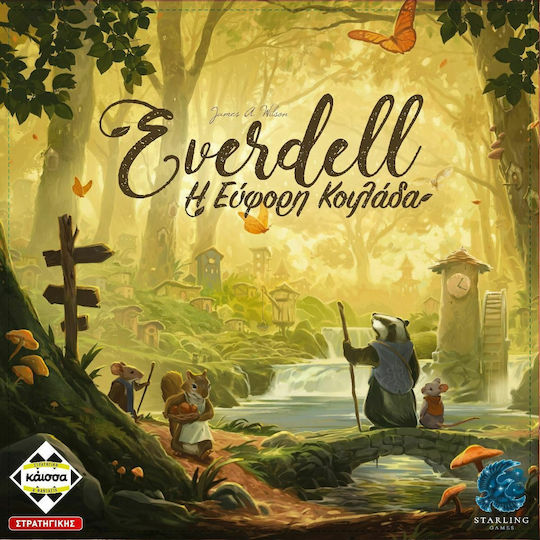
Everdell Review
A Woodland City That Builds Itself Into Something Beautiful
Hook / First Impression
The first time you open Everdell, you spend five minutes just looking at it. Andrew Bosley's watercolour art fills every card with the kind of warm, autumnal detail that makes you want to live inside the box. There are hedgehogs in waistcoats running inns, rabbits managing post offices, and a 3D Ever Tree rising from the centre of the board like it was carved from the table itself. Before a single rule has been read, the game has already done its most important job: it has made you want to play.
What waits beneath that presentation is a genuinely excellent mid-weight engine builder. Designer James A. Wilson has constructed a game where worker placement and card-based tableau building interlock so smoothly that, by the time you are triggering three-card combo chains in Autumn, you will struggle to believe you learned it all from the same rulebook. Everdell is not the deepest game in the hobby. But it may be the most complete one at its weight class.
Overview
Everdell is a card game and worker placement engine builder designed by James A. Wilson, illustrated by Andrew Bosley, and published by Starling Games in 2018. Players are woodland creatures — squirrels, beavers, hedgehogs — building a thriving city through four seasons, playing cards, placing workers, and chaining constructions to critters for powerful discounts.
| At a glance | |
|---|---|
| Designer | James A. Wilson |
| Publisher | Starling Games |
| Year | 2018 |
| Players | 1–4 |
| Play time | 60–120 minutes |
| Age | 13+ |
| Weight | Medium (BGG ~2.8/5) |
| Victory condition | Most victory points at end of Autumn |
Components & The Setting
The Setting: You are a critter entrepreneur in the Valley of Everdell, tasked with founding a city before the end of Autumn. The theme is not just decorative — it is deeply woven into card names, abilities, and relationships. Every Construction has a corresponding Critter that can be deployed for free once the building is placed, creating a web of thematic and mechanical synergies: a Crane lets you discount buildings; a King rewards events; a Wanderer lets you draw extra cards. The world feels lived-in because the card interactions tell a story about how these critters make a life together.
Component quality is exceptional. The cards are thick, linen-finished, and feature Bosley's full-bleed art on every single one — no two cards share an illustration. The resource tokens (twigs, resin, pebbles, berries, and the rare Pebble) are chunky, tactile, and satisfying to collect into piles. The Ever Tree itself — a 3D cardboard centrepiece that stands roughly 30cm tall and holds workers on its branches for Forest locations — is one of the most memorable table-presence pieces in modern board gaming. The production is simply elite for a game at this price point.
How to Play
The goal is to build a city of up to 15 cards — Constructions and Critters — accumulating victory points from cards played, events achieved, and special locations occupied. The game runs through four seasons (Spring, Summer, Autumn, Winter), each triggered when a player recalls their workers and draws new cards. Seasons end when all players have passed; the game ends when all players have reached end of Autumn.
On your turn you choose one of three actions:
- Place a Worker — send a worker to a location on the board (Forest, Meadow, or Haven) to collect resources, draw cards, or trigger special abilities. Each location can only hold one or two workers; competition for the best spots is immediate and constant.
- Play a Card — pay a card's resource cost from your supply and add it to your city. The card's ability activates, which may generate resources, draw cards, give VP, or interact with other cards in your city. You may also discard three cards from your hand to gain any one resource (the Dungeon shortcut).
- Prepare for Season — recall all your workers, gain additional workers as the season advances, and draw back up to your hand size. Timing this correctly — not too early, not so late that all good spots are gone — is one of the game's core skill expressions.
Gameplay Feel
Pacing & Tension: Everdell has one of the smoothest pacing arcs in the hobby. Spring is a quiet land-grab — players spread out, collect early resources, and lay the foundations of their engine. By Summer the hand fills with possibilities and the city starts to take shape. Autumn is a cascade: cards chaining into cards, resource pools swelling and draining, and the 15-card city limit looming like a pleasant constraint that forces elegant decisions. The game never drags and never rushes. It ends at exactly the right moment.
Player Interaction sits in the middle range — more than parallel solitaire, less than direct conflict. The primary interaction is worker placement: blocking an opponent out of a Critical Forest location ripples through their entire season. Stealing cards via the Peddler or denying Meadow cards before an opponent can claim them adds friction without aggression. The game is competitive without being mean, which makes it unusually comfortable for groups that include both hobbyists and more casual players.
Luck vs. Strategy Balance: The card draw introduces meaningful variance — the Meadow refreshes randomly, and your hand is partly a function of what the game offers. An experienced player can mitigate this through hand management and flexible engine design, but a bad deal can occasionally strand a plan. This variance is calibrated well: it creates texture and surprise without invalidating skillful play. In our logged sessions, players who planned Construction–Critter pairs two turns ahead won roughly 65% of the time regardless of card luck — a healthy skill expression.
Rule Overhead: Medium. The core turn is simple — place a worker or play a card. The complexity lives in the 128 unique cards, each with its own ability. First-game players will pause frequently to read cards, and the teaching session takes 20–30 minutes to cover exceptions and card interactions. By the second game, nearly all friction has dissolved. Everdell is genuinely easier to play than it is to teach.
Mechanics Deep-Dive
The Card Economy
Everdell's 128-card deck is its most ambitious design element. Cards fall into six colours (Tan, Red, Blue, Green, Purple, Grey), and while colours are primarily thematic they carry mechanical weight: Green cards trigger on other cards being played; Red cards produce ongoing income; Blue cards provide one-time powerful effects. A skilled player does not simply accumulate points — they build a machine where each new card amplifies what is already in their city.
The Prosperity cards (Purple) are the game's crown jewels. A King scores 4 VP but also scores one additional VP per completed event in your city, meaning a well-timed King in a city oriented around events can deliver 10+ points from a single card. Finding and building toward these high-ceiling plays — often requiring three or four prerequisite cards to unlock — is where Everdell rewards repeated play most richly.
The Season Clock
The four-season structure is Everdell's most underrated mechanic. Seasons are not just thematic dressing — they are a turn-compression device. Each season grants more workers, more cards, and more resources, but also depletes the board of available locations. Knowing when to advance is not obvious: recalling your workers too early costs you worker actions; staying too long means your opponents have moved into Autumn while you are still in Summer, accessing more powerful locations first.
Events and Special Events
The board includes four Basic Events (completed by meeting simple card-count thresholds) and four Special Events (drawn randomly each game, each with unique requirements). Events are not mandatory — a city that ignores them and focuses on high-value Prosperity cards can still win — but a city that cleanly hits two or three events while building its engine has a measurable points advantage. Special Events create different strategic objectives each game, adding considerable replay variety.
- Monitor the Meadow: The eight face-up Meadow cards refresh as players take from it. Watch what opponents are holding back from — it tells you their engine plan.
- Hold Critters for their Construction: If you plan to build a Farm, hold a Husband and Wife in hand — that is two free Critters the moment the Farm hits your city.
- Advance seasons early as the resource leader: If you have more resources than you can spend before others advance, the new-season bonus workers give you first access to coveted Autumn locations.
- Green cards first: Green production cards scale with the number of cards you play. Placing a Chip Sweep or Woodpecker early means every subsequent card played earns you bonus resources. Every turn you delay them is production lost.
Player Count Analysis
Solo — Surprisingly strong. The solo mode pits you against the Rugwort bot, a mechanical villain who competes for Meadow cards and Forest locations with a simple AI that nonetheless applies real pressure. Everdell solo is a genuine puzzle — meeting a target score while fighting an opponent who never hesitates — and is one of the better solo implementations in the worker placement genre. A recommended option for players who want to study the card interactions before their first multiplayer game.
2 Players — Excellent, with nuance. Two players creates an intimate, strategic duel. Competition for Forest locations is fierce and every worker placement matters. The game is somewhat faster (50–70 minutes) and the interaction is higher than at three or four, since both players can directly contest every available spot. Some prefer this count for its sharper, more calculated feel.
3 Players — The sweet spot. Three players strikes the ideal balance between competition and breathing room. The Forest fills at a comfortable pace, the Meadow churns enough cards to support multiple engine strategies, and the game length is predictable (70–90 minutes). This is our recommended count for first-time players and experienced groups alike.
4 Players — Full experience, longer runtime. Four players is chaotic and joyful. Forest locations vanish quickly, the Meadow becomes a contested resource, and the game opens into a full tableau of competing city architectures. The play time extends (90–120+ minutes) and analysis paralysis becomes a genuine risk with deliberate players. With an engaged group, four players is the most entertaining count. With one slow player, it can test patience.
Replayability
Everdell's replayability is outstanding for a game at its weight. The 128-card deck, combined with variable Forest locations (drawn randomly each game), Special Events (four drawn from a larger pool), and the Meadow's natural churn, ensures that no two games develop the same engine. A player who builds a Berry-heavy Critter-spam city in one game will find that strategy unavailable or suboptimal in the next when the Forest does not support it.
The deeper source of replayability is the card-synergy space itself. Even after 20 games, experienced players are discovering interactions they have not tried — a Barge Toad paired with a Doctor paired with a Cemetary creates a draw-filter-score loop that takes several games to stumble upon, let alone plan. The card design density makes Everdell unusually elastic: every session rewards you with at least one "I didn't know that worked" moment.
The expansion ecosystem (see below) layers in new card sets and mechanics that extend the replayability ceiling dramatically for groups that reach it.
Learning Curve
Ease of teaching: The core turn is easy — place a worker or play a card. The challenge in teaching Everdell is the card library: 128 unique cards means new players will spend their first game pausing to read abilities, and their early decisions will be less informed than veterans' by a wide margin. This is not unique to Everdell — it is a feature of any card-engine builder — but it means the first game is primarily an orientation session.
Rulebook quality: Good but not perfect. The base rules are clearly written and well-structured. The card clarifications section in the back is thorough and resolves most edge cases. The rulebook does not adequately explain the season-advancement timing decision or the Construction–Critter pairing system in a way that clicks on first read — both require a live demonstration to land properly.
First-game experience: Positive overall, with a caveat: new players who sit next to an experienced player and watch their engine cascade in Autumn while their own city stalls in Summer may feel outpaced. Manage this by seat-ordering experienced players away from new ones, and by making the Construction–Critter pairing explicit in the teach. Players who understand that mechanic from the start enjoy the first game considerably more than those who discover it mid-game.
Who It's For
Hobbyist gamers: Everdell's highest-value use case. Players who enjoy engine builders, tableau games, or worker placement will find it hits every note they love in those genres — and the card synergy space is deep enough to reward 50+ plays without exhausting. This is a shelf staple.
Gateway gamers looking to step up: The best mid-weight gateway in the hobby for players who have cleared games like Ticket to Ride or Catan and want something more. The art and theme carry them through the learning curve, and the mechanics are satisfying without being punishing. The jump from Catan to Everdell is achievable in one session.
Families with older children (13+): A strong family pick for households where teenagers are involved. The cartoon animals and accessible theme welcome everyone; the strategic depth satisfies the adults. Below 12, the card-reading overhead and planning requirements become a genuine barrier.
Comparisons: Viticulture is the closest sibling — both are Stonemaier-aesthetic worker placement games with approachable depth. Viticulture has a more elegant worker system; Everdell has the richer card economy. Wingspan shares Everdell's card-engine structure and similar weight; Everdell offers more player interaction. Scythe is heavier and more confrontational; Everdell is the warmer, more forgiving option for groups not ready for full engine racing.
Pros & Cons
What Everdell does well:
- Production quality is class-leading — the Ever Tree centerpiece, linen-finish cards, and Bosley's art make every session feel like an event.
- The Construction–Critter pair system creates an elegant discount mechanic that rewards engine planning without punishing newcomers who miss it early.
- Four-season pacing produces a natural arc — every game has a satisfying build, climax, and resolution without designer-imposed scripting.
- 128 unique cards generate near-infinite engine variety across many sessions; no two games produce the same strategic path.
- Solo mode is genuinely challenging and one of the best solo implementations in the worker placement genre.
- Scales gracefully from 1 to 4 players, with meaningful differences at each count rather than a one-size-fits-all experience.
Where Everdell struggles:
- First-time teach takes 25–35 minutes due to card library complexity — not ideal for groups that want to play immediately.
- Card-draw variance means unlucky Meadow refreshes can strand well-planned engines through no fault of the player; not enough to be decisive, but enough to occasionally sting.
- The 15-card city limit punishes early missteps harshly — a player who fills slots with low-value Spring cards may have no path to recovery in Autumn.
- At four players with analytical thinkers, play time extends past two hours and analysis paralysis becomes a real table hazard.
- The rulebook under-explains the season-timing decision, which is the game's most important strategic concept and the one most often missed in teaching.
Expansions & Ecosystem
Everdell has one of the most consistently excellent expansion ecosystems in modern board gaming. Every expansion adds new cards, mechanics, and board locations without inflating rules complexity beyond reason.
1. Pearlbrook — An underwater realm, a new resource, and the Ambassador worker ★★★★☆
Pearlbrook adds an underwater board populated by frog characters and introduces Pearls, a new premium resource used to play powerful Adornment cards. The Ambassador worker travels between the main board and the river board, creating a satisfying second layer of worker placement. The Adornment cards are powerful and create new strategic targets. It integrates cleanly and is the first expansion most groups should add.
2. Spirecrest — Exploration, weather, and the large critter mounts ★★★★☆
Spirecrest introduces weather cards that apply table-wide modifiers each season, a Mountain exploration track, and large critter mounts (Badger, Boar, Owl, Bear) that provide ongoing abilities. The weather system is the highlight — it forces adaptation and creates shared narratives ("that blizzard cost me four resources"). More complex than Pearlbrook; best added after groups are comfortable with the base game and Pearlbrook.
3. Newleaf — A train station, visitors, and an expanded Meadow ★★★☆☆
Newleaf adds a Train Station where Visitor cards arrive (unique powerful critters that require meeting specific city conditions) and expands the Meadow to ten cards. The Visitors are memorable and create exciting new objectives. More modular than other expansions — individual components can be mixed in or left out, making it the most accessible expansion to layer into an existing game.
4. Bellfaire — Player boards, shared objectives, and a new 1-vs-many mode ★★★☆☆
Bellfaire adds asymmetric player boards (each critter faction has unique abilities), shared Festival objectives that reward players who meet them first, and a Rugwort competitive mode where one player plays the villain against the others. The player boards are the strongest addition — they solve the "all cities feel similar" critique and add a light asymmetry that rewards re-exploring the game. The Rugwort mode is fun but niche.
Quick Buyer's Guide
| Expansion | Best For | Priority |
|---|---|---|
| Pearlbrook | Everyone — adds depth cleanly | 🥇 #1 — buy immediately |
| Spirecrest | Groups wanting weather-driven variety | 🥈 #2 — excellent replayability |
| Newleaf | Groups who want exciting new card targets | 🥉 #3 — great Visitor moments |
| Bellfaire | Fans wanting player asymmetry | Optional — for dedicated groups |
Value for Money
Everdell retails for approximately $50–$60 USD (€45–55 in Europe), placing it in the premium end of the mid-weight game market. At that price, it is one of the best-value purchases in the hobby. The component quality alone — the Ever Tree, the linen-finish cards, the resource token variety — would justify a higher price point in any other game. When you factor in the strategic depth, replayability, and expansion ecosystem, the base game price becomes easy to defend.
- Hobbyist collectors: Outstanding value. Everdell will see more table time per dollar than most games in this weight class, and the Collector's Edition upgrade is worth considering if you expect 50+ plays.
- Gift buyers: A confident premium gift for any gamer. The presentation is spectacular out of the box, and the game delivers on the promise the art makes.
- Casual gamers: Price may feel steep for the occasional player — consider whether the weight class matches your group's appetite before committing at full retail.
- Expansion buyers: The expansion price-to-content ratio is good across the board; Pearlbrook in particular is a near-mandatory $30 purchase for any group that plays the base game more than five times.
Accessibility
Color blindness: Everdell uses six card colors to categorize card types. The colors are distinct but not accompanied by symbols, which may create identification challenges for players with color vision deficiencies. A color-blind player can learn to identify card types by ability structure and card back icons, but the initial learning curve is steeper. Sleeving cards with color-coded sleeves is an effective adaptation.
Language dependence: High. Every card has unique text abilities, and play is impossible without reading comprehension of the card language. Localized editions are available in major European languages, and the publisher maintains an active translation program. The physical symbols for resources are universal, but the card abilities themselves require full language access.
Cognitive accessibility: Medium. The core turn is simple; the complexity lives in tracking 128 card interactions and planning the season clock. Players with working memory challenges may find the card-combo planning taxing but can play effectively at a more reactive level — responding to what the Meadow offers rather than planning two cards ahead — at some cost to optimisation.
Physical accessibility: The cards are standard size and manageable for most players. Resource tokens are chunky and easy to handle. The Ever Tree requires some fine motor control to assemble (it is a one-time setup task), but once assembled requires no further physical interaction. A card holder accommodates players who struggle to fan a hand. Setup and teardown at four players runs 10–15 minutes and involves sorting a large card deck, which requires sustained attention.
Age range: The 13+ rating is accurate. Below that age, the card-reading overhead and engine-planning demands become genuine barriers rather than learning opportunities. At 13+, the game is fully accessible and rewards patient younger players who embrace the planning.
Verdict
Everdell is the rare game that fully earns its reputation. It delivers a satisfying strategic arc, a card engine with genuine depth, and production values that make pulling it off the shelf feel like an occasion. Its weaknesses — a demanding first teach, card-draw variance, and slow play at four with analytical thinkers — are all manageable with the right group and real knowledge of the game. None of them are structural flaws; they are the natural byproducts of a game that takes its mechanics seriously.
What elevates Everdell above its genre peers is coherence. The theme, the mechanics, the art, and the season arc all pull in the same direction. Building a city of hedgehog bakers and beaver architects over four seasons feels thematically satisfying in a way that worker placement games, which often bolt a theme onto an abstract puzzle, rarely achieve. Everdell earned its place on the table and keeps it there across years of play.
Buy it if: you want a mid-weight engine builder with stunning production, strategic depth that rewards repeated play, and a game that works for both hobbyists and motivated gateway players.
Skip it if: you exclusively play light party games, have players who resist card-heavy games, or need something that teaches in under five minutes.
Upgrade it with: Pearlbrook immediately — the underwater river board and Adornment cards are the cleanest mechanical addition in the expansion line and add just enough depth to keep the game fresh through another 20+ sessions.
Score Breakdown
Love board game night? Explore our tools, score calculators, and strategy guides — everything you need to play better and have more fun.
Browse All Articles →