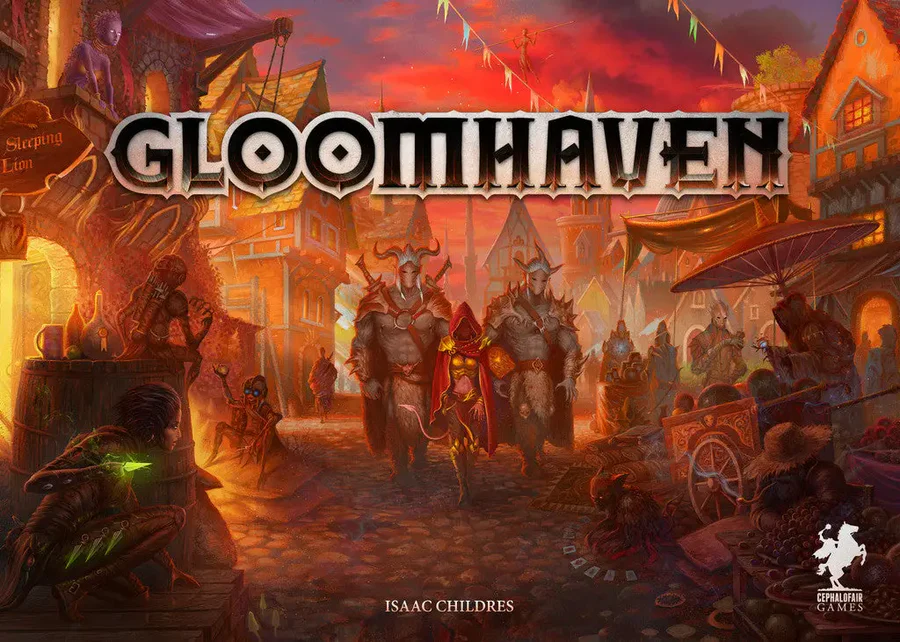
Gloomhaven: Jaws of the Lion Review
The Dungeon Crawler That Finally Respects Your Time
Hook / First Impression
The original Gloomhaven is one of the most celebrated board games ever made — and one of the most intimidating. A 22-pound box, 95 scenarios, 17 playable classes, and a setup time that could eat an entire game night on its own. For years, it sat at the top of BoardGameGeek's rankings while remaining inaccessible to anyone without a dedicated gaming table, four patient friends, and the organisational instincts of a logistics director.
Gloomhaven: Jaws of the Lion changes that. Designed as a direct on-ramp to the full Gloomhaven experience, it fits in a box you can carry with one hand, teaches itself through the first four scenarios, and delivers an almost identical tactical depth for a third of the price. It is, by any measure, one of the best dungeon crawlers ever produced — and arguably the better version of its parent game for the vast majority of players.
Overview
Gloomhaven: Jaws of the Lion is a cooperative dungeon-crawling campaign game designed by Isaac Childres, published by Cephalofair Games in 2020. Players control a party of mercenaries navigating a 25-scenario campaign set in the dark fantasy city of Gloomhaven, fighting monsters, completing objectives, and developing their characters across a persistent legacy-lite progression system.
| At a glance | |
|---|---|
| Designer | Isaac Childres |
| Publisher | Cephalofair Games |
| Year | 2020 |
| Players | 1–4 |
| Play time | 60–120 minutes per scenario |
| Age | 14+ |
| Weight | Heavy (BGG ~3.7/5) |
| Campaign length | 25 scenarios (~50–80 hours total) |
Components & The Setting
The Setting: Jaws of the Lion takes place in Gloomhaven, a frontier city at the edge of the known world — a dark, morally grey place where mercenaries solve problems that the city guard pretend not to notice. You play as four mercenaries for hire: the Valrath Red Guard, a tank who manipulates enemies; the Inox Hatchet, a ranged fighter who throws axes and retrieves them; the Human Voidwarden, a support caster who debuffs enemies and buffs allies; and the Quatryl Demolitionist, an explosive melee combatant who destroys obstacle tiles for bonus effects. Each character has a unique personality woven into the campaign's dialogue, and the story — while not literary fiction — does a better job than most dungeon crawlers at making you care about the outcome of each scenario.
Component quality is excellent at this price point. The four double-sided stickered map boards replace the tile-laying setup of the original Gloomhaven, slashing setup time by 80%. The 16 monster standees are sturdy; the character miniatures are detailed enough to paint if you choose. The 504 action cards that form each character's deck are well-printed and handle thousands of shuffles. The rulebook contains full-colour illustrations for every edge case, and the scenario book doubles as a story delivery mechanism and map guide — it is one of the best-designed rulebooks in the hobby.
How to Play
The goal varies by scenario — kill all monsters, escort a figure across the map, retrieve an object, survive a number of rounds — but the tactical challenge is always the same: use your limited hand of cards to take down increasingly dangerous enemies before your characters exhaust themselves.
Each character begins a scenario with a hand of ability cards drawn from their personal deck of roughly 10–12 unique cards. On each round, every player secretly selects two cards. The top half of the first card determines your action order (initiative), and you choose whether to use the top or bottom half of each card for its printed ability. Cards are either discarded (recoverable via a Rest action) or lost (gone for the scenario). When you run out of cards to play, you are exhausted and removed from the scenario.
Monster AI is driven by a deck of ability cards specific to each enemy type. Every round you flip a monster ability card that tells you what that monster type does — move, attack, apply conditions. Combined with each monster's stat card, this creates fully deterministic enemy behaviour with zero dice: you always know exactly what a monster will do. What you do not always know is which monsters will be in range, which of your allies will block which path, or whether your careful positioning will survive contact with the enemy turn.
- Initiative: Set secretly each round, revealed simultaneously — outmanoeuvring enemies by a single initiative point is one of the game's most reliable micro-triumphs.
- Conditions: Stun, Immobilize, Muddle, Poison, Curse, Disarm — each applies a precise mechanical penalty tracked with tokens. Managing the condition economy is a large part of high-level play.
- Elements: Some abilities create elemental tokens (Fire, Ice, Air, Earth, Light, Dark) that persist until the next round and can be consumed by other abilities for enhanced effects. Planning element generation and consumption between characters is a key layer of co-operative strategy.
- Long Rests vs. Short Rests: Resting recovers your discard pile at a cost. Short Rest is fast but random (lose one card at random); Long Rest skips your turn but lets you choose what to keep. Every rest decision is a resource-management puzzle.
Gameplay Feel
Pacing & Tension: A typical Jaws of the Lion scenario unfolds in three phases. In the early rounds the party sets up position, the enemies approach, and the players establish their rhythm. In the middle rounds the board becomes chaotic — enemies spawn, objectives emerge, and hand sizes start shrinking. In the final rounds the game tightens into a desperate race: can you finish the objective before anyone exhausts? That compression of urgency in the final stretch is the game's signature emotional beat, and it delivers it reliably.
Co-operative Dynamics: Communication is encouraged before cards are selected, forbidden during. This creates a natural rhythm of planning and improvisation — you agree on a general strategy, then execute it in the dark. When a teammate's card choice perfectly sets up yours (a Stun that lets you bypass a monster's retaliate ability, an element creation that powers your biggest attack), the feeling is genuinely satisfying in a way that purely individual games cannot replicate.
Decision Density: Every turn involves multiple meaningful choices: which two cards to play, which half of each to use, whether to move first or attack first, whether to use an element, whether to apply a loss ability now or conserve it. There is rarely a dominant play. This density is what earns the game its complexity rating — not rule complexity, but decision complexity. The rules are learnable in an evening; playing well takes a campaign.
Luck: Almost none. The monster AI is deterministic and predictable once you understand it. The only random elements are the minor shuffle of each monster's ability deck (which determines the order of their ability cards, not their stats) and the small modifier decks each character uses to vary attack damage slightly. Neither creates swingy outcomes. Winning and losing is almost entirely a function of player decisions. When you fail a scenario, you almost always know exactly why.
Mechanics Deep-Dive
The Card System
The card system is Gloomhaven's most original and important innovation. Each ability card has a top action and a bottom action — typically one offensive and one utility. Playing the top of one card and the bottom of another on the same turn creates a pairing that you chose specifically for this scenario, this situation, this moment. Because your hand contains roughly 10 cards and you play two per round, you have about 5 rounds of sustained combat before you need to rest — and every pairing decision affects which combinations remain available later.
Over the campaign, each character unlocks new ability cards by levelling up, adding them to a personal pool from which they build their 10-card starting hand before each scenario. This deck-building meta-layer is where character identity emerges. A Hatchet player who builds around retrieval loops feels different from one who stacks damage — same class, different flavour.
The Monster AI
Monster behaviour is governed by a simple ruleset: each enemy type has a priority list of conditions (Focus on the player they can attack; if tied, focus the player with the lowest initiative; if still tied, closest). Every round a revealed ability card tells you what they attempt to do. Because the behaviour is deterministic, experienced players learn to read the board state and predict exactly where every enemy will move and what it will target — which transforms combat from reactive firefighting into proactive setup.
Character Progression
Between scenarios, characters earn gold and experience. Gold buys permanent equipment — boots, armour, weapons, consumables — that modifies base stats or adds new abilities. Experience unlocks level-ups which expand your ability card pool. The progression is satisfying without being overwhelming: no decision feels irreversible, but every decision feels meaningful. By scenario 15 a fully kitted character plays noticeably differently than their starting state, and that evolution is one of the campaign's primary rewards.
- Personal quests: Each character has a hidden personal goal — achieve certain actions across multiple scenarios — that, when completed, triggers a character retirement. This is the narrative engine of the full Gloomhaven experience, preserved here in a lighter form.
- City Events: Between scenarios the party draws city event cards that present moral choices with mechanical consequences — small narrative vignettes that build the city's personality and occasionally reward or penalise the group.
- Modifier decks: As characters level up they add enhanced modifier cards (+2 damage, rolling effects, curses added to enemy decks) that improve the combat floor of their attacks over time.
Player Count Analysis
Solo (1 Player, 2 Characters) — Exceptional. Jaws of the Lion is one of the best solo board game experiences available. The recommended solo format has one player controlling two characters, which requires genuine dual-hand management but creates a satisfying strategic depth. The game scales monster count and health automatically. Many dedicated players consider solo the optimal way to learn the game, as you control both sides of the co-operative planning and can experiment freely without slowing a group down. If you are on the fence between solo and group play, solo is a safer bet for your first campaign.
2 Players — Very good. Two players each control one character. The dynamic is tighter than the four-character game — fewer resources, fewer answers to unexpected situations — which makes the game harder but more focused. Communication matters more because you have less redundancy. A strong two-player duo who have played together before will often find this the most satisfying format, with clear role delineation and no analysis paralysis from competing opinions.
3 Players — Good with a caveat. Three players means one character sits out, which is fine mechanically (the game scales) but means the player whose character is excluded from a session needs to play a second character or skip. Roster management across a 25-scenario campaign with three players requires coordination. If your group is stable and you start together, this works well. If attendance is inconsistent, play at two or four.
4 Players — The designed sweet spot. Four players, four characters, full chaos. The game is at its most complex and its most social at four — every round involves a full cycle of quiet planning followed by a turn order that can unravel in wonderfully unexpected ways. Longer turns, more table talk, and occasional analysis paralysis from having four opinions on every move. The optimal campaign format for groups who can commit to regular sessions and full attendance.
Replayability
Jaws of the Lion is a legacy-lite game — some components are modified permanently during play (stickers applied to boards, cards crossed off scenario books), but nothing is destroyed, and the scenario book remains fully readable after completion. You can replay the campaign with different character combinations and find meaningfully different experiences. The four characters interact with scenarios differently enough that a Red Guard-Voidwarden pair and a Hatchet-Demolitionist pair feel like different games in the same box.
However, the campaign's narrative payoffs and scenario reveals lose their surprise on replay. You will know what is behind every door and which enemies spawn when. Replay value is primarily mechanical — exploring different character builds and class synergies — rather than narrative. For a 50–80 hour campaign, this is honest: most players will not replay the full campaign more than twice, and the game earns that level of engagement honestly.
The most significant replayability factor is the gateway it provides to the full Gloomhaven ecosystem. Players who finish Jaws of the Lion are well-positioned to tackle the original Gloomhaven's 95 scenarios, Forgotten Circles, or the upcoming Gloomhaven Second Edition with full confidence in the core system — which dramatically extends the effective lifetime of the mechanical investment.
Learning Curve
Ease of teaching: Genuinely the most approachable heavy game we have reviewed. The four tutorial scenarios introduce rules incrementally — Scenario 1 uses only basic movement and attack, Scenario 4 introduces the full ruleset. By the time all rules are live, players have four sessions of muscle memory. A group that starts fresh will never be rule-dumped, which eliminates the most common failure mode of heavy games: the 45-minute explanation that buries the table before a card is played.
Rulebook quality: The scenario book is one of the most innovative rulebooks in the hobby. Each scenario is presented on a two-page spread: left page has the map overlay, right page has the setup instructions, special rules, and win/loss conditions. Special rules are only presented when they apply. There is no reason to read the entire rulebook before Scenario 1 — and the game actively discourages it.
First-game experience: Excellent, but demands investment. Scenario 1 takes about 45 minutes for a fresh group, which is long for a tutorial. Players who approach it as a full game experience — not just a rules demo — will enjoy it; players who want to evaluate quickly will find it slower to reward than lighter games. The payoff accelerates sharply by Scenario 3, when the full card system and character differentiation come online.
Who It's For
Hobbyist gamers ready for their first heavy game: This is Jaws of the Lion's primary audience and its best use case. If you have plateaued on mid-weight games like Catan, Ticket to Ride, or Viticulture and want something with deeper tactical teeth, this is the correct next step. The tutorial structure makes it achievable; the depth makes it rewarding.
Co-operative game fans: If you enjoy Pandemic or Spirit Island and want more individual agency within co-op play, Jaws of the Lion gives each player a fully distinct tactical identity that collaborative games with shared decision-making cannot replicate.
Solo gamers: One of the strongest solo experiences in hobby gaming. The two-character solo format creates a genuine strategic puzzle with no social coordination overhead. Many players who buy it for group play end up spending more hours in solo mode.
Gloomhaven veterans: If you have played the original Gloomhaven or Forgotten Circles, Jaws of the Lion offers four classes not available elsewhere and a tighter, more narratively coherent campaign. The new characters are mechanically interesting; the Voidwarden in particular introduces support mechanics absent from the original game's class roster.
Who should look elsewhere: Casual players, mixed-experience groups with inconsistent attendance, or anyone who wants a self-contained two-hour experience without campaign commitment. Jaws of the Lion asks you to return. If you cannot guarantee that, look at HeroQuest for scenario-independent dungeon crawling, or Dune: Imperium Uprising for tactical depth without the campaign obligation.
Pros & Cons
What Gloomhaven: Jaws of the Lion does exceptionally well:
- The incremental tutorial is one of the best rule-teaching designs in the hobby — players are functional before they know all the rules.
- Near-total elimination of luck from combat creates a rare, satisfying causality: you win because you outplayed the scenario, and you lose because you made mistakes. Both feel honest.
- Four asymmetric characters each play distinctly, with meaningful build choices that accumulate across the campaign into a personal playstyle.
- The pre-printed map boards solve dungeon crawling's oldest problem — setup time — without sacrificing tactical variety.
- Exceptional solo implementation: one of the few heavy games where solo is not a compromise but a fully realised format.
- Outstanding value — a 50–80 hour campaign for the price of two restaurant meals is among the best cost-per-hour ratios in the hobby.
- The co-operative format eliminates kingmaking, betrayal mechanics, and runaway leader problems that plague competitive games at similar complexity levels.
Where Gloomhaven: Jaws of the Lion struggles:
- Campaign commitment is significant — dropping a session means your character falls behind, and a full campaign requires 15–20 dedicated play sessions.
- At 14+ the age rating is genuine — the card iconography and multi-layered decision-making genuinely require teenage-or-above cognition to enjoy rather than endure.
- The four starting characters are not equally approachable: the Red Guard's push-pull mechanics and the Voidwarden's support kit require understanding the full system before they shine, while the Hatchet and Demolitionist reward players earlier.
- Scenario difficulty is uneven in places — a handful of mid-campaign scenarios have a notably harder spike than their neighbours, which can produce demoralising consecutive failures if you hit them unprepared.
- No catch-up mechanism for players who miss sessions — character progression is individual, and a three-session gap creates a genuine mechanical imbalance.
- The scenario book, while excellent, cannot be replaced if damaged — it doubles as the campaign record, and its loss effectively ends a campaign run.
Expansions & Ecosystem
Jaws of the Lion is a self-contained game, but it exists within the broader Gloomhaven universe. Its characters and campaign are fully compatible with the original Gloomhaven as a standalone entry point.
1. Gloomhaven (Original) — The full campaign, 95 scenarios, 17 classes ★★★★★
The original Gloomhaven is the natural next step for players who finish Jaws of the Lion and want more. It is a significantly larger undertaking — the box is five times the weight, setup is more involved, and the campaign commitment is proportionally greater. But the system mastery gained from Jaws of the Lion makes the original far more accessible than it would be cold. If Jaws of the Lion is the tutorial, Gloomhaven is the full game.
2. Frosthaven — The successor, set in the northern frontier ★★★★☆
Frosthaven is Cephalofair's 2022 follow-up, a full standalone game in the same system with new mechanics — base building, resource management, and seasonal cycles — layered on top. Larger than the original Gloomhaven in scope, it is designed for groups who completed that campaign and want a new challenge in a familiar framework. Not recommended as a starting point.
Quick Pathway Guide
| Game | Best For | Entry Order |
|---|---|---|
| Jaws of the Lion | Everyone — best starting point | 🥇 Start here |
| Gloomhaven (2nd Ed.) | Committed groups post-JOTL | 🥈 Step 2 |
| Frosthaven | Veterans of the full Gloomhaven campaign | 🥉 Step 3 |
Value for Money
Gloomhaven: Jaws of the Lion retails for approximately $40–$50 USD (€38–45 in Europe) — a remarkable price for a game that delivers 50–80 hours of play across a full campaign. By cost-per-hour it is one of the cheapest experiences in hobby gaming, comparable to a streaming subscription but meaningfully more interactive and social.
- Committed groups: Exceptional value. The price of one restaurant dinner for an entire group buys a campaign that will occupy you for months. No other purchase in the hobby offers a better return on investment for a stable group.
- Solo players: Excellent. The two-character solo format is fully supported and mechanically rich. At $40–50 for 50+ hours of solo play, it competes with video game RPGs on both depth and price.
- Casual groups or inconsistent attendees: Moderate value. The campaign requires commitment — a group that plays it three times and abandons it has paid for a lot of unused content. Know your group before you buy.
Second-hand copies are widely available and often in near-mint condition — the self-stickering campaign elements mean the game is not physically consumable like true legacy games, and many groups sell copies after completing the campaign. A used copy at $25–30 is an outstanding deal.
Accessibility
Color blindness: Jaws of the Lion uses colour extensively in its iconography — elemental tokens (Fire, Ice, Air, Earth, Light, Dark) are distinguished primarily by colour and symbol. Players with colour vision deficiency may need to rely more heavily on the symbol components, which are present but secondary in visual design. The game is playable but may require supplementary labelling of tokens for full comfort.
Language dependence: High. Card text, scenario books, and city event cards are all language-dependent, with no icon-only version of most ability cards. The game is available in numerous localisations; the English edition is the most widely supported. Non-native English speakers with strong reading comprehension will be fine; the vocabulary is consistent and the iconography handles most combat effects.
Cognitive accessibility: The 14+ rating is meaningful. The card pairing system requires holding multiple simultaneous constraints in mind — initiative, action types, element states, monster intentions — that genuinely demand working memory and forward planning. Younger players or those with significant cognitive impairments may find the decision density overwhelming. The tutorial pacing helps but does not eliminate the ceiling.
Physical accessibility: Card hands of 8–10 cards are manageable for most players; a card holder makes the game fully playable for those with limited grip or hand dexterity. The map boards are fixed and require no physical manipulation during play. Standees require basic placement precision but no fine motor performance. Setup is one of the lightest in the dungeon-crawler genre, largely due to the pre-printed map boards.
Session length: At 60–120 minutes per scenario, sessions are long for players with attention, fatigue, or scheduling constraints. The clear scenario structure (setup, play, resolution, city phase) means natural break points exist, but mid-scenario pauses are awkward given the persistent board state.
Verdict
Gloomhaven: Jaws of the Lion is the rare game that justifies its complexity. It asks more of its players than almost anything else at this price point — a campaign commitment, regular attendance, patience through a tutorial arc, and genuine engagement with its layered tactical system. In exchange it delivers something that light and mid-weight games fundamentally cannot: the feeling that your decisions, over dozens of hours, have built something specific and personal. A character you levelled from a blank sheet into a machine tuned to your playstyle, in a campaign whose outcome depended on choices only you made.
The tutorial structure, the pre-printed map boards, and the tight four-character roster make this the most accessible version of the Gloomhaven system ever produced. For anyone who has ever wanted to try a dungeon crawler without committing to a 22-pound box and 95 scenarios, this is the answer.
Buy it if: you want the deepest tactical co-operative game available at this price, you have a stable group of 1–4 who can commit to a campaign, and you are ready to invest an evening in learning before the fun fully unlocks.
Skip it if: your group is casual or irregular, you want a self-contained evening experience without session-to-session progression, or complexity beyond BGG 3.5 makes your table anxious.
Pair it with: HeroQuest if you want accessible dungeon-crawling between sessions without campaign commitment; Viticulture if your group wants beautiful mid-weight depth while building toward heavier games; or step directly into Gloomhaven Second Edition once you complete the campaign.
Score Breakdown
Love board game night? Explore our tools, score calculators, and strategy guides — everything you need to play better and have more fun.
Browse All Articles →